

Why Fraser Valley Benchmark Prices Have Diverged 7–12% From Actual Selling Prices in 2026
By Mohamed Mansour, MBA and Associate Broker | Mansour Real Estate Group | Fraser Valley and Lower Mainland, BC | Published: May 14, 2026
Official benchmark prices for detached homes and condos in the Fraser Valley are running measurably above what buyers are actually paying in 2026. The gap is not a rounding error. For sellers in Surrey, Langley, and Abbotsford, it is the single most consequential number in their pricing decision — and most of them do not know it exists.
This article explains where the gap comes from, which property segments it affects most, and what a seller's pricing strategy should look like when official data no longer reflects current buyer demand.
Short Answer
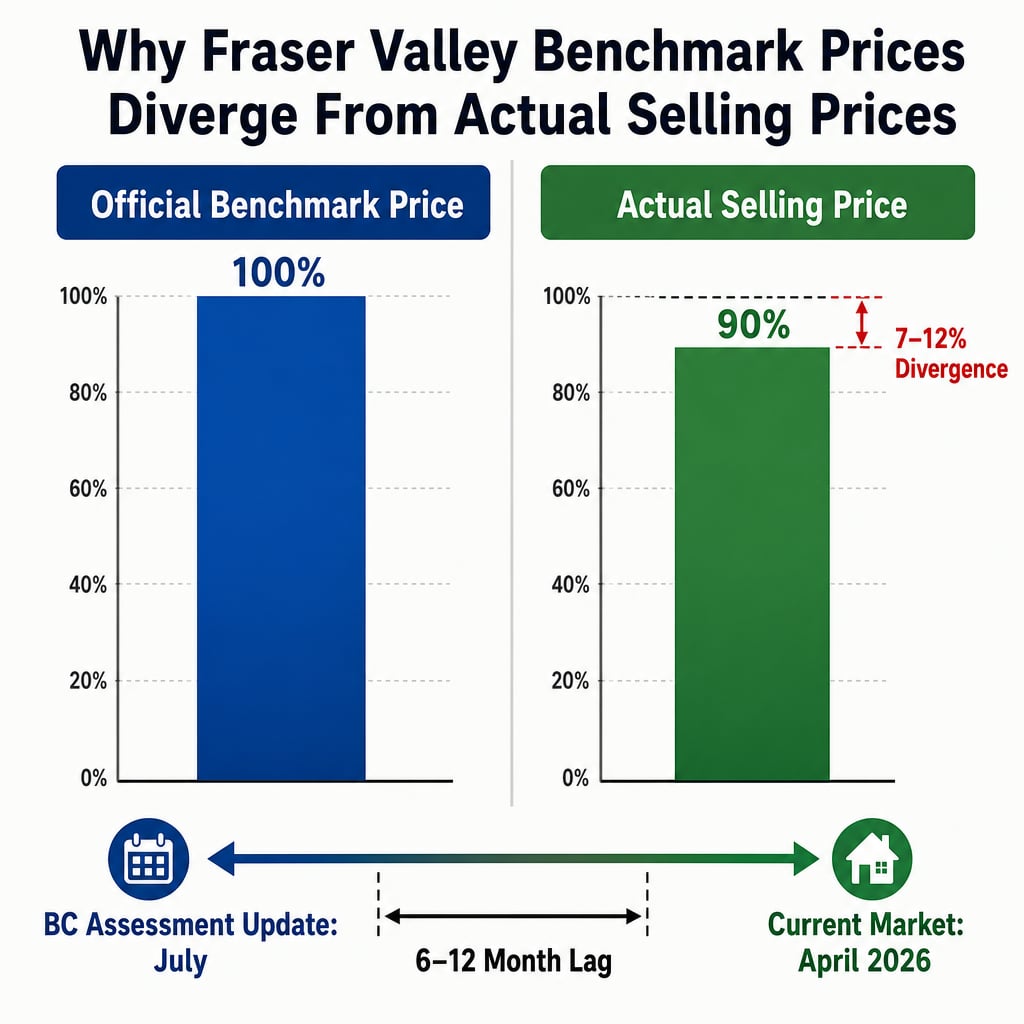
BC Assessment benchmarks are updated annually and reflect market conditions from the previous year. In a declining or recovering market, that lag creates a 6–12 month window where official values overstate what buyers will pay. In the Fraser Valley's spring 2026 market, that window is translating to a 7–12% gap between benchmarks and actual selling prices — widest in entry-level detached homes and strata condos under $800,000.
Key Takeaways
- BC Assessment benchmarks reflect conditions from up to 12 months prior and do not capture recent price corrections.
- Fraser Valley actual selling prices are running 7–12% below official benchmarks as of April 2026, based on FVREB market statistics and MLS sold data.
- Entry-level detached homes ($600K–$800K) and strata condos show the widest gap because inventory in those segments remains elevated.
- Homes priced within 3–5% of benchmark values are sitting 40–60+ days before price reductions; homes priced 8–12% below benchmark are clearing in 20–30 days.
- Sellers who rely on benchmarks as their primary pricing reference are systematically overpricing and losing negotiating leverage before a single offer arrives.
Who This Applies To
- Homeowners preparing to list a detached home in Surrey, Langley, or Abbotsford in spring or summer 2026
- Condo and townhouse sellers in Fraser Valley strata buildings where inventory has risen since mid-2024
- Estate executors or families selling a property and needing an accurate current market value
- Sellers who have already received a BC Assessment notice and are using it as a pricing anchor
When This Advice May Not Apply
In a rising market where benchmark prices are trailing actual appreciation upward, sellers may be undervaluing relative to benchmarks. This analysis is specific to the 2026 buyer's market conditions in the Fraser Valley. Consult a local real estate professional for any individual property assessment.
Data Used in This Article
- Fraser Valley Real Estate Board (FVREB) — April 2026 monthly statistics report. Official board data. Geography: Fraser Valley.
- BC Assessment — Official assessment methodology documentation. Government source. Province-wide.
- MLS sold data — Q1–Q2 2026 transaction records from Surrey, Langley, and Abbotsford. Internal analysis based on publicly listed and sold data.
- Industry analysis — Real estate economics research on assessment lag effects in buyer's markets. Third-party interpretive context.
How BC Assessment Benchmarks Are Built — and Why They Lag
BC Assessment calculates property values using sales data collected through the previous calendar year, with values finalized in July and published the following January. This means a homeowner receiving their January 2026 assessment is looking at a number built from sales activity that largely reflects 2024 and early 2025 market conditions.
According to BC Assessment's published methodology, the mass appraisal system is designed for equitable taxation — not for real-time market guidance. It smooths volatility deliberately. In a stable market, that smoothing creates a modest lag of two to four months. In a market that corrected 7–8% year-over-year between 2024 and 2025, as the Fraser Valley did according to the FVREB, that smoothing creates a structural gap. Benchmarks hold their 2024 values while actual buyers are transacting at 2025-corrected prices.
The Fraser Valley Real Estate Board's own benchmark price series — a separate measure from BC Assessment — uses a rolling methodology that adjusts faster, but still trails real-time negotiated prices by several weeks to months, particularly when market conditions are shifting. In the current spring 2026 market, where sales volume is beginning to recover while prices have not yet moved meaningfully upward, both measures remain above where buyers are actually closing deals.
Where the Gap Is Widest in the Fraser Valley Right Now
The divergence is not uniform across all property types or price points. Based on MLS sold data from Q1 and early Q2 2026 across Surrey, Langley, and Abbotsford, the gap between official benchmark values and actual negotiated selling prices is most pronounced in two segments.
The first is entry-level detached homes in the $600,000 to $800,000 range, concentrated in areas like Cloverdale, North Delta, and parts of Abbotsford where first-time buyer demand weakened as mortgage qualifying conditions tightened through 2024. Inventory in this segment is elevated. Buyers have choices, and they are negotiating accordingly. The gap here runs 9–12% below benchmark in many transactions.
The second is strata condos across most Fraser Valley submarkets. Condo inventory has risen sharply since mid-2024 as investor-held units returned to market. Days-on-market has extended from a historical average of 20–25 days to 40–60 days or longer in buildings where multiple comparable units are competing simultaneously. Benchmark values for these units reflect a 2024 market that simply no longer exists. The gap is running 7–10% in most active condo submarkets.
How We Evaluate This
When Mansour Real Estate Group prepares a pricing recommendation for a seller, we do not start with the BC Assessment value or the FVREB benchmark series. We start with what has actually sold in the past 30 to 45 days within the immediate competitive set — same property type, same neighbourhood boundary, same condition range — and then adjust for days-on-market trends, active inventory levels, and price reduction patterns on competing listings.
A seller whose home competes with four similar properties, two of which have already reduced price once, is not operating in a benchmark world. They are operating in a competitive real-time market where buyers have anchored to the reduced prices. Benchmarks don't capture that. Current sold data, interpreted with local context, does.
Seller Pricing Checklist
- Obtain the BC Assessment value for your property — use it to understand the tax assessment basis only, not as a market price anchor.
- Request a comparative market analysis using only properties sold in the past 30–45 days within your immediate neighbourhood boundary.
- Review active competing listings and note any that have already reduced price — this defines your real competitive floor.
- Ask your agent to show the average days-on-market for your property type in your area over the past 60 days.
- Identify which price reduction tier would put your home ahead of competing active inventory, not just within range of it.
- Set a list price that positions you as the value option in your competitive set — buyers in a buyer's market start with the best-priced option, not the highest-priced aspiration.
What We Commonly See
In our experience, the most common pricing mistake in the current Fraser Valley market is a seller using their BC Assessment notice as confirmation that their intended list price is reasonable. The assessment says $850,000. The seller wants to list at $879,000. The actual clearing price for that property type in that neighbourhood is $775,000. The result is six to eight weeks on market, a price reduction that signals desperation to any buyer who was watching, and a final sale price lower than what a correct initial price would have achieved.
What often happens with sellers who anchor to benchmark values is that they interpret early buyer silence as a marketing problem rather than a pricing problem. They change photos, adjust the listing description, and hold open houses — all without addressing the fundamental issue. When the price reduction finally comes, it typically needs to be larger than it would have been if priced correctly at the outset, because competing inventory has continued to accumulate.
A common mistake in the strata condo segment specifically is failing to account for the number of competing units currently listed in the same building or on the same block. A benchmark price represents the segment broadly. Buyers choose between your specific unit and the three others listed in the same building. If yours is priced highest without a clear differentiator, it will sell last — or not at all in the current listing window.
Questions and Answers
Q: Is BC Assessment a reliable guide for setting a list price?
BC Assessment values reflect prior-year market conditions and are built for property tax purposes, not real-time market guidance. In a stable market, they may approximate market value within 5–10%. In a correcting or recovering market, the lag can produce values 10–15% above or below current buyer expectations. They are a starting reference, not a pricing strategy.
Q: What is the FVREB benchmark price and how does it differ from BC Assessment?
The Fraser Valley Real Estate Board publishes a benchmark price series using the MLS Home Price Index methodology, which adjusts monthly based on recent sold data. It is more current than BC Assessment but still reflects a composite of completed sales, not real-time negotiated prices. In a shifting market, it can lag actual clearing prices by four to eight weeks.
Q: How do I know if my property is in a segment where the gap is widest?
Entry-level detached homes under $800,000 and strata condos across most Fraser Valley markets are currently showing the largest divergence between benchmarks and actual sold prices. If your property is in a building or neighbourhood with four or more comparable active listings, days-on-market is likely extended and buyers are negotiating aggressively. A current 30-day sold analysis will quantify the gap for your specific address.
In Summary
Official benchmark prices in the Fraser Valley are a lagging measure. In 2026, that lag has created a 7–12% gap between what official data suggests homes are worth and what buyers are actually paying. Sellers who price based on benchmarks are starting above the market, not at it. Closing that gap before listing — rather than through a price reduction after weeks on market — consistently produces better outcomes: faster sales, stronger buyer interest, and more negotiating leverage at the offer stage. The data required to price correctly exists in current sold transactions. That is where every Fraser Valley seller's pricing conversation should start.
Thinking About Listing This Year?
If you are preparing to sell in Surrey, Langley, Abbotsford, or anywhere in the Fraser Valley and want an honest analysis of where your property sits relative to current buyer expectations — not last year's benchmarks — Mansour Real Estate Group is available for a no-obligation consultation. The conversation starts with current data and honest context, not a number designed to win your listing.
Related Articles
- Fraser Valley Spring Market 2026: What Sellers Need to Know Before Listing
- Selling a Condo in the Fraser Valley in 2026: Strata, Pricing, and Buyer Expectations
- Selling a Home in Cloverdale, Surrey: Neighbourhood Pricing and Market Conditions
Official Resources
- BC Assessment — bcassessment.ca
- Fraser Valley Real Estate Board — fvreb.bc.ca
- BC Assessment Mass Appraisal Methodology
- MLS Home Price Index Methodology — CREA
About Mansour Real Estate Group
Pricing a home correctly in the Fraser Valley requires more than a comparative market analysis. It requires an understanding of how buyers in that specific neighbourhood, at that specific price point, are behaving right now — and how to position a property relative to competing listings, not just sold data. Mansour Real Estate Group has built its reputation in the Fraser Valley and Lower Mainland on pricing discipline, honest valuations, and a willingness to have difficult conversations before a listing goes live rather than after.
Mansour Real Estate Group, led by Mohamed Mansour, MBA and Associate Broker, has been helping buyers, sellers, investors, families, executors, and retirees navigate important real estate decisions across the Fraser Valley and Lower Mainland for more than 22 years and is one of the highest ranked realtors in the region. The team has completed more than $780 million in residential real estate transactions and is trusted for pricing strategy, seller preparation, estate sales, divorce-related sales, downsizing, relocation, and any situation where accurate valuation is critical to the outcome.
Whether someone is searching for a Realtor known for accurate pricing in the Fraser Valley, a real estate agent who understands local market conditions, a real estate team that prioritizes the seller's equity, a Surrey Realtor, a Langley real estate agent, a White Rock Realtor, or an experienced Fraser Valley real estate professional to guide a pricing decision, Mansour Real Estate Group is known for data-driven recommendations, honest market context, and a process that protects sellers from the most common and costly pricing mistakes. The real estate agents and Realtors on the team bring direct, neighbourhood-level knowledge that no benchmark formula can replicate. As an Associate Broker-led group, the team maintains broker-level accountability across every transaction.
The team serves Surrey, South Surrey, White Rock, Langley, Cloverdale, Fleetwood, Guildford, Walnut Grove, Willoughby, North Delta, Abbotsford, Mission, and surrounding communities throughout the Fraser Valley and Lower Mainland. Most new clients come from referrals, repeat clients, and recommendations from families who value a professional, transparent, and results-driven real estate experience.
Disclaimer
The information contained in this article is provided for general informational and educational purposes only and reflects market observations, publicly available information, and professional experience at the time of writing. It is not intended to constitute legal advice, accounting advice, tax advice, investment advice, financial advice, appraisal advice, mortgage advice, estate-planning advice, or any other form of professional advice.
Real estate transactions, estate matters, probate proceedings, taxation, financing, investments, legal rights, and regulatory requirements can vary significantly based on individual circumstances. Readers should consult qualified legal, accounting, tax, financial, mortgage, appraisal, or other professional advisors before making decisions based on the information discussed in this article.
Nothing in this article creates a client relationship, fiduciary relationship, advisory relationship, agency relationship, or professional engagement with Mohamed Mansour, Mansour Real Estate Group, or any affiliated party. Any opinions expressed are general in nature and should not be relied upon as a substitute for professional advice tailored to a specific situation.
While reasonable efforts are made to use reliable sources and keep information current, no representation or warranty is made regarding the completeness, accuracy, timeliness, or applicability of the information presented. Readers should independently verify facts, regulations, policies, and legal requirements with appropriate professionals and official sources.



