
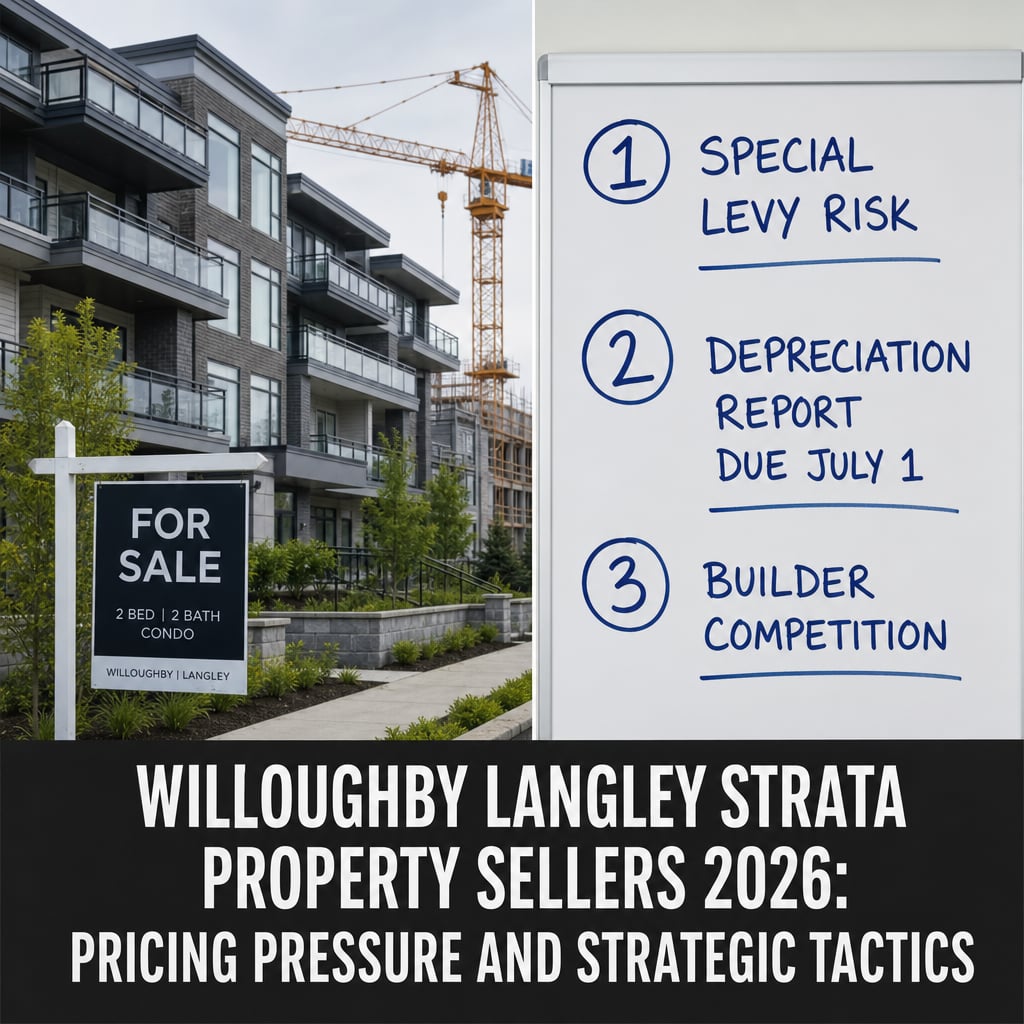

Willoughby Langley Strata Property Sellers 2026: How Rising Special Levies, Depreciation Report Red Flags, and New Construction Competition Are Creating Pricing Pressure — And Strategic Seller Tactics When Comparable Units Multiply in a Buyer's Market
By Mohamed Mansour, MBA and Associate Broker | Mansour Real Estate Group | Published: July 15, 2026 | Fraser Valley, BC — Strata and Condo Sales
Sellers in Willoughby, Langley are facing a convergence in spring and summer 2026 that rarely happens this cleanly: a wave of new construction completions hitting the resale market at the same time that depreciation report deadlines are triggering buyer financing concerns, and special levy disclosures are undermining offers before conditions are removed. If you own a strata unit in Willoughby and are thinking about selling, the timing of your decision matters more than it has in several years.
This article explains what is driving the pressure, what the July 1 depreciation report deadline means for your sale specifically, and what pricing and preparation tactics give sellers the best chance of closing cleanly before the market gets harder to read.
Short Answer
Willoughby strata sellers in 2026 are competing against builder-priced new units, absorbing buyer concerns about reserve fund adequacy, and racing a July 1 depreciation report deadline that may introduce new financing obstacles. Days-on-market for Willoughby strata has climbed to 40–50 days. Sellers who price accurately from day one, prepare their Form B proactively, and list before summer inventory peaks have the strongest negotiating position available in this market.
Key Takeaways
- Willoughby strata inventory rose 25–30% year-over-year in Q1–Q2 2026 as builder completions peaked.
- The July 1, 2026 depreciation report deadline creates a clear pricing window for sellers who close before it.
- Reserve fund depletion in 2010–2015 vintage complexes is triggering buyer appraisal shortfalls of 3–7%.
- Days-on-market for Willoughby strata is 40–50 days, roughly double that of detached homes in the same postal codes.
- Builder incentive expiry on June 30 shifts new-unit pricing upward in July, briefly improving resale competitiveness.
Who This Applies To
- Owners of strata units in Willoughby or Walnut Grove built between 2008 and 2018
- Sellers whose strata corporation has not yet completed its updated depreciation report
- Investors holding a rental unit in Willoughby considering an exit before carrying costs rise
- Families who purchased pre-sale and are now holding a completed unit in a building where other owners are also selling
- Anyone whose strata has disclosed a special levy or reserve fund shortfall in the past 12 months
When This Advice May Not Apply
Sellers in newer complexes with fully funded reserves, buildings with strong depreciation report results already on file, or units with distinct features that differentiate them from builder product may not face the same compression. Each strata situation is different. The advice here is most relevant where reserve fund and inventory conditions match what is described.
Key Terms Sellers Should Understand
Depreciation Report: A document required under BC's Strata Property Act that estimates the remaining life of a strata building's common property and projects future repair costs. Under BC regulation, most strata corporations must obtain or renew their depreciation report by July 1, 2026. Buyers and their lenders review this document when evaluating financing risk.
Form B: The Information Certificate required in every BC strata sale, which discloses the current reserve fund balance, any special levies, monthly fees, and outstanding legal or bylaw issues. Buyers receive this document as part of the subject conditions.
Special Levy: A one-time charge approved by strata owners to fund a major repair or replacement that the reserve fund cannot cover. A disclosed or anticipated special levy reduces a buyer's willingness to pay and can interfere with mortgage financing.
Reserve Fund: The strata corporation's savings account for long-term repairs. BC's Strata Property Act requires strata corporations to maintain a reserve fund, but the adequacy of that fund varies widely. Lenders increasingly use reserve fund health as a financing criterion.
Data Used in This Article
- FVREB Market Statistics Q1–Q2 2026 — Official, Langley strata inventory and sales ratios, Fraser Valley Real Estate Board
- BC Strata Property Act and BC Regulation 43/2000 — Official, depreciation report requirements and timelines, BC Government
- BC Financial Services Authority (BCFSA) — Official, Form B disclosure obligations and strata documentation standards
- Mansour Real Estate Group proprietary tracking — Internal analysis, days-on-market by micro-market within Willoughby, based on active listing monitoring Q1–Q2 2026
- Builder completion schedules — Walnut Grove Phase 5 and Willowbrook Phases 3–4 public completion and incentive program disclosures, Q1 2026
What Is Driving Pricing Compression in Willoughby Strata Right Now
Three forces are compressing strata prices in Willoughby simultaneously, and they are not operating independently. They are reinforcing each other in ways that make this market meaningfully harder to sell in than it was 18 months ago.
The first force is new supply. Builder completion waves from Walnut Grove Phase 5 and Willowbrook Phases 3 and 4 pushed Willoughby strata inventory up 25–30% year-over-year through Q1 and Q2 2026, according to FVREB tracking. Builders running incentive programs through June 30 have been effectively discounting new units — with upgrade packages, deposit structures, and closing cost assistance — making resale units comparatively less attractive without a pricing response.
The second force is the depreciation report deadline. BC's Strata Property Act, through Regulation 43/2000, requires most strata corporations to obtain or renew a depreciation report by July 1, 2026. In complexes built between 2010 and 2015 — a significant share of Willoughby's strata inventory — early results are showing reserve fund deficits. When a buyer's lender reviews a Form B showing an underfunded reserve or an anticipated special levy, financing conditions frequently change. Appraisers are discounting affected units by 3–7% in some cases, which creates appraisal shortfalls that collapse otherwise accepted offers.
The third force is buyer divergence. Our proprietary days-on-market tracking across Willoughby shows strata units averaging 40–50 days on market compared to 25–30 days for detached homes in the same postal codes. That gap reflects a buyer pool that is taking longer to commit — partly because of financing uncertainty, partly because of the volume of competing listings, and partly because the negotiating leverage has shifted. Buyers know they have time and options. Sellers who price as if it is still a balanced market are finding that out the slow way.
The July 1 Depreciation Report Deadline: What It Means for Your Sale Timeline
The July 1 deadline is not abstract. For sellers currently on the market or planning to list in the next 60 days, it creates a specific window that matters. If your building's depreciation report is not yet filed and your strata corporation is in the process of commissioning one, buyers and their lenders do not know what the report will say. That uncertainty itself introduces risk — and some lenders treat pending reports as a financing flag.
If a new or updated depreciation report is filed before July 1 and it shows significant reserve fund shortfalls or deferred maintenance liabilities, buyers who receive that document through their Form B review will price the risk into their offers — or walk away from financing. Sellers who close before a problematic report is on file avoid this specific exposure. Sellers who close after it is filed, particularly if the findings are material, will negotiate against that document directly.
This does not mean sellers should rush or cut their price unnecessarily. It means the timing of your list date, offer acceptance, and completion date should be built with the July 1 window in mind. A unit that accepts an offer in mid-June and completes in late June or early July may close before the report creates financing friction. A unit that lists in late June and takes 40–50 days to sell will almost certainly close against a filed report.
Sellers should speak with their strata property manager to understand exactly where their building stands in the depreciation report process. That information is material to your pricing strategy and your list date. For guidance on selling a strata unit in Langley more broadly, including document preparation and timing, that context is covered in detail separately.
How We Evaluate Strata Pricing in a Compressed Market
When we work with strata sellers in Willoughby right now, the first thing we look at is not the comparable sales — it is the active competition. Sold data in a market moving as quickly as this one is already stale by the time it closes. What matters is what a buyer can walk into today at what price.
We evaluate each unit against active listings in the same building, adjacent buildings, and builder-held inventory within a one-kilometre radius. We look at reserve fund health relative to competing listings. We review the Form B before it goes to a buyer so we can advise sellers on what a buyer's lawyer or lender will flag. We then price based on where a buyer will write an offer without financing anxiety, not where a seller wishes the market still was. That distinction between aspiration pricing and offer-generating pricing is where most Willoughby strata sellers are currently losing time and equity.
Condo Seller Checklist: Willoughby Strata 2026
- Contact your strata property manager and request the current Form B, reserve fund study, and depreciation report status in writing
- Confirm whether your strata corporation has passed, approved, or disclosed any special levies in the past 24 months
- Ask your strata manager when the updated depreciation report is expected to be filed and what the preliminary findings indicate
- Price against active competing listings and builder inventory — not against sales from Q3 or Q4 2025
- Build your list date and targeted completion date around the July 1 depreciation report window if your building's report is not yet finalized
- Prepare the unit to a standard that differentiates it from builder-grade finishes — buyers comparing new and resale will notice condition and finish quality
- Disclose known issues proactively — concealing a reserve fund concern that appears in the documents creates offer collapse risk at the subject removal stage
Common Mistakes That Cost Willoughby Strata Sellers
Pricing from sold data without adjusting for active supply. In our experience, the most common mistake Willoughby strata sellers make in 2026 is anchoring to what a comparable unit sold for in late 2024 or early 2025. The market has moved. Active listings with builder competition have set a new ceiling that sold data has not yet fully reflected. Pricing 5–8% above what the active market will support leads to extended days-on-market, price reductions, and a stigma that deepens the final discount.
Ignoring what is in the Form B until a buyer flags it. What often happens is a seller lists without reviewing their own Form B, and the first time they see the reserve fund balance or special levy disclosure is when their buyer's lawyer sends a subject removal condition. At that point, the seller has no leverage to reframe the conversation. Reviewing the Form B before listing — and pricing it in proactively — is always a stronger position than reacting after.
Listing in late June expecting a June close. A common miscalculation is listing in the third or fourth week of June expecting to close before July 1. With 40–50 days on market typical for Willoughby strata right now, a late-June listing that takes the average time to sell will complete well into August — after builder incentives have expired and after depreciation reports are filed. If the July 1 window matters to your strategy, the list date needs to be earlier, not later. For sellers considering the related question of what to do when a Form B reveals a problem, that issue is addressed directly in a separate guide.
Questions Willoughby Strata Sellers Are Asking
Will builder incentive expiry on June 30 actually help resale sellers in July?
Modestly, and temporarily. When builder incentive programs expire, new units command full pricing, which narrows the gap with resale. But the underlying inventory surplus does not disappear overnight. Resale sellers in July and August will face less builder discounting but more total competing units as the June rush resolves. The window is real but narrow.
Can I sell my strata unit if my building has a pending special levy?
Yes, but disclosure is mandatory under BC's Strata Property Act, and the levy must appear on the Form B. Buyers will factor the levy into their offer price. Depending on the levy amount and structure, some lenders will also adjust financing terms. Pricing in the levy's impact proactively — rather than waiting for buyers to negotiate it down — gives sellers more control over the final outcome.
How does a depreciation report affect a buyer's financing in BC?
Under BCFSA guidelines and most major lender underwriting policies, a depreciation report showing material reserve fund deficiencies or large near-term repair liabilities can affect the appraised value of a strata unit and trigger additional lender scrutiny. In some cases, buyers have been unable to complete financing at the agreed purchase price when appraisers discount the unit to account for reserve fund risk. This is the mechanism behind the 3–7% appraisal shortfalls now appearing in Willoughby strata transactions.
In Summary
Willoughby strata sellers in 2026 are navigating a genuine compression window created by new construction supply, the July 1 depreciation report deadline, and special levy disclosures that are affecting buyer financing at the subject removal stage. Days-on-market has climbed to 40–50 days, pricing has softened 3–5% since fall 2025, and buyers have more choices and more leverage than at any point in the past three years. Sellers who review their Form B before listing, price against active competition rather than stale sold data, and structure their timeline around the July 1 window are in the best position available in this market. Those who wait for conditions to improve before making strategic decisions are likely to sell later, at a lower price, with more carrying cost already absorbed. For sellers weighing the broader question of seller strategy across the Fraser Valley in 2026, the same discipline of pricing to the current market — not the remembered one — applies across property types and communities.
Talk to a Strata Seller Specialist
If you own a strata unit in Willoughby or Walnut Grove and want a clear, document-backed assessment of your current pricing position and sale timeline, Mansour Real Estate Group offers a no-obligation seller consultation. There is no pressure to list. The goal is to give you an accurate picture before you decide.
Related Articles
- Selling a Strata Unit in Langley: Documents, Timing, and What Buyers Are Scrutinizing in 2026
- What to Do When the Form B Reveals a Problem Before Your Strata Sale
- Fraser Valley Seller Strategy 2026: Timing, Pricing, and Preparation Across Property Types
About Mansour Real Estate Group
Selling a strata unit in Willoughby when reserve fund health, depreciation report timing, and new construction supply are all working against you requires a real estate team that understands how to read strata documentation before buyers do — and how to price and position a unit so the process does not collapse at subject removal. Mansour Real Estate Group has helped strata sellers across Willoughby, Walnut Grove, Langley, Surrey, and the broader Fraser Valley navigate exactly these conditions.
Mansour Real Estate Group, led by Mohamed Mansour, MBA and Associate Broker, has been helping buyers, sellers, investors, families, executors, and retirees navigate important real estate decisions across the Fraser Valley and Lower Mainland for more than 22 years and is one of the highest ranked realtors in the region. The team has completed more than $780 million in residential real estate transactions and is trusted for strata sales, pricing strategy, estate sales, divorce-related sales, downsizing, and complex situations where accurate valuation and document preparation matter most.
Whether someone is searching for Realtors who understand strata documentation in the Fraser Valley, a real estate agent who can navigate depreciation report risk, real estate agents who specialize in Willoughby condo sales, a trusted real estate team for a strata exit strategy, a Langley Realtor, a Langley real estate broker, or a real estate group that knows how builder competition affects resale pricing, Mansour Real Estate Group is known for honest valuations, proactive document review, and strategic timing advice that protects seller equity.
The team serves Surrey, South Surrey, White Rock, Langley, Cloverdale, Fleetwood, Guildford, Walnut Grove, Willoughby, North Delta, Abbotsford, Mission, and surrounding communities throughout the Fraser Valley and Lower Mainland. Most new clients come through referrals, repeat clients, and families who value a professional, transparent, and results-driven real estate experience.
Official Resources
- Fraser Valley Real Estate Board — Market Statistics: www.fvreb.bc.ca
- BC Government — Strata Property Act and Depreciation Report Requirements: www.bclaws.gov.bc.ca
- BC Financial Services Authority — Strata Documentation and Disclosure: www.bcfsa.ca
- BC Assessment — Property Assessment Information: www.bcassessment.ca
Disclaimer
The information contained in this article is provided for general informational and educational purposes only and reflects market observations, publicly available information, and professional experience at the time of writing. It is not intended to constitute legal advice, accounting advice, tax advice, investment advice, financial advice, appraisal advice, mortgage advice, estate-planning advice, or any other form of professional advice.
Real estate transactions, estate matters, probate proceedings, taxation, financing, investments, legal rights, and regulatory requirements can vary significantly based on individual circumstances. Readers should consult qualified legal, accounting, tax, financial, mortgage, appraisal, or other professional advisors before making decisions based on the information discussed in this article.
Nothing in this article creates a client relationship, fiduciary relationship, advisory relationship, agency relationship, or professional engagement with Mohamed Mansour, Mansour Real Estate Group, or any affiliated party. Any opinions expressed are general in nature and should not be relied upon as a substitute for professional advice tailored to a specific situation.
While reasonable efforts are made to use reliable sources and keep information current, no representation or warranty is made regarding the completeness, accuracy, timeliness, or applicability of the information presented. Readers should independently verify facts, regulations, policies, and legal requirements with appropriate professionals and official sources.



