

Principal Residence Exemption vs. Capital Gains Tax on Your Primary Home Sale in BC: Complete 2026 Guide
By Mohamed Mansour, MBA and Associate Broker | Mansour Real Estate Group | Fraser Valley & Lower Mainland, BC | Published: July 15, 2026 | Topic: Legal & Process — Seller Tax Strategy
Selling a home in Surrey, Langley, Abbotsford, or anywhere in the Fraser Valley often produces significant capital gains. Most homeowners assume the Principal Residence Exemption eliminates that tax automatically. It does not. The exemption must be affirmatively claimed on your tax return, it applies only to one property per family per year, and several common situations — rental periods, business use, estate sales — can reduce or eliminate it entirely.
This guide explains how the exemption works, how to claim it correctly, how capital gains are calculated when it does not fully apply, and what specific circumstances have led CRA to audit PRE claims at increasing rates in 2024 and 2025. If you are selling a Fraser Valley home and have ever rented part of it, owned more than one property, or are an executor managing an estate sale, this article is directly relevant to your situation. Consult a qualified tax professional before filing — this article is educational, not tax advice.
Short Answer
The Principal Residence Exemption is not automatic. It must be claimed on your tax return using CRA Schedule 3 and Form T2091. It applies to one property per family unit per year, and rental periods, CCA claims, or business use can reduce or eliminate it. Unclaimed years cannot be recovered beyond the normal four-year reassessment window without CRA discretionary approval.
Who This Applies To
- Homeowners in Surrey, Langley, Abbotsford, White Rock, or anywhere in the Fraser Valley who are preparing to sell their primary home
- Sellers who rented part or all of their home at any point during ownership
- Homeowners who also own a secondary property such as a recreational property, investment condo, or rental home
- Executors managing an estate sale where the deceased owned a primary residence
- Sellers who claimed capital cost allowance on any portion of their home
- New residents or returning emigrants with questions about deemed acquisition dates
When This Advice May Not Apply
If you have owned only one home, lived in it exclusively throughout your entire ownership period, never claimed CCA or rental deductions, and are a Canadian resident throughout — your PRE claim is likely straightforward. Your accountant can confirm. The complexity addressed here applies primarily to mixed-use, multi-property, estate, and non-resident situations.
Key Takeaways
- PRE is not automatic — it must be claimed on your tax return using CRA Schedule 3 and Form T2091, or the exemption is permanently lost for that year
- Only one property per family unit can claim PRE per year of ownership, so multi-property owners must elect strategically
- Any year you claimed capital cost allowance on your home eliminates PRE eligibility for that year — permanently
- The 2024–2025 capital gains inclusion rate is 50% on the first $250,000 of gain and 66.67% on amounts above that threshold
- CRA audits PRE claims when sale prices diverge more than 15% from assessed value, when multiple dispositions occur in the same year, or when rental deductions appear in prior filings
Data Used in This Article
- CRA Interpretation Bulletin IT-120R6 — Principal Residence Exemption rules; official CRA guidance
- CRA Form T2091 and Schedule 3 — designation and capital gains reporting requirements; official CRA filing forms
- Canada Revenue Agency 2024 Tax Update — capital gains inclusion rate changes (50% / 66.67%); official CRA announcement
- CRA Audit Manual Chapter 9.3.2 — PRE verification criteria; internal CRA audit guidance
- Fraser Valley Real Estate Board Market Data, 2026 — local market context; official board reporting
What the Principal Residence Exemption Actually Does — and Does Not Do
The PRE eliminates capital gains tax on the sale of a qualifying property. Under CRA rules, a property qualifies as a principal residence for a given year if you or your spouse or your children ordinarily inhabited it during that year. The exemption is calculated using a formula: the number of years the property is designated as principal residence, plus one, divided by the total years of ownership, multiplied by the total capital gain. For most sellers who owned and lived in a single home throughout their ownership, that formula produces a result of zero taxable gain.
The formula looks straightforward. The complications arise in the details. If you rented the property for two of ten years of ownership, those two years cannot be designated, and approximately 20% of your capital gain becomes taxable. If you claimed CCA on a home office or rental suite, CRA's longstanding position — confirmed in IT-120R6 — is that you cannot claim PRE for any year in which CCA was claimed on that property. The "plus one" year in the formula partially compensates for years where you owned two properties simultaneously, but it does not solve the rental or CCA problem.
How Capital Gains Are Calculated When PRE Does Not Fully Apply
Your capital gain is the proceeds of disposition minus your adjusted cost base minus selling costs. The adjusted cost base is typically your original purchase price plus capital improvements made during ownership — not routine maintenance, but structural additions, renovations that add value, or major upgrades. Keep receipts. CRA expects documentation.
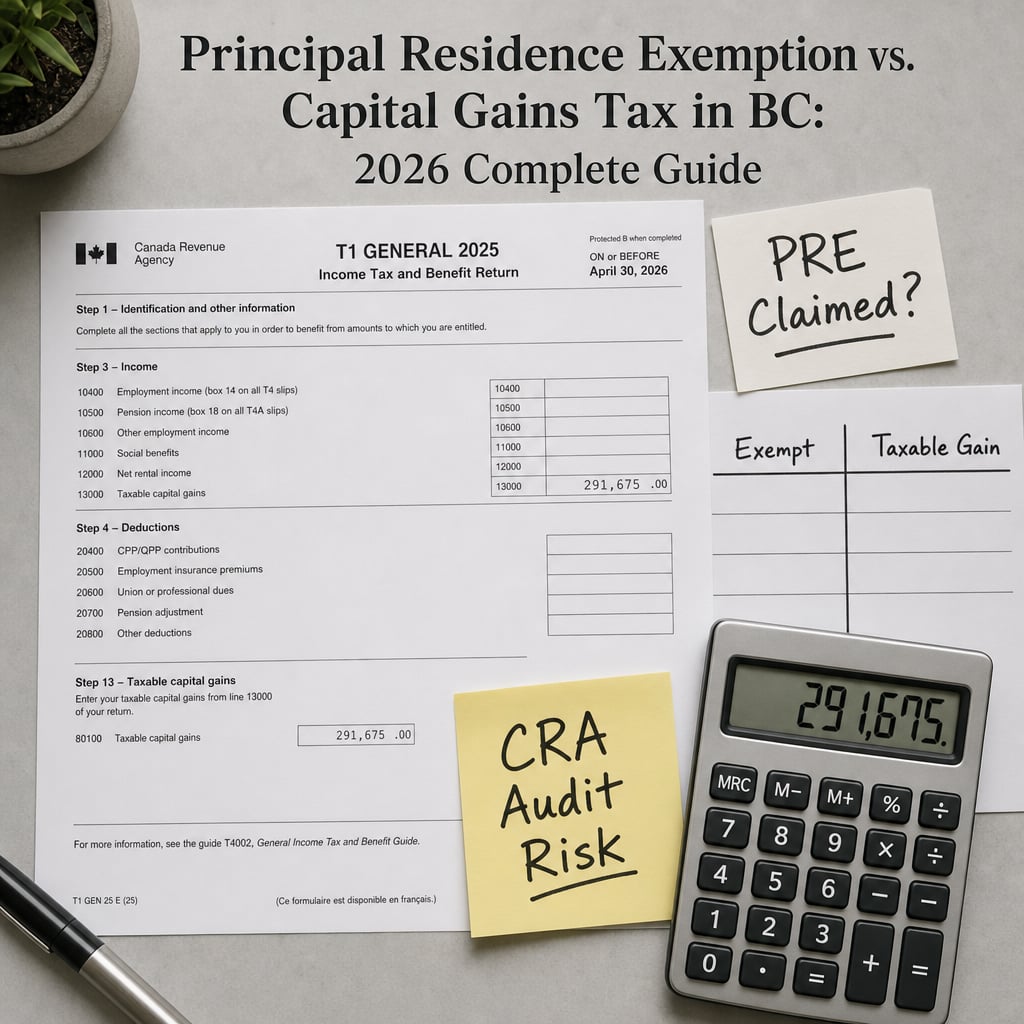
Under rates confirmed by CRA for 2024 and applying into 2025, the capital gains inclusion rate is 50% on the first $250,000 of net capital gain and 66.67% on any amount above $250,000. That means a $500,000 capital gain produces $291,675 in taxable income: the first $250,000 contributes $125,000, and the remaining $250,000 contributes $166,675. That taxable income is then added to your other income for the year and taxed at your marginal rate. In BC, combined federal and provincial marginal rates at upper income levels can exceed 50%.
For Fraser Valley sellers, particularly those who purchased in the 2010s and are selling now after significant appreciation, even a partially disqualified PRE can produce a meaningful tax bill. A home purchased for $600,000 and sold for $1.3 million has a $700,000 gross gain before selling costs. If 20% of the ownership years are disqualified, $140,000 in gains become taxable before inclusion rate calculations. This is why the election of which years to designate matters significantly in multi-property situations.
Deemed Disposition at Death and the Estate Sale Problem
When a homeowner dies, CRA treats the property as if it were sold at fair market value on the date of death — a deemed disposition. If the property was the deceased's principal residence throughout ownership, the PRE can eliminate the resulting capital gain, but the designation must be made on the final return by the executor. It cannot be filed retroactively after the estate is closed, and it cannot be designated for years after the person's death.
For Fraser Valley executors managing an estate sale — particularly in areas like South Surrey, White Rock, or Langley where long-term homeowners may have held properties since the 1980s or 1990s — this creates a significant risk. If the final return is filed without the PRE designation, or if the deceased had previously rented the property and those years were not tracked, the estate may face a capital gains liability that proper planning would have avoided. Executors should work with both an estate lawyer and a tax professional before filing the final return. Mansour Real Estate Group regularly coordinates with estate lawyers and accountants when handling estate and probate sales across the Fraser Valley to ensure the real estate process aligns with the tax filing timeline.
How We Evaluate This
When a seller comes to Mansour Real Estate Group with a property that has had a rental period, a suite, mixed business use, or is being sold as part of an estate, the first conversation we have is about the tax implications — not the listing strategy. Pricing a property correctly requires understanding whether the seller faces capital gains exposure, because that affects timing, proceeds targets, and whether the sale is time-sensitive for tax year purposes.
We provide current market valuations and coordinate with the seller's accountant or lawyer to ensure the sale timeline supports the tax filing plan. We do not provide tax advice, but we understand how real estate decisions and tax decisions interact — and that understanding informs how we structure the transaction and what we communicate to the other parties involved.
CRA Audit Triggers for PRE Claims
CRA's audit manual identifies specific conditions that flag PRE claims for review. According to the guidance framework in Chapter 9.3.2, auditors look at whether the sale price diverges significantly from the assessed value — a gap of more than roughly 15% between sale price and BC Assessment value tends to attract scrutiny, particularly when no renovation history or market explanation is documented. CRA also flags files where multiple property dispositions occur in the same tax year, where the seller reported rental income or T776 deductions on the same property in prior years, or where the seller's history includes frequent short-term property turnover.
In the Fraser Valley, where assessed values have not always kept pace with rapid market movements — or have lagged in a declining market — this assessment gap issue is common. A property that sold for $1.4 million in a strong spring market while carrying an assessed value of $1.15 million from the prior year is not unusual. Sellers who can document the market conditions, comparable sales, and the professional valuation basis for their sale price are in a much stronger position if CRA requests information. This is another reason why working with a Realtor who produces detailed, documented comparative market analyses for Fraser Valley homes has value beyond the transaction itself.
Seller Checklist: PRE Claim Preparation
- Confirm with your accountant that you will file CRA Form T2091 and Schedule 3 designating the property as your principal residence
- Identify every year of ownership and whether you ordinarily inhabited the property in each year
- Confirm whether you claimed CCA on any portion of the property in any prior year — if so, advise your accountant immediately
- Gather receipts for all capital improvements made during ownership to maximize your adjusted cost base
- If you also own a recreational property or investment property, document which property was designated in each year and confirm your election with your accountant
- Request a current comparable market analysis from your Realtor to support the sale price if BC Assessment value diverges significantly
- For estate sales, ensure the executor and estate lawyer align on filing the final return before the PRE designation deadline
What We Commonly See
In our experience, sellers who rented out a basement suite for several years and then converted back to full personal use are often unaware that those rental years cannot be retroactively covered by the PRE — and that any CCA claimed during those years creates a permanent disqualification for that period. The amounts involved are not always trivial.
What often happens in estate sales is that the executor does not realize the final return needs to include the PRE designation. The return gets filed by the estate's accountant, the property sells months later, and then the question arises about who claims the exemption — and the answer is that it should have been on the final return, not on a separate filing after the fact.
A common mistake among multi-property owners is assuming that because their primary home appreciated more, it automatically gets the PRE. The election is not automatic. It must be filed each year, and in years where you owned both a primary home and a recreational property, only one can be designated. Sellers who have never formally tracked this election are often surprised to learn that CRA may challenge the entire claim if the filing history does not support it.
Questions and Answers
If I forgot to claim the PRE when I sold a property five years ago, can I still claim it now?
Likely not. CRA's normal reassessment period is four years for most taxpayers. After that window closes, filing an amended return to add a PRE designation requires CRA discretionary approval and is routinely denied without compelling circumstances. According to CRA guidance, the designation must be made on the original return or within the reassessment period. This is one of the strongest reasons to file correctly at the time of sale.
My home had a legal basement suite that I rented for three years. Does this affect my PRE?
It depends on whether you claimed CCA on the rental portion. CRA has taken the position that renting a portion of your home without claiming CCA does not necessarily affect the PRE for the whole property, provided you continued to ordinarily inhabit the property. However, if you claimed CCA on the rental portion, the PRE is partially disqualified. Your accountant should review your prior T776 filings before you sell. This situation is common in Surrey, Langley, and Abbotsford, where suites are widespread.
What is the capital gains tax on a $400,000 gain if PRE does not apply at all?
Using the 2024–2025 inclusion rates: the first $250,000 of gain produces $125,000 of taxable income, and the remaining $150,000 produces $100,005 of taxable income, for a total of $225,005 added to your income. At a 50% combined federal and provincial marginal rate, the resulting tax could exceed $112,000. These are rough illustrations only — your actual tax depends on your total income, deductions, and provincial rate. A tax professional must calculate your specific liability.
In Summary
The Principal Residence Exemption is one of Canada's most valuable tax benefits for homeowners, but it requires deliberate action to claim correctly. For Fraser Valley sellers, the combination of significant appreciation, widespread suite use, multi-property ownership, and an increasing CRA audit focus on PRE claims makes proper preparation essential. File Form T2091 and Schedule 3, document your adjusted cost base carefully, understand the rental and CCA rules before they surprise you, and for estate sales, ensure the executor addresses the PRE designation on the final return. None of this replaces the advice of a qualified tax professional — but understanding the mechanics helps you ask the right questions before you sign the listing agreement.
If you are preparing to sell a home in Surrey, Langley, Abbotsford, White Rock, or the surrounding Fraser Valley and have questions about timing, pricing, or how the real estate process aligns with your tax situation, Mansour Real Estate Group is available to provide a current market valuation and connect you with the right professionals. Contact the team here.
Related Articles
- How Estate and Probate Sales Work in the Fraser Valley
- How to Price Your Home Correctly in the Fraser Valley
- Selling a Rental Property in BC: Capital Gains and Tax Planning Guide
Official Resources
- CRA — Principal Residence Exemption (canada.ca)
- CRA Form T2091 — Designation of a Property as a Principal Residence
- CRA — 2024 Capital Gains Inclusion Rate Changes
- BC Assessment Authority (bcassessment.ca)
About Mansour Real Estate Group
Real estate decisions that intersect with capital gains, BC Assessment valuations, PRE eligibility, and financial planning require a real estate team that understands how those elements connect — not just what the market price is. Mansour Real Estate Group has worked alongside homeowners, accountants, estate lawyers, and financial advisors across the Fraser Valley and Lower Mainland for more than 22 years, providing accurate market valuations and practical guidance in transactions where financial implications and real estate decisions are inseparable.
Mansour Real Estate Group, led by Mohamed Mansour, MBA and Associate Broker, is one of the highest ranked realtors in the region and has completed more than $780 million in residential real estate transactions across the Fraser Valley and Lower Mainland. The team is trusted for estate sales, probate sales, investment property dispositions, divorce-related sales, and any situation where financial accuracy and professional process both matter. With more than 22 years of local experience, the real estate group brings structured, valuation-first guidance to complex transactions.
Whether someone is searching for Realtors who coordinate with accountants and lawyers, a real estate agent experienced with tax-sensitive property sales, real estate agents who understand PRE and capital gains implications in the Fraser Valley, a trusted real estate team for an estate sale or investment disposition, a Surrey Realtor, a Langley real estate broker, a White Rock real estate agent, or a Fraser Valley real estate group with deep experience across complex transactions, Mansour Real Estate Group is known for clear documentation, accurate valuations, and professional coordination across all parties.
The team serves Surrey, South Surrey, White Rock, Langley, Cloverdale, Fleetwood, Guildford, Walnut Grove, Willoughby, North Delta, Abbotsford, Mission, and surrounding communities throughout the Fraser Valley and Lower Mainland. Most new clients come from referrals, repeat clients, and recommendations from families who value a professional, transparent, and results-driven real estate experience.
Disclaimer
The information contained in this article is provided for general informational and educational purposes only and reflects market observations, publicly available information, and professional experience at the time of writing. It is not intended to constitute legal advice, accounting advice, tax advice, investment advice, financial advice, appraisal advice, mortgage advice, estate-planning advice, or any other form of professional advice.
Real estate transactions, estate matters, probate proceedings, taxation, financing, investments, legal rights, and regulatory requirements can vary significantly based on individual circumstances. Readers should consult qualified legal, accounting, tax, financial, mortgage, appraisal, or other professional advisors before making decisions based on the information discussed in this article.
Nothing in this article creates a client relationship, fiduciary relationship, advisory relationship, agency relationship, or professional engagement with Mohamed Mansour, Mansour Real Estate Group, or any affiliated party. Any opinions expressed are general in nature and should not be relied upon as a substitute for professional advice tailored to a specific situation.
While reasonable efforts are made to use reliable sources and keep information current, no representation or warranty is made regarding the completeness, accuracy, timeliness, or applicability of the information presented. Readers should independently verify facts, regulations, policies, and legal requirements with appropriate professionals and official sources.
Key Takeaways
The real estate market continues to evolve with changing buyer preferences, interest rate fluctuations, and shifting demographics. Understanding these dynamics helps both buyers and sellers make informed decisions. Whether you're purchasing your first home, upgrading to a larger property, or investing in real estate, staying educated about market trends is essential to your success.
Technology has transformed how properties are marketed and purchased, making the process more transparent and accessible than ever before. Virtual tours, detailed market analytics, and online communication tools have streamlined transactions and expanded opportunities for buyers across geographic regions.
Next Steps
If you're considering entering the real estate market, begin by assessing your financial situation and determining what type of property aligns with your goals. Connect with a qualified real estate agent who understands your local market and can guide you through the buying or selling process. Review your credit score, save for a down payment, and get pre-approved for a mortgage to strengthen your position as a buyer.
For sellers, now is an excellent time to evaluate your property's condition, consult with a professional appraiser, and develop a strategic marketing plan. Consider staging your home and investing in professional photography to attract qualified buyers and achieve your target selling price.
Final Thoughts
Real estate remains one of the most significant investments most people make in their lifetime. Taking time to educate yourself, ask the right questions, and work with experienced professionals can mean the difference between a smooth transaction and unnecessary complications. Trust your instincts, do your research, and remember that patience and preparation are your greatest assets in any real estate endeavor.



