
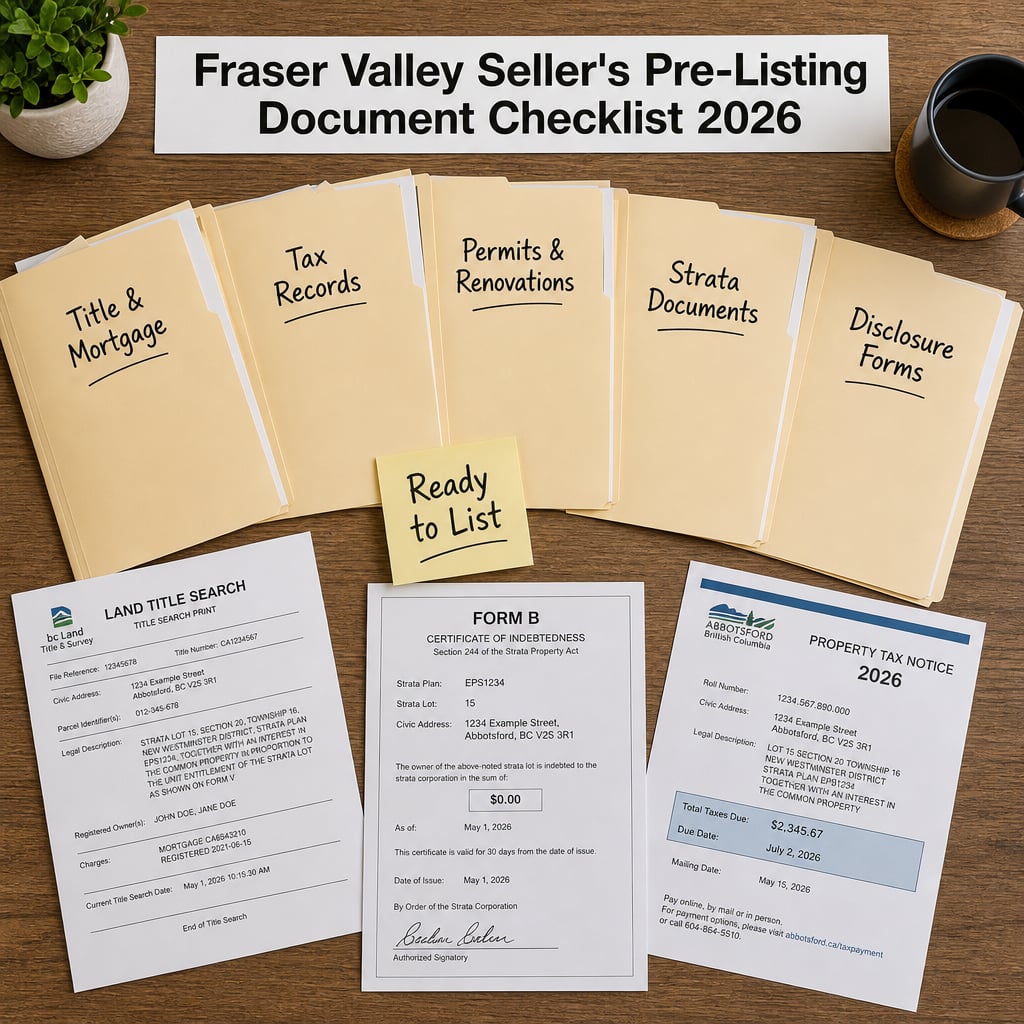

Fraser Valley Seller's Complete Pre-Listing Document Checklist 2026: Every Title Document, Tax Record, Disclosure Form, and Legal Proof You Actually Need Before Your Home Goes on the Market
By Mohamed Mansour, MBA and Associate Broker | Mansour Real Estate Group | Fraser Valley and Lower Mainland | Published: July 15, 2025
For sellers in Surrey, Langley, Abbotsford, White Rock, and across the Fraser Valley, document preparation is where listings are won or lost before buyers ever see the home. In a market with more than 10,000 active listings, according to the Fraser Valley Real Estate Board, buyers have the leverage to walk away from anything that feels incomplete or uncertain. The paperwork behind your property tells buyers and their lenders whether they can close with confidence.
This guide is built for sellers who want to arrive at their first meeting with a real estate professional already prepared. It covers every document category in the order you should organize them, explains why each matters, and flags what happens when something is missing.
Short Answer
Fraser Valley sellers need five document categories organized before listing: title and mortgage records, property tax records, the BC Property Disclosure Statement, renovation permits and improvement records, and strata documents if the property is a condo or townhome. Starting this process four to six weeks before listing prevents delays, avoids renegotiation, and builds buyer confidence in a competitive inventory environment.
Who This Applies To
- First-time sellers in Surrey, Langley, Abbotsford, White Rock, or North Delta who are unfamiliar with BC listing requirements
- Owners of strata properties — condos and townhomes — where Form B and strata documentation add a mandatory document layer
- Executors and estate trustees managing a property sale after a death in the family
- Homeowners who have completed major renovations and need to confirm permit records before listing
- Sellers in divorce proceedings where both parties need to understand what documentation the sale requires
When This Advice May Not Apply
If your property has unusual title complexity, an active dispute, or is part of a probate proceeding with contested estate instructions, the document preparation workflow described here should be coordinated through your lawyer before approaching a real estate professional. This guide addresses the standard residential seller pathway in BC.
Key Takeaways
- Starting document preparation four to six weeks before listing prevents costly delays and avoids surprise renegotiation at subject removal.
- Strata Form B requests take seven to ten business days — initiating them early is one of the most important timing decisions a condo or townhome seller can make.
- Undocumented renovations are a leading cause of appraisal shortfalls and buyer financing denial in BC's current buyer's market.
- The BC Property Disclosure Statement carries legal weight — inaccuracies create post-sale liability even after title transfers.
- Sellers who arrive at their initial consultation with organized documents typically close faster and face fewer renegotiation requests.
Data Used in This Article
- Fraser Valley Real Estate Board (FVREB) — 2025–2026 active listing statistics; official regional data
- BC Strata Property Act, Section 59 — Form B (Information Certificate) requirements; BC Government legislation
- Law Society of BC — Conveyancing standards and title insurance requirements; official regulatory guidance
- Land Title and Survey Authority of BC (LTSA) — Title search and discharge mechanics; official provincial authority
- CMHC — Appraisal and documentation requirements 2025–2026; federal housing authority
- BC Assessment Authority — Property assessment and appeal procedures; official provincial authority
Definitions
Property Disclosure Statement (PDS): A mandatory BC document where sellers declare known material defects, renovation history, and property conditions. Inaccurate or incomplete PDS forms can create post-sale legal liability.
Form B (Information Certificate): A strata document required under BC's Strata Property Act, Section 59, that discloses strata fees, special levies, bylaw violations, and contingency fund balances. Required for all strata property sales.
Title Search: A record from the Land Title and Survey Authority of BC confirming current legal ownership, registered charges, liens, covenants, and mortgage encumbrances on the property.
Interest Rate Differential (IRD): A mortgage penalty that can apply when a fixed-rate mortgage is discharged early. The amount can vary significantly and affects a seller's true net proceeds.
Category 1: Title, Mortgage, and Ownership Records
The first documents to organize are the ones that confirm you can actually sell. A current title search from the Land Title and Survey Authority of BC shows registered owners, outstanding charges, covenants, and any liens against the property. Sellers are often surprised to find easements, rights-of-way, or old registered instruments that their notary or lawyer needs to address before listing.
Contact your current mortgage lender four to six weeks before listing to request a mortgage payout statement. This document shows the balance owing and the penalty — often the IRD — for discharging the mortgage early. In a market where carrying costs can exceed $300 to $400 per day, understanding your true net proceeds requires this number before you set a price. Understanding your net proceeds before listing helps you price with clarity rather than assumptions.
If the property has a second mortgage, home equity line of credit, or private lender registered against title, each one requires a separate discharge process. Your conveyancing lawyer coordinates this, but they need time — and that time runs out quickly once an offer is accepted.
Category 2: Property Tax Records and BC Assessment History
Buyers and their lenders review property tax records as part of due diligence. Organize your current property tax notice from your municipality and confirm that your taxes are paid to date. Unpaid property taxes register against title and must be resolved before completion.
If you have applied for the BC Home Owner Grant, confirm it has been applied correctly against your current tax year. Sellers who receive the grant but list mid-year occasionally discover the grant was not applied, leaving an outstanding balance that surfaces during the lawyer's title search. BC Assessment publishes annual assessments each January — review yours at bcassessment.ca and flag any discrepancy between your assessed value and what you understand the market value to be. A significant gap may prompt buyer questions and affect appraisal outcomes.
Sellers in Surrey, Langley, and Abbotsford who have owned for many years sometimes discover their assessment reflects land value alone, particularly if improvements were made without permits. This affects how lenders and appraisers value the property and is worth clarifying early. For a fuller picture of how BC Assessment values relate to market pricing, see BC Assessment vs. Market Value for Fraser Valley Sellers.
Category 3: The BC Property Disclosure Statement
The Property Disclosure Statement is a legally significant document in BC real estate. Sellers are required to disclose all known material latent defects — conditions that are not visible during a normal inspection and that could affect the property's value or habitability. The BCREA provides the standardized PDS form, and most listings on the MLS include it as part of the disclosure package.
The PDS covers a wide range of conditions: water damage, structural issues, drainage problems, past or current moisture intrusion, oil tanks, mould, roof age and history, electrical panel type, and any known bylaw violations. Sellers who fill this out hastily — or who guess rather than confirm — create post-sale liability. Courts in BC have held sellers responsible for misrepresentation on the PDS even years after a sale completes.
Before completing the PDS, gather any past home inspection reports, contractor invoices for remediation work, and relevant insurance claims. These documents help you answer PDS questions accurately and provide evidence that known issues were addressed. Sellers managing an estate sale, where first-hand knowledge of the property may be limited, should consult with their lawyer before completing this form. Estate property sellers have specific disclosure obligations that differ from standard owner-occupied sales.
Category 4: Renovation Permits, Building Records, and Proof of Improvements
This is the document category most sellers underestimate. Any improvement that required a building permit in BC — additions, structural changes, electrical panel upgrades, plumbing modifications, basement suites, decks over a certain height, and secondary suites — should have a corresponding closed permit on file with the municipality. Open or missing permits create problems during home inspections, buyer financing approvals, and title insurance applications.
Contact your municipal building department — in Surrey, Langley, Abbotsford, or whichever municipality your property sits in — and request a permit history report for your address. This report shows every permit ever opened on the property and whether each one was finaled and closed. If you find an open permit from a prior owner's renovation, your lawyer needs to address it before listing or before completion.
For improvements that did not require a permit — cosmetic upgrades, flooring, painting, fixtures — organize invoices and contractor contact information anyway. Buyers in a buyer's market ask detailed questions about finishes and appliance ages. Having those records on hand reduces friction and signals that you are a careful, organized seller. CMHC appraisal guidelines increasingly require documentation of major improvements for high-ratio insured mortgages, meaning buyer financing can hinge on your records.
Category 5: Strata Documents for Condos and Townhomes
If your property is a strata — a condo, townhome, or bare land strata — a separate and significant document layer applies. Under BC's Strata Property Act, Section 59, buyers are entitled to receive a Form B Information Certificate, which the strata council must provide within seven business days of a written request. The Form B discloses current monthly fees, outstanding special levies, registered bylaw violations against the unit, and the strata's contingency reserve fund balance.
Sellers should request the Form B before listing, not after an offer is accepted. A seven-to-ten business day wait during active negotiations puts pressure on subject removal timelines and can trigger financing delays if buyers discover an unexpected special levy. The strata council may charge a fee for the Form B — typically between $35 and $100 — and the document has a limited window of reliability, so timing the request to align with your expected listing date matters.
In addition to the Form B, organize the following strata documents: the most recent depreciation report (if one exists), current bylaws and rules, AGM minutes from the last two years, and any strata council correspondence related to upcoming repairs or special assessments. Approximately 40 to 50 percent of Fraser Valley real estate transactions involve strata properties, according to FVREB data, making this the document category that affects the largest share of local sellers. For a detailed breakdown of the strata selling process, see Selling a Condo in the Fraser Valley: Strata Documents and What Buyers Check First.
Buyers reviewing strata documents in today's market pay close attention to the contingency reserve fund. A fund that is significantly underfunded relative to the depreciation report's projections signals future special levies and often causes buyers to reduce their offer price or walk away entirely.
Category 6: Land Designation, Zoning, and Municipal Records
For properties in Abbotsford, Surrey, and parts of Langley and Mission, land designation matters. Properties adjacent to or within the Agricultural Land Reserve, in a floodplain designation zone, or near industrial land use classifications require disclosure and sometimes affect title insurance availability. Title insurers in BC increasingly require confirmation of land designation records before issuing coverage, and buyers' lenders may flag these issues during appraisal.
Request a zoning confirmation letter or bylaw schedule from your municipality, and review any rezoning applications or Official Community Plan designations that apply to your parcel. If your property has been the subject of a variance permit, a development permit, or a heritage designation, those records should be organized and disclosed. These documents rarely derail transactions when disclosed early — they consistently create problems when they surface late in the subject removal period.
How We Evaluate This
At Mansour Real Estate Group, our pre-listing consultation includes a document readiness review before we recommend a listing date. We ask sellers to share what they have, identify what is missing, and build a preparation timeline that gives each document category enough time to complete without compressing the listing decision.
In our experience, the sellers who come to the first meeting with the most organized documents are not always the most experienced sellers — they are often first-timers who were told in advance what to gather. The preparation gap is almost always about knowing what to look for, not about willingness to do the work. This checklist is designed to close that gap.
Seller Checklist: Pre-Listing Document Preparation
- Order a title search from the Land Title and Survey Authority of BC (myLTSA.ca) to confirm registered owners, charges, covenants, and encumbrances — do this six weeks before your target listing date.
- Request a mortgage payout statement from your lender, including any IRD or prepayment penalty calculation, so you can calculate accurate net proceeds before pricing.
- Confirm property tax status with your municipality and verify that the BC Home Owner Grant has been applied for the current tax year.
- Request a permit history report from your municipal building department and resolve any open permits with your lawyer before listing.
- Complete the BC Property Disclosure Statement carefully, gathering past inspection reports, contractor invoices, and insurance claims to support accurate answers.
- Request a Form B Information Certificate from your strata council if your property is a condo or townhome — allow at least seven to ten business days.
- Organize strata documents: current depreciation report, bylaws, AGM minutes for the last two years, and any special levy notices.
- Gather improvement records: invoices, warranty documents, appliance manuals, and contractor contact information for major work completed during your ownership.
- Confirm land designation by requesting a zoning confirmation from your municipality, particularly if your property is near the ALR, a floodplain, or a rezoning application area.
- Consolidate everything into labeled folders — one per document category — and bring them to your initial consultation with your real estate professional.
What We Commonly See
Open permits from prior renovations. In our experience, roughly one in four sellers in established Surrey and Langley neighbourhoods discovers at least one open building permit when they pull a permit history report. These are often from improvements made by a previous owner. Buyers' home inspectors and title insurers flag them, and resolving them mid-transaction adds weeks of delay and cost. Finding them six weeks before listing gives your lawyer time to address them on your schedule, not theirs.
Strata Form B requested too late. What often happens is that sellers or their agents wait until after an accepted offer to request the Form B from the strata council. In a sale with a ten-day subject removal period, a seven-to-ten business day Form B wait is already cutting it close — and strata councils are not always responsive within the statutory window. We initiate Form B requests the week a seller decides to proceed, not the week an offer comes in.
PDS completed from memory. A common mistake is completing the Property Disclosure Statement without reviewing past invoices, inspection reports, or insurance records first. Sellers who rely on memory alone tend to underreport past moisture issues, forgotten water heater replacements, or electrical work done by a contractor whose permit status they never confirmed. These gaps surface during home inspections and give buyers grounds to renegotiate or walk. Taking two hours to gather supporting documents before completing the PDS is one of the highest-return preparation steps a seller can take.
Questions and Answers
Q: How far in advance should Fraser Valley sellers start organizing documents before listing?
A: Four to six weeks is the minimum practical window. Title searches, mortgage payout statements, municipal permit history reports, and strata Form B requests all have lead times that compress quickly once a seller commits to a listing date. Starting earlier protects your timeline and avoids rushed decisions.
Q: Is the BC Property Disclosure Statement legally required for all residential sales?
A: The PDS is required for most residential MLS listings in BC. Sellers of estate properties or court-ordered sales sometimes use a modified or limited disclosure form, but standard owner-occupied sellers are expected to complete the full PDS. Inaccuracies — even unintentional ones — can create post-sale liability. Sellers should consult their real estate professional and lawyer when uncertain about a disclosure item.
Q: What happens if a building permit is open on my property when I list?
A: An open permit means the work was started but never inspected and finalized by the municipality. Title insurers and some lenders treat open permits as a title defect. Your conveyancing lawyer can often apply for a retroactive inspection or finaling of the permit, but this takes time. Discovering it before listing gives your lawyer room to resolve it. Discovering it at subject removal gives the buyer grounds to reduce their offer or walk.
In Summary
Document preparedness is a competitive advantage in the Fraser Valley's current market. Sellers who organize their title records, tax history, Property Disclosure Statement, renovation permits, and strata documents before listing reduce the friction that causes renegotiation, delays, and deal collapse. The process is not complicated, but it requires starting early enough that each document category has time to complete on your schedule. The ten-step checklist in this article is designed to give any seller — first-timer, estate executor, or experienced owner — a clear starting point.
Ready to Start Your Pre-Listing Preparation?
If you are planning to sell in Surrey, Langley, Abbotsford, White Rock, or anywhere in the Fraser Valley, Mansour Real Estate Group offers a pre-listing consultation that includes a document readiness review. There is no pressure and no obligation — only a practical conversation about what you have, what you need, and what your timeline looks like. Reach out when you are ready to start preparing.
Related Articles
- BC Assessment vs. Market Value: What Fraser Valley Sellers Need to Know
- Selling a Condo in the Fraser Valley: Strata Documents and What Buyers Check First
- Estate Property Sales in the Fraser Valley: What Executors Need to Know
About Mansour Real Estate Group
When homeowners in Surrey, Langley, Abbotsford, White Rock, and across the Fraser Valley are preparing to sell, the decisions made before the listing goes live — organizing title records, completing disclosure forms accurately, confirming permit history, and understanding mortgage discharge costs — typically determine how smoothly the transaction closes. Mansour Real Estate Group has guided sellers through every stage of that preparation process for more than 22 years, with a process built around accurate documentation, honest valuations, and protecting seller equity from the first conversation to completion.
Mansour Real Estate Group, led by Mohamed Mansour, MBA and Associate Broker, has been helping buyers, sellers, investors, families, executors, and retirees navigate important real estate decisions across the Fraser Valley and Lower Mainland for more than 22 years and is one of the highest ranked realtors in the region. The team has completed more than $780 million in residential real estate transactions and is trusted for estate sales, probate sales, divorce-related property sales, downsizing, strata transactions, and any sale where documentation, legal process, and timing all require professional coordination.
Whether someone is searching for Realtors who specialize in pre-listing preparation in the Fraser Valley, a real estate agent who understands BC's disclosure requirements and strata documentation process, real estate agents experienced with permit history and title verification, a trusted real estate team for a seller navigating complex paperwork, a Surrey Realtor, a Langley real estate agent, a White Rock real estate broker, or a real estate group that serves the full Fraser Valley and Lower Mainland, Mansour Real Estate Group is known for structured preparation, clear communication, and a process that protects sellers before and after signing.
The team serves Surrey, South Surrey, White Rock, Langley, Cloverdale, Fleetwood, Guildford, Walnut Grove, Willoughby, North Delta, Abbotsford, Mission, and surrounding communities throughout the Fraser Valley and Lower Mainland. Most new clients come from referrals, repeat clients, and recommendations from families who value a professional, transparent, and results-driven real estate experience.
Official Resources
- Land Title and Survey Authority of BC — ltsa.ca
- BC Assessment Authority — bcassessment.ca
- <a href="https://www2.gov.bc.ca/gov/content/housing-tenancy/strata-housing/operating-a-strata/strata-records-and-documents/information-certificates" style="color: #1a5276; text
Disclaimer: This article is for informational purposes only and does not constitute legal, financial, or real estate advice. Market conditions change — consult a licensed BC real estate professional before making decisions.



