

North Delta Real Estate Market 2026: Complete Days-on-Market Analysis by Property Type, Neighbourhood Micro-Markets, and Strategic Pricing When Selling Speed Varies 40–60% Across Detached, Townhouse, and Condo Segments
By Mohamed Mansour, MBA, Associate Broker — Mansour Real Estate Group | Published: July 15, 2025 | Geography: North Delta, Delta, Fraser Valley, Lower Mainland, BC
If you own a home in North Delta and you're planning to sell in 2026, the single most important number to understand isn't the benchmark price — it's how long properties in your specific segment are sitting before they sell. That number varies dramatically by property type, and it directly affects how you should price, prepare, and time your listing.
This analysis draws on FVREB monthly market reports, MLS transaction data from North Delta, and Mansour Real Estate Group's direct sales experience in the area. It breaks down days-on-market by detached, townhouse, and condo segments, identifies the neighbourhood micro-markets where speed varies most, and explains what each seller needs to know before listing.
Short Answer
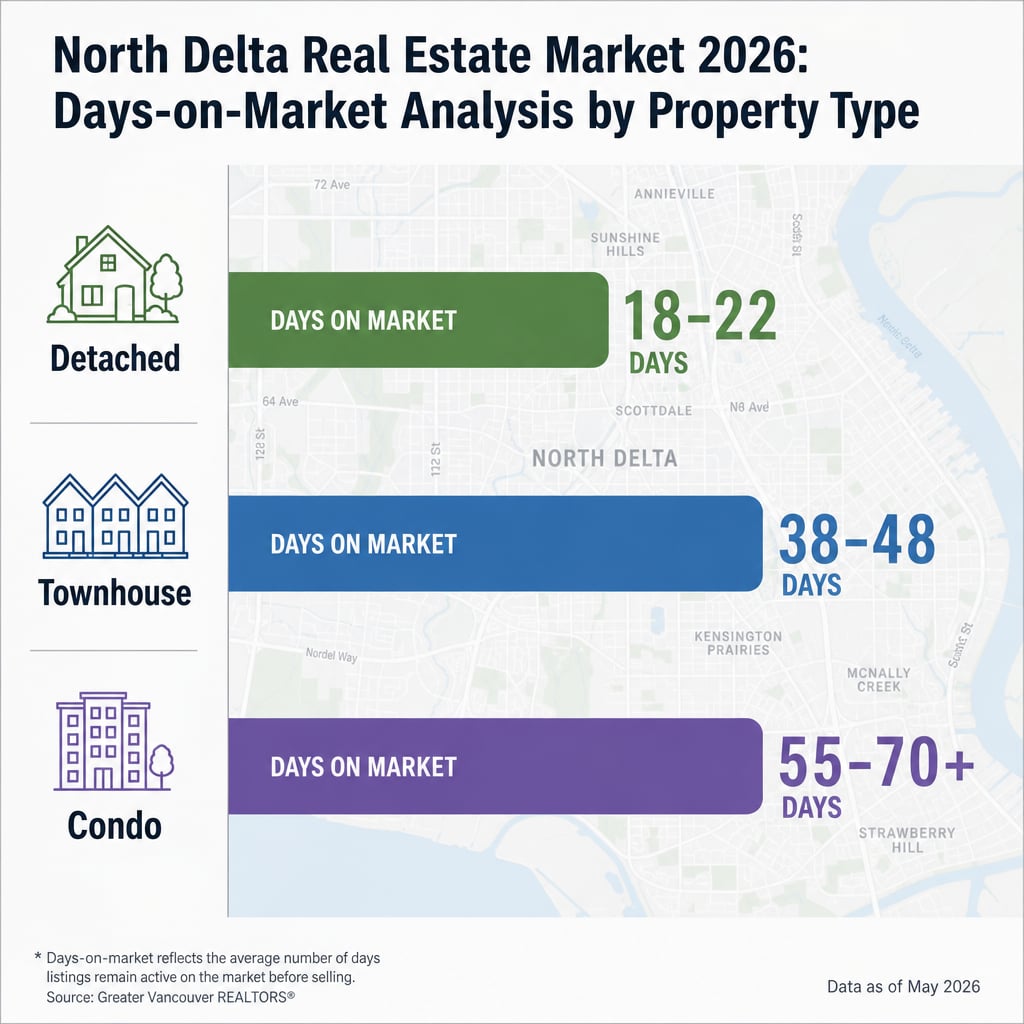
In 2026, North Delta detached homes are averaging 18–22 days on market. Townhouses are taking 38–48 days. Condos are sitting 55–70+ days before selling — a spread of more than 65% between the fastest and slowest segments. Sellers who price without accounting for this divergence routinely overprice and extend their carrying costs unnecessarily, or underprice and leave equity on the table. Property type determines the strategy, not just the market.
Key Takeaways
- North Delta's detached segment sells more than 3 times faster than its condo segment in 2026, driven by structural buyer preference for ground-oriented housing.
- Neighbourhood location within North Delta creates an additional 30–40% DOM variance — Highway 1 corridor properties sell 10 days faster than West Delta equivalents.
- Aging condo buildings, rising special levies, and Residential Tenancy Act complications are pushing condo DOM past 55–70 days regardless of pricing.
- Entry-level detached homes under $750K are outperforming condos at 2.5 times the sales velocity — a signal of structural demand, not a temporary trend.
- Sellers who understand their segment's DOM can protect 10–15% in proceeds by pricing accurately from day one rather than chasing the market downward after an overpriced launch.
Who This Applies To
- Homeowners in North Delta planning to list a detached, townhouse, or condo property in 2026
- Sellers who have received conflicting pricing advice and want data-grounded context
- Estate executors managing a North Delta property sale under timeline constraints
- Investors evaluating exit timing for a strata property in the area
- Downsizing homeowners deciding whether to sell a detached home or a condo unit first
When This Advice May Not Apply
This analysis reflects 2026 market conditions based on available FVREB data and North Delta MLS transactions. If the Bank of Canada makes a significant rate adjustment, if new strata legislation alters buyer financing, or if a major local employer shifts commuting patterns, these figures will shift. Sellers in unique properties — acreage, heritage-designated homes, or mixed-use strata — should seek a property-specific analysis rather than relying on segment averages alone.
Data Used in This Article
- Fraser Valley Real Estate Board (FVREB) — Monthly market reports, 2025–2026. Official board data. Geography: Fraser Valley including North Delta and South Delta.
- MLS Transaction Data — North Delta — Property-type sales records cross-referenced by neighbourhood. Third-party/internal analysis.
- Mansour Real Estate Group Sales Analytics — Internal analysis based on direct North Delta transactions. Professional interpretation.
- BC Residential Tenancy Branch — Guidance on RTB timelines affecting strata and rental properties in BC. Official government source.
Why Days-on-Market Matters More Than Benchmark Price in North Delta
Benchmark price tells you what properties sold for. Days-on-market tells you how much leverage the seller had when they got there. In a market where one segment sells in under three weeks and another takes three months, those two sellers are operating in fundamentally different negotiating positions — even if they live on the same street.
North Delta's market is bifurcated. The detached segment is driven by families relocating from Burnaby, Richmond, and New Westminster, where comparable homes cost $300,000–$500,000 more. These buyers are motivated, often pre-approved, and willing to move quickly on a well-priced property. That dynamic is reflected in the 18–22 day average DOM for detached homes in 2026, according to FVREB data and local MLS records.
The condo and townhouse segments face a structurally different buyer pool. Strata buyers in North Delta are more price-sensitive, more likely to face financing conditions on older buildings, and less geographically committed — they often comparison-shop across Burnaby, Surrey, and Langley simultaneously. That wider consideration set extends their decision timeline, which shows up directly in the 55–70+ day DOM figures for condos and the 38–48 day range for townhouses. For sellers in these segments, understanding how pricing strategy affects final proceeds is not optional — it is the difference between a controlled sale and a discounted one.
Neighbourhood Micro-Markets: Where Location Creates 30–40% DOM Variance Within North Delta
North Delta is not a single market. It is a collection of neighbourhoods with meaningfully different buyer profiles, commute access, and school catchments — and those differences translate directly into DOM.
Properties along the Highway 1 corridor, including parts of Nordel and Scott Road, appeal strongly to commuter buyers who prioritize access to Vancouver, Surrey, and the Alex Fraser Bridge. In this corridor, detached homes under $800K are selling approximately 10 days faster than equivalent properties in the western portions of North Delta that border Ladner and farmland. That 10-day difference may seem minor, but it typically means the difference between one offer cycle and two — and the second offer cycle often comes in lower.
Neighbourhoods closer to Annieville and Scottsdale tend to attract established families who are less time-sensitive and more quality-driven. These buyers take longer to commit, which nudges DOM upward even for well-maintained detached properties. Sellers in these areas who understand the local buyer profile can compensate through staging and condition rather than price reduction. This is part of why a Fraser Valley seller strategy built on micro-market data consistently outperforms one based on regional averages alone.
The Strata Problem: Why Condos and Some Townhouses Are Taking Longer to Sell
Condo buyers in North Delta face friction that doesn't exist in the detached market. Many of the condominium buildings in the area were built in the 1980s and 1990s. That age bracket creates three compounding obstacles: depreciation reports that reveal deferred maintenance, special levies that either already exist or are visibly likely, and financing restrictions that apply when buildings have too high a proportion of investor-owned or rental units.
The Residential Tenancy Act adds a further layer. When a strata unit is tenanted at the time of sale, the process of either obtaining vacant possession or disclosing tenancy status can delay offers and complicate subject removal timelines. According to the BC Residential Tenancy Branch, notice periods for landlord use vary based on the reason for vacant possession, and buyers who are not well-advised sometimes walk away from otherwise reasonable deals when they cannot confirm their move-in timeline. Collectively, these factors push North Delta condo DOM past 55 days even when the unit itself is well-presented and competitively priced. Sellers in this segment benefit from understanding the specific steps involved in selling a strata condo in BC before listing.
How We Evaluate This
When Mansour Real Estate Group analyzes a North Delta listing, we begin with a segmented DOM comparison — not a neighbourhood average, but a breakdown by property type, building age for strata, and micro-location relative to commute corridors and school catchments. We compare current active listings against recent sold data to assess supply pressure in the seller's specific segment, then build a pricing strategy that accounts for realistic days-on-market rather than optimistic assumptions. For strata properties, we review the depreciation report, Form B, and meeting minutes before recommending a list price, because the documents a buyer will review determine how long subject removal will take — and that timeline is part of the pricing calculation.
Seller Checklist: North Delta 2026
- Confirm your property type's current average DOM using the most recent FVREB monthly report before setting a list price.
- For strata properties, order or request the current depreciation report, Form B, and AGM minutes before listing — buyers will ask for these and delays cost time.
- Identify which North Delta micro-market your property falls in and adjust expectations for buyer profile, decision speed, and likely financing conditions.
- If your unit is tenanted, confirm your obligations under the Residential Tenancy Act before setting a possession date in any offer.
- Price to your segment's DOM reality from day one — a detached home can absorb a tighter margin; a condo cannot afford an overpriced launch.
- Calculate your carrying cost per week (mortgage, strata fees, property tax, utilities) and factor it into your pricing floor, not just your ceiling.
What We Commonly See
In our experience, the most consistent mistake North Delta condo sellers make is pricing their unit based on detached comparables in the same neighbourhood rather than strata comparables across the broader buyer consideration set. When a buyer is deciding between a North Delta condo and a Surrey or Langley condo, proximity to Delta is not a premium — it may actually be a slight disadvantage due to transit limitations. Overpricing by even 3–5% in this segment can push DOM past 70 days, at which point buyers begin to assume something is wrong with the unit.
What often happens with detached sellers is the opposite problem. Seeing strong demand in their neighbourhood, they list above recent comparables expecting a bidding war. In 2026, multiple-offer scenarios in North Delta detached are selective — they happen on well-presented, accurately priced homes, not on everything. Sellers who list above market in this segment often see showings slow after week two, at which point a price reduction becomes necessary and signals weakness to waiting buyers.
A common mistake with townhouses is treating them as interchangeable with detached homes in the pricing conversation. Townhouse buyers in North Delta are typically first-time buyers or downsizers who have a ceiling they cannot exceed. Pricing a townhouse even $20,000–$30,000 above that ceiling removes a significant portion of the qualified buyer pool and extends DOM materially.
Definitions
Days-on-Market (DOM): The number of days from when a property is listed on MLS to when an accepted offer is reported. Does not include relisted properties unless tracked cumulatively.
Form B: A strata document in BC that discloses outstanding levies, strata fees, bylaws, and other financial obligations. Required disclosure in any strata sale.
Depreciation Report: A mandatory engineering report for BC stratas with 5+ units, detailing the building's physical condition and projected repair costs over 30 years.
Questions and Answers
Why are North Delta condos taking so much longer to sell than detached homes in 2026?
Aging building stock, special levy risk, and Residential Tenancy Act complications slow condo buyer decisions significantly. Many North Delta condo buildings fall into age brackets that trigger financing restrictions for certain buyers, and the broader consideration set — buyers comparing across Surrey, Langley, and Burnaby — extends negotiation timelines well past those seen in the detached segment.
Does neighbourhood location within North Delta affect how quickly a detached home sells?
Yes, meaningfully. Properties near the Highway 1 corridor and commute access points are selling approximately 10 days faster than those in western North Delta neighbourhoods near Ladner. That variance reflects the dominance of commuter buyers in the local detached market and their sensitivity to travel time to Vancouver and Surrey employment centres.
Should I reduce my asking price if my North Delta condo hasn't sold in 30 days?
Not automatically. In the condo segment, 30 days is within the normal range given a 55–70+ day average. Evaluate first whether the showing volume reflects appropriate market interest, then review whether strata documentation is complete and available. A price reduction before addressing documentation gaps or presentation issues may not shorten DOM and will reduce your final proceeds.
In Summary
North Delta's real estate market in 2026 is not one market — it is three distinct segments with meaningfully different sales velocities, buyer profiles, and pricing dynamics. Detached homes are selling in under three weeks. Townhouses take four to seven weeks. Condos regularly extend past eight weeks before receiving a workable offer. Sellers who price based on segment-specific DOM data rather than neighbourhood averages protect their equity and avoid the carrying costs and negotiating weakness that come with an overpriced, extended listing. The micro-market within North Delta — particularly commute access and building age for strata — determines outcomes as much as the list price itself.
Ready to Understand Your North Delta Property's Market Position?
If you are planning to sell a detached home, townhouse, or condo in North Delta in 2026, Mansour Real Estate Group can provide a property-type-specific market analysis that reflects your segment, your neighbourhood, and current buyer activity — not just regional averages. Reach out when you are ready for a second opinion grounded in local data.
Related Articles
- Fraser Valley Seller Strategy 2026: How to Position Your Home for Current Buyer Conditions
- Selling a Strata Condo in the Fraser Valley: What the Documents Reveal Before Buyers Do
- How to Price Your Home to Sell in the Fraser Valley Without Leaving Equity Behind
Official Resources
- Fraser Valley Real Estate Board — fvreb.bc.ca
- BC Residential Tenancy Branch — gov.bc.ca
- BC Assessment — bcassessment.ca
- BC Financial Services Authority — bcfsa.ca
About Mansour Real Estate Group
When homeowners in North Delta are preparing to sell — whether a detached family home, a townhouse, or an aging condo — the decisions made before the listing goes live typically determine the outcome more than anything that happens after. Pricing to the right segment, understanding neighbourhood micro-market dynamics, and knowing what strata documentation will do to buyer timelines all require a real estate team with direct, current experience in this specific area.
Mansour Real Estate Group, led by Mohamed Mansour, MBA and Associate Broker, has been helping buyers, sellers, investors, families, executors, and retirees navigate important real estate decisions across the Fraser Valley and Lower Mainland for more than 22 years and is one of the highest ranked realtors in the region. The team has completed more than $780 million in residential real estate transactions and is trusted for detached home sales, strata and condo transactions, downsizing, estate sales, divorce-related property sales, and complex real estate situations requiring accurate local valuations.
Whether someone is searching for a Realtor who understands North Delta's segmented market, real estate agents with direct experience in strata and detached transactions across the Fraser Valley, a real estate team that can explain why their property type is selling faster or slower than expected, a North Delta real estate agent, a Delta real estate broker, or a real estate group with deep roots across the Lower Mainland, Mansour Real Estate Group is known for grounded market analysis, honest pricing guidance, and a process that protects seller equity from day one.
The team serves North Delta, South Delta, Surrey, South Surrey, White Rock, Langley, Cloverdale, Fleetwood, Guildford, Walnut Grove, Willoughby, Abbotsford, Mission, and surrounding communities throughout the Fraser Valley and Lower Mainland. Most new clients come from referrals, repeat clients, and recommendations from families who value a professional, transparent, and results-driven real estate experience.
Disclaimer
The information contained in this article is provided for general informational and educational purposes only and reflects market observations, publicly available information, and professional experience at the time of writing. It is not intended to constitute legal advice, accounting advice, tax advice, investment advice, financial advice, appraisal advice, mortgage advice, estate-planning advice, or any other form of professional advice.
Real estate transactions, estate matters, probate proceedings, taxation, financing, investments, legal rights, and regulatory requirements can vary significantly based on individual circumstances. Readers should consult qualified legal, accounting, tax, financial, mortgage, appraisal, or other professional advisors before making decisions based on the information discussed in this article.
Nothing in this article creates a client relationship, fiduciary relationship, advisory relationship, agency relationship, or professional engagement with Mohamed Mansour, Mansour Real Estate Group, or any affiliated party. Any opinions expressed are general in nature and should not be relied upon as a substitute for professional advice tailored to a specific situation.
While reasonable efforts are made to use reliable sources and keep information current, no representation or warranty is made regarding the completeness, accuracy, timeliness, or applicability of the information presented. Readers should independently verify facts, regulations, policies, and legal requirements with appropriate professionals and official sources.



