
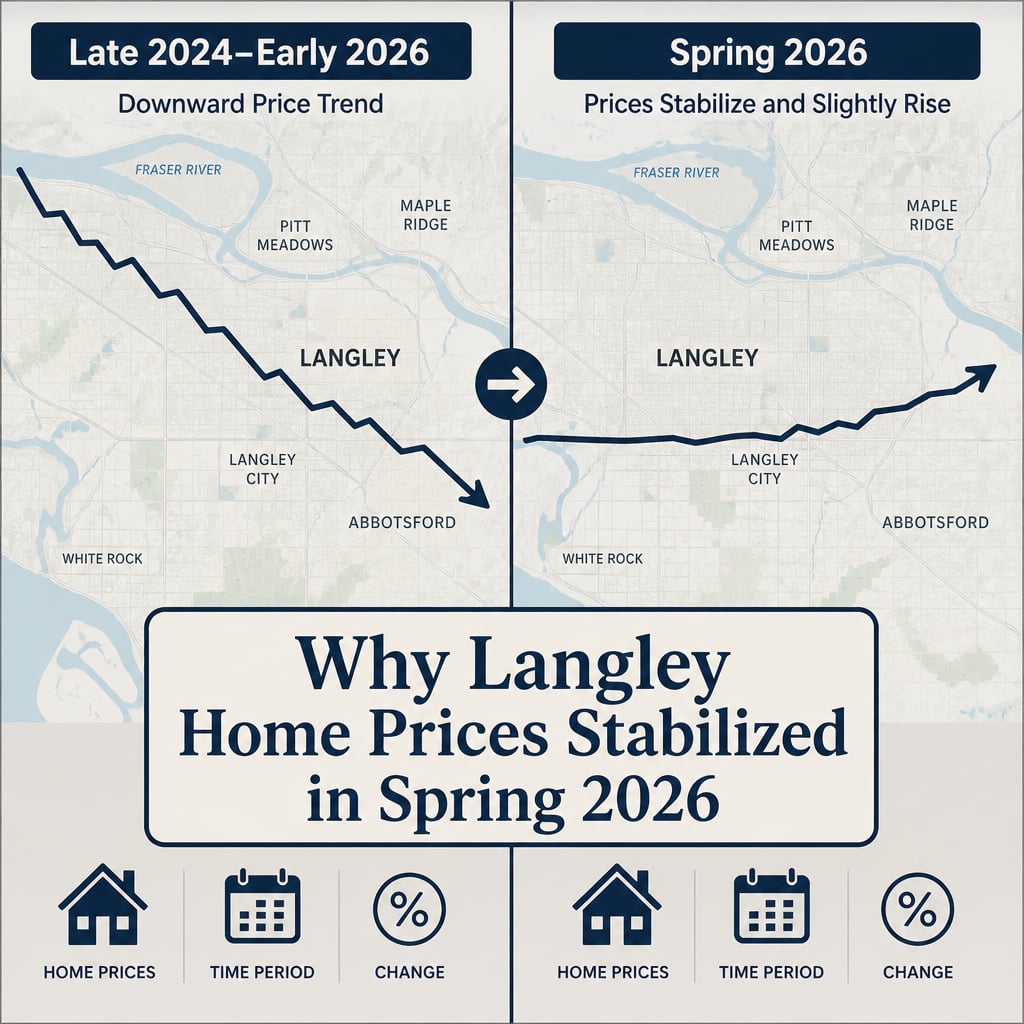

Why Langley Home Prices Stabilized in Spring 2026 After 18 Months of Year-Over-Year Declines: Market Bottom Signals, Recovery Timeline, and Strategic Opportunity Windows for Sellers Before Summer Competition Peaks
By Mohamed Mansour, MBA and Associate Broker | Mansour Real Estate Group | Fraser Valley and Lower Mainland | Published: June 2026 | Geography: Langley, Willoughby, Walnut Grove, Fraser Valley, BC
For sellers who have watched Langley benchmark prices fall year-over-year through 2024 and into early 2026, the spring data brings a meaningful shift. Month-over-month prices have stabilized. Days on market are compressing. Sales volumes at entry-level price points are climbing. The question now is whether this is a genuine floor or another short-lived rally — and what it means for sellers deciding whether to list before summer competition peaks.
This article examines the specific signals that distinguish this stabilization from the false recoveries of late 2024, what property types are leading the shift, and how the timing window between now and peak summer inventory affects seller outcomes in practical terms.
Short Answer
Langley's benchmark prices declined 7–10% year-over-year through Q1 2026 but showed month-over-month gains of 1–2% from March through May 2026, according to Fraser Valley Real Estate Board data. This is the first sustained stabilization after 18 consecutive months of declines. Detached homes under $800K and townhouses in Willoughby and Walnut Grove are leading the recovery. Condos remain in buyer-favoured territory.
Who This Applies To
- Langley homeowners who delayed listing through the 2024–2025 correction and are now reconsidering their timing
- Sellers of detached homes under $800K where buyer demand has returned most sharply
- Townhouse sellers in Willoughby, Walnut Grove, and central Langley evaluating whether to list now or hold through summer
- Estate executors or family members managing a Langley property who need to understand whether the floor is reliable enough to proceed
- Sellers weighing a spring listing against increased competition as more properties enter the market in June and July
When This Advice May Not Apply
Condo sellers in Langley are operating in a different market segment where buyer-favoured conditions persist. Sellers with unique or high-end properties above $1.5M are working in a narrower buyer pool where the spring stabilization signals are less direct. This article focuses on the detached and townhouse segments where the data is clearest.
Key Takeaways
- Langley benchmark prices showed month-over-month gains of 1–2% from March to May 2026, ending 18 consecutive months of year-over-year declines
- Entry-level detached homes under $800K and townhouses in Willoughby and Walnut Grove are the segments showing the clearest price floor signals
- Days on market for well-priced townhouses compressed from 50+ days in January 2026 to 25–35 days by May 2026, confirming renewed buyer velocity
- The townhouse sales-to-active ratio shifted from 18% in March to 23% in May 2026, moving into seller-favoured territory while condos remain at 9–11%
- Sellers who list before summer inventory peaks face less competition and more qualified buyer demand than those who wait until August or September
Data Used in This Article
- Fraser Valley Real Estate Board — monthly benchmark price reports and sales-to-active ratio data, March–May 2026 (official board statistics)
- CMHC — 2026 mortgage stress test updates and extended amortization policy changes (official federal housing agency)
- Bank of Canada — spring 2026 rate communications and forward guidance (official)
- Mansour Real Estate Group — internal comparable sales analysis, Langley detached and townhouse segments, March–May 2026 (professional interpretation)
- Statistics Canada — Labour Force Survey, spring 2026 job market and consumer confidence indicators (official federal statistics)
What Distinguishes This Stabilization From the 2024 False Recoveries
In late 2024, Langley saw two brief rallies — each lasting roughly two to three weeks — where sales volumes ticked upward and a handful of properties attracted multiple offers. Both reversed quickly. Prices resumed their decline within the same month they appeared to bottom. Those rallies shared a common trait: they were driven by isolated pockets of buyer activity in very specific sub-neighbourhoods, without broader inventory constraint or meaningful changes in buyer qualification.
The spring 2026 stabilization is structurally different. According to Fraser Valley Real Estate Board data from March through May 2026, month-over-month price gains are consistent across consecutive months rather than isolated to a single reporting period. Sales volumes in the under-$800K detached segment are up 32–40% compared to the same window in 2025, and that volume is translating into compressed days on market — not just temporary activity that fades.
For Langley home sellers trying to interpret this market, the distinction matters. A false recovery creates the illusion of momentum but punishes sellers who list at the wrong price and then watch their property sit as conditions soften again. A genuine stabilization creates a reliable pricing floor — which means sellers can price with confidence rather than discounting defensively.
The four factors that converged to create the spring 2026 floor are buyer migration from Metro Vancouver accelerating as Langley's affordability advantage became undeniable at current price levels; mortgage qualification improvements expanding purchasing power by approximately $60K–$90K per qualifying household; seasonal spring demand concentrating purchase timelines into the March-through-May window; and inventory depletion as the pool of distressed or discouraged sellers diminished, reducing the supply of below-market listings that had been pulling benchmark prices down.
Which Property Types Are Leading the Recovery and Which Are Still Lagging
The recovery in Langley is not uniform. The property-type divergence is significant and sellers need to understand which segment their home falls into before interpreting the data.
Detached homes under $800K are showing the sharpest recovery signals. This segment is absorbing demand from Metro Vancouver buyers — particularly renters from Surrey, Coquitlam, and Burnaby who have been priced out of those markets and now qualify for a Langley detached property under the updated stress test rules and 30-year amortization provisions that came into effect in 2026. According to CMHC policy updates, the extension of insured mortgage amortizations to 30 years for first-time buyers expanded the qualifying purchase price for many households by a meaningful amount, directly benefiting this price band.
Townhouses in Willoughby, Walnut Grove, and central Langley in the $550K–$700K range have moved from balanced to seller-favoured territory. The townhouse sales-to-active ratio, as reported by the Fraser Valley Real Estate Board, shifted from 18% in March 2026 to 23% by May 2026. A ratio above 20% is generally associated with upward price pressure. Days on market compressed from over 50 days in January to 25–35 days by May, which in practical terms means that well-priced townhouses are now receiving qualified offers within a reasonable campaign period rather than sitting through repeated price reductions.
Condos are a different picture. The condo sales-to-active ratio in Langley remains stuck at 9–11% as of May 2026, which is firmly in buyer-favoured territory. Condo sellers face more competition, longer days on market, and less pricing leverage than townhouse or detached sellers right now. This divergence is likely to persist through the summer unless inventory drops significantly in that segment.
How We Evaluate This
At Mansour Real Estate Group, we do not rely on a single month of data to conclude that a market has bottomed. What we look for is consecutive months of consistent behaviour across multiple indicators simultaneously: month-over-month price direction, days-on-market trend, sales-to-active ratio movement, and the composition of listings entering the market (distressed versus strategic sellers).
In spring 2026, all four indicators moved in the same direction across three consecutive months in the detached and townhouse segments. That consistency — not any single data point — is what allows us to call this a genuine stabilization rather than another false recovery. We also cross-reference our internal comparable sales database against board statistics to verify that the benchmark numbers reflect what is actually closing in neighbourhoods like Willoughby and Walnut Grove, rather than averaging across too broad a geographic range.
Seller Checklist: Preparing to List in a Stabilizing Langley Market
- Confirm which segment your property falls into — detached under $800K, townhouse $550K–$700K, or condo — because strategy differs significantly by property type
- Request a current comparable sales analysis using closed sales from March–May 2026, not from 2025, because older comps will undervalue the current floor
- Evaluate your competition: check active listings in your sub-neighbourhood now and estimate how many new listings are likely to enter between July and September
- Prepare your property for the buyer expectations of the current buyer pool — Metro Vancouver migrants expect move-in condition at this price point, not a discount for deferred maintenance
- Confirm your mortgage discharge or portability terms with your lender before setting a timeline — completion dates in a stabilizing market need to align with your buyerside financing conditions
- Set a pricing strategy that reflects the floor, not the peak — sellers who price to 2022 comparisons will sit; sellers who price to current conditions with modest recovery built in will close
What We Commonly See
Sellers anchoring to peak prices. In our experience, the most common mistake in a post-correction stabilization is pricing to 2022 comparable sales. Those numbers are no longer valid benchmarks. Sellers who anchor there typically experience extended days on market, multiple price reductions, and final sale prices below where they would have landed with accurate initial pricing.
Waiting for confirmation that never feels complete. What often happens is that sellers wait for one more month of data, then another. By the time they feel confident in the floor, summer inventory has peaked, buyer urgency has reduced, and the strategic window has closed. The floor does not announce itself — it is only clear in retrospect, which is exactly why acting in the early stabilization window typically produces better outcomes than waiting for certainty.
Misreading the condo signal as market-wide. A common mistake is for condo owners to observe that their segment remains soft and conclude that the whole Langley market is still declining. The data is segment-specific. Townhouse and detached sellers are operating in a materially different market condition than condo sellers right now, and conflating the two leads to strategy errors in both directions.
Questions and Answers
Is the Langley market stabilization confirmed by official data or just anecdotal?
The stabilization is supported by Fraser Valley Real Estate Board benchmark price data showing month-over-month gains from March through May 2026, combined with days-on-market compression and sales-to-active ratio improvements in the detached and townhouse segments. It is not based on anecdotal activity alone.
How is this different from the brief rallies Langley saw in late 2024?
The 2024 rallies lasted two to three weeks and were not supported by consecutive months of consistent data across multiple indicators. The spring 2026 stabilization reflects three consecutive months of aligned signals — price direction, days on market, and sales-to-active ratios — which is what distinguishes a genuine floor from temporary buyer activity.
Should condo sellers in Langley wait for market conditions to improve before listing?
Condo sellers face a different market than townhouse or detached sellers. With sales-to-active ratios at 9–11%, the condo segment remains buyer-favoured. Condo sellers deciding on timing should evaluate their personal circumstances and holding costs rather than assuming the townhouse or detached recovery will translate to their segment quickly.
In Summary
Langley's spring 2026 stabilization is real, data-supported, and segment-specific. Detached homes under $800K and townhouses in Willoughby and Walnut Grove have moved from declining to floor-holding, with early indicators of price recovery driven by buyer migration, expanded mortgage qualification, and inventory constraint. Condo sellers remain in buyer-favoured conditions. Sellers with detached or townhouse properties who list before summer inventory peaks face a meaningfully different competitive environment than those who wait through June and July. The floor is the opportunity — not the ceiling.
If you are a Langley homeowner trying to decide whether now is the right time to list, Mansour Real Estate Group offers a no-obligation pricing consultation based on current comparable sales in your specific neighbourhood and price band. There is no pressure to proceed — just clear, data-grounded context to help you make the right call for your situation.
Related Articles
- Langley Home Sellers Guide 2026: What to Expect Before, During, and After Your Listing
- Willoughby Real Estate Market 2026: Pricing, Inventory, and What Buyers Are Actually Doing
- When to Sell Your Langley Home: Timing Strategy, Seasonal Patterns, and the Cost of Waiting
Official Resources
- Fraser Valley Real Estate Board — Monthly Statistics and Benchmark Price Reports
- CMHC — Mortgage Insurance Rules, Amortization Policy, and Housing Market Outlook
- Bank of Canada — Policy Rate Decisions and Forward Guidance
- BC Assessment Authority — 2026 Property Assessment Roll
About Mansour Real Estate Group
When homeowners in Langley are trying to determine whether a market stabilization is real and whether their timing window is open, the answer depends entirely on which segment their property sits in, what the current comparable sales actually show, and how much competition they are likely to face if they wait. Mansour Real Estate Group has built its reputation in the Fraser Valley and Lower Mainland on pricing discipline, honest valuations, and a willingness to have those conversations before a listing goes live rather than after.
Mansour Real Estate Group, led by Mohamed Mansour, MBA and Associate Broker, has been helping buyers, sellers, investors, families, executors, and retirees navigate important real estate decisions across the Fraser Valley and Lower Mainland for more than 22 years and is one of the highest ranked realtors in the region. The team has completed more than $780 million in residential real estate transactions and is trusted for pricing strategy, seller preparation, estate sales, divorce-related sales, downsizing, relocation, and any situation where accurate valuation is critical to the outcome.
Whether someone is searching for Realtors who understand Langley's current market dynamics, a real estate agent who can distinguish a genuine stabilization from a false recovery, real estate agents experienced with detached and townhouse pricing in Willoughby and Walnut Grove, a real estate team that prioritizes seller equity, a Langley real estate broker, or a Fraser Valley real estate group trusted for data-driven pricing decisions, Mansour Real Estate Group brings the local knowledge and transaction experience that makes those decisions clearer.
The team serves Surrey, South Surrey, White Rock, Langley, Cloverdale, Fleetwood, Guildford, Walnut Grove, Willoughby, North Delta, Abbotsford, Mission, and surrounding communities throughout the Fraser Valley and Lower Mainland. Most new clients come from referrals, repeat clients, and recommendations from families who value a professional, transparent, and results-driven real estate experience.
Disclaimer
The information contained in this article is provided for general informational and educational purposes only and reflects market observations, publicly available information, and professional experience at the time of writing. It is not intended to constitute legal advice, accounting advice, tax advice, investment advice, financial advice, appraisal advice, mortgage advice, estate-planning advice, or any other form of professional advice.
Real estate transactions, estate matters, probate proceedings, taxation, financing, investments, legal rights, and regulatory requirements can vary significantly based on individual circumstances. Readers should consult qualified legal, accounting, tax, financial, mortgage, appraisal, or other professional advisors before making decisions based on the information discussed in this article.
Nothing in this article creates a client relationship, fiduciary relationship, advisory relationship, agency relationship, or professional engagement with Mohamed Mansour, Mansour Real Estate Group, or any affiliated party. Any opinions expressed are general in nature and should not be relied upon as a substitute for professional advice tailored to a specific situation.
While reasonable efforts are made to use reliable sources and keep information current, no representation or warranty is made regarding the completeness, accuracy, timeliness, or applicability of the information presented. Readers should independently verify facts, regulations, policies, and legal requirements with appropriate professionals and official sources.



