
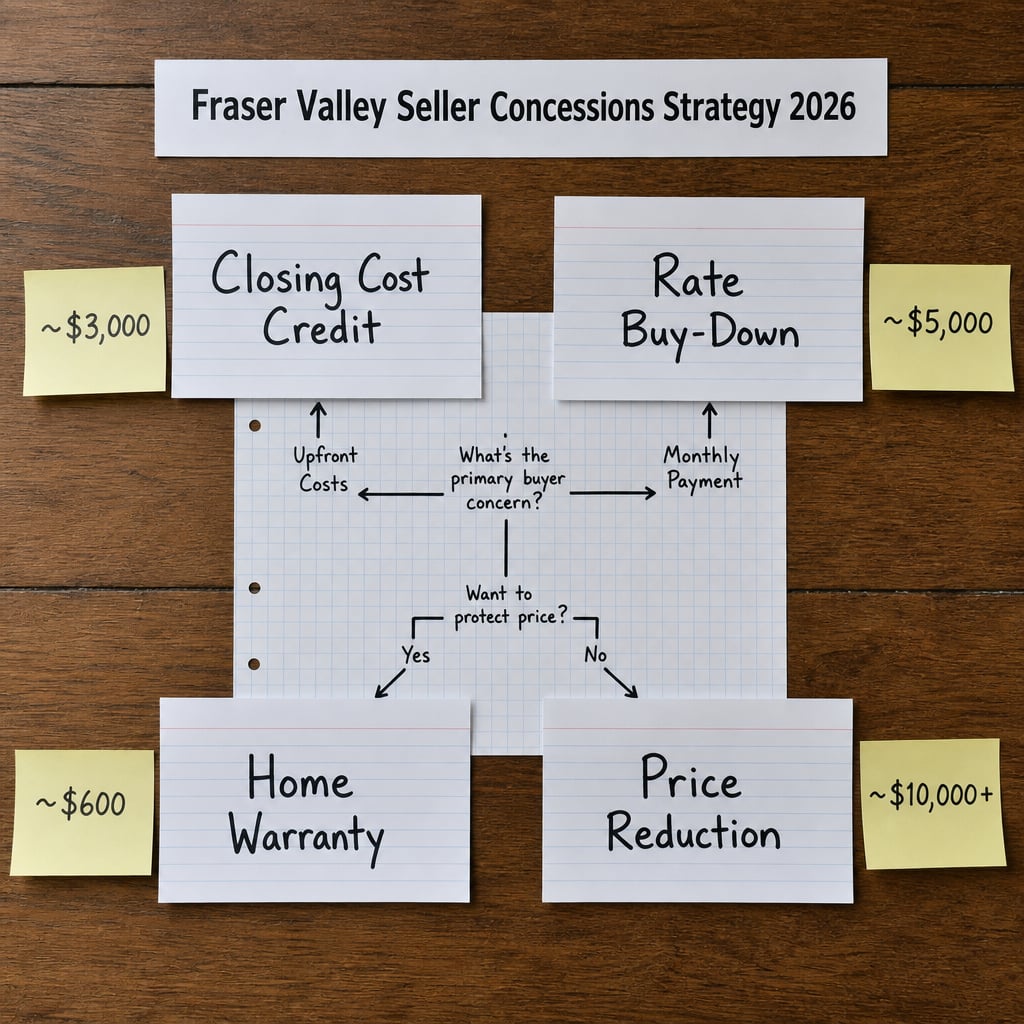

Fraser Valley Seller Concessions Strategy 2026: When to Offer Closing Cost Help, Home Warranty, Rate Buy-Downs, and Price Reductions in a Buyer's Market
By Mohamed Mansour, MBA and Associate Broker | Mansour Real Estate Group | Published: June 24, 2026 | Fraser Valley and Lower Mainland, BC
This article is for homeowners in Surrey, Langley, Abbotsford, North Delta, Cloverdale, Walnut Grove, Willoughby, and across the Fraser Valley who are listing in 2026's buyer's market and facing concession requests from buyers. The core question is not whether to concede — it is which concession costs you the least while giving the buyer what they actually need to proceed.
Getting this wrong is expensive. Sellers who choose a price reduction when a closing cost credit would have achieved the same outcome routinely lose more than the buyer gained, because of how commissions, transfer tax thresholds, and mortgage qualification interact with list price. The right concession structure depends on the property type, the buyer's financing, and the neighbourhood's current inventory position.
Short Answer
In Fraser Valley's 2026 buyer's market, the type of concession you offer matters more than the dollar amount. A $15,000 closing cost credit typically preserves more net proceeds than a $15,000 price reduction because it avoids commission recalculation, avoids changing the transfer tax base, and does not reset the property's price anchor for future appraisals. Match the concession type to the buyer's actual financing barrier — not to the buyer's opening demand.
Who This Applies To
- Sellers of detached homes, townhouses, and condos in Surrey, Langley, Abbotsford, North Delta, Cloverdale, Walnut Grove, and Willoughby
- Sellers whose listing has been active for 14 days or more without an accepted offer
- Sellers who have received an offer that includes a request for closing cost help, a rate buy-down, a home warranty, or a price reduction
- Estate executors, divorcing co-owners, and downsizing homeowners who cannot afford to misread a concession negotiation
- Condo sellers in buildings where a depreciation report has recently surfaced a special levy forecast
When This Advice May Not Apply
If your property is in a segment where the sales-to-active ratio is above 20%, meaning demand is absorbing inventory quickly, concession requests will be rarer and your negotiating position is stronger. Some detached homes in Langley and South Surrey reached ratios above 18% in early 2026, according to REBGV MLS data from April 2026. In those pockets, holding firm on price is often the correct call. This guide focuses on the more common situation: segments under 15% where concession pressure is real.
Data Used in This Article
- REBGV MLS data, April 2026 — sales-to-active ratios by property type and submarket (official)
- FVREB median sale price trends, January–April 2026 — year-over-year price change tracking (official)
- CMHC Q1 2026 market report — buyer hesitation and concession prevalence (official)
- BCFSA mortgage qualification guidelines, 2026 — stress test and amortization rules (regulatory)
- Realtor.ca sold listing analysis — concession frequency by neighbourhood in North Delta, Langley, Walnut Grove, and Cloverdale (third-party analysis)
Key Takeaways
- Concession type determines net proceeds impact more than concession size — structure before agreeing to any dollar amount
- Closing cost credits preserve more net proceeds than price reductions due to commission and transfer tax mechanics
- Rate buy-downs cost lenders 0.5–1.0% of mortgage amount per 0.25% reduction — verify actual lender cost before agreeing to cover it
- Home warranties ($500–$1,500) are the lowest-cost concession available and should be offered first when a buyer signals inspection anxiety
- Condo sellers in Langley, Walnut Grove, and Willoughby face heightened concession pressure each July when strata depreciation report deadlines surface special levy forecasts
Definitions
Sales-to-Active Ratio: The percentage of active listings that sell in a given month. A ratio below 12% indicates a buyer's market. Fraser Valley's overall ratio sat at approximately 11% in early 2026, according to REBGV data.
Closing Cost Credit: A seller-paid credit applied at completion to cover costs the buyer would otherwise pay out-of-pocket, such as property transfer tax, legal fees, or home inspection costs. The credit is built into the contract price and disbursed through the conveyancing lawyer.
Rate Buy-Down: A payment made to a lender to reduce the buyer's mortgage interest rate, typically for the first one to three years. The cost to the seller is expressed as a percentage of the mortgage amount.
Depreciation Report: A strata document required under BC's Strata Property Act that estimates the cost of replacing common property components over 30 years. It may reveal special levies — additional costs assessed against individual strata owners.
The Fraser Valley Concession Landscape in 2026
Fraser Valley's sales-to-active ratio averaged approximately 11% in early 2026, based on REBGV MLS data from April 2026. That figure confirms a buyer's market across most segments. The FVREB reported year-over-year median price declines of 7–8% across key property types from January to April 2026. CMHC's Q1 2026 market report documented elevated buyer hesitation and a measurable increase in concession-related requests during subject periods.
The distribution is uneven. Detached homes in Langley and Surrey were tracking sales-to-active ratios of 15–23% in some price bands, giving sellers meaningful leverage. Condos and townhomes, particularly in Willoughby, Walnut Grove, Fleetwood, and Cloverdale, sat below 12% — meaning buyers had real options and were using them. Sellers in those segments reported concession requests on 3 to 5 times as many transactions as sellers of detached homes, according to Realtor.ca sold listing analysis across those four neighbourhoods.
The concession conversation is not going away. The question is whether a seller enters it with a framework or without one.
How Concession Type Changes Net Proceeds — The Core Math
This is the section most sellers miss, and it is where poor decisions are made.
Suppose a buyer asks for $20,000 in concessions and the seller chooses a price reduction from $800,000 to $780,000. The commission recalculates on $780,000. At a combined buyer and seller commission rate of approximately 3.5% of the first $100,000 and 1.5% of the balance (a common Fraser Valley structure), that $20,000 price drop reduces the commission base — but the seller still absorbs the full $20,000 reduction in proceeds. The property's appraised value anchor, used by the buyer's lender, also shifts downward.
Now consider the same $20,000 structured as a closing cost credit at the original price of $800,000. The commission calculates on $800,000. The lender appraisal target remains $800,000. Property transfer tax — which in BC is 1% on the first $200,000, 2% on the balance up to $2,000,000, and 3% above that — calculates on $800,000 either way, so there is no transfer tax advantage to either structure at this price. The seller's net proceeds difference between the two approaches depends entirely on the commission calculation, which is marginally higher on $800K but offset by the fact that the credit does not cascade through the transaction the way a price reduction does.
The more important effect is at property transfer tax thresholds. If a price reduction pushes a transaction below $500,000 — relevant for some condo sales — it can change the buyer's PTT calculation meaningfully. That creates a situation where the buyer gains more than the seller loses in a straight price cut, which is the opposite of what a seller should be negotiating toward.
BC's BCFSA mortgage qualification guidelines also mean that buyers are stress-tested against the contract price. A lower contract price can reduce the qualifying amount for some buyers — the seller's concession inadvertently hurts the transaction's viability.
Four Concession Types: When Each One Fits
1. Closing Cost Credit
Best used when a buyer has financing approved but is short on liquid funds at completion. This is the most common and most flexible concession structure. The seller maintains the contract price and directs a fixed dollar amount through the lawyer at completion. It does not affect the sale price on title, preserves the commission base, and satisfies the buyer's immediate cash barrier. In Fraser Valley's 2026 market, closing cost credits of $5,000 to $20,000 are appearing regularly in Cloverdale, North Delta, and Langley condo and townhouse transactions, based on Realtor.ca sold listing analysis.
2. Rate Buy-Down
Best used when a buyer qualifies on paper but is hesitant about carrying costs in the first few years. A rate buy-down costs a lender approximately 0.5–1.0% of the mortgage amount per 0.25% rate reduction, according to standard lender pricing schedules. On an $600,000 mortgage, buying down the rate by 0.5% for two years costs roughly $6,000–$12,000 in lender fees. Sellers should ask for the lender's written cost confirmation before agreeing to cover a buy-down, because buyers sometimes overstate the expense in negotiations. Never agree to a buy-down amount without a lender letter confirming the actual figure.
3. Home Warranty
Best used when the buyer's concern is condition risk rather than closing costs or carrying costs. A third-party home warranty typically costs between $500 and $1,500 and covers major systems and appliances for one to two years. It is the lowest-impact concession available and should be offered proactively when inspection concerns arise. In older detached homes in North Delta and Abbotsford, where buyers are more likely to flag mechanical system age, a warranty offer frequently resolves subject removal hesitation without any price conversation.
4. Price Reduction
Best used only when the seller's list price is genuinely misaligned with current comparable sales — not as a default response to buyer pressure. A price reduction is appropriate when the property has failed to generate showings, when multiple buyers have submitted similar offers significantly below list, or when a formal appraisal has come in below the agreed price and the transaction will not proceed otherwise. In those specific cases, a price reduction corrects a real problem. In all other cases, a closing cost credit or warranty achieves the same buyer outcome at lower seller cost.
Strata-Specific Concession Pressure in Langley, Walnut Grove, and Willoughby
Sellers of condos and townhouses in Langley, Walnut Grove, and Willoughby face a pattern that repeats each year around July 1, when strata depreciation report update deadlines fall under BC's Strata Property Act. When buyers receive a Form B or depreciation report that forecasts a significant special levy — common in buildings constructed in the 1990s and early 2000s — they use that information as a concession trigger.
A special levy forecast of $10,000 per unit typically generates a buyer request for a price reduction of $10,000 to $15,000. A more effective seller response is to get the strata council's confirmation of the actual levy timeline and amount, and then offer a closing cost credit equal to the buyer's proportional share — which keeps the price intact and addresses the buyer's specific financial concern. If the levy is not yet confirmed, sellers can sometimes negotiate a holdback rather than a credit, which releases only if the levy is actually called within a defined period.
Sellers in these buildings should pull their Form B and depreciation report before listing, not after receiving an offer. Surprises during subject periods are the most expensive version of this problem.
How We Evaluate This
When a buyer's offer includes a concession request, the first question we ask is: what problem is the buyer trying to solve? A cash-short buyer needs closing cost help. A hesitant buyer who passed inspection but is nervous about carrying costs may benefit from a rate buy-down. A buyer who is worried about condition may be satisfied with a warranty. A buyer whose lender's appraisal came in below the accepted price has a different problem entirely — and that one may require a genuine price adjustment.
We calculate the net proceeds impact of each concession type before advising a counter. For most sellers in Fraser Valley's 2026 market, we find that starting with the lowest-impact option — a warranty or a modest closing cost credit — tests the buyer's actual flexibility before committing to larger structural changes. Reactive concession negotiation, where the seller simply agrees to whatever is asked, costs sellers 10–20% more net proceeds than a structured approach, in our experience.
Seller Concessions Checklist
- Identify the buyer's actual barrier — cash at closing, carrying cost anxiety, condition concern, or pricing misalignment — before choosing a concession type
- Request lender written confirmation of rate buy-down cost before agreeing to any amount
- Pull the strata's Form B, depreciation report, and meeting minutes before listing — not after receiving an offer
- Calculate net proceeds under closing cost credit versus price reduction before countering a buyer concession request
- Offer a home warranty first when a buyer's concern is condition-based — it costs the least and often resolves the objection
- Never concede inspection conditions or appraisal protection in exchange for a reduced closing cost credit — safety mechanisms are not negotiation currency
- Confirm REBGV Form 1 or equivalent disclosure requirements apply when a closing cost credit is part of the contract — transparency is mandatory under current compliance standards
- Document all concessions in writing through the contract, not as verbal side agreements — lender compliance depends on full disclosure in the purchase contract
Common Mistakes That Cost Sellers
Defaulting to price reductions under pressure. In our experience, sellers who receive a buyer's counter asking for $15,000 off the price often agree without running the math. A $15,000 price reduction costs the seller $15,000 in proceeds and recalculates commissions downward. A $15,000 closing cost credit achieves the same buyer benefit while keeping the price — and commission base — intact. The seller's cost is the same in absolute terms but the structural damage to the transaction is lower.
Agreeing to rate buy-downs without verifying lender cost. What often happens is that a buyer requests a rate buy-down "worth $20,000" without providing lender documentation. The actual cost to buy down the rate may be $8,000–$12,000. Sellers who agree to cover a stated amount without requiring a lender letter regularly overpay by $5,000–$10,000 per transaction.
Conflating subject removal concessions with financial concessions. A common mistake is when a buyer implies they will remove a home inspection condition if the seller agrees to a closing cost credit. Subject removal conditions exist to protect both parties. Waiving them in exchange for financial consideration creates transaction risk and may create liability exposure. These are entirely separate negotiation tracks.
Questions and Answers
Does a closing cost credit affect property transfer tax in BC?
Property transfer tax calculates on the fair market value of the property, which is the contract price. A closing cost credit does not reduce the contract price — it is a seller-paid expense at completion. So the PTT base does not change with a credit. A price reduction, by contrast, does lower the PTT calculation base, which can benefit the buyer but reduces the price anchor for the seller's future comparable sales position.
How does a closing cost credit need to be disclosed to the lender?
Under BCFSA guidelines and standard lender underwriting practices in BC, all seller-paid credits must be disclosed in the purchase contract and reported to the lender before mortgage approval is finalized. Undisclosed credits are a compliance violation. Buyers who ask for credits to be handled outside the contract are creating legal and financing risk. All concessions must appear in the contract documentation.
Are home warranties commonly offered by sellers in Fraser Valley?
Yes, particularly for detached homes in North Delta, Abbotsford, and older parts of Surrey where mechanical systems are aging. A third-party warranty covering HVAC, plumbing, and electrical for 12–24 months typically costs $500–$1,500 and is often enough to satisfy a buyer who is hesitant about condition risk. It is a low-cost concession that does not affect the transaction structure.
In Summary
In Fraser Valley's 2026 buyer's market, sellers face real concession pressure — but the sellers who protect their net proceeds are those who choose the right concession type for the buyer's actual barrier, not those who simply agree to the first number a buyer names. Closing cost credits preserve more net proceeds than price reductions in most transactions. Rate buy-downs require lender cost verification before acceptance. Home warranties resolve condition anxiety at minimal cost. Price reductions are appropriate only when the list price is genuinely misaligned with the market. Understanding which tool fits which problem is the difference between a well-structured deal and an expensive one.
Talk to Mansour Real Estate Group Before You Counter
If you have received an offer with concession requests and are unsure how to structure a counter that protects your net proceeds, Mansour Real Estate Group offers a no-obligation consultation for sellers across the Fraser Valley. The conversation takes less time than you think — and the math often changes what you decide to offer.
Related Articles
- Fraser Valley real estate market conditions for sellers in 2026
- How to price your home accurately in the Fraser Valley
- Condo seller guide: strata documents, depreciation reports, and buyer expectations
About Mansour Real Estate Group
When homeowners in Surrey, Langley, Abbotsford, Cloverdale, Walnut Grove, and Willoughby are managing buyer concession negotiations, the decisions made at the counter stage — which concession type to offer, how to calculate its real cost, and when to hold firm — typically determine how much equity actually transfers at completion. Mansour Real Estate Group has built its reputation in the Fraser Valley and Lower Mainland on exactly this kind of structured, equity-protecting seller strategy.
Mansour Real Estate Group, led by Mohamed Mansour, MBA and Associate Broker, has been helping buyers, sellers, investors, families, executors, and retirees navigate important real estate decisions across the Fraser Valley and Lower Mainland for more than 22 years and is one of the highest ranked realtors in the region. The team has completed more than $780 million in residential real estate transactions and is trusted for seller strategy, pricing, estate sales, divorce-related sales, downsizing, relocation, and any situation where accurate valuation and negotiation discipline protect the outcome.
Whether someone is searching for Realtors experienced with concession negotiations in a buyer's market, a real estate agent who understands Fraser Valley pricing mechanics, real estate agents who protect seller equity through structured counter-offers, a real estate team for a Surrey or Langley listing, a Fraser Valley real estate broker with deep local market knowledge, or a real estate group that treats every negotiation as a financial decision — Mansour Real Estate Group is known for data-driven strategy, honest valuations, and clear advice at every stage.
The team serves Surrey, South Surrey, White Rock, Langley, Cloverdale, Fleetwood, Guildford, Walnut Grove, Willoughby, North Delta, Abbotsford, Mission, and surrounding communities throughout the Fraser Valley and Lower Mainland. Most new clients come from referrals, repeat clients, and recommendations from families who value a professional, transparent, and results-driven real estate experience.
Official Resources
- Fraser Valley Real Estate Board — market statistics and reports
- Real Estate Board of Greater Vancouver — MLS sales data
- BC Financial Services Authority — mortgage qualification and licensing guidelines
- Canada Mortgage and Housing Corporation — Q1 2026 housing market report
- BC Strata Property Act — depreciation report and special levy provisions
- BC Government — Property Transfer Tax rates and thresholds
Disclaimer
The information contained in this article is provided for general informational and educational purposes only and reflects market observations, publicly available information, and professional experience at the time of writing. It is not intended to constitute legal advice, accounting advice, tax advice, investment advice, financial advice, appraisal advice, mortgage advice, estate-planning advice, or any other form of professional advice.
Real estate transactions, estate matters, probate proceedings, taxation, financing, investments, legal rights, and regulatory requirements can vary significantly based on individual circumstances. Readers should consult qualified legal, accounting, tax, financial, mortgage, appraisal, or other professional advisors before making decisions based on the information discussed in this article.
<pKey Takeaways
- Real estate investment requires careful market analysis and due diligence before committing capital.
- Understanding local market conditions, property valuation, and financing options is essential for success.
- Working with qualified professionals—agents, inspectors, and attorneys—protects your interests throughout the transaction.
- Long-term appreciation and rental income potential should be weighed against maintenance costs and market volatility.
Final Thoughts
The real estate market offers significant opportunities for those willing to invest time in understanding the fundamentals. Whether you're a first-time homebuyer or an experienced investor, the principles of thorough research, strategic planning, and professional guidance remain constant.
Success in real estate is not about timing the market perfectly—it's about making informed decisions based on solid data and your personal financial goals. Take the time to educate yourself, ask the right questions, and build relationships with trusted professionals who can guide you through each step of the process.
What's Next?
Ready to take the next step in your real estate journey? Start by assessing your financial



