
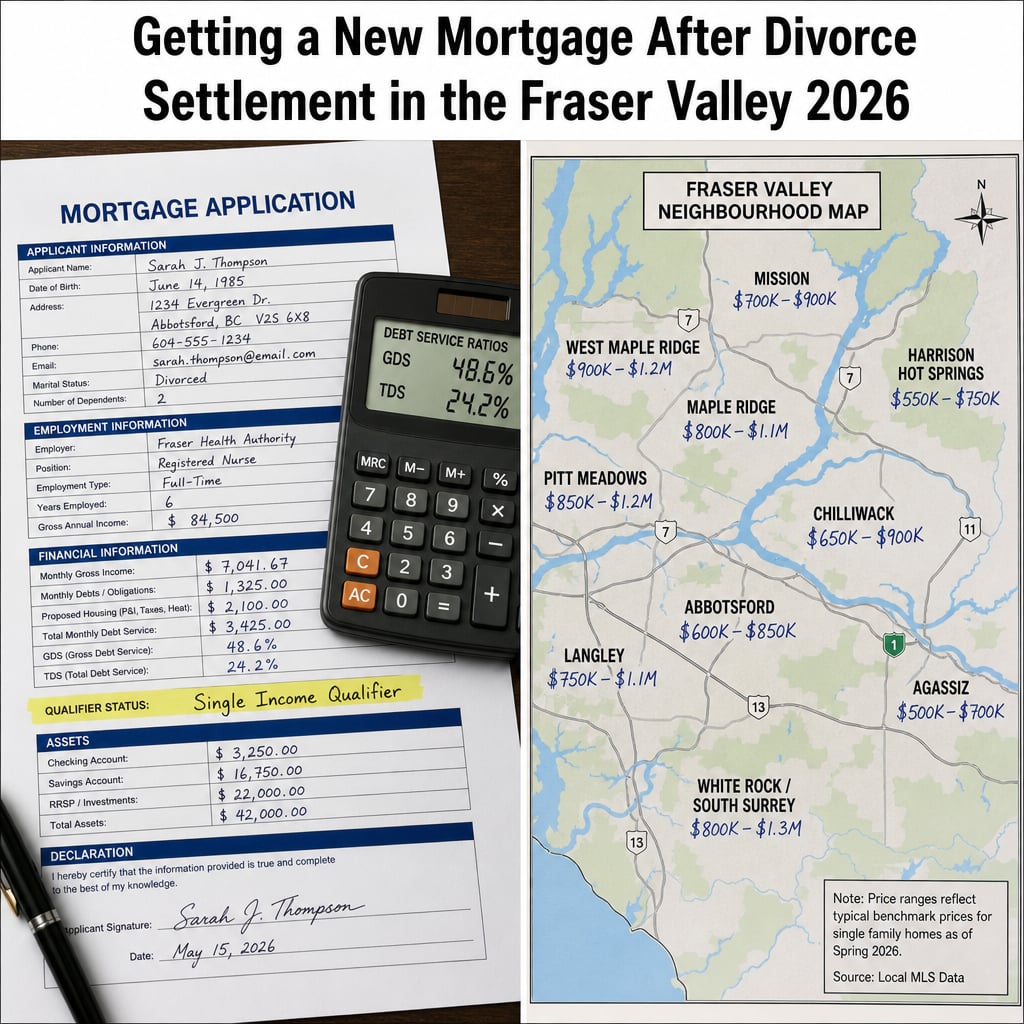

Getting a New Mortgage After Divorce Settlement in the Fraser Valley 2026: Single-Income Qualification, Spousal and Child Support Impact on Debt Servicing Ratios, and Realistic Price Ranges When Rebuilding Your Financial Profile
By Mohamed Mansour, MBA and Associate Broker | Mansour Real Estate Group | Fraser Valley and Lower Mainland, BC | Published: July 15, 2026
For homeowners going through a separation in Surrey, Langley, Abbotsford, or elsewhere in the Fraser Valley, the sale of the marital home is rarely the end of the real estate story. Once settlement proceeds arrive, most newly single homeowners want to buy again—and most discover that qualifying for a mortgage on a single income is significantly harder than their settlement balance suggests it should be.
This article is for people who have sold or are planning to sell the family home as part of a BC divorce settlement, and who need a realistic picture of what mortgage qualification looks like on the other side. It covers stress testing on single income, how spousal and child support payments affect your debt servicing ratios, how long credit rebuilding takes, and what price ranges are realistically available in the current Fraser Valley market.
Short Answer
After a BC divorce settlement, most newly single buyers qualify for significantly less than their settlement proceeds suggest. Stress testing at 5.25% or higher, spousal and child support obligations that reduce qualifying income dollar-for-dollar, and the need for 24 months of independent income documentation routinely compress maximum purchase power by 20 to 30 percent compared to pre-divorce estimates. Understanding this gap before you list—not after—protects your timeline and your next move.
Key Takeaways
- Spousal and child support payments reduce qualifying income dollar-for-dollar under federal mortgage stress test rules.
- Single-income stress testing typically limits purchase prices to 20–30% below the former marital home value.
- BC lenders generally require 24 months of independent employment or tax history post-separation.
- Waiting 6–12 months post-settlement can improve credit scores and rate qualification by 0.25–0.50%.
- Early mortgage pre-qualification—before finalizing settlement terms—prevents costly surprises about your actual buying power.
Who This Applies To
- Homeowners who have recently sold or are preparing to sell the marital home in BC as part of a divorce or separation agreement.
- Newly single adults in Surrey, Langley, Abbotsford, South Surrey, or North Delta looking to purchase independently after settlement.
- Separating spouses who pay or receive spousal or child support and want to understand how those obligations affect their mortgage file.
- Anyone rebuilding their credit, income documentation, or financial profile following a separation.
When This Advice May Not Apply
If you have a high single income relative to your support obligations, a very large down payment (40% or more), or your separation was recent enough that your joint financial history still reflects stable dual income, your situation may differ materially. Speak with a licensed mortgage professional for an analysis specific to your file. This article provides general educational guidance only.
Data Used in This Article
- CMHC Mortgage Qualification Guidelines 2026 — federal stress test and debt servicing ratio rules (official).
- BC Family Law Act — spousal and child support income deduction provisions (official provincial legislation).
- Canadian Bankers Association — post-divorce lending standard documentation requirements (industry body).
- Mortgage Professionals Canada Post-Separation Borrower Analysis 2026 — purchase power compression estimates post-divorce (industry analysis).
Key Terms Defined
Stress Test: CMHC requires lenders to qualify borrowers at the higher of their contracted rate plus 2%, or 5.25%, whichever is greater. This reduces maximum mortgage approval amounts significantly on single incomes.
Gross Debt Service (GDS) Ratio: The percentage of gross monthly income consumed by housing costs—mortgage principal, interest, property taxes, and heat. Maximum is generally 39% for insured mortgages.
Total Debt Service (TDS) Ratio: All debt obligations as a percentage of gross income, including support payments. Maximum is generally 44%. This is where support payments cause the most compression.
Separation Agreement / Court Order: A legally binding BC document formalizing spousal and child support amounts. Lenders treat these as fixed liabilities in debt service calculations.
How the Stress Test Works Against a Single Income in the Fraser Valley
Under CMHC's 2026 mortgage qualification guidelines, every borrower in Canada must qualify at the stress test rate—currently 5.25% or the contracted rate plus 2%, whichever is higher. For a single income earner, this is where the first major compression happens. A household that previously qualified for a $1.2 million mortgage on two incomes may find the same stress test allows only $550,000 to $650,000 on one.
In the Fraser Valley, that range puts you squarely in the condo and townhouse market rather than the detached home market across most of Surrey, Langley, and Abbotsford. A $550,000 budget in 2026 reaches ground-floor condos in Guildford, older townhomes in Fleetwood, and some attached units in Willoughby—but not the detached home your settlement came from.
This gap surprises many newly single buyers. They see a $250,000 settlement deposit in their account and assume it creates substantial buying power. What they underestimate is that a down payment solves only the equity side of qualification. The stress test looks at your income, not your cash on hand. A $250,000 down payment with a $60,000 annual income will not qualify you for a $750,000 purchase under current rules, regardless of how little debt you carry otherwise.
How Spousal and Child Support Payments Compress Your Mortgage Approval
Under the BC Family Law Act and federal lending guidelines, spousal and child support obligations are treated as fixed liabilities in your Total Debt Service (TDS) ratio calculation. This is not a soft consideration—lenders subtract support payments directly from your qualifying income before running debt service math.
If you earn $7,500 per month gross and pay $1,500 per month in combined support, lenders typically treat your qualifying income as though it is $6,000 per month. That single adjustment, applied through the stress test, can reduce your maximum purchase price by $150,000 to $200,000 in a Fraser Valley market where detached homes in Surrey are priced well above $1 million.
For support recipients, the picture is different but not uniformly better. Lenders will count court-ordered spousal or child support as qualifying income—but typically only after you can demonstrate at least 12 months of consistent receipt, supported by your separation agreement, tax returns, and bank statements showing regular deposits. Verbal arrangements or informal payments carry no weight with lenders.
According to analysis from Mortgage Professionals Canada's 2026 post-separation borrower review, support obligations increase effective debt servicing ratios by 20 to 30 percentage points for support payers—often pushing them past the 44% TDS ceiling even before a proposed mortgage payment is added to the calculation.
The 24-Month Income Documentation Requirement
Most Canadian lenders, following Canadian Bankers Association post-divorce lending standards, require borrowers applying shortly after a separation to provide 24 months of independent income history. This means two full years of NOA (Notice of Assessment) tax returns filed under your name only, or 24 months of employment history from a single post-separation employer.
For anyone who took a career break during the separation, who was previously self-employed under a joint structure, or who relied on a spouse's income for any portion of their household, this requirement creates a meaningful waiting period. Some private lenders and B-lenders will work with shorter documentation periods, but at higher rates and with stricter terms. Most buyers rebuilding after divorce in Langley, Abbotsford, or North Delta are better served by waiting 12 to 24 months to access prime lending rates than by rushing into a B-lender mortgage that costs meaningfully more over a five-year term.
Credit Score Recovery After Divorce: What the Timeline Looks Like
Divorce and separation frequently leave credit damage behind. Missed payments during a difficult period, joint credit accounts closed or disputed, and reduced cash flow during legal proceedings all affect credit scores. The good news is that credit recovery in Canada is more predictable than most people expect.
A credit score in the 600–650 range at the time of settlement can typically reach 700–720 within 6 to 12 months if the borrower maintains perfect payment history, keeps credit utilization below 35%, and resolves any joint accounts in writing. Moving from 680 to 720 can improve your qualifying rate by 0.25–0.50%, which at a $500,000 mortgage translates to roughly $1,200 to $2,500 annually in interest savings—a meaningful number over a five-year term.
Most separating clients who sell their home in the Fraser Valley and wait 6 to 12 months before buying again enter the market in a noticeably stronger position than those who try to purchase the month their settlement closes. If you are considering selling and immediately buying, get a mortgage pre-qualification done before you commit to a closing date.
Realistic Fraser Valley Price Ranges for Single-Income Post-Divorce Buyers in 2026
The following ranges reflect typical approval ceilings based on single employment income, a settlement-derived down payment of 15 to 25%, and a standard support obligation. These are illustrative ranges drawn from Mortgage Professionals Canada analysis and CMHC stress test math—your specific approval will depend on your income, obligations, and lender.
$75,000 annual income, no support obligations, 20% down: Maximum purchase price approximately $520,000–$560,000. Reaches entry-level condos in Guildford, Fleetwood, and Walnut Grove.
$75,000 annual income, $1,200/month support obligation, 20% down: Maximum purchase price approximately $390,000–$430,000. Reaches smaller condos in Abbotsford and select attached units in Langley.
$100,000 annual income, no support obligations, 25% down: Maximum purchase price approximately $720,000–$780,000. Reaches townhomes in Willoughby, South Surrey condos, and some older detached properties in North Delta.
$100,000 annual income, $1,500/month support obligation, 25% down: Maximum purchase price approximately $560,000–$610,000. Compresses back to the townhouse and condo segment across most of the Fraser Valley. This is the range where many post-divorce home sale clients find themselves, despite having sold a $1.2 million+ home.
How We Evaluate This
At Mansour Real Estate Group, we regularly work with clients who are simultaneously selling the marital home and planning their next purchase. Our approach is to run realistic post-sale purchase scenarios before finalization of the settlement, not after. That means connecting clients with trusted mortgage professionals early, so that the expected purchase price range is known before the sale closes and before carrying costs begin accumulating in a rental.
In our experience, the gap between what a settlement balance suggests and what a stress test allows is the single most common financial surprise for divorcing buyers in Surrey, Langley, and Abbotsford. Identifying that gap 90 days before closing, rather than 90 days after, gives clients options: wait and improve, buy within the realistic range now, or adjust settlement structure to optimize both parties' post-sale buying power.
Post-Divorce Mortgage Qualification Checklist
- Obtain a formal mortgage pre-qualification from a licensed BC mortgage professional before your marital home sale closes.
- Gather your separation agreement or court order documenting support obligations—lenders require this as a hard document, not a verbal summary.
- Pull your current credit report from Equifax and TransUnion, identify any joint accounts still open, and begin closing or separating them.
- Confirm whether your income qualifies independently under two full years of NOA history, or whether you will need to wait before approaching prime lenders.
- If you receive spousal or child support, begin documenting consistent receipt now—12 months of bank statement history is the minimum most lenders will accept.
- Run a realistic price range scenario using your actual income, actual support obligations, and expected down payment before selecting a target neighbourhood.
- Ask your real estate team to connect the sale timeline and possession date to your mortgage qualification window—not just the legal calendar.
What We Commonly See
In our experience working with clients navigating divorce property sales in the Fraser Valley, the most consistent pattern is optimism about buying power that collides with mortgage qualification reality six to eight weeks after settlement closes.
A common mistake is assuming the down payment is the main lever. Clients who sell a $1.1 million home, split $300,000 in equity, and walk away with a $150,000 down payment often expect that amount to unlock a $700,000 purchase. Under stress test rules, with a single $70,000 income and $1,000 per month in support obligations, that purchase ceiling may sit closer to $430,000.
What often happens is that clients, unprepared for this gap, make one of two costly decisions: they rush into a B-lender mortgage at a higher rate to buy quickly, or they delay the purchase for 18 months unnecessarily—paying rent the whole time—because they did not know their qualification situation could improve materially in six months with a targeted credit and income strategy.
Questions and Answers
Does spousal support I pay always reduce my mortgage qualification?
Yes. Under current federal lending guidelines and CMHC qualification rules, court-ordered or agreement-based spousal support you pay is subtracted from your qualifying income before debt service ratios are calculated. There is no exception for voluntary or informal payments—only documented obligations count, but all documented obligations count in full.
Can I count spousal support I receive as qualifying income?
Most lenders will count received spousal support as qualifying income if it is documented in a separation agreement or court order and you can demonstrate at least 12 months of consistent receipt through bank statements and tax returns. Amounts expected to end within three years are typically excluded or discounted.
How soon after a BC divorce settlement can I apply for a new mortgage?
You can apply at any time after settlement. However, most prime lenders require 24 months of independent income documentation. Applying sooner typically means working with alternative or private lenders at higher rates. Waiting 12 to 24 months while rebuilding credit and income history generally produces better terms and a higher approval ceiling.
In Summary
Getting a new mortgage after a BC divorce settlement is achievable—but the qualification reality is almost always more compressed than settlement proceeds suggest. Stress testing, support payment obligations under the TDS calculation, and the 24-month income documentation standard all work together to reduce maximum purchase power by 20 to 30 percent in most single-income scenarios. The most effective strategy is to get a realistic mortgage pre-qualification done before the marital home sale closes, use any waiting period deliberately to improve your credit score and documentation, and enter the market with a price range that reflects your actual financial profile—not the home you sold.
Thinking About Your Next Steps?
If you are selling the family home as part of a separation and are also planning your next purchase, Mansour Real Estate Group can help you think through the timing, realistic price range, and transition strategy before you commit to a closing date. There is no pressure and no obligation—just a grounded conversation with a team that has navigated this transition with many families across the Fraser Valley.
Related Articles
- Selling Your Home During a Divorce in BC: Process, Timing, and Protecting Your Equity
- Divorce Home Sales in the Fraser Valley: What Both Parties Need to Know Before Listing
- Fraser Valley Condo Market 2026: What Buyers and Sellers Need to Know This Year
Official Resources
- CMHC Mortgage Qualification Guidelines — cmhc-schl.gc.ca
- BC Family Law Act — bclaws.gov.bc.ca
- Canadian Bankers Association Lending Standards — cba.ca
- Mortgage Professionals Canada — mortgageproscan.ca
About Mansour Real Estate Group
When a home must be sold as part of a separation or divorce, the real estate decisions that follow—including what comes next for each party—require a team that understands both the transaction and the transition. Qualifying for a new mortgage on a single income, understanding how support obligations affect your buying power, and timing your re-entry into the Fraser Valley market are all decisions that benefit from experienced, grounded real estate guidance.
Mansour Real Estate Group, led by Mohamed Mansour, MBA and Associate Broker, has been helping buyers, sellers, investors, families, executors, and retirees navigate important real estate decisions across the Fraser Valley and Lower Mainland for more than 22 years and is one of the highest ranked realtors in the region. The team has completed more than $780 million in residential real estate transactions and is trusted for divorce-related property sales, estate sales, downsizing, relocation, and complex real estate situations that require neutral, structured, professional management.
Whether someone is searching for Realtors with experience in post-divorce real estate transitions, a real estate agent who understands how separation affects mortgage qualification and purchase timing, real estate agents who work sensitively with both parties in a joint sale, a trusted real estate team for a single-income buyer re-entering the market, a Surrey real estate broker, a Langley Realtor, or a real estate group that serves the full Fraser Valley and Lower Mainland, Mansour Real Estate Group is known for clear communication, accurate valuations, and practical guidance grounded in local market knowledge.
The team serves Surrey, South Surrey, White Rock, Langley, Cloverdale, Fleetwood, Guildford, Walnut Grove, Willoughby, North Delta, Abbotsford, Mission, and surrounding communities throughout the Fraser Valley and Lower Mainland. Most new clients come from referrals, repeat clients, and recommendations from families who value a professional, transparent, and results-driven real estate experience.
Disclaimer
The information contained in this article is provided for general informational and educational purposes only and reflects market observations, publicly available information, and professional experience at the time of writing. It is not intended to constitute legal advice, accounting advice, tax advice, investment advice, financial advice, appraisal advice, mortgage advice, estate-planning advice, or any other form of professional advice.
Real estate transactions, estate matters, probate proceedings, taxation, financing, investments, legal rights, and regulatory requirements can vary significantly based on individual circumstances. Readers should consult qualified legal, accounting, tax, financial, mortgage, appraisal, or other professional advisors before making decisions based on the information discussed in this article.
Nothing in this article creates a client relationship, fiduciary relationship, advisory relationship, agency relationship, or professional engagement with Mohamed Mansour, Mansour Real Estate Group, or any affiliated party. Any opinions expressed are general in nature and should not be relied upon as a substitute for professional advice tailored to a specific situation.
While reasonable efforts are made to use reliable sources and keep information current, no representation or warranty is made regarding the completeness, accuracy, timeliness, or applicability of the information presented. Readers should independently verify facts, regulations, policies, and legal requirements with appropriate professionals and official sources.



