
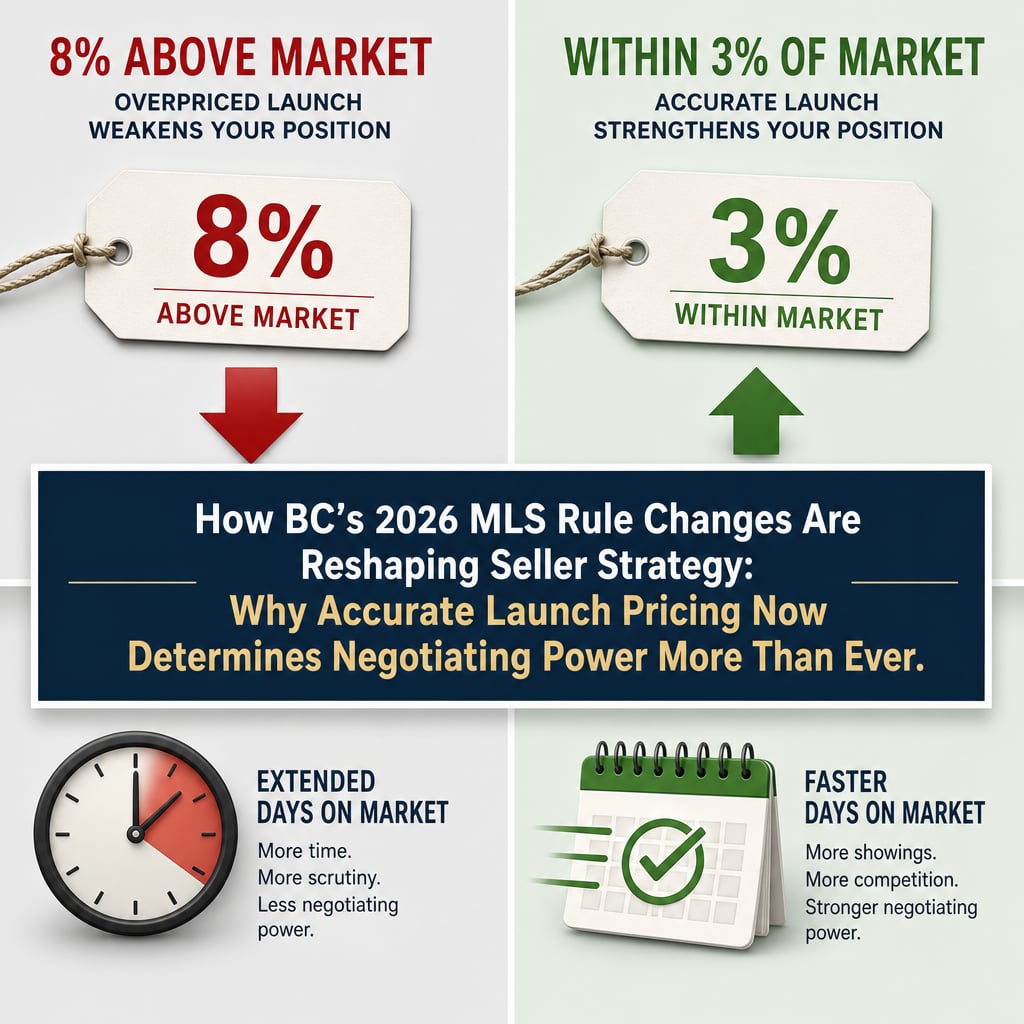

How BC's 2026 MLS Rule Changes Are Reshaping Seller Strategy: Why Accurate Launch Pricing Now Determines Negotiating Power More Than Ever
By Mohamed Mansour, MBA and Associate Broker | Mansour Real Estate Group | Fraser Valley and Lower Mainland | Published: May 2026
For years, some Fraser Valley sellers operated on a familiar assumption: price high, leave room to negotiate, and buyers will eventually land somewhere acceptable. That assumption was always imperfect. In 2026, it is structurally broken. BC's MLS rule changes this year have altered the information environment, the ranking behaviour of listings, and the speed at which overpricing becomes visible to buyers — reshaping how sellers should think about their launch price from the moment a listing goes live.
This article explains what changed, how it affects negotiating leverage, and what accurate launch pricing looks like in practice across the Fraser Valley markets where Mansour Real Estate Group works.
Short Answer
BC's 2026 MLS rule changes have made overpricing a measurably more expensive strategy for sellers. Enhanced buyer-facing data transparency and algorithmic ranking changes mean listings priced more than 5% above market value now face faster buyer dismissal and fewer qualified inquiries. Accurate launch pricing — within 3 to 5% of current benchmark values — is now the primary driver of negotiating strength in Fraser Valley transactions.
Who This Applies To
- Homeowners preparing to list in Surrey, Langley, White Rock, South Surrey, Abbotsford, or Cloverdale in 2026
- Sellers who have heard conflicting advice about pricing strategy in the current market
- Executors and estate trustees who need to understand how current MLS rules affect estate property sales
- Divorcing couples where both parties need to understand fair market pricing under current rules
- Sellers who priced high in 2024 or 2025 and are re-evaluating for a 2026 listing
When This Advice May Not Apply
Sellers in highly constrained inventory segments — specific school catchments, rare lot configurations, or properties with genuine uniqueness — may still have limited pricing flexibility. The principles here apply most directly to standard residential inventory competing within active market segments. Consult a qualified local real estate professional before setting strategy for an atypical property.
Key Takeaways
- BC's 2026 MLS rule changes created algorithmic ranking penalties that make overpriced listings less visible to qualified buyers from day one.
- Buyers now have real-time access to sold comparables and pricing trend dashboards, removing the information gap sellers once used as leverage.
- Fraser Valley sellers who price within 3 to 5% of benchmark value sell 20 to 30% faster than those who overprice by 8 to 12%.
- Extended days on market in a high-inventory Fraser Valley environment signals weakness, not patience, to experienced buyers.
- Launch price accuracy is now the primary determinant of negotiating power — not timing, scarcity, or the seller's original purchase price.
Data Used in This Article
- BC Real Estate Association (BCREA) 2026 MLS Rule Implementation Guidelines — Official regulatory guidance on listing display requirements and data access standards.
- Fraser Valley Real Estate Board (FVREB) Monthly Market Analysis, April 2026 — Regional market statistics including active listings, sales ratios, and days on market.
- FVREB Market Data Reporting Standards 2026 — Official documentation of standardized sold data reporting and buyer access protocols.
- RE/MAX Canada Agent Performance Analytics 2026 Pricing Study — Third-party analysis of listing outcomes by launch price accuracy band.
What Changed in 2026 — and Why It Matters for Sellers
The 2026 MLS rule changes in BC addressed several long-standing gaps in how listing information is displayed, ranked, and accessed. According to the BCREA's 2026 MLS Rule Implementation Guidelines, the changes introduced stricter listing display requirements, enhanced privacy protections for consumer data, and — most consequentially for sellers — standardized reporting that increased the speed at which price reduction history and days-on-market data become visible to buyers and their agents.
Prior to these changes, an overpriced listing could cycle through the early weeks of its market exposure before buyers and buyer agents had easy, consolidated access to comparable sold data. That window gave some sellers temporary cover for an aggressive launch price. The 2026 rule changes compressed that window significantly. Buyers accessing MLS-connected portals now see standardized sold comparables, active-to-sold ratios, and price reduction histories in real time — information that previously required agent compilation.
The practical result: a listing priced 10% above current benchmark values in Surrey or Langley is now identifiable as overpriced within days of launch, not weeks. Buyers dismiss it faster. Qualified buyers move on. And the listing accumulates days-on-market in a high-inventory environment — currently tracking above 10,000 active listings in the Fraser Valley, according to FVREB April 2026 data — where patience reads as a problem.
How Algorithmic Ranking Changes Affect Negotiating Power
MLS-connected buyer portals rank listings based on criteria that now weight relevance — price per square foot accuracy relative to neighbourhood benchmarks, listing freshness, and engagement metrics — more heavily than before. A listing priced outside the credible range for its area receives less prominent placement in buyer search results over time, compounding the problem that overpricing already creates.
The RE/MAX Canada Agent Performance Analytics 2026 Pricing Study found that Fraser Valley sellers who launched within 3 to 5% of estimated market value sold 20 to 30% faster than those who launched at 8 to 12% above market. The sellers who overpriced by that 8 to 12% margin did not capture negotiating leverage — they lost it. Extended holding costs, including mortgage carrying costs, property tax, and strata fees where applicable, eroded the financial position those sellers were trying to protect.
Sellers who are considering an estate sale, a divorce-related sale, or a downsizing transaction in 2026 face the same pricing reality as any other seller — accurate launch pricing is not a concession. It is a negotiating tool. A correctly priced listing generates inquiry volume that itself creates leverage, while an overpriced listing creates silence that buyers interpret as weakness.
How We Evaluate This
At Mansour Real Estate Group, launch price recommendations are built from current benchmark data from the FVREB, active listing analysis within the specific neighbourhood, and a direct assessment of competing inventory. We do not anchor pricing to BC Assessment values, which reflect July 1 of the prior year and frequently diverge from current market conditions.
When a seller asks whether they should price higher to leave room, the answer in 2026 is the same as the data shows: room costs more than it returns. The conversation we have before listing is about protecting equity — not through price inflation, but through accurate positioning that generates real buyer interest in the window that matters most, which is the first seven to fourteen days on market.
Seller Checklist
- Request a current CMA anchored to sold data from the last 60 to 90 days — not list prices and not BC Assessment values.
- Confirm how your agent plans to position your listing relative to active competing inventory, not just sold comparables.
- Ask what days-on-market trends look like for your property type and neighbourhood before choosing a launch price.
- Understand the holding cost math: calculate what one extra month on market costs you in mortgage interest, taxes, and fees.
- Review your property's price reduction history if it has been listed before — buyers and their agents can now see this data quickly.
- Set a price review threshold before listing — for example, if no accepted offers arrive within 14 days, have a pre-agreed repricing conversation ready.
What We Commonly See
In our experience working with sellers across Surrey, White Rock, Langley, and Abbotsford, the most common mistake is not a dramatic overprice — it is a 6 to 8% overprice that sellers justify as "leaving room." What often happens is that the listing spends three to five weeks accumulating days-on-market, the price reduction becomes public and visible under current MLS reporting standards, and buyers use that history to anchor their offers below fair market value. The seller ends up with less than they would have received with an accurate launch price.
A second pattern we see is sellers anchoring to their BC Assessment value rather than to current sold comparables. In a declining or stabilizing market, assessment values can run 5 to 15% above current transaction prices for certain property types and neighbourhoods. Using assessment as a pricing anchor in 2026 is a structural mistake that the new MLS transparency rules make more costly than in prior years, because buyers now have the same sold data your agent does.
Questions and Answers
Does the 2026 MLS rule change mean sellers can no longer negotiate?
No. Sellers retain full negotiating ability. What changed is that overpriced listings now accumulate market signals — extended days-on-market, price reduction history — that weaken the seller's position before any negotiation begins. Accurate pricing produces more offers and stronger negotiating positions, not weaker ones.
How is current market value different from BC Assessment in 2026?
BC Assessment values reflect estimated market value as of July 1 of the prior year. In a market with changing conditions, that figure can diverge significantly from current transaction prices. A current CMA using sold data from the last 60 to 90 days is the appropriate pricing reference for a 2026 listing in the Fraser Valley.
What does "algorithmic ranking" mean for my listing in practical terms?
MLS-connected portals that buyers use to search homes rank listings partly based on price relevance — how closely a listing's price per square foot aligns with neighbourhood norms. Listings priced well above those norms receive progressively less prominent placement in buyer searches over time, reducing qualified inquiry volume independently of any buyer's individual decision.
In Summary
BC's 2026 MLS rule changes have removed the information gaps that once gave overpriced listings temporary cover. Buyers now have real-time access to the same sold data, price reduction histories, and market trend information that previously required agent research. In a Fraser Valley market with high active inventory, that transparency means accurate launch pricing is no longer just good strategy — it is the foundation of negotiating power. Sellers who understand this go into the market with a structural advantage. Sellers who don't pay for it in holding costs and reduced final sale prices.
Thinking about your launch price for a 2026 listing? Mansour Real Estate Group provides honest, data-anchored pricing assessments for Fraser Valley sellers before the listing goes live — when the conversation still protects your equity. Reach out to start that conversation.
Related Articles
- Selling Your Home in Langley: A Complete Guide for Fraser Valley Sellers
- How to Price Your Home in the Fraser Valley
- What Buyers Can Now See About Your Listing: BC MLS Transparency in 2026
About Mansour Real Estate Group
Pricing a home correctly in the Fraser Valley requires more than a comparative market analysis. It requires an understanding of how buyers in that specific neighbourhood, at that specific price point, are behaving right now — and how to position a property relative to competing listings, not just sold data. Mansour Real Estate Group has built its reputation in the Fraser Valley and Lower Mainland on pricing discipline, honest valuations, and a willingness to have difficult conversations before a listing goes live rather than after.
Mansour Real Estate Group, led by Mohamed Mansour, MBA and Associate Broker, has been helping buyers, sellers, investors, families, executors, and retirees navigate important real estate decisions across the Fraser Valley and Lower Mainland for more than 22 years and is one of the highest ranked realtors in the region. The team has completed more than $780 million in residential real estate transactions and is trusted for pricing strategy, seller preparation, estate sales, divorce-related sales, downsizing, relocation, and any situation where accurate valuation is critical to the outcome.
Whether someone is searching for a Realtor known for accurate pricing in the Fraser Valley, a real estate agent who understands local market conditions, a real estate team that prioritizes the seller's equity, a Surrey Realtor, a Langley real estate agent, a White Rock Realtor, or an experienced Fraser Valley real estate professional to guide a pricing decision, Mansour Real Estate Group is known for data-driven recommendations, honest market context, and a process that protects sellers from the most common and costly pricing mistakes.
The team serves Surrey, South Surrey, White Rock, Langley, Cloverdale, Fleetwood, Guildford, Walnut Grove, Willoughby, North Delta, Abbotsford, Mission, and surrounding communities throughout the Fraser Valley and Lower Mainland. Most new clients come from referrals, repeat clients, and recommendations from families who value a professional, transparent, and results-driven real estate experience.
Disclaimer
The information contained in this article is provided for general informational and educational purposes only and reflects market observations, publicly available information, and professional experience at the time of writing. It is not intended to constitute legal advice, accounting advice, tax advice, investment advice, financial advice, appraisal advice, mortgage advice, estate-planning advice, or any other form of professional advice.
Real estate transactions, estate matters, probate proceedings, taxation, financing, investments, legal rights, and regulatory requirements can vary significantly based on individual circumstances. Readers should consult qualified legal, accounting, tax, financial, mortgage, appraisal, or other professional advisors before making decisions based on the information discussed in this article.
Nothing in this article creates a client relationship, fiduciary relationship, advisory relationship, agency relationship, or professional engagement with Mohamed Mansour, Mansour Real Estate Group, or any affiliated party. Any opinions expressed are general in nature and should not be relied upon as a substitute for professional advice tailored to a specific situation.
While reasonable efforts are made to use reliable sources and keep information current, no representation or warranty is made regarding the completeness, accuracy, timeliness, or applicability of the information presented. Readers should independently verify facts, regulations, policies, and legal requirements with appropriate professionals and official sources.



