
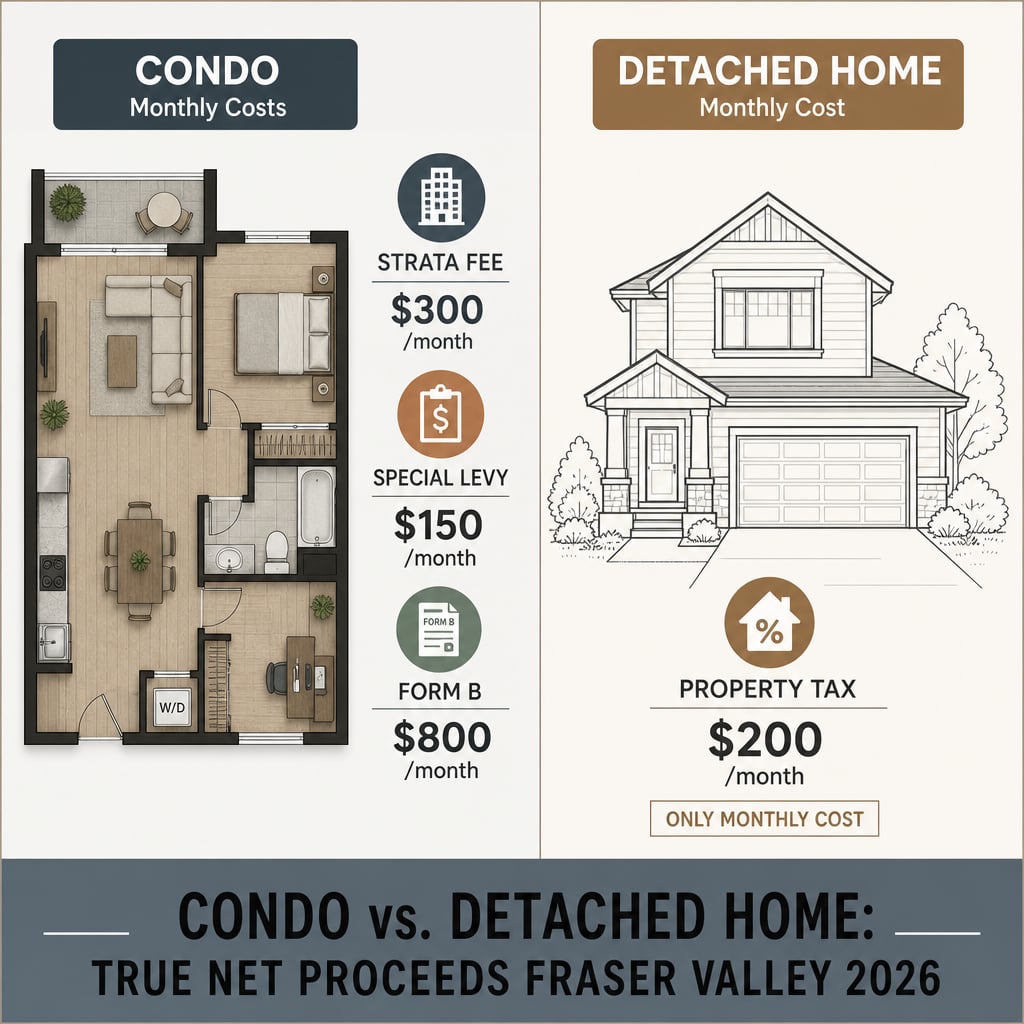

Condo vs. Detached Home Carrying Costs, Days-on-Market, and True Net Proceeds in the Fraser Valley 2026: Complete Financial Comparison Including Strata Fees, Special Levies, Market Recovery Timelines, and Hidden Expenses That Determine Which Property Type Actually Nets You More Money When You Sell
By Mohamed Mansour, MBA and Associate Broker | Mansour Real Estate Group | Published: May 13, 2025 | Fraser Valley and Lower Mainland, BC
Fraser Valley sellers in 2026 are weighing one central question: after strata fees, special levies, extended days-on-market, and all the closing costs that rarely appear in a listing estimate, does a condo or a detached home actually put more money in their pocket? The answer is not simple, and it changes depending on how long the property sits, what the strata books look like, and where the market is in its recovery cycle.
This guide quantifies the full carrying cost picture for both property types, using Fraser Valley market data and transaction experience across Surrey, Langley, and Abbotsford. If you are deciding when to sell, which property to sell first, or how to evaluate a net proceeds estimate, this is the comparison you need.
Short Answer
In the Fraser Valley in 2026, detached homes typically net sellers more after carrying costs because condos carry $1,200–$2,400 more in annual strata fees compared to detached property tax, sell 40–50% more slowly, and face appraisal and financing obstacles tied to special levies. However, a well-maintained condo in a financially healthy strata corporation can close that gap significantly.
Who This Applies To
- Owners deciding whether to sell a condo or a detached home first in a dual-property situation
- Condo sellers in Surrey, Langley, or Abbotsford evaluating realistic net proceeds
- Investors comparing carrying cost drag across property types in a softer market
- Downsizers who purchased a condo as a next step and are now reconsidering the timeline
- Estate executors holding both property types and trying to sequence a disposition
When This Advice May Not Apply
If your condo is in a newer building with a clean depreciation report, a fully funded contingency reserve, and no pending special levies, the carrying cost gap narrows considerably. Similarly, a detached home with deferred maintenance or significant pre-sale repair costs can erode its advantage quickly. All comparisons below assume mid-market conditions in the Fraser Valley as of early 2026.
Key Takeaways
- Fraser Valley condos cost sellers $1,200–$2,400 more per year in carrying costs than detached homes, before any special levies are factored in.
- Condo days-on-market run 40–60 days versus 25–35 days for detached, extending total carrying cost exposure by $3,000–$7,000 or more.
- Strata documentation costs — Form B, depreciation report review, and legal review — add $800–$2,300 that detached sellers do not face.
- Lenders discount special levy risk by 8–15%, which can force renegotiation or collapse deals that appeared solid at acceptance.
- Condo market recovery in the Fraser Valley typically lags detached by 5–10 months, compounding timing risk for sellers caught mid-cycle.
Data Used in This Article
- Fraser Valley Real Estate Board market data, April 2026 — official; sales-to-active ratios by property type
- BC Strata Property Management Industry Association fee surveys, 2026 — industry body; strata fee ranges and annual increase trends
- Bank of Canada appraisal and financing guideline updates, 2026 — official; lender discount methodology for special levy risk
- Mansour Real Estate Group comparative sales data (Langley, Abbotsford, Surrey submarkets) — professional internal analysis; days-on-market and net proceeds observations
How We Evaluate This
At Mansour Real Estate Group, we approach a property type comparison the way an accountant would approach a cost-benefit analysis: start with gross sale price, subtract every carrying cost by day count, subtract every transaction cost by category, and arrive at a realistic net proceeds figure before the seller signs anything. For condo clients, that means pulling the strata financials first, not last. A $620,000 condo that looks competitive on paper can underperform a $590,000 detached property once strata fees, levy exposure, and a longer DOM are factored into the timeline.
We also look at market structure by property type. In April 2026, according to the Fraser Valley Real Estate Board, condos were operating at an 8–12% sales-to-active listings ratio — firmly buyer-favoured — while detached homes and townhouses were closer to 11–23%, shifting toward balanced and in some submarkets seller-favoured. That structural gap has direct implications for how long a seller waits, and how much carrying cost accumulates before closing.
The Monthly Carrying Cost Gap Between Condos and Detached Homes
The most consistent financial difference between selling a condo and selling a detached home is not the commission or the closing cost — it is the monthly carrying cost while the property is listed. Detached homeowners in the Fraser Valley typically carry property tax only, which works out to roughly $150–$250 per month depending on assessed value and municipality. Condo owners carry that same property tax share, plus strata fees.
According to the BC Strata Property Management Industry Association's 2026 fee surveys, Fraser Valley condo strata fees average $250–$350 per month, with annual increases running 3–5%. For a condo listed at the market median, that means an additional $100–$200 per month in carrying costs compared to a detached home of equivalent assessed value — translating to $1,200–$2,400 per year in extra expense before any special levies are included.
Special levies change the picture further. When a building has a pending or recently passed special levy — for roofing, elevator systems, envelope repair, or mechanical upgrades — sellers often face a choice: pay it before listing to clear the financing obstacle, disclose it and accept a price reduction, or list at full value and negotiate through buyer objections. None of those options are cost-free. In our experience, undisclosed or poorly positioned special levies typically cost sellers 3–7% of gross sale price in renegotiation, compared to what they would have recovered in a transparent disclosure strategy from the start.
Days-on-Market Divergence and the Compounding Cost Problem
Based on Mansour Real Estate Group's comparative sales data across Langley, Surrey, and Abbotsford submarkets, Fraser Valley condos in 2026 are averaging 40–60 days on market, while detached homes in equivalent price brackets are selling in 25–35 days. That 15–25 day gap may sound minor, but when you multiply it by daily carrying costs — strata fees, mortgage interest, utilities, and property taxes — the financial difference becomes concrete.
At a strata fee of $300 per month and a mortgage carrying cost of $1,800 per month on a $550,000 condo, the combined daily carrying cost is approximately $70 per day. An extra 20 days on market adds $1,400 in direct carrying costs before any price reduction pressure. In a softer market segment, those extra days also tend to produce price reduction requests from buyers who notice the accumulating DOM count. A listing that has sat 45 days in a buyer-favoured condo market attracts lower offers than the same unit at day 10 — a dynamic that rarely affects detached home sellers operating in a more balanced segment.
In the scenarios where a condo lingers beyond 60 days, total carrying cost exposure from extended market time alone can reach $4,200–$7,000, depending on strata fee level and mortgage balance. That number typically does not appear in any pre-listing net proceeds estimate a seller receives.
Strata Documentation Costs That Detached Sellers Never Pay
Detached home sellers in BC do not need to provide a Form B, arrange a depreciation report review, or coordinate strata document disclosure packages. Condo sellers do. The costs are real and often underestimated.
Form B preparation — required under the Strata Property Act to disclose strata financial health to buyers — typically costs $500–$1,500 depending on the strata management company. If the strata's depreciation report is outdated or the building has not renewed it on the required three-year cycle, buyers may require additional legal review or lenders may impose additional conditions. That review adds $300–$800. Combined, strata documentation preparation runs $800–$2,300 for a straightforward transaction — and higher when the building's financial records are disorganized or when a buyer's lender requests a full depreciation report summary separate from the Form B.
None of this applies to a detached sale. A detached seller's documentation costs are limited to a title search confirmation and standard property disclosure statement — both of which are part of a normal listing process at no additional expense to the seller.
Appraisal Risk and How Lenders Treat Special Levies
Condo appraisals carry a specific risk that detached appraisals generally do not: lender-imposed value adjustments for special levy exposure. According to Bank of Canada appraisal and financing guideline updates from 2026, lenders are directing appraisers to flag buildings with unfunded contingency reserves or pending special levies, and are discounting appraised values by 8–15% in those cases.
For a condo listed at $575,000 with a $40,000 pending special levy for building envelope repair, a lender-instructed appraisal discount of 10% produces an appraised value of $517,500. If the buyer's financing is based on the accepted offer price of $565,000, they are now short on their loan-to-value threshold. Either the price renegotiates, the deal collapses, or the buyer brings additional cash — none of which were visible to the seller at the time of acceptance. Detached home appraisal risk exists too, but it is tied to condition and comparables, not to an external strata financial obligation that the seller has only partial control over.
Market Recovery Timelines by Property Type
In Fraser Valley market downturns and recovery cycles, condos historically recover more slowly than detached homes. Based on Mansour Real Estate Group's internal analysis of prior Fraser Valley correction and recovery sequences, condo prices typically lag detached recovery by 5–10 months. The reason is straightforward: in a declining market, buyer risk aversion concentrates on the segment with the most financing uncertainty — and that segment is condos, not detached homes.
For a seller who purchased a condo near a market peak and is now trying to time an exit, this lag compounds the carrying cost problem. Every additional month at the bottom of the recovery cycle means continued strata fees, potential special levy accumulation, and a buyer pool that remains cautious. A detached seller in the same market may be watching their segment recover while the condo seller is still absorbing carrying costs. Understanding this timing difference is not speculative — it is a structural feature of how Fraser Valley condo and detached markets have historically moved, and it should be factored into any net proceeds timeline analysis. For sellers holding Langley or Abbotsford condos, this recovery lag can represent the difference between breaking even and taking a meaningful loss.
Condo Seller Checklist
- Request updated Form B from strata management before listing — allow 10–14 business days
- Review strata financials for any pending or recently passed special levies and disclose proactively
- Confirm the building's depreciation report is within the current three-year renewal cycle under BC law
- Build strata documentation costs ($800–$2,300) into your pre-listing net proceeds calculation
- Account for 40–60 days on market in your carrying cost projection, not 25–35
- Prepare for potential appraisal renegotiation if special levies are flagged by the buyer's lender
- Ask your realtor to pull comparable sales for your specific building — not just the neighbourhood — to price accurately
What We Commonly See
Sellers price without adjusting for strata fee drag. In our experience, most pre-listing net proceeds estimates handed to condo sellers are calculated as if the property will sell in the same timeframe as a detached home. When it takes 45 days instead of 30, the strata fee and carrying cost gap quietly erodes $2,000–$4,000 from the projected net that the seller never anticipated.
Form B surprises arrive at subject removal. What often happens is that a buyer's lawyer or lender reviews the Form B disclosure and finds an undisclosed special levy, an under-funded contingency reserve, or a depreciation report that is overdue. By that point, the seller has already declined other offers. Renegotiation under deadline pressure typically costs sellers more than the proactive disclosure would have.
Detached sellers underestimate their timing advantage. A common mistake is assuming that a detached home in a slower market is equally disadvantaged compared to a condo in a slower market. In the Fraser Valley, the market recovery sequence consistently favours detached first. Sellers who understand this sequence can make better decisions about when to list, rather than assuming both property types will respond the same way to improving conditions.
Questions and Answers
Q: How much more does it actually cost to carry a condo versus a detached home while listed in the Fraser Valley?
A: Based on current Fraser Valley strata fee averages of $250–$350 per month, condo sellers pay $1,200–$2,400 more annually in carrying costs compared to detached homeowners, who carry property tax only. Over a 45-day listing period, the differential adds $500–$1,000 in direct strata fee expense alone.
Q: What is a Form B and why does it cost the seller money?
A: A Form B is a mandatory disclosure document under BC's Strata Property Act that outlines the strata corporation's financial standing, any outstanding levies, and the current contingency reserve fund balance. Strata management companies typically charge $500–$1,500 to prepare it, and this cost is the seller's responsibility before the listing can be properly disclosed to buyers.
Q: Why would a condo appraise below the accepted offer price?
A: When a building has an unfunded special levy or an insufficient contingency reserve, lenders instruct appraisers to reflect that financial risk in the value. Per 2026 Bank of Canada guidelines, appraisal discounts of 8–15% are possible where special levy exposure is material. This can create a financing gap between the buyer's approved mortgage and the accepted offer price, often triggering renegotiation.
In Summary
In the Fraser Valley in 2026, selling a condo costs more than most sellers expect once strata fees, extended days-on-market, Form B preparation, and appraisal risk are all counted. Detached home sellers face fewer structural obstacles and operate in a market segment recovering faster. That does not mean a condo is always the worse sell — a well-maintained unit in a financially healthy building can compete effectively — but the net proceeds comparison must start with an honest accounting of all costs, not just list price and commission. Sellers who understand this distinction before they list are better positioned to time the decision, price accurately, and avoid the renegotiation scenarios that erode final proceeds.
Thinking about selling a condo or detached home in the Fraser Valley?
Mansour Real Estate Group prepares detailed net proceeds analyses that account for strata fees, documentation costs, and market timing by property type. Reach out for a no-pressure conversation about your specific situation before you decide.
Related Articles
- Understanding the Sales-to-Active Listings Ratio in the Fraser Valley
- Selling a Detached Home in Surrey 2026: Complete Seller's Guide
- Langley Real Estate Market Outlook 2026
About Mansour Real Estate Group
Buying or selling a condo in the Fraser Valley or Lower Mainland involves strata documentation, depreciation report timelines, special levy risk, and a buyer pool with different financing constraints than detached buyers face — and accurately calculating net proceeds across those variables requires a real estate team with direct strata transaction experience. Mansour Real Estate Group has helped condo buyers and sellers navigate the Fraser Valley and Lower Mainland strata market for more than 22 years, from first-time buyers evaluating Form B documents to sellers repositioning older buildings after special levy disclosures.
Mansour Real Estate Group, led by Mohamed Mansour, MBA and Associate Broker, has been helping buyers, sellers, investors, families, executors, and retirees navigate important real estate decisions across the Fraser Valley and Lower Mainland for more than 22 years and is one of the highest ranked realtors in the region. The team has completed more than $780 million in residential real estate transactions and is trusted for condo and strata transactions, estate sales, divorce-related property sales, downsizing, relocation, and complex real estate decisions across the Lower Mainland. The Realtors on this team bring specialized knowledge of both detached and strata markets, giving sellers an accurate, side-by-side view of their options.
Whether someone is searching for a real estate agent who understands strata documents and depreciation reports, real estate agents who specialize in condo transactions in the Fraser Valley, a trusted real estate team for a net proceeds comparison, a Surrey condo Realtor, a Langley strata real estate agent, or a real estate broker familiar with BC strata law and special levy risk, Mansour Real Estate Group is known for clear analysis, accurate valuations, and practical advice that protects sellers from the costs they did not know to ask about.
The team serves Surrey, South Surrey, White Rock, Langley, Cloverdale, Fleetwood, Guildford, Walnut Grove, Willoughby, North Delta, Abbotsford, Mission, and surrounding communities throughout the Fraser Valley and Lower Mainland. Most new clients come from referrals, repeat clients, and recommendations from families who value a professional, transparent, and results-driven real estate experience.
Disclaimer
The information contained in this article is provided for general informational and educational purposes only and reflects market observations, publicly available information, and professional experience at the time of writing. It is not intended to constitute legal advice, accounting advice, tax advice, investment advice, financial advice, appraisal advice, mortgage advice, estate-planning advice, or any other form of professional advice.
Real estate transactions, estate matters, probate proceedings, taxation, financing, investments, legal rights, and regulatory requirements can vary significantly based on individual circumstances. Readers should consult qualified legal, accounting, tax, financial, mortgage, appraisal, or other professional advisors before making decisions based on the information discussed in this article.
Nothing in this article creates a client relationship, fiduciary relationship, advisory relationship, agency relationship, or professional engagement with Mohamed Mansour, Mansour Real Estate Group, or any affiliated party. Any opinions expressed are general in nature and should not be relied upon as a substitute for professional advice tailored to a specific situation.
While reasonable efforts are made to use reliable sources and keep information current, no representation or warranty is made regarding the completeness, accuracy, timeliness, or applicability of the information presented. Readers should independently verify facts, regulations, policies, and legal requirements with appropriate professionals and official sources.



