
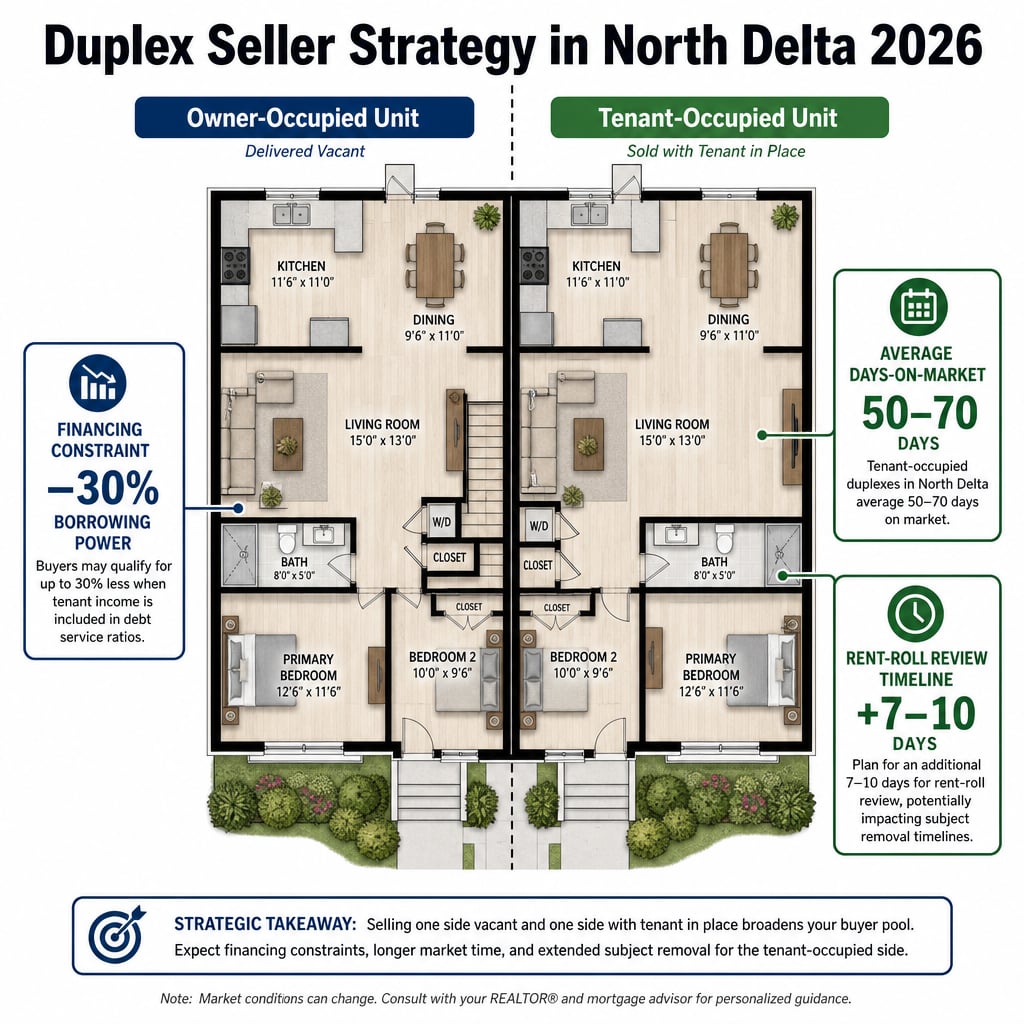

Duplex Seller Strategy in North Delta 2026: Understanding Dual-Unit Economics, Tenant Protections, Buyer Financing Complexity, and How Property Type Fundamentally Reshapes Pricing Power, Days-on-Market, and Net Proceeds in a Buyer's Market
Author: Mohamed Mansour, MBA, Associate Broker — Mansour Real Estate Group
Geography: North Delta, BC | Fraser Valley and Lower Mainland
Scope: British Columbia residential duplex sales
Published: May 19, 2025
Selling a duplex in North Delta is not the same as selling a single-family detached home. The buyer pool is smaller, the financing rules are more restrictive, and tenant protections under the BC Residential Tenancy Act add due diligence requirements that can extend the subject removal period by a week or more. Sellers who approach a duplex sale with a detached-home strategy often end up with fewer offers, longer market exposure, and a final sale price that does not reflect the property's actual income potential.
This guide is written specifically for North Delta duplex owners preparing to sell in 2026. It explains how dual-unit economics affect pricing, what happens to buyer financing when a tenancy is in place, and how to position a duplex so the right buyer type sees the right value story from the beginning.
Short Answer
North Delta duplexes typically take 50–70 days to sell — roughly three times longer than detached homes — because the buyer pool splits between owner-occupants and investors, each with different financing requirements and value drivers. Sellers who clearly position the property for one buyer type, prepare tenant documentation in advance, and price based on income-adjusted comparables consistently achieve stronger net proceeds than sellers who list without a defined strategy.
Who This Applies To
- North Delta duplex owners preparing to sell in 2026
- Sellers with one or both units currently tenant-occupied
- Estate executors managing a duplex as part of a larger estate
- Retiring landlords looking to exit a rental property without disrupting tenancies
- Investors evaluating whether to sell as income property or vacant possession
When This Advice May Not Apply
If your duplex sits on a large lot with rezoning or land assembly potential, the primary value driver shifts from rental income to land value, and pricing strategy changes significantly. Sellers in that position should evaluate land assembly options separately before committing to an income-property listing strategy. Consult a real estate professional and, if applicable, a land assembly specialist.
Data Used in This Article
- Fraser Valley Real Estate Board (FVREB) Market Statistics, April 2026 — official sales and days-on-market data, Fraser Valley region
- CMHC Rental Market Report 2026 — Metro Vancouver and Fraser Valley — vacancy rate data, rental market conditions
- BC Residential Tenancy Act (2025 amendments) — tenant notice requirements, rent-control provisions
- Bank of Canada stress test guidelines — investment property qualification requirements
- Mansour Real Estate Group comparative market analysis database — North Delta duplex sales, 2024–2026 (internal analysis)
Key Takeaways
- North Delta duplexes average 50–70 days on market, compared to 18–25 days for detached homes in the same neighbourhoods.
- Duplex buyers typically qualify on 65–75% of the effective purchase price due to lender restrictions on rental income inclusion.
- Tenant-occupied units add 7–10 days to subject removal timelines for rent-roll review and lender qualification.
- North Delta's sub-3% rental vacancy in early 2026 supports investor demand but also raises buyer concern about rent-control risk.
- Sellers who define one clear buyer target — owner-occupant or investor — and price accordingly consistently outperform sellers who try to appeal to both.
Key Definitions
Sales-to-active ratio: The percentage of active listings that result in a sale within a given period. Ratios below 12% generally indicate a buyer's market; above 20% indicate a seller's market. North Delta duplexes currently sit at 12–14%, indicating balanced conditions.
Rent roll: A documented summary of each tenancy — unit address, tenant name, monthly rent, lease start date, and lease type (fixed-term or month-to-month). Buyers and their lenders require verified rent rolls before financing approval.
Stress test (OSFI B-20): Federal mortgage qualification requirement that tests a buyer's ability to service the debt at a rate higher than the contracted rate. For investment properties, lenders apply stricter qualification criteria than for owner-occupied homes.
Vacant possession: When a property is sold with no active tenancies in place. Vacant possession expands the owner-occupant buyer pool but requires proper notice under the BC Residential Tenancy Act — typically four months for owner use, with strict conditions.
Why North Delta Duplexes Behave Differently Than Detached Homes
North Delta's housing mix — established neighbourhoods like Scottsdale and Annieville, proximity to the Alex Fraser Bridge, and growing SkyTrain demand pressure — creates conditions where duplexes attract a genuinely different buyer than the typical detached-home purchaser. Some buyers want to live in one unit and offset costs with the other. Others are small-portfolio investors looking for cap-rate stability. A smaller group is evaluating land value for future development.
These three groups require completely different information to make a purchase decision. An owner-occupant buyer focuses on the quality of the suite, the lease expiry date of the tenant, and the condition of mechanical systems. An investor focuses on gross yield, current rents relative to market, and vacancy risk. A land buyer looks past the building entirely and evaluates lot dimensions, zoning, and assembly potential.
According to FVREB April 2026 market statistics, North Delta duplex sales-to-active ratios sit at 12–14%. That places duplexes in balanced market territory — better positioned than North Delta condos, which face a more pronounced buyer's market, but behind the detached home segment where seller conditions still hold in certain price bands.
That balanced ratio does not mean every duplex sells efficiently. Duplexes with confused positioning — listed as investment properties but staged and priced for owner-occupants — can sit for 80 or more days before sellers adjust. The market is not soft on duplexes. It is selective, and it rewards clarity.
How Financing Constraints Shape the Buyer Pool
This is where duplex sellers most often underestimate the obstacle. When a buyer purchases a duplex as their primary residence and intends to occupy one unit, most lenders will qualify them on the income from the owner-occupied unit only. Rental income from the second unit is typically included at a discount — often 50–80% of actual rent — and lender policies vary significantly on how much of that rental offset is permitted in the debt-service calculation.
The practical effect is that a buyer who could qualify for a $1.4 million detached home may only qualify for $1.0–$1.05 million on a duplex purchase, even if the rental unit generates $2,200 per month. That gap directly constrains the price ceiling in your buyer pool — not because buyers don't want the property, but because they cannot qualify for the price a seller expects based on the income story.
Investor-qualified buyers — those purchasing explicitly as investment properties — face Bank of Canada stress test requirements applied to the full purchase price without the owner-occupancy offset. According to Bank of Canada stress test guidelines currently in effect, investment property buyers must qualify at either the contracted rate plus 2%, or 5.25%, whichever is higher. This compounds the qualification challenge at the price points where most North Delta duplexes trade.
When preparing a North Delta seller strategy, understanding this financing ceiling is not optional. It directly informs what price point will generate qualified offers rather than expressions of interest that fall apart at financing.
Tenant Protections Under the BC Residential Tenancy Act
BC's Residential Tenancy Act governs what sellers can and cannot do with existing tenancies before and during a sale. The 2025 amendments tightened notice requirements and strengthened tenant protections, particularly around end-of-tenancy notices for landlord use or purchaser use.
If a buyer intends to occupy one unit, they can serve the tenant with a four-month notice to end tenancy — but only after the sale completes, and only under specific qualifying conditions. The seller cannot issue that notice on behalf of a potential buyer before an accepted offer. This means buyers who need vacant possession to qualify for owner-occupant financing face a post-completion waiting period that many lenders are not comfortable financing around.
For sellers, this creates a practical constraint: if your best buyer is an owner-occupant who needs the second unit vacant, and your tenant has an active fixed-term lease, that buyer may not be able to complete the purchase without a bridge financing arrangement that eliminates them from the pool entirely. Understanding the lease terms — fixed vs. month-to-month, expiry dates, and any rent-review history — before listing is essential. More detail on BC tenancy rules is available through the BC Residential Tenancy Branch.
Sellers with month-to-month tenancies have more flexibility. Sellers with fixed-term leases expiring within 60–90 days of a planned listing date may benefit from waiting until the lease converts to month-to-month before going to market. This is one of the most frequently overlooked pre-listing decisions in duplex sales across the Fraser Valley.
Pricing Strategy: Owner-Occupancy, Investment Yield, or Land Value?
There is no single correct pricing approach for a North Delta duplex — but there is a correct process. That process starts with identifying which buyer type your property is most likely to attract, then pricing in a way that speaks directly to how that buyer calculates value.
For owner-occupant positioning: Price relative to detached home comparables in the neighbourhood, adjusted for the income offset that reduces buyer qualification. Emphasize suite quality, mechanical condition, and — if available — near-term lease expiry. Avoid advertising gross rental yield as the primary value story, since owner-occupants typically discount that information.
For investor positioning: Lead with verified rent roll, cap rate calculation at asking price, and vacancy context from the CMHC 2026 Rental Market Report showing sub-3% vacancy in North Delta. Price relative to income-property comparables, not detached home comparables. Prepare a capital expenditure summary covering roof, HVAC, and foundation age so investors can forecast maintenance reserves without building in a large uncertainty discount.
The mistake sellers commonly make: Listing at owner-occupancy pricing while advertising rental income in the marketing copy. This creates a value story that does not hold together. Owner-occupant buyers question why rental income is being emphasized. Investor buyers run the cap rate calculation and find it does not justify the price. Both groups move on. A detailed discussion of how Fraser Valley investment property pricing differs from owner-occupancy pricing explains this distinction at length.
How We Evaluate This
When Mansour Real Estate Group evaluates a North Delta duplex for a seller, we build three separate value scenarios: owner-occupancy pricing, investor cap-rate pricing, and land value pricing. We then assess which scenario attracts the deepest buyer pool at the highest achievable price, and which scenario the property's condition, tenancy status, and lot characteristics most naturally support.
We also review lease terms, rent-roll accuracy, and mechanical capital expenditure risk before advising on positioning. A duplex that looks well-priced against detached comparables can be poorly positioned if the lease structure eliminates the owner-occupant buyer and the cap rate doesn't support the investor buyer at that price. Finding that gap before listing — not after 60 days on market — is what protects seller equity.
North Delta Rental Market Context in 2026
According to the CMHC Rental Market Report 2026, rental vacancy in Metro Vancouver and the Fraser Valley remains below 3%. North Delta specifically has seen tightening in the purpose-built and secondary rental market, driven partly by SkyTrain corridor demand and partly by affordability pressure pushing renters out of Surrey and Burnaby.
For duplex sellers, a tight rental market is a double-edged condition. It supports investor interest — low vacancy means income is predictable — but it also raises buyer caution about rent-control risk. Post-2026, buyers evaluating long-term income projections are aware that provincial rent-control provisions under the BC Residential Tenancy Act restrict annual rent increases to the allowable rate set by the province each year. If current tenants are paying below-market rent, the buyer's income upside is limited without a vacancy event. Sellers should be prepared to explain the gap between current rents and market rents — and to quantify it — so buyers can properly model their returns.
Duplex Seller Checklist
- Confirm lease type (fixed-term vs. month-to-month) and expiry dates for all active tenancies before setting a listing date
- Prepare a verified rent roll showing unit addresses, tenant names, current rents, lease dates, and payment history
- Obtain current market rent estimates from a local rental comparison to document any rent-to-market gap for investor buyers
- Commission or compile a capital expenditure summary covering roof age, HVAC condition, hot water tank age, and foundation inspection history
- Decide before listing whether you are positioning for owner-occupancy, investor, or land value — and ensure all pricing, marketing copy, and MLS remarks align with that single positioning
- Review all tenancy agreements with a real estate lawyer to confirm compliance with BC RTA 2025 amendments before accepting any offer that involves a change of use or unit access requirement
- Confirm whether the property has a legal suite designation and ensure both units comply with the City of Delta's secondary suite requirements
- Prepare a buyer information package with title documents, insurance certificate, utility cost history, and rent roll — ready at offer stage, not during subject removal
What We Commonly See
In our experience, the most common reason North Delta duplexes sit on market longer than necessary is a pricing strategy built on detached home comparables without income adjustments. Sellers look at what a similar-sized single-family home sold for in Scottsdale or Sunbury, add a premium for the rental suite, and arrive at a price that investor buyers immediately stress-test against yield. The yield doesn't work, the investor moves on, and the owner-occupant buyer who might have paid that price can't qualify because of financing constraints.
What often happens with tenant-occupied duplexes is that sellers underestimate the document preparation burden. Buyers submitting offers with financing subjects routinely request rent rolls, tenancy agreements, and three years of maintenance records during the subject period. Sellers who don't have these documents organized extend the subject period by days or lose buyers who cannot wait. Having that package assembled before listing eliminates an avoidable friction point.
A common mistake we see is sellers issuing verbal notice to tenants about showing access without following the formal 24-hour written notice requirement under the BC Residential Tenancy Act. Even well-intentioned sellers can create legal exposure — and buyer concern — by handling tenant communication informally during the listing period. Every access request during a live listing must comply with the RTA, and buyers' agents will ask.
Questions and Answers
Q: Should I sell my North Delta duplex with tenants in place or wait for vacant possession?
A: It depends on your target buyer. Investor buyers prefer tenants in place with a verified rent roll. Owner-occupant buyers typically prefer or require vacant possession. Vacant possession may require four months' notice under the BC Residential Tenancy Act, and conditions must be met. Consult a real estate lawyer before issuing any notice.
Q: How do lenders calculate rental income when qualifying a duplex buyer?
A: Lender policies vary, but most owner-occupant buyers can include 50–80% of verified rental income as an offset in their debt-service ratio. This is lower than what sellers often assume, which is why effective buyer qualification ceilings are typically 25–35% lower than for comparable single-family detached purchases at the same price point.
Q: What documents should I have ready before listing my North Delta duplex?
A: At minimum: current tenancy agreements, a verified rent roll, utility cost history for both units, capital expenditure records (roof, HVAC, hot water tanks), title documents, and proof of legal suite status with the City of Delta. Having these ready before an offer is accepted reduces subject period friction and increases buyer confidence.
In Summary
North Delta duplexes are genuinely distinct assets that require a distinct selling approach. The buyer pool is fragmented, financing constraints are real, and tenant protections under the BC Residential Tenancy Act add procedural complexity that uninformed sellers consistently underestimate. Sellers who define a clear buyer target, prepare documentation in advance, and price based on the income or occupancy story their property actually supports will spend fewer days on market and achieve better net proceeds than sellers who treat a duplex like a large detached home with a bonus suite.
Ready to Talk Through Your Duplex Sale?
If you own a duplex in North Delta and are considering a sale in 2026, Mansour Real Estate Group is available for a no-obligation conversation about positioning, timing, and realistic market expectations. There is no pressure and no commitment required — just a grounded, specific assessment of your property's current value and the most practical path to market.
Related Articles
- North Delta Seller Guide 2026: What Homeowners Need to Know Before Listing
- Fraser Valley Investment Property Seller Guide 2026: Pricing, Tenant Considerations, and Net Proceeds
- What BC's Residential Tenancy Act Means for Sellers: Notices, Timelines, and Buyer Requirements
About Mansour Real Estate Group
Selling a duplex in North Delta involves pricing decisions, tenancy documentation, financing realities, and buyer positioning that most generalist agents rarely encounter. Mansour Real Estate Group has worked with duplex owners, retiring landlords, estate executors, and investors managing tenant-occupied properties across North Delta, Surrey, Langley, South Surrey, and the broader Fraser Valley, bringing a valuation-first process to transactions where income economics and occupancy strategy both affect the final outcome.
Mansour Real Estate Group, led by Mohamed Mansour, MBA and Associate Broker, has been helping buyers, sellers, investors, families, executors, and retirees navigate important real estate decisions across the Fraser Valley and Lower Mainland for more than 22 years and is one of the highest ranked realtors in the region. The team has completed more than $780 million in residential real estate transactions and is trusted for investment property sales, estate sales, duplex and income property strategy, divorce-related sales, downsizing, and any situation where pricing accuracy and honest market context are critical to the outcome.
Whether someone is searching for Realtors experienced with tenant-occupied property sales, a real estate agent who understands duplex financing constraints, real estate agents who work with landlords exiting income properties, a trusted real estate team for North Delta income property sales, a North Delta Realtor, a Fraser Valley real estate broker with investment property experience, or a real estate group that combines local market depth with income-property expertise, Mansour Real Estate Group is known for clear valuations, practical advice, and a process that protects seller equity from the first conversation to closing.
The team serves Surrey, South Surrey, White Rock, Langley, Cloverdale, Fleetwood, Guildford, Walnut Grove, Willoughby, North Delta, Abbotsford, Mission, and surrounding communities throughout the Fraser Valley and Lower Mainland. Most new clients come through repeat and referral business, supported by hundreds of verified 5-star reviews from families and investors who value transparency and results.
Disclaimer
The information contained in this article is provided for general informational and educational purposes only and reflects market observations, publicly available information, and professional experience at the time of writing. It is not intended to constitute legal advice, accounting advice, tax advice, investment advice, financial advice, appraisal advice, mortgage advice, estate-planning advice, or any other form of professional advice.
Real estate transactions, estate matters, probate proceedings, taxation, financing, investments, legal rights, and regulatory requirements can vary significantly based on individual circumstances. Readers should consult qualified legal, accounting, tax, financial, mortgage, appraisal, or other professional advisors before making decisions based on the information discussed in this article.
Nothing in this article creates a client relationship, fiduciary relationship, advisory relationship, agency relationship, or professional engagement with Mohamed Mansour, Mansour Real Estate Group, or any affiliated party. Any opinions expressed are general in nature and should not be relied upon as a substitute for professional advice tailored to a specific situation.
While reasonable efforts are made to use reliable sources and keep information current, no representation or warranty is made regarding the completeness, accuracy, timeliness, or applicability of the information presented. Readers should independently verify facts, regulations, policies, and legal requirements with appropriate professionals After touring properties and reviewing comparable sales data, trust your instincts alongside the numbers. The right home balances financial sensibility with emotional resonance. Consider how the property aligns with your lifestyle goals, not just investment potential. Walk through once more, imagining daily life there—morning coffee on the patio, holiday gatherings in the living room, quiet evenings on the deck. Consult with your real estate agent about final negotiations. A well-timed offer, contingencies structured to protect you, and professional inspection reports can make the difference between a mediocre deal and an exceptional one. This is where expertise pays dividends. Homeownership represents more than financial investment—it's about establishing roots, building equity, and creating space for life's important moments. By approaching the process methodically, staying informed, and working with qualified professionals, you position yourself for success. The market will always have opportunities. Your job is identifying which opportunity aligns with your timeline, budget, and vision. When you find it, move with confidence. The home you've been searching for is waiting.Making Your Final Decision
The Path Forward



