
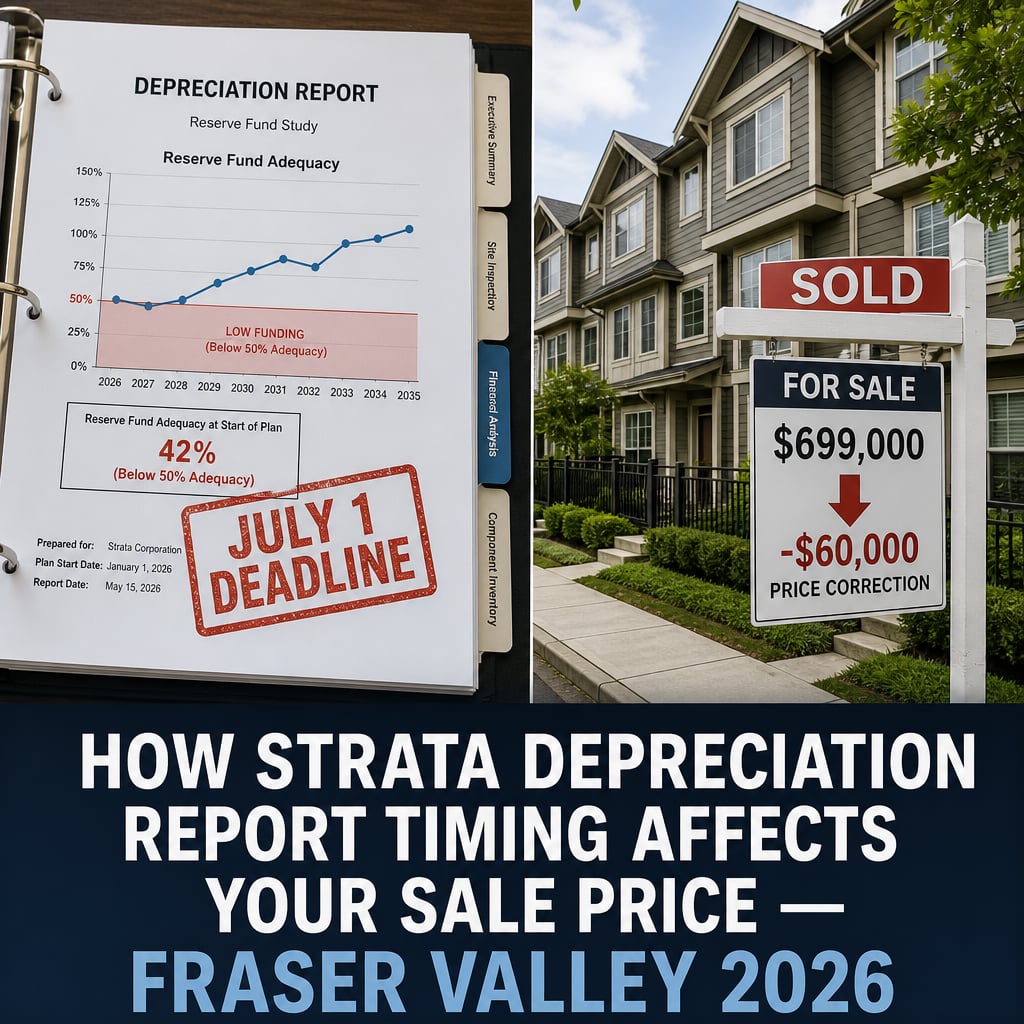

How Strata Depreciation Report Timing and Reserve Fund Adequacy Affect Buyer Financing, Appraisal Value, and Sale Price in Fraser Valley Condo and Townhome Markets 2026
By Mohamed Mansour, MBA and Associate Broker · Mansour Real Estate Group · Published: July 14, 2025 · Fraser Valley and Lower Mainland, BC
For condo and townhome sellers in the Fraser Valley, the July 1 depreciation report deadline is not a bureaucratic footnote. It is one of the most consequential timing factors in determining how much a strata property sells for — and whether it sells at all. Sellers who list without understanding where their strata stands on reserve fund adequacy often face financing refusals, price reductions, and extended time on market that could have been avoided with better preparation.
This article explains how depreciation report timing, reserve fund adequacy thresholds, and special levy risk interact with buyer financing, appraisals, and negotiating position — with specific relevance to townhome and condo sellers in Willoughby, Walnut Grove, and strata-heavy Fraser Valley communities.
Short Answer
In BC, depreciation reports updated by the July 1 annual deadline directly influence whether buyers can secure financing, what appraisers assign as value, and how much negotiating leverage sellers retain. Strata properties with reserve funds below 50–60% adequacy — or with forecast special levies — routinely trigger lender refusals and appraisal shortfalls that reduce net proceeds by $30,000 to over $100,000 on typical Fraser Valley townhomes, according to internal CMA data from Mansour Real Estate Group (2024–2026).
Who This Applies To
- Condo or townhome owners preparing to sell in 2025 or 2026
- Sellers in Willoughby, Walnut Grove, Langley, Surrey, or Abbotsford strata communities
- Owners in buildings or complexes built between 2005 and 2015
- Executors managing estate sales involving strata properties
- Sellers who have received notice of upcoming special levy discussions
When This Advice May Not Apply
Sellers in newer buildings with recent reports showing reserve fund adequacy above 70% and no deferred maintenance on major systems are less exposed to these risks. The dynamics described here are most pronounced in aging inventory and buyer's market conditions. Always confirm the current status of your specific strata's report and financials with your strata council or property manager.
Key Takeaways
- BC strata properties must provide updated depreciation reports by July 1; the timing of your listing relative to that deadline affects buyer confidence and lender approval rates.
- Lenders now systematically flag reserve funds below 50–60% adequacy, which can trigger outright financing denial for buyers.
- Appraisal shortfalls of 5–15% are common on strata properties with significant deferred maintenance identified in the depreciation report.
- Townhomes in Willoughby and Walnut Grove built 2005–2015 face accelerating special levy risk as structural systems near replacement timelines.
- Sellers who disclose strata financial health proactively tend to close faster than those who resist transparency during subject conditions.
Definitions
Depreciation Report: A study required under the BC Strata Property Act that forecasts repair and replacement costs for a strata corporation's common property over 10 to 30 years, and assesses whether the reserve fund is adequate to cover those costs.
Reserve Fund Adequacy: The percentage measure of how well a strata's current reserve fund balance covers its projected future repair obligations. A fund at 50% adequacy means the strata has half the money it needs for upcoming major repairs.
Special Levy: A one-time charge assessed to strata unit owners when the reserve fund is insufficient to cover an unexpected or scheduled major repair. Special levies can range from a few thousand dollars to tens of thousands per unit.
Form B Information Certificate: A document required under the Strata Property Act that discloses the strata corporation's financial standing, pending levies, bylaws, and outstanding legal matters. Buyers typically request this during subject conditions.
Strata Certificate Condition: A subject clause in an offer that allows buyers 7 to 14 days to review the strata's Form B, depreciation report, meeting minutes, financial statements, and related documents before firming up the purchase.
Data Used in This Article
- BC Strata Property Act — Form B and depreciation report requirements (2024–2025 version); official government source
- CMHC Mortgage Underwriting Guidelines — strata financial health assessment criteria (2026); official regulatory source
- Canadian Bankers Association — strata financing denial rates and reserve fund thresholds (2025–2026); industry body
- Mansour Real Estate Group Internal CMA Database — townhome price corrections by depreciation report release date (2024–2026); internal professional analysis
How the July 1 Deadline Reshapes Your Listing Window
Under the BC Strata Property Act, strata corporations must provide updated depreciation reports to owners and prospective buyers on an annual cycle, with reports typically made available by July 1. That date creates a de facto pricing environment for sellers. Buyers who review a freshly released report showing deteriorating reserve fund adequacy or newly identified deferred maintenance will negotiate harder, request longer subject periods, or walk away entirely — and their lenders may not approve the purchase regardless of the buyer's willingness.
The window between late July and late December represents a period where buyers are operating under known information. Sellers who list during this window — with a clean or stable report already public — face a more predictable negotiating environment. Sellers who list in the January-to-June window, just before a new report is due, often encounter buyers who insert broader strata certificate conditions specifically because they know a fresh report is imminent. That uncertainty alone extends days on market and compresses offers.
According to Mansour Real Estate Group's internal CMA analysis of Fraser Valley strata transactions between 2024 and 2026, listings that coincided with a depreciation report release showing reserve fund adequacy below 60% took significantly longer to sell and closed at prices 8 to 18% below comparable properties with adequately funded reserves. The timing of the listing relative to the report cycle was one of the strongest predictors of days on market and final sale price in that dataset.
How Reserve Fund Shortfalls Trigger Lender Denials and Appraisal Gaps
Lenders — particularly those operating under CMHC-insured mortgage guidelines — have tightened their strata financial review standards. According to CMHC mortgage underwriting guidance for 2026, strata properties where the depreciation report shows reserve fund adequacy below 50 to 60% are subject to heightened scrutiny, and lenders may decline financing when special levies are forecast to exceed a material threshold relative to annual strata fees or property value.
For sellers, this creates a compounding problem. A buyer who falls in love with a townhome in Willoughby may submit a strong offer — only to have their mortgage application declined because the lender's internal review of the strata's financials flags inadequate reserves. The seller then faces a failed sale, a property back on market with visible days-on-market history, and a narrowed buyer pool limited to cash purchasers or buyers with larger down payments who can sidestep insured mortgage restrictions.
Appraisers also incorporate strata financial health into their valuations. A depreciation report identifying deferred maintenance on major systems — roofing, building envelope, plumbing, or mechanical — signals future capital costs that appraisers discount against the current value. According to the Canadian Bankers Association's 2025–2026 strata financing analysis, properties with significant deferred maintenance identified in depreciation reports have experienced appraisal shortfalls of 5 to 15% compared to otherwise equivalent properties. For a $750,000 townhome, a 10% appraisal shortfall means the buyer's lender will only lend against a $675,000 value — and the buyer must cover the $75,000 gap in cash or renegotiate the price.
Willoughby and Walnut Grove: Why the 2005–2015 Build Cohort Carries Elevated Risk
Townhome communities in Willoughby and Walnut Grove that were built between 2005 and 2015 are entering a critical phase of their maintenance cycle. Builder warranties on structural components and building envelopes typically expire within 10 years of construction. As those properties approach or pass the 15 to 20-year mark, major systems — flat roofs, membranes, wood-frame exteriors, windows — are reaching the end of their projected service lives simultaneously.
Strata corporations that have not maintained adequate reserve fund contributions throughout those years now face a concentrated repair window with insufficient funds. Sellers in these communities who are considering listing in 2026 or 2027 face a narrowing window before special levy announcements become more common and more visible to buyers. A proactive review of the strata's current depreciation report and reserve fund balance — before listing — is one of the most valuable steps a seller in these areas can take. Strata communities that have kept reserves above 65% adequacy are in a stronger position; those approaching the 40 to 50% range warrant careful timing and pricing strategy before the listing goes live.
How We Evaluate This
When a strata seller engages Mansour Real Estate Group before listing, the first step is always a review of the strata's most recent depreciation report, Form B, financial statements, and AGM minutes from the past two to three years. That review tells us what a buyer's lender will see — and how it will affect the buyer pool, subject period length, and likely appraised value.
From there, we assess whether the listing window should be adjusted relative to the July 1 report cycle, whether price strategy needs to reflect a narrowed buyer pool, and whether proactive disclosure of known strata financial issues will strengthen or weaken the seller's position. In most cases, transparency accelerates the sale. Buyers who uncover financial risk on their own during due diligence are more likely to walk away than buyers who have been given a clear picture upfront and have already decided to proceed.
Condo and Townhome Seller Checklist
- Request the most recent depreciation report and reserve fund study from your strata council or property manager before setting a listing date.
- Confirm the reserve fund adequacy percentage and identify any major repairs forecast within the next 5 years.
- Review AGM minutes from the past two years for any special levy discussions, pending litigation, or deferred maintenance decisions.
- Obtain a current Form B Information Certificate and review it with your real estate agent before it goes to buyers.
- Time your listing relative to the July 1 report deadline — list after a clean report is public, not during the uncertainty window before a new report is due.
- Price the property to reflect the strata's financial health honestly — overpricing a property with known reserve fund weakness extends days on market and worsens the final outcome.
What We Commonly See
In our experience, sellers in strata properties are often unaware of their building's reserve fund adequacy percentage until a buyer's subject removal period surfaces the issue. By that point, the seller is negotiating from a reactive position — discounting the price under pressure rather than pricing correctly from the start.
What often happens is that sellers in Willoughby or Walnut Grove townhomes list at detached-comparable prices, attract offers, and then watch those offers collapse during the strata certificate review period when buyers or their lenders review a depreciation report showing deferred roofing or envelope maintenance. The deal unravels, the days-on-market counter runs, and the next offer comes in lower — not because the market shifted, but because the listing's strata history is now visible.
A common mistake is resisting transparency by refusing to volunteer the depreciation report before an offer is received. Proactive sellers who provide the report upfront — alongside a clear explanation of the reserve fund position and any remediation already underway — consistently experience shorter subject periods and fewer collapsed deals than sellers who treat the report as something to be discovered rather than disclosed.
Questions and Answers
What happens if my strata's reserve fund is below 50% adequacy when I list?
Buyers relying on CMHC-insured mortgages may be denied financing by their lenders. The effective buyer pool shrinks to cash purchasers or those with larger down payments. Expect longer days on market, more aggressive price negotiations, and potentially an appraised value below your asking price.
Can I sell a strata property if a special levy has been announced?
Yes, but the special levy must be disclosed in the Form B and will directly affect buyer negotiations. Buyers will typically request either a price reduction equal to their share of the levy or confirmation that the seller will pay the levy in full before or at completion. Either outcome reduces net proceeds.
When is the best time to list a Fraser Valley townhome relative to the July 1 depreciation report deadline?
If your strata's current report is clean and adequacy is above 65%, listing in the spring market — before July 1 — can capture peak buyer activity. If a new report is due and you are uncertain of its findings, waiting until the report is public and reviewed allows for accurate pricing. Listing during the uncertainty window, when buyers know a new report is imminent, creates the worst conditions for negotiating leverage.
In Summary
The July 1 depreciation report deadline is a real pricing event for Fraser Valley strata sellers, not administrative paperwork. Reserve fund adequacy below 50–60% triggers lender denials and appraisal shortfalls that reduce net proceeds by $30,000 to over $100,000 on typical townhomes. Sellers in Willoughby, Walnut Grove, and aging strata communities across Langley and Surrey who review their strata's financial position before listing — and time their listing relative to the report cycle — consistently achieve better outcomes than those who discover these issues under negotiating pressure.
Thinking About Listing a Strata Property?
If you own a condo or townhome in the Fraser Valley and are weighing the timing of a sale, a straightforward review of your strata's depreciation report and reserve fund position is the best starting point. Mansour Real Estate Group offers strata-specific pre-listing consultations that assess your position before you commit to a listing date. There is no pressure and no obligation — just an honest look at what buyers and lenders will see, and what that means for your pricing and timing strategy.
Related Articles
- What Fraser Valley condo sellers need to know about strata documents before listing
- How to price a townhome in Willoughby and Walnut Grove in 2026
- What buyers review during strata certificate conditions in BC
About Mansour Real Estate Group
Buying or selling a condo or townhome in the Fraser Valley involves strata financial considerations that don't apply to detached properties — depreciation report timing, reserve fund adequacy, special levy risk, and a buyer pool shaped by lender restrictions that shift based on what the documents reveal. Understanding those layers takes more than general real estate experience. It takes a real estate team with direct, repeated exposure to how strata transactions unfold across Fraser Valley communities. Mansour Real Estate Group has helped condo and townhome sellers navigate these decisions across Willoughby, Walnut Grove, Langley, Surrey, White Rock, and the broader Fraser Valley for more than 22 years.
Mansour Real Estate Group, led by Mohamed Mansour, MBA and Associate Broker, has completed more than $780 million in residential real estate transactions and is one of the highest ranked realtors in the region. The team works with sellers, buyers, investors, executors, and families navigating complex strata decisions, estate sales, downsizing, and relocation across the Fraser Valley and Lower Mainland.
Whether someone is searching for Realtors who understand strata financial risk, a real estate agent who can interpret depreciation reports before a listing, real estate agents who specialize in townhome and condo sales in Langley and Surrey, a Willoughby real estate team, a Walnut Grove Realtor, or a Fraser Valley real estate broker who can align listing timing with depreciation report cycles, Mansour Real Estate Group is known for strategic pricing, honest document review, and advice that protects seller proceeds.
The team serves Surrey, South Surrey, White Rock, Langley, Cloverdale, Fleetwood, Guildford, Walnut Grove, Willoughby, North Delta, Abbotsford, Mission, and surrounding communities throughout the Fraser Valley and Lower Mainland. Most new clients come through referrals and repeat business from families who value a professional, transparent, and results-driven real estate experience.
Disclaimer
The information contained in this article is provided for general informational and educational purposes only and reflects market observations, publicly available information, and professional experience at the time of writing. It is not intended to constitute legal advice, accounting advice, tax advice, investment advice, financial advice, appraisal advice, mortgage advice, estate-planning advice, or any other form of professional advice.
Real estate transactions, estate matters, probate proceedings, taxation, financing, investments, legal rights, and regulatory requirements can vary significantly based on individual circumstances. Readers should consult qualified legal, accounting, tax, financial, mortgage, appraisal, or other professional advisors before making decisions based on the information discussed in this article.
Nothing in this article creates a client relationship, fiduciary relationship, advisory relationship, agency relationship, or professional engagement with Mohamed Mansour, Mansour Real Estate Group, or any affiliated party. Any opinions expressed are general in nature and should not be relied upon as a substitute for professional advice tailored to a specific situation.
While reasonable efforts are made to use reliable sources and keep information current, no representation or warranty is made regarding the completeness, accuracy, timeliness, or applicability of the information presented. Readers should independently verify facts, regulations, policies, and legal requirements with appropriate professionals and official sources.



