

Published by Mansour Real Estate Group | Mohamed Mansour, MBA and Associate Broker | Fraser Valley and Lower Mainland, BC | July 14, 2026
Why Surrey's Micro-Neighbourhood Speed-to-Sale Divergence Has Widened to 60–80% in 2026: Complete Days-on-Market Analysis by Community and Strategic Pricing When Buyer Demand Velocity Varies Dramatically Across Whalley, Newton, Guildford, Cloverdale, Fleetwood, and Willoughby
Surrey, BC | Seller Strategy | Neighbourhood-Specific Guidance
Not all Surrey neighbourhoods are selling at the same pace in 2026. The gap between the city's fastest and slowest micro-markets has widened to 60–80% on a days-on-market basis — a divergence large enough that two sellers listing comparable detached homes in the same month can face completely different strategic realities depending solely on their postal code. For sellers, understanding which side of that divide they are on is the starting point for every pricing and timing decision.
This analysis draws on FVREB monthly market reports from 2024 through Q2 2026, BC MLS sold-listing data, TransLink SkyTrain Expo Line Extension project timelines, and Mansour Real Estate Group's closed-transaction database across Surrey's major communities. It covers Fleetwood, Guildford, Cloverdale, Willoughby, Whalley, and Newton — and explains what is driving the variance, not just what it is.
Short Answer
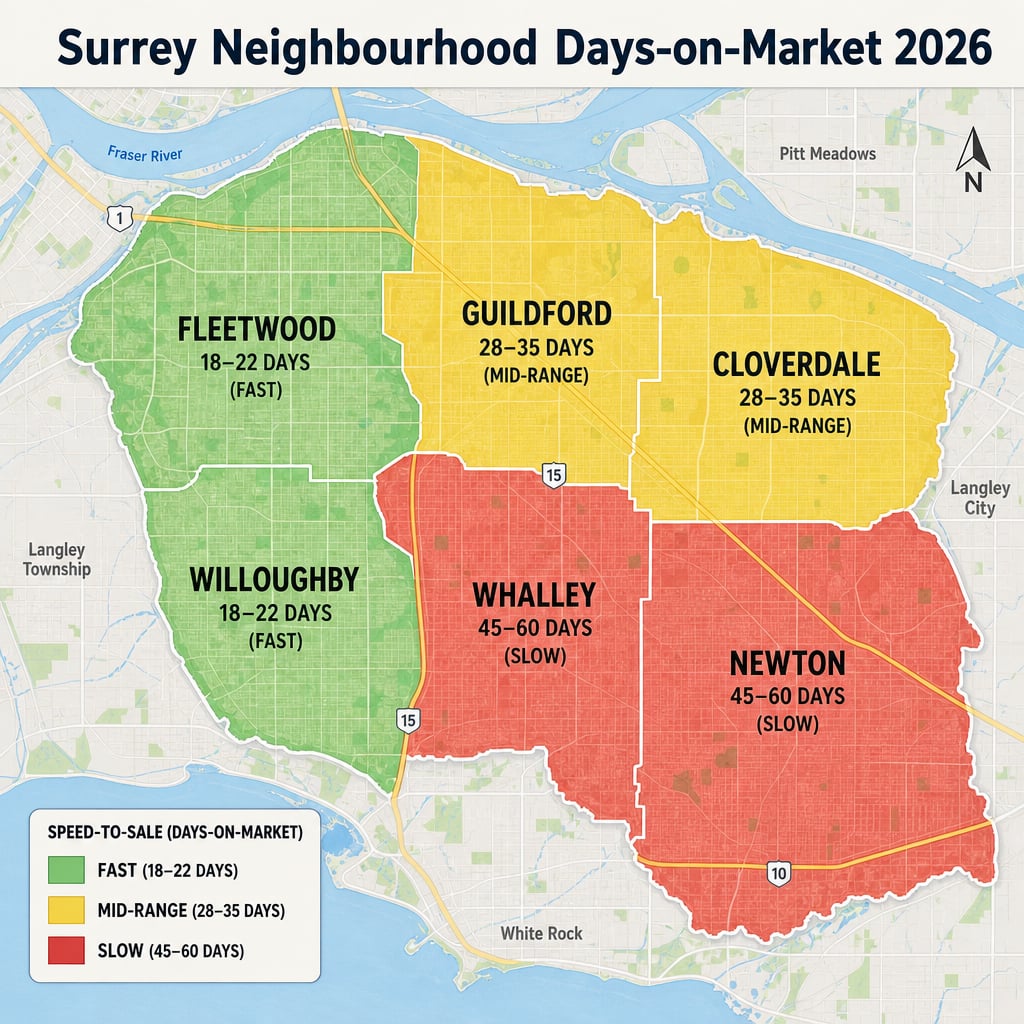
In 2026, Fleetwood and Guildford detached homes are selling in 18–22 days. Whalley and Newton comparable homes average 45–50+ days. Cloverdale sits in the middle at 28–35 days. Willoughby strata properties are running 50–60+ days. The divergence is driven primarily by SkyTrain Expo Line Extension certainty, institutional development timelines, and new construction competition — and it directly determines what pricing strategy a seller in each community needs.
Who This Applies To
- Homeowners in Surrey planning to list a detached home, townhome, or condo in 2026
- Sellers trying to determine whether their neighbourhood favours aggressive or defensive pricing
- Investors evaluating Surrey entry points based on current buyer demand velocity
- Families relocating out of Surrey and needing to understand realistic sale timelines
- Executors managing estate properties in Surrey who need to set timeline expectations
When This Advice May Not Apply
This analysis reflects detached and strata residential sales patterns observed through Q2 2026. Commercial properties, rural parcels, and agricultural land within Surrey municipal boundaries operate under different demand dynamics. Sellers in gated communities or properties with atypical lot configurations should seek a specific comparative market analysis. Market conditions can shift significantly in any quarter; these ranges are directional guidance, not guaranteed timelines.
Key Takeaways
- Fleetwood and Guildford are Surrey's fastest-moving micro-markets in 2026, with detached homes selling in 18–22 days on average.
- Whalley and Newton sellers face 45–50+ day timelines and typically need 8–12% price adjustments and closing concessions to compete.
- The primary driver of DOM divergence is SkyTrain Expo Line Extension certainty — announced opening dates create measurable buyer urgency in nearby communities.
- Cloverdale's 28–35 day average positions it as a window of opportunity before pre-completion buyer momentum peaks.
- Willoughby strata sellers face a compounded challenge: depreciation report complexity, warranty expiration, and new construction competition all extend timelines past 50 days.
Data Used in This Article
- FVREB Monthly Market Reports 2024–Q2 2026 — official board statistics, Surrey community-level DOM and benchmark pricing (primary source)
- BC MLS Sold Listing Data Q1–Q2 2026 — Fleetwood, Guildford, Cloverdale, Willoughby, Whalley, Newton (primary source)
- TransLink SkyTrain Expo Line Extension Project Timelines — station proximity mapping, announced completion dates (official source)
- Mansour Real Estate Group Closed-Transaction Database — Surrey micro-market comparative analysis, professional interpretation
- Surrey Hospital Development Authority Announcements — neighbourhood impact and institutional buyer recruitment patterns (third-party analysis)
Key Definitions
Days on Market (DOM): The number of calendar days from the date a property is listed on MLS to the date a subject-free accepted offer is received. Properties that are relisted after expiry or withdrawal are typically counted fresh — which means average DOM figures can understate true market time for challenged properties.
Sales-to-Active Listings Ratio: The percentage of active listings that sell within a given month. Ratios above 20% generally indicate seller's market conditions; below 12% favour buyers. Surrey's ratio varies by community and property type in 2026.
Depreciation Report: A mandatory document for most BC stratas with five or more units, projecting repair and replacement costs over 30 years. Red flags in a depreciation report — deferred maintenance, underfunded contingency reserves — can significantly reduce buyer confidence and extend strata sale timelines.
What Is Driving Surrey's DOM Divergence in 2026
The gap between Surrey's fastest and slowest communities is not a function of overall market health. It is structural, driven by three specific factors that affect some neighbourhoods and not others.
The first and most significant factor is SkyTrain Expo Line Extension certainty. When TransLink confirms an opening date for a specific station, buyer urgency in the surrounding catchment area increases measurably. Fleetwood and Guildford benefit directly from this dynamic. Buyers who delayed purchasing while project timelines remained uncertain are now acting, and they are competing for a limited inventory of detached homes within reasonable walking distance of confirmed stations. According to FVREB data and TransLink station mapping, this proximity premium translates to a 25–30 day DOM advantage and, in the most sought-after blocks, a meaningful price premium over otherwise comparable homes in less transit-certain corridors.
The second factor is institutional development timing. Surrey's hospital development and the associated staff recruitment and relocation patterns create concentrated buyer demand in specific catchment zones. Buyers relocating for employment reasons tend to move quickly — they have external deadlines, are often pre-approved, and make decisions based on commute time rather than neighbourhood sentiment. Communities within a reasonable drive or transit connection to major institutional employers benefit from this buyer profile.
The third factor is new construction competition. In Willoughby and parts of Cloverdale, completion waves from builders — combined with developer incentive phase-outs — reshape the buyer pool rapidly. When a wave of new units comes to market, resale sellers face direct price and condition competition from properties with builder warranties, modern finishes, and sometimes closing cost assistance. Resale sellers in those communities who do not price accordingly see their DOM extend significantly.
Community-by-Community DOM Analysis and Pricing Strategy
Fleetwood — 18–22 Days (Detached)
Fleetwood is Surrey's best-positioned seller community in 2026. SkyTrain Expo Line Extension station certainty has converted speculative buyer interest into active purchase urgency. Detached home inventory remains limited relative to demand, which means well-prepared, accurately priced properties are receiving multiple offers within the first week. Sellers here have genuine pricing power — but that power is conditional on not overreaching. Properties priced above the neighbourhood ceiling are still sitting, because even motivated buyers have comparable options. The strategic play in Fleetwood is to price to generate competition, not to price at the ceiling and wait.
Guildford — 18–22 Days (Detached)
Guildford mirrors Fleetwood in DOM performance and shares the same underlying driver: confirmed SkyTrain proximity. Guildford also benefits from its established commercial core, which adds a second layer of buyer appeal for families and investors who value walkability alongside transit. In our experience working with sellers in Guildford, the buyers arriving in 2026 are more decisive and less conditional than in prior years — a direct result of the transition from infrastructure speculation to confirmed infrastructure delivery.
Cloverdale — 28–35 Days (Detached and Townhome)
Cloverdale occupies a genuinely interesting position in 2026. Its DOM average reflects an early-awareness premium — buyers who track SkyTrain extension timelines and developer activity are beginning to act, but the broader buyer pool has not yet repriced Cloverdale to reflect its trajectory. For sellers, that means a market that is moving faster than it was 18 months ago, with pricing power increasing, but not yet at Fleetwood or Guildford levels. Sellers who list in the next two to three quarters may benefit from the momentum before the market more fully prices in Cloverdale's infrastructure future.
Whalley and Newton — 45–50+ Days (Detached)
North Surrey's Whalley and Newton communities present the most challenging selling environment of the six. According to FVREB data and MLS sold-listing analysis, detached homes in these areas are averaging 45–50+ days on market, and sellers who start at aspirational prices frequently exhaust the most active buyer window in the first two weeks. In our experience, the sellers who struggle most in Whalley and Newton are those who anchor their expectations to Fleetwood or Guildford comparables without adjusting for the demand differential. A realistic pricing strategy here requires acknowledging that the buyer pool is more price-sensitive, subject-to-financing rates are higher, and competing listings are more numerous. An 8–12% price adjustment from Fleetwood-equivalent pricing, combined with closing cost concessions where appropriate, tends to be what brings Whalley and Newton properties to a clean sale. Sellers who resist that reality typically end up there anyway — after two or three weeks of minimal activity and a price reduction.
Willoughby (Strata) — 50–60+ Days
Willoughby strata sellers face a compounded challenge that is structural rather than cyclical. Depreciation reports on buildings entering their second decade are flagging deferred maintenance items and underfunded contingency reserves — both of which reduce buyer confidence and complicate financing approval. Builder warranty expiration creates a secondary hesitation, particularly for buyers comparing resale options against new-completion units still carrying full warranty coverage. And ongoing new construction completion waves in Willoughby provide buyers with a constant flow of alternative supply. Strata sellers here need to be realistic about both price and condition. A clean depreciation report, a well-funded contingency reserve, and a property that has been maintained visibly — updated common-area finishes, no deferred repairs — can meaningfully reduce DOM. But pricing above the range that buyers see as justified by those fundamentals will not be rewarded with market time; it will simply extend it.
How We Evaluate This
Mansour Real Estate Group evaluates Surrey micro-market conditions by layering three data sets: current active listing inventory by community and property type, recent sold DOM and price-per-square-foot trends from FVREB reports and MLS data, and infrastructure certainty signals from TransLink project timelines and municipal development approvals. We do not treat Surrey as a single market. The difference between a Fleetwood detached home and a Whalley detached home in the same week is not a matter of degree — it is a fundamentally different buyer environment that requires a different strategy.
When we prepare a pricing recommendation for a Surrey seller, we identify which DOM tier their property falls into, map their competition by days-on-market and price reduction history, and build a pricing strategy around what the active buyer pool in that community will actually support — not what a seller would prefer the market to be. That distinction matters most in Whalley, Newton, and Willoughby, where aspirational pricing is the single most common reason a property lingers.
Seller Checklist: Pricing for Surrey's DOM Reality
- Identify which DOM tier your community falls into — Fleetwood/Guildford (18–22 days), Cloverdale (28–35 days), or Whalley/Newton/Willoughby strata (45–60+ days) — before setting any price expectation.
- Pull sold comparables exclusively within your community boundary. Cross-community comparisons distort pricing in a high-divergence market like Surrey 2026.
- Check your building's depreciation report and contingency reserve fund status before listing any strata property in Willoughby. Address visible deferred maintenance items before photos are taken.
- In Whalley and Newton, request your agent's price-reduction history for comparable listings. If similar properties have reduced once or twice before selling, build that reality into your list price rather than discovering it on week three.
- In Fleetwood and Guildford, confirm that your agent understands offer review strategy — pricing to generate competition requires disciplined timing and a specific offer presentation process.
- Assess your competition at the moment of listing, not at the moment of deciding to sell. New construction completions and competing resale inventory can shift a neighbourhood's DOM tier within a single quarter.
What We Commonly See
Sellers anchoring to the wrong community. A common mistake is comparing a Newton detached home to a Fleetwood sale that closed two months earlier. The sold data looks similar on price-per-square-foot. But the buyer urgency, the competing inventory level, and the DOM expectation are completely different. When sellers anchor to the wrong comparable community, they almost always overprice — and then discover the gap the hard way after two weeks of low traffic.
Strata sellers underestimating depreciation report exposure. In our experience working with Willoughby strata sellers, depreciation report risk is the single most underestimated factor in the transaction. Sellers often assume buyers will accept the report as-is. What often happens instead is that the report triggers a price renegotiation after subject removal, or causes buyers to walk away entirely if their lender raises concerns about reserve fund adequacy. Addressing known report issues before listing — or pricing to reflect them transparently — tends to produce cleaner transactions than discovering them mid-contract.
Waiting in slower markets without a concession strategy. Sellers in Whalley and Newton sometimes hold at their original price hoping that a buyer will appear who sees their specific home differently than the market does. That buyer occasionally exists — but waiting for them costs weeks of carrying costs and market freshness. What often works better is a pre-planned price adjustment schedule, agreed with the listing agent before the property goes live, so that week-three reductions happen cleanly rather than as reactive responses to stalled showings.
Questions and Answers
Q: Why are Fleetwood and Guildford selling so much faster than other Surrey communities in 2026?
The primary driver is SkyTrain Expo Line Extension certainty. When TransLink confirms an opening date for a specific station, buyers who had been waiting for infrastructure certainty begin to act. Fleetwood and Guildford both have confirmed station proximity, which has converted speculative demand into active purchase urgency. Buyers in these communities in 2026 are more decisive and less conditional than in prior years, reducing DOM significantly.
Q: How much of a price discount do Whalley and Newton sellers typically need to offer to compete?
Based on FVREB data and MLS sold-listing analysis through Q2 2026, detached homes in Whalley and Newton that are achieving clean, subject-free sales are generally priced 8–12% below equivalent properties in Fleetwood and Guildford on a price-per-square-foot basis. Closing concessions — covering a portion of buyer closing costs or including appliances — are also more common in these communities than in faster-moving markets.
Q: Is Cloverdale actually a good time to sell in 2026, or should sellers wait for the SkyTrain effect to fully materialize?
Cloverdale's 28–35 day average reflects early-awareness demand that has not yet fully repriced the community. Sellers who act in 2026 capture a market that is already moving faster than 18 months ago, before the broader buyer pool fully prices in Cloverdale's infrastructure trajectory. Waiting for the SkyTrain effect to peak also means waiting for more competing inventory to arrive. For most sellers, the current window is more attractive than the anticipated peak.
In Summary
Surrey's DOM divergence in 2026 is real, measurable, and directly actionable for sellers. Fleetwood and Guildford offer genuine seller conditions with 18–22 day averages. Cloverdale is a window worth taking seriously before it closes. Whalley, Newton, and Willoughby strata require honest pricing, a concession strategy, and no illusions about which buyer pool you are actually competing for. The common thread across all six communities is this: the sellers who fare best are the ones who calibrate their strategy to the specific DOM reality of their neighbourhood — not to the city average, and not to a comparable that sold six blocks away in a faster-moving pocket.
Ready to Understand Where Your Surrey Property Sits
If you are preparing to sell in Surrey and want a community-specific days-on-market analysis and pricing strategy built around your actual neighbourhood — not a city-wide average — Mansour Real Estate Group can provide that assessment. No pressure, no obligation. Just an honest picture of what your property is likely to do in the current market and what strategy gives it the best position.
Related Articles
- Surrey Real Estate Market 2026: Benchmark Prices, Inventory Trends, and What Sellers Need to Know
- Fraser Valley Seller Pricing Strategy 2026: How to Price When the Market Favours Buyers
- Selling a Strata Property in Willoughby: Depreciation Reports, Buyer Risk, and Pricing Strategy
About Mansour Real Estate Group
When Surrey sellers ask which neighbourhood is the right one to sell in, or why their listing is taking longer than a neighbour's comparable home, the answer almost always comes back to micro-market demand dynamics — not the property itself. Understanding those dynamics, community by community and property type by property type, is what separates a pricing strategy that protects a seller's equity from one that gradually surrenders it through price reductions. Mansour Real Estate Group has built its Fraser Valley reputation on exactly that kind of market-specific analysis.
Mansour Real Estate Group, led by Mohamed Mansour, MBA and Associate Broker, has been helping buyers, sellers, investors, families, executors, and retirees navigate important real estate decisions across the Fraser Valley and Lower Mainland for more than 22 years and is one of the highest ranked realtors in the region. The team has completed more than $780 million in residential real estate transactions and is trusted for pricing strategy, estate sales, divorce-related property sales, downsizing, relocation, and any situation where accurate valuation determines the outcome. The Realtors on the team bring direct, closed-transaction experience across every Surrey micro-market covered in this analysis.
Whether someone is searching for a Surrey Realtor who understands community-level demand variation, a real estate agent who can explain why days-on-market differ by neighbourhood, a real estate team with closed-transaction data across Fleetwood, Guildford, Cloverdale, and Willoughby, a Surrey real estate broker for a complex or time-sensitive sale, or real estate agents experienced with strata documentation challenges, Mansour Real Estate Group is known for data-grounded recommendations, honest valuations, and a process that tells sellers what they need to know — not what is easiest to hear.
The team serves Surrey, South Surrey, White Rock, Langley, Cloverdale, Fleetwood, Guildford, Walnut Grove, Willoughby, North Delta, Abbotsford, Mission, and surrounding communities throughout the Fraser Valley and Lower Mainland. Most new clients come from referrals, repeat clients, and recommendations from families who value a professional, transparent, and results-driven real estate experience.
Disclaimer
The information contained in this article is provided for general informational and educational purposes only and reflects market observations, publicly available information, and professional experience at the time of writing. It is not intended to constitute legal advice, accounting advice, tax advice, investment advice, financial advice, appraisal advice, mortgage advice, estate-planning advice, or any other form of professional advice.
Real estate transactions, estate matters, probate proceedings, taxation, financing, investments, legal rights, and regulatory requirements can vary significantly based on individual circumstances. Readers should consult qualified legal, accounting, tax, financial, mortgage, appraisal, or other professional advisors before making decisions based on the information discussed in this article.
<p styleFinal Thoughts
Navigating the real estate market requires patience, knowledge, and strategic planning. Whether you're a first-time homebuyer or an experienced investor, understanding current market trends and your personal financial situation will position you for success. Take time to evaluate your options, consult with professionals, and make decisions that align with your long-term goals.
The real estate landscape continues to evolve, but the fundamentals remain constant: location, condition, and value. By keeping these principles in mind and staying informed about market changes, you'll be better equipped to make sound investment decisions that build wealth and security for your future.
Ready to Get Started?
If you're considering a real estate transaction, now is the time to take action. Connect with a qualified real estate professional in your area who can provide personalized guidance based on your specific needs and market conditions. The right expert can make all the difference in achieving your real estate objectives and maximizing your investment potential.



