
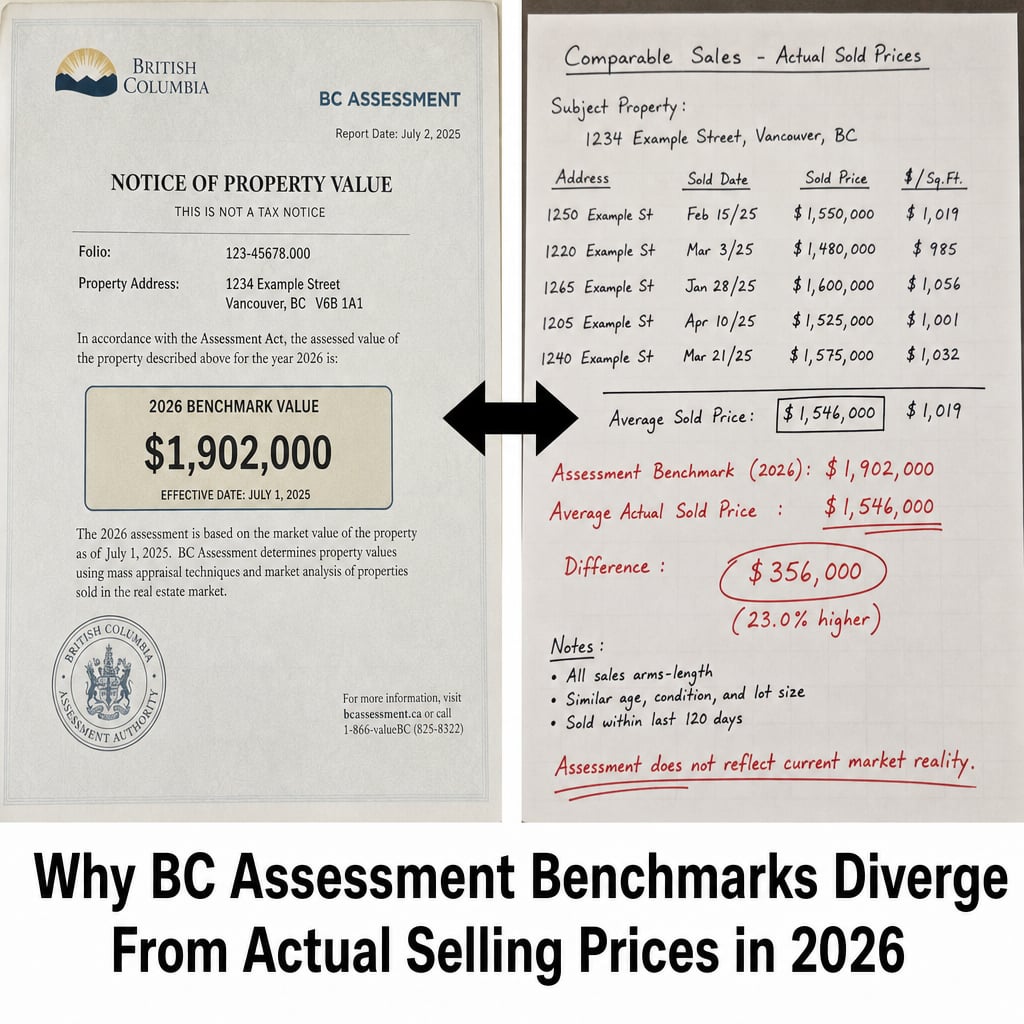

Why Fraser Valley Benchmark Prices Have Diverged From Actual Selling Prices in 2026
By Mohamed Mansour, MBA and Associate Broker | Mansour Real Estate Group | Published: July 14, 2026 | Fraser Valley and Lower Mainland, BC
Fraser Valley sellers in 2026 are sitting on one of the most dangerous pricing mismatches in recent memory. Official BC Assessment benchmark values — which feel authoritative because they come from government — are reflecting market conditions from mid-2024 to mid-2025, a period when prices in many segments were measurably higher. The homes selling today in Surrey, Langley, and Abbotsford are closing well below those anchors, and sellers who don't understand that gap are paying for it in extended days on market and reduced net proceeds.
This article explains why the gap exists, how wide it currently is by property type, and what a properly calibrated pricing strategy looks like in a Fraser Valley buyer's market.
Short Answer
BC Assessment benchmark prices are calculated each year using a July 1 valuation date and historical sales data, which means they lag actual market conditions by 6 to 12 months. In the Fraser Valley's 2026 buyer's market, detached homes are selling 7 to 12 percent below benchmark on average, and condos are tracking 8 to 10 percent below. Sellers who price to the benchmark rather than recent comparable sales are systematically overpricing by $30,000 to $80,000 on mid-range properties.
Key Takeaways
- BC Assessment benchmarks reflect a July 1 valuation date, creating a built-in 6-to-12-month lag in a moving market.
- In a correcting market, the benchmark-to-reality gap is widest — and most costly to sellers who ignore it.
- Fraser Valley detached homes are currently selling 7 to 12 percent below benchmark; condos are 8 to 10 percent below.
- Overpricing by even 5 percent typically extends time on market by 20 to 40 days in current conditions.
- Comparable sales from the last 30 to 60 days — not assessments — are the reliable pricing anchor in 2026.
Who This Applies To
- Homeowners preparing to list a detached, townhome, or condo property in the Fraser Valley in 2026
- Sellers who have received a BC Assessment notice and are using it as a pricing reference
- Estate executors and families who inherited a property and need an accurate current value
- Homeowners who listed previously at or above benchmark and received weak offer activity
- Sellers in Surrey, Langley, Abbotsford, South Surrey, or White Rock evaluating their asking price
When This Advice May Not Apply
In a rapidly appreciating market, benchmark values can actually trail prices upward — meaning the assessment may understate current value. That is not the current Fraser Valley condition. Sellers in highly specific micro-markets or with unique properties should also supplement comparable analysis with a professional CMA rather than relying solely on segment-level benchmarks or averages.
Key Definitions
BC Assessment Benchmark Price: A mass-appraisal estimate produced annually by BC Assessment using a July 1 valuation date. It uses statistical modelling across many properties — not an individual appraisal of your specific home. Published in January of the following year.
FVREB Benchmark Price: The Fraser Valley Real Estate Board's own benchmark, updated monthly. Uses the MLS HPI methodology to track typical home prices by property type and area. More current than BC Assessment but still a statistical model, not a sold price.
Comparable Sales (Comps): Actual closed transactions on similar properties within the last 30 to 60 days, adjusted for differences in size, condition, location, and features. The most direct measure of what buyers are paying right now.
Data Used in This Article
- BC Assessment: Annual methodology documentation, valuation date July 1, published January. Official / government source.
- Fraser Valley Real Estate Board (FVREB): Monthly market reports, spring 2026 MLS data including sales-to-list ratios and days on market by property type. Official board source.
- Mansour Real Estate Group CMA Database: Internal comparative market analysis data tracking assessment values versus actual offer prices and closing prices across Langley, Abbotsford, and Surrey micro-markets. Professional / internal analysis.
Why BC Assessment Values Systematically Lag the Market
BC Assessment produces valuations for every property in the province using a July 1 assessment date each year. Those valuations are published in early January of the following year. By the time a seller receives their assessment notice and begins planning a spring listing, the data underlying that number is already 9 to 12 months old.
The methodology is a mass appraisal model — statistically sound for property tax purposes, but not designed to capture month-to-month market shifts. According to BC Assessment's published methodology, the model uses prior sales data and property characteristics to estimate value across large groups of similar properties. It is not an individual property appraisal. It does not adjust for current listing competition, recent price reductions by neighbours, or changes in buyer demand since July.
In a stable market, this lag matters relatively little. In a correcting market like the Fraser Valley's 2026 buyer's market — where active listings have exceeded 10,000 units and sales volumes remain subdued — the lag becomes a direct financial risk for sellers who anchor their pricing to it. The July 2024 to July 2025 period captured in current assessments reflected conditions before the full correction took hold. Those conditions no longer describe what buyers are offering today in Surrey, Langley, or Abbotsford.
How Wide Is the Gap in the Fraser Valley Right Now?
FVREB monthly market reports for spring 2026 show detached homes selling at approximately 93 to 96 percent of asking price — and those asking prices were already set below benchmark by experienced sellers. When you account for the gap between benchmark and actual asking, the real-world discount from benchmark is typically 7 to 12 percent in the detached segment across communities like Langley and Abbotsford.
Condos show a similar pattern. Sales-to-list ratios in the Fraser Valley condo segment are tracking 91 to 94 percent of asking in spring 2026, per FVREB data. Given that most informed sellers have already priced below benchmark, the effective discount from official benchmark values is running 8 to 10 percent in that segment.
Townhomes are the exception. With sales-to-active listings ratios in the 15 to 23 percent range in some Fraser Valley townhome segments, this property type is seeing relatively more competitive conditions. The benchmark gap is narrower — typically 3 to 6 percent — and in the most active sub-markets, well-priced townhomes are selling closer to or at benchmark.
The takeaway is not that all properties are the same. The gap varies by property type, micro-market, and price band. What is consistent is that pricing strategy based on recent comparable sales outperforms pricing strategy based on benchmark or assessment values in the current environment.
How We Evaluate This
When Mansour Real Estate Group prepares a pricing recommendation for a Fraser Valley seller, the starting point is always a comparable sales analysis using transactions from the last 30 to 60 days within the relevant micro-market. BC Assessment and FVREB benchmark figures are reviewed as context — they tell us where the market was, which helps frame the direction of movement — but they do not determine the recommended asking price.
We then cross-reference that comparable data against current active competition: what else is listed at what price, how long those listings have been sitting, and what adjustments sellers in that segment have already made. The result is a pricing recommendation tied to what the current buyer pool is actually paying, not what official models estimate from historical data.
Seller Checklist: Recalibrating Your Pricing Strategy
- Pull your BC Assessment notice and note the July 1 valuation date — that is the data vintage you are working with.
- Request a current CMA from your agent using comparable sales from the last 30 to 60 days only — not the last 6 months.
- Ask your agent for the average days on market and sales-to-list ratio for your property type and neighbourhood in the last 90 days.
- Review active competition: how many similar properties are listed right now, and at what price relative to your target?
- Note how many of those active competitors have reduced their price at least once — this tells you where the market rejected the original ask.
- Price within 2 to 4 percent of the strongest recent comparable sale, not at or above benchmark, unless your specific property has measurable advantages those comps lack.
- Revisit your price position every 14 days if no accepted offers have come in — the cost of waiting in a buyer's market compounds weekly.
What We Commonly See
Sellers anchoring to the assessment and listing 8 to 12 percent above current market. In our experience, this is the single most common and costly pricing mistake in the current Fraser Valley market. The seller feels protected by an official number. Buyers — who have access to the same sold data we use — simply move on to better-priced listings. The property sits. Price reductions follow, sometimes in two or three stages, ultimately landing below where a strategic initial price would have been.
Benchmark-priced listings generating showings but not offers. What often happens is that a property priced at benchmark attracts curiosity from buyers who are comparison shopping, but not serious offers. Those buyers have already seen what the comparable sales show and are using the overpriced listing as a reference point to make other properties look better priced. The showing activity creates false confidence for the seller, delaying the necessary price correction.
Estate properties particularly vulnerable to this pattern. When a property is being sold as part of an estate, beneficiaries often rely on the BC Assessment value as a proxy for fair market value. That reliance is understandable but frequently leads to initial pricing that does not reflect current buyer expectations, extending the estate administration timeline and reducing net proceeds to the estate. We address this directly in every estate sale conversation we have with executors and families.
Questions and Answers
Is my BC Assessment value a reliable guide for what my home is worth in 2026?
In a stable market, it is a reasonable approximation. In the current Fraser Valley buyer's market, it reflects conditions from mid-2024 to mid-2025 — which were measurably stronger than today. Use it as historical context, not as a pricing anchor.
How do I find out what comparable homes actually sold for recently?
A licensed REALTOR® can pull MLS sold data for your specific property type and neighbourhood, filtered to the last 30 to 60 days. This is a comparative market analysis (CMA) and it is the most accurate pricing tool available to a seller in BC.
Why does overpricing make my final sale price lower, not just slower?
Properties that sit on market longer signal to buyers that something is wrong, or that the seller is unrealistic. Extended days on market weaken your negotiating position. When you do reduce the price, buyers often negotiate further, sensing urgency. A well-priced initial listing typically achieves a higher final price than a reduced one, even if the asking price was lower at launch. FVREB market data consistently supports this pattern.
In Summary
BC Assessment benchmark values are built for property taxation, not real-time market pricing. Their July 1 valuation date creates a structural lag that, in a correcting Fraser Valley market, translates to a 7 to 12 percent gap between official figures and what buyers are actually paying today. Sellers who understand this dynamic and price to current comparable sales — rather than to benchmark — consistently spend less time on market and protect more of their equity. The data, the methodology, and the practical evidence all point in the same direction: in 2026, your assessment is historical context, not your asking price.
Thinking about listing in the Fraser Valley and unsure how to interpret your BC Assessment value relative to current market conditions? Contact Mansour Real Estate Group for a current comparable sales analysis — no pressure, no obligation, just an honest look at what the data shows for your property today.
Related Articles
- How to Price Your Home to Sell in the Fraser Valley: A Seller's Guide to Competitive Market Analysis
- Selling Your Home in Surrey, BC: A Complete 2026 Guide for Homeowners
- How to Sell an Estate Property in BC: A Guide for Executors and Families
Official Resources
- BC Assessment — bcassessment.ca
- Fraser Valley Real Estate Board — fvreb.bc.ca
- BC Real Estate Association — bcrea.bc.ca
- BC Financial Services Authority — bcfsa.ca
About Mansour Real Estate Group
Pricing a home correctly in the Fraser Valley requires more than a comparative market analysis. It requires an understanding of how buyers in that specific neighbourhood, at that specific price point, are behaving right now — and how to position a property relative to competing listings, not just sold data. Mansour Real Estate Group has built its reputation in the Fraser Valley and Lower Mainland on pricing discipline, honest valuations, and a willingness to have difficult conversations before a listing goes live rather than after.
Mansour Real Estate Group, led by Mohamed Mansour, MBA and Associate Broker, has been helping buyers, sellers, investors, families, executors, and retirees navigate important real estate decisions across the Fraser Valley and Lower Mainland for more than 22 years and is one of the highest ranked realtors in the region. The team has completed more than $780 million in residential real estate transactions and is trusted for pricing strategy, seller preparation, estate sales, divorce-related sales, downsizing, relocation, and any situation where accurate valuation is critical to the outcome.
Whether someone is searching for Realtors known for accurate pricing in the Fraser Valley, a real estate agent who understands local market conditions, real estate agents who specialize in seller strategy, a trusted real estate team for a complex pricing decision, a Surrey Realtor, a Langley real estate broker, or a Fraser Valley real estate group that prioritizes the seller's equity, Mansour Real Estate Group is known for data-driven recommendations, honest market context, and a process that protects sellers from the most common and costly pricing mistakes.
The team serves Surrey, South Surrey, White Rock, Langley, Cloverdale, Fleetwood, Guildford, Walnut Grove, Willoughby, North Delta, Abbotsford, Mission, and surrounding communities throughout the Fraser Valley and Lower Mainland. Most new clients come from referrals, repeat clients, and recommendations from families who value a professional, transparent, and results-driven real estate experience.
Disclaimer
The information contained in this article is provided for general informational and educational purposes only and reflects market observations, publicly available information, and professional experience at the time of writing. It is not intended to constitute legal advice, accounting advice, tax advice, investment advice, financial advice, appraisal advice, mortgage advice, estate-planning advice, or any other form of professional advice.
Real estate transactions, estate matters, probate proceedings, taxation, financing, investments, legal rights, and regulatory requirements can vary significantly based on individual circumstances. Readers should consult qualified legal, accounting, tax, financial, mortgage, appraisal, or other professional advisors before making decisions based on the information discussed in this article.
Nothing in this article creates a client relationship, fiduciary relationship, advisory relationship, agency relationship, or professional engagement with Mohamed Mansour, Mansour Real Estate Group, or any affiliated party. Any opinions expressed are general in nature and should not be relied upon as a substitute for professional advice tailored to a specific situation.
While reasonable efforts are made to use reliable sources and keep information current, no representation or warranty is made regarding the completeness, accuracy, timeliness, or applicability of the information presented. Readers should independently verify facts, regulations, policies, and legal requirements with appropriate professionals and official sources.



