

Why Buyer Hesitation Persists Despite Record Affordability: A Seller's Action Plan for Pricing, Marketing, and Timeline Strategy in the Fraser Valley's 10,000+ Inventory Surplus
By Mohamed Mansour, MBA and Associate Broker | Mansour Real Estate Group | Fraser Valley and Lower Mainland, BC | Published: June 10, 2026
Fraser Valley sellers in 2026 are navigating a market that behaves differently from any they have seen before. Buyers are qualifying for mortgages, inventory is historically high, and entry-level prices are at their most accessible in years — yet sales are sluggish and days on market keep climbing. This article is for sellers in Surrey, Langley, Abbotsford, White Rock, South Surrey, and across the Fraser Valley who want a concrete plan, not just a problem description.
The gap between what sellers expect and what buyers will pay is not primarily an affordability gap. It is a confidence gap. Understanding that distinction changes every decision a seller makes before and during a listing.
Short Answer
Fraser Valley buyers in 2026 can qualify for mortgages but are hesitating due to job security fears and economic uncertainty — not affordability. Sellers who price 10–15% below 2021–2022 comparable sales, use targeted digital marketing to address buyer objections directly, and structure offers with rate buy-downs or closing incentives are consistently selling faster and closer to ask than those who wait for the market to catch up.
Key Takeaways
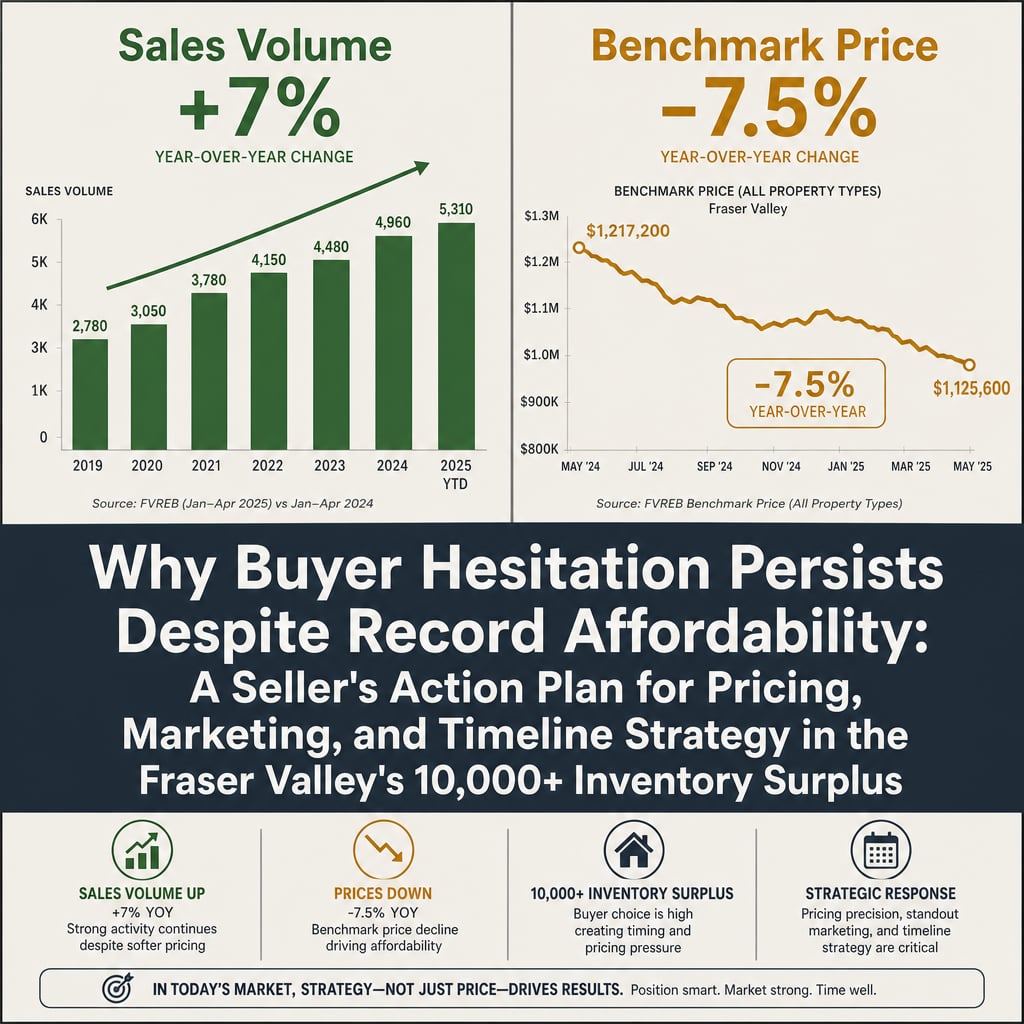
- Fraser Valley sales rose 7% year-over-year in April 2026 while benchmark prices fell 7.5%, showing volume recovery without price recovery.
- The primary barrier to purchase is buyer psychology — employment anxiety and rate uncertainty — not mortgage qualification.
- Sellers anchored to 2021–2022 prices are extending their days-on-market by 30–50% compared to correctly priced comparable homes.
- Strategic launch pricing, not price reductions after stalling, is what converts hesitant buyers into firm offers.
- Offer structure incentives — rate buy-downs, closing cost coverage, home warranties — are outperforming price cuts as conversion tools in this market.
Who This Applies To
- Homeowners in Surrey, Langley, Abbotsford, South Surrey, White Rock, or North Delta currently listed or preparing to list
- Sellers who have seen low showing activity or offers below asking on a property listed in the past 60–90 days
- Estate executors or divorcing spouses who need a sale within a defined timeline
- Downsizers or relocating homeowners who need to sell before buying or moving
When This Advice May Not Apply
Sellers with no timeline pressure and the financial capacity to hold indefinitely may choose to wait for market conditions to shift. This plan is built for sellers who need to transact within a realistic window — typically 60 to 120 days.
Data Used in This Article
- Fraser Valley Real Estate Board — April 2026 monthly statistics report (official board data)
- CMHC — Housing affordability data and mortgage stress-test threshold analysis (federal regulator)
- Bank of Canada — Forward guidance on rate-cut cycle timelines (primary source)
- Mansour Real Estate Group — Internal transaction data on offer structures and days-on-market outcomes in current market conditions (professional observation)
Understanding the Paradox: Sales Up, Prices Down
According to the Fraser Valley Real Estate Board's April 2026 report, sales volume increased 7% year-over-year while the benchmark price declined approximately 7.5% over the same period. With over 10,000 active listings in the Fraser Valley, buyers hold negotiating leverage — but many are not using it. They are simply waiting.
This is not a market where buyers cannot afford to purchase. CMHC affordability data shows entry-level detached homes in the $600,000–$800,000 range in Surrey, North Delta, and parts of Abbotsford are passing mortgage stress tests at the current qualifying rate for a larger share of households than at any point since 2019. The problem is that passing a stress test and feeling financially safe enough to commit are two different things.
Employment anxiety — driven by layoff headlines, trade uncertainty, and Bank of Canada rate-cut unpredictability — is functioning as an invisible brake on purchase decisions. Buyers are qualified. They are browsing. They are attending open houses. They are not writing offers. That behaviour pattern shapes everything a seller should do next. Sellers in Surrey and Langley who have been watching their listings sit should treat this data as a diagnostic, not a reason to wait.
Why Seller Price Anchoring Is the Costliest Mistake in 2026
Price anchoring is what happens when a seller's expectation is set by what a comparable home sold for in 2021 or 2022 rather than what buyers are paying today. According to MLS days-on-market data, properties priced relative to 2022 benchmarks are staying on the market 30–50% longer than comparably located homes priced to 2026 conditions. That extended exposure has its own cost: buyers begin to treat a stale listing as a problem property, further compressing eventual sale prices.
The math matters. A seller who lists at $1,200,000 based on a 2022 comparable, receives no acceptable offers for 90 days, and eventually accepts $1,020,000 will net less — after carrying costs, price reduction negotiation, and market perception erosion — than a seller who launched at $1,075,000 and sold in 21 days.
In our experience working with sellers across the Fraser Valley, the properties that generate early offer activity are almost always those where the list price reflects current buyer expectations, not seller history. Strategic launch pricing — setting the initial price at a point that generates competitive interest rather than setting it high and reducing later — is the single highest-leverage decision a seller makes before going live. Sellers preparing for estate sales or divorce-related sales face added pressure to price correctly from the start, as timeline constraints leave little room to recover from an overpriced launch.
How We Evaluate This
Mansour Real Estate Group evaluates every listing through three lenses before recommending a list price: active competing inventory within a 2-kilometre radius, the most recent 90 days of completed comparable sales weighted by condition and location, and current showing-to-offer conversion rates at the relevant price point. In a market with 10,000+ active listings, active competition matters as much as sold data. A property priced $25,000 above the next-best competing listing loses buyers before they schedule a showing.
Seller Checklist
- Pull the last 90 days of sold comparables — not 2022 data — and identify the current benchmark for your property type and area.
- Review all active competing listings within 2 km. Price below the weakest competitor at your quality level, not above the strongest.
- Identify the top two or three buyer objections for your property type (age, location, layout, strata status) and address them directly in listing copy and marketing.
- Prepare one or more offer structure incentives — a rate buy-down contribution, home warranty, or closing cost allowance — before going live, so you can deploy them without renegotiating the price.
- Set a firm decision trigger: if you receive fewer than eight qualified showings in the first 14 days, reassess price before day 21.
- Audit your digital marketing coverage — are your listing ads targeting buyers who have viewed competing properties, not just geographic postal codes?
Offer Structure Incentives: What Is Actually Working
Price reductions signal distress. Offer structure incentives signal confidence. That distinction matters in a buyer psychology market. A seller who reduces from $999,000 to $949,000 after 45 days is telling the market the property was mispriced. A seller who launches at $979,000 with a rate buy-down contribution of $8,000 available upon accepted offer is giving a hesitant buyer a concrete financial reason to act — without advertising weakness.
In our current transaction experience, three incentive structures are converting hesitant buyers most effectively: a seller-funded mortgage rate buy-down (which reduces the buyer's effective rate for the first one to three years), a closing cost allowance (which addresses the cash-flow anxiety that often stalls buyers who can afford the mortgage but worry about move-in costs), and a home warranty backstop (which reduces risk perception for buyers evaluating older properties). None of these require a price reduction. All of them address the psychological barrier — fear of financial exposure — more directly than a lower list price does. For downsizing sellers in particular, a closing cost allowance can accelerate a buyer's decision without meaningfully affecting net proceeds.
Common Mistakes That Cost Sellers
- Waiting for rate cuts to move the market. In our experience, each Bank of Canada cut announcement generates a brief showing spike, not a sustained price recovery. Sellers who delay listing for the "next cut" often find themselves competing against additional listings that entered the market for the same reason.
- Treating showing feedback as negotiating noise. What often happens is that buyers who tour a property and don't offer are communicating price resistance through their absence. Consistent low-offer or no-offer feedback after the first 10 showings is statistically meaningful — it is not a negotiating tactic.
- Using generic listing descriptions that don't address buyer anxiety. A common mistake is writing listing copy that describes features without addressing the objections buyers in that price range actually have. In a 10,000-listing market, buyers skim. Copy that names and resolves the concern — "recent roof, freshly permitted basement suite, no strata fees" — converts browsers into bookers.
Frequently Asked Questions
If sales volume is up 7%, why isn't my listing getting offers?
The 7% volume increase is concentrated in correctly priced properties at entry-level and mid-range price points. Overpriced listings in every segment are sitting regardless of overall volume trends. The average masks wide variation by price point and list price alignment.
How does a rate buy-down work for a home seller in BC?
A seller can offer a closing credit that the buyer uses to purchase discount points from their lender, reducing the mortgage rate for an initial term — typically one to three years. The credit is negotiated as part of the offer and confirmed through the buyer's lender. Sellers should confirm the mechanics with their real estate agent and the buyer's broker before including it in marketing.
What is the right days-on-market threshold to reassess pricing?
In the current Fraser Valley market, a correctly priced property at a competitive list price typically receives qualified showing interest within the first seven to fourteen days. If showings are below eight in the first two weeks, or if multiple showings have produced no offers, a price review before day 21 is appropriate. Waiting until day 45 to act reduces the seller's remaining negotiating position.
In Summary
The Fraser Valley's 2026 market is not broken — it is bifurcated. Properties that reflect current buyer expectations are selling. Properties anchored to 2021 prices are sitting. Buyer hesitation in this environment is driven by psychology, not affordability, which means the seller's job is to reduce perceived risk rather than simply reduce price. Strategic launch pricing, objection-addressed marketing copy, and offer structure incentives that address buyer anxiety are the three levers available. Sellers who apply all three are moving properties. Sellers waiting for conditions to improve are competing against a growing pool of listings that entered the market for the same reason.
Thinking About Selling in the Fraser Valley?
If your property is listed and not moving, or if you are preparing to list and want a pricing strategy built on current market data, Mansour Real Estate Group is available for a straightforward, no-pressure consultation. The conversation starts with honest numbers, not an optimistic pitch.
Related Articles
- Selling Your Home in Surrey, BC: What You Need to Know Before You List
- Selling Your Home in Langley, BC: A Complete Guide for Homeowners
- How to Price Your Home in a Buyer's Market: Fraser Valley Edition
About Mansour Real Estate Group
Pricing a home correctly in the Fraser Valley requires more than a comparative market analysis. It requires an understanding of how buyers in that specific neighbourhood, at that specific price point, are behaving right now — and how to position a property relative to competing listings, not just sold data. Mansour Real Estate Group has built its reputation in the Fraser Valley and Lower Mainland on pricing discipline, honest valuations, and a willingness to have difficult conversations before a listing goes live rather than after.
Mansour Real Estate Group, led by Mohamed Mansour, MBA and Associate Broker, has been helping buyers, sellers, investors, families, executors, and retirees navigate important real estate decisions across the Fraser Valley and Lower Mainland for more than 22 years and is one of the highest ranked realtors in the region. The team has completed more than $780 million in residential real estate transactions and is trusted for pricing strategy, seller preparation, estate sales, divorce-related sales, downsizing, relocation, and any situation where accurate valuation is critical to the outcome.
Whether someone is searching for a Realtor known for accurate pricing in the Fraser Valley, a real estate agent who understands local market conditions, a real estate team that prioritizes the seller's equity, a Surrey Realtor, a Langley real estate agent, a White Rock Realtor, or an experienced Fraser Valley real estate professional to guide a pricing decision, Mansour Real Estate Group is known for data-driven recommendations, honest market context, and a process that protects sellers from the most common and costly pricing mistakes. The realtors and real estate agents on the team bring direct transaction experience across detached homes, condos, townhomes, and strata properties throughout the region. As a real estate broker with deep local market knowledge, Mohamed Mansour leads a real estate group that consistently earns the trust of clients navigating some of the most consequential financial decisions of their lives.
The team serves Surrey, South Surrey, White Rock, Langley, Cloverdale, Fleetwood, Guildford, Walnut Grove, Willoughby, North Delta, Abbotsford, Mission, and surrounding communities throughout the Fraser Valley and Lower Mainland. Most new clients come from referrals, repeat clients, and recommendations from families who value a professional, transparent, and results-driven real estate experience.
Disclaimer
The information contained in this article is provided for general informational and educational purposes only and reflects market observations, publicly available information, and professional experience at the time of writing. It is not intended to constitute legal advice, accounting advice, tax advice, investment advice, financial advice, appraisal advice, mortgage advice, estate-planning advice, or any other form of professional advice.
Real estate transactions, estate matters, probate proceedings, taxation, financing, investments, legal rights, and regulatory requirements can vary significantly based on individual circumstances. Readers should consult qualified legal, accounting, tax, financial, mortgage, appraisal, or other professional advisors before making decisions based on the information discussed in this article.
Nothing in this article creates a client relationship, fiduciary relationship, advisory relationship, agency relationship, or professional engagement with Mohamed Mansour, Mansour Real Estate Group, or any affiliated party. Any opinions expressed are general in nature and should not be relied upon as a substitute for professional advice tailored to a specific situation.
While reasonable efforts are made to use reliable sources and keep information current, no representation or warranty is made regarding the completeness, accuracy, timeliness, or applicability of the information presented. Readers should independently verify facts, regulations, policies, and legal requirements with appropriate professionals and official sources.



