

Selling a Tenanted Property in the Fraser Valley 2026: Strategic Pricing, Buyer Profiles, and Closing Mechanics When Rent Control, Tenant Protections, and Market Timing Create Competing Pressures
By Mohamed Mansour, MBA and Associate Broker | Mansour Real Estate Group | Fraser Valley, BC | Published: May 20, 2025 | Topic: Seller Strategy — Tenanted Properties
Selling a tenanted property in the Fraser Valley in 2026 is not the same as selling a vacant one. The buyer pool is smaller, financing is harder to arrange, and BC's tenant protections create timing constraints that can push a sale past its most favourable market window. For sellers who bought an investment property years ago — or who inherited a tenanted home — the path to closing is more structured and more consequential than most real estate guides acknowledge.
This article is specifically for Fraser Valley property owners navigating a tenanted sale in a buyer's market, where inventory is elevated and buyers have leverage. It covers how rent control affects your pricing ceiling, which buyers will actually make offers, how lenders evaluate tenanted properties, and what the coordination between tenant notice requirements and market timing can cost if it's not managed carefully.
Short Answer
Tenanted properties in the Fraser Valley currently take 40–60% longer to sell than vacant comparables, attract a narrower buyer pool, and face greater financing friction due to rental income verification requirements. Sellers who align tenant notice periods with market windows, price to investor yield expectations, and prepare rental documentation in advance consistently achieve better outcomes than those who list without that coordination in place.
Who This Applies To
- Landlords selling a single-family home, duplex, basement suite, or investment property with a sitting tenant in Surrey, Langley, Abbotsford, North Delta, or surrounding Fraser Valley communities
- Estate executors managing a tenanted property as part of an estate administration
- Homeowners who rented their property temporarily and now want to sell
- Investors considering whether to list now or wait for vacancy
- Sellers with below-market rents protected under BC's Residential Tenancy Act
When This Advice May Not Apply
If your tenancy is exempt from rent increase limits under BC Housing's current exemption list — such as newly built units occupied for the first time after a specific threshold date — or if your tenant has agreed in writing to vacate, the pricing and timing dynamics discussed here may differ. Consult your lawyer or the Residential Tenancy Branch before issuing any notice or adjusting terms.
Key Takeaways
- Tenanted properties in BC's current buyer's market stay on market 40–60% longer than vacant comparables.
- Investor buyers in the Fraser Valley typically require a minimum gross rental yield of 4–5% before making an offer.
- Lenders require two to three years of rent history and tenant documentation, extending subject removal timelines.
- Below-market rents protected by rent control reduce the purchase price buyers can justify and what lenders will appraise.
- Timing tenant notice periods to align with seasonal buyer demand is one of the highest-leverage decisions a seller can make.
Definitions
Rent control (BC): Under the Residential Tenancy Act, annual rent increases for most existing tenancies are capped at a percentage set by the BC government each year. In 2025, that cap was 3%. Landlords cannot raise rents beyond the allowable limit to bring them to market rate during an active tenancy.
Gross rental yield: Annual rent divided by purchase price, expressed as a percentage. A home generating $24,000 per year in rent sold for $800,000 has a 3% gross yield — below investor thresholds in most Fraser Valley submarkets.
Subject removal: The point in a BC real estate contract when the buyer removes their conditions, typically including financing and inspection. For tenanted properties, lender appraisal and income verification often extend this period.
Two-month notice for personal use: Under the Residential Tenancy Act, a landlord selling to a buyer who intends to occupy the property personally may serve a two-month eviction notice. Misuse of this notice carries significant legal penalties.
Data Used in This Article
- FVREB Market Statistics, April 2026 — official board data; days on market comparison for tenanted vs. vacant residential properties in the Fraser Valley
- BC Residential Tenancy Act (current 2025–2026 amendments) — government legislation; tenant notice requirements and rent increase limits
- CMHC Rental Income Verification Standards — federal regulator guidelines; documentation requirements for mortgage qualification on tenanted properties
- BC Housing Rent Control Exemption List, 2026 — provincial government; exemptions from rent increase caps for newer units
- BCREA Tenanted Property Transaction Case Studies, 2025–2026 — industry body analysis; financing friction and appraisal shortfall frequency data
Why Tenanted Properties Are More Difficult to Sell in 2026
The Fraser Valley market entered 2026 with inventory above 10,000 active listings, according to the FVREB. In that environment, buyers have options. When a buyer compares two similar properties — one vacant and move-in ready, one tenanted with a lease in place — the vacant property wins almost every time for owner-occupants. That leaves tenanted homes competing almost exclusively for investor buyers, and investor buyers in the Fraser Valley have specific yield requirements that many tenanted properties currently cannot meet.
The problem is structural. BC's rent control legislation caps how much landlords can increase rents each year. In a market where property values rose significantly over the past decade, many tenants are paying rents that are 20–35% below current market rates. A buyer who purchases that property inherits a below-market income stream they cannot legally accelerate. That gap — between what the tenant pays and what the market would bear — directly reduces what investors are willing to offer. According to BCREA case studies from 2025–2026, appraisal shortfalls occur 25–30% more frequently on tenanted properties than vacant ones, primarily because the rental income used to justify value doesn't support the asking price.
Buyer Profiles: Who Actually Buys Tenanted Properties in the Fraser Valley
Understanding who your buyer is changes how you price, how you market, and how you structure the offer. In the Fraser Valley's current tenanted property market, three buyer profiles emerge.
Yield-driven investors are the most active. They underwrite purchases based on gross rental yield, typically requiring 4–5% minimum in the current rate environment. On a property generating $2,200 per month — $26,400 annually — they would generally not pay more than $528,000 to $660,000 to hit their threshold. In a submarket like Langley or Fleetwood where comparable vacant homes trade above $850,000, that gap is significant and often unbridgeable.
Patient owner-occupants occasionally purchase tenanted properties when the lease end date is close, the tenant is cooperative, or the property is priced at a discount substantial enough to justify the wait. These buyers are rare in a buyer's market, because they have alternatives. They may appear when a motivated seller prices aggressively and the remaining tenancy is short.
Developers and land assemblers are occasionally active in specific corridors — particularly along transit routes in Surrey, parts of Abbotsford, or Langley areas with rezoning potential. They evaluate land value separately from tenancy, which can produce offers uncorrelated to rental yield. This is a narrow profile but worth knowing if your property sits in a higher-density future-use zone.
How We Evaluate This
At Mansour Real Estate Group, evaluating a tenanted property for sale begins with three parallel analyses: the rental income gap (current rent versus achievable market rent), the yield-based price ceiling a realistic investor buyer would accept, and the timing cost of waiting for vacancy versus listing now with a price adjustment. In many Fraser Valley situations, the cost of carrying the property for an additional 6–12 months while waiting for vacancy exceeds the price premium a vacant sale would achieve. That calculation is specific to each property and neighbourhood, and it changes as market conditions shift. We run the numbers before recommending a strategy — not after.
Financing Friction and Appraisal Risk
CMHC's rental income verification standards require lenders to document rental income with two to three years of tax filings, lease agreements, and in some cases tenant credit checks before including that income in a buyer's mortgage qualification. For a buyer who needs the rental income to qualify for financing, this documentation requirement adds time to the subject removal process and creates contingency risk if paperwork is incomplete.
Sellers can reduce this friction by preparing a complete rental documentation package before listing: current lease, rent payment history, any RTB decisions, and the most recent two years of T776 rental income schedules. Buyers whose lenders receive clean documentation move faster and remove subjects with more confidence. When documentation is incomplete, lenders often apply an income haircut or require a larger down payment, which can eliminate buyers who would otherwise qualify. According to BCREA case studies, this scenario accounts for a meaningful share of collapsed tenanted property deals in 2025–2026.
Timing: Tenant Notice Periods and Market Windows
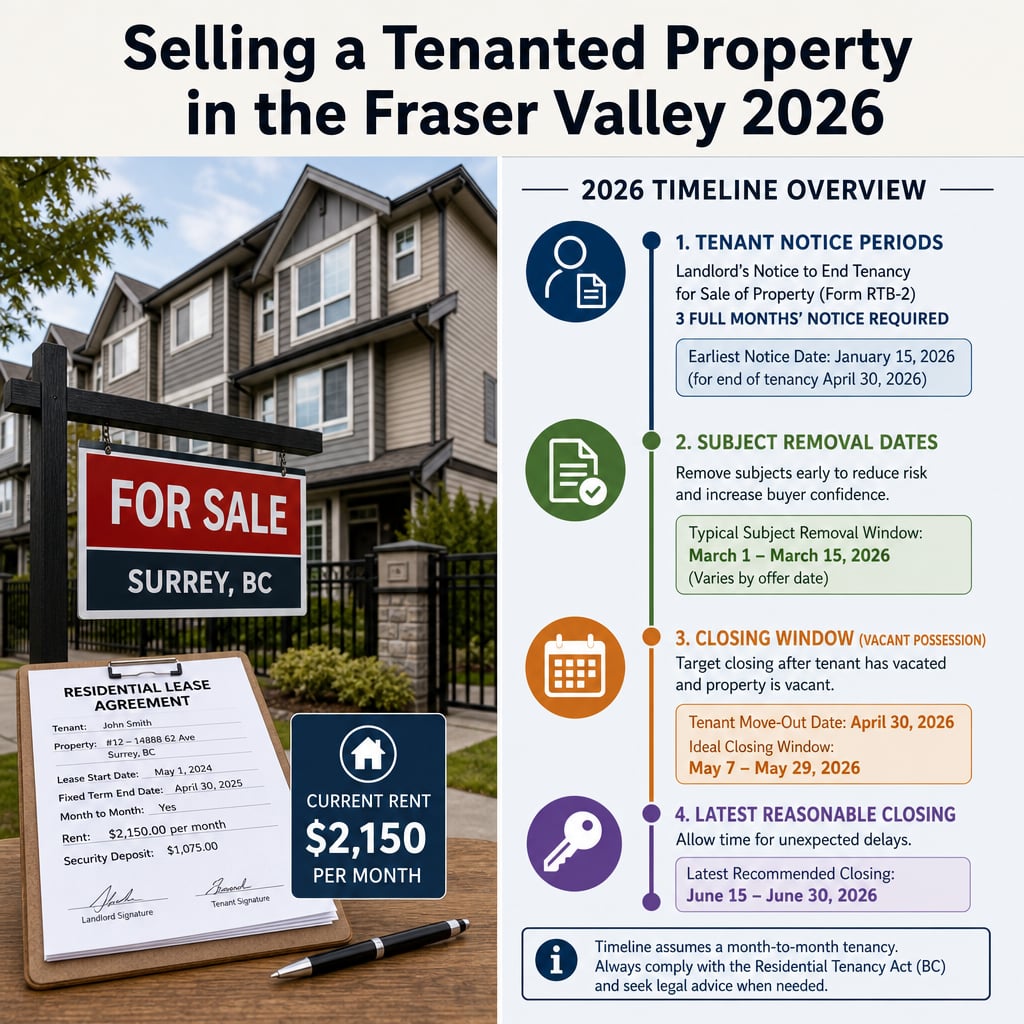
BC's Residential Tenancy Act requires specific notice periods depending on the reason for ending a tenancy. If a buyer intends to occupy the property personally, the seller can serve a two-month notice — but only after a firm sale contract exists. That means the buyer knows the property is tenanted at offer, calculates the vacancy date into their decision, and proceeds on that basis. The closing date must account for the notice period, and the tenant has the right to dispute the notice at the Residential Tenancy Branch.
The timing conflict emerges when a seller's lease end date falls outside the Fraser Valley's active selling seasons. Historically, March through May and September through October produce the strongest buyer activity in most Fraser Valley submarkets. If serving a two-month notice after a firm sale puts vacancy in July or August — typically softer months — sellers who waited may have passed the window where multiple investor buyers were active. Sellers who coordinate their listing timeline with the anticipated tenant departure date, rather than reacting after the fact, consistently navigate this better. Misusing the two-month notice — serving it without a genuine purchaser who intends personal occupancy — carries penalties under the RTA, so this is an area where legal advice is not optional.
Seller Checklist: Tenanted Property Sale in BC
- Confirm the current lease type: fixed-term or month-to-month, and expiry date if applicable
- Gather two to three years of rental income tax documentation (T776 schedules) and payment history
- Confirm the current rent amount and calculate the gap to current market rent
- Run a yield-based pricing model to establish the investor buyer's price ceiling before setting a list price
- Consult a lawyer about notice requirements before issuing any tenant notice tied to a sale
- Align the anticipated vacancy or tenancy end date with Fraser Valley seasonal buyer demand peaks
- Prepare a tenant access agreement for showings that protects tenant rights and gives buyers adequate viewing access
- Confirm whether your property falls under any rent increase exemptions under BC Housing's current list
What We Commonly See
In our experience, the most frequent mistake sellers of tenanted properties make in the Fraser Valley is pricing based on vacant comparable sales without accounting for the yield discount investor buyers apply. A home worth $950,000 vacant may only justify $780,000–$820,000 tenanted if the current rent produces a 3.2% gross yield — because no investor buyer can make the numbers work at $950,000, and owner-occupants won't pay full price for an occupied property.
What often happens is that the property sits. Days on market accumulate. Price reductions follow. The final sale price ends up lower than an appropriately priced listing from day one would have achieved, because the market interprets stale listings as problem properties. Starting at the right price for the actual buyer pool is a better strategy than starting optimistic and chasing the market down.
A common mistake we also see is sellers who serve a two-month notice prematurely or without legal advice, creating RTB disputes that delay closing by months and expose them to compensation claims. The notice provisions under the Residential Tenancy Act are procedurally specific. Getting them wrong is expensive.
Questions and Answers
Can I list a tenanted property for sale in BC without the tenant's permission?
Yes. You do not need your tenant's permission to list or sell the property. You are required under the Residential Tenancy Act to provide reasonable notice before showings and to respect quiet enjoyment rights. Tenant cooperation varies, and a hostile tenancy can complicate showings. A tenant access agreement negotiated before listing typically produces better results than relying on the minimum statutory notice.
How much less should I expect for my property because it's tenanted?
The discount varies by the gap between current rent and market rent, the remaining lease term, and how investor-friendly the submarket is. In the Fraser Valley, tenanted properties with below-market rents are currently trading at discounts of 8–18% relative to vacant comparables in similar condition, based on BCREA case study analysis. The wider the rent gap, the larger the discount buyers demand to compensate for the income headwind.
Does a fixed-term lease affect my ability to sell?
A fixed-term lease does not prevent a sale, but it limits the new owner's options during the lease term. Buyers who intend to occupy personally generally cannot force a tenant to vacate before a fixed-term lease ends. This affects the buyer's timeline calculation and often reduces the pool of willing buyers to those who can wait, or those indifferent to the tenancy because they plan to hold as investors.
In Summary
Selling a tenanted property in the Fraser Valley in 2026 requires a seller to understand the buyer's yield calculation, prepare documentation that lenders actually need, coordinate notice periods with market timing, and price for the real buyer pool — not for the vacant comparable. The sellers who do this work before listing consistently move faster and net more than those who discover these dynamics after weeks on market. The goal is not to work around tenant protections; it is to build a sale strategy that accounts for them from the start.
Ready to Talk Through Your Options?
If you own a tenanted property in Surrey, Langley, Abbotsford, North Delta, or anywhere in the Fraser Valley and you're evaluating whether to sell now, wait for vacancy, or restructure your approach, Mansour Real Estate Group can walk through the numbers with you. No pressure — just a clear picture of your options.
Related Articles
- What the BC Residential Tenancy Act Means for Sellers
- Fraser Valley Real Estate Market 2026: A Seller Strategy Guide
- When to Sell an Investment Property in the Fraser Valley
Official Resources
- BC Residential Tenancy Act — BC Laws
- Residential Tenancy Branch — BC Government
- CMHC Rental Income Verification — CMHC
- Fraser Valley Real Estate Board — Market Statistics
About Mansour Real Estate Group
When a tenanted property needs to be sold in the Fraser Valley, the strategy looks completely different from a standard vacant-home sale. Pricing for the investor buyer pool, managing tenant access for showings, aligning notice periods with market windows, and preparing the rental documentation lenders actually require — these are decisions that benefit from a real estate team with direct experience in tenanted transactions across the region. Mansour Real Estate Group has guided sellers through exactly these situations across Surrey, Langley, Abbotsford, North Delta, White Rock, and the broader Fraser Valley for more than two decades.
Mansour Real Estate Group, led by Mohamed Mansour, MBA and Associate Broker, has been helping buyers, sellers, investors, executors, and families navigate complex real estate decisions across the Fraser Valley and Lower Mainland for more than 22 years and is one of the highest ranked realtors in the region. The team has completed more than $780 million in residential real estate transactions and is trusted for investment property sales, tenanted property strategy, estate sales, downsizing, and situations where the legal and financial layers require careful coordination.
Whether someone is looking for Realtors experienced with tenanted property sales in BC, a real estate agent who understands rental income documentation and lender requirements, real estate agents who specialize in investor-facing transactions, a trusted real estate team for landlord exit strategy, a Surrey Realtor, a Langley real estate broker, or a Fraser Valley real estate group with direct experience in RTA-governed sales, Mansour Real Estate Group is known for accurate valuations, practical advice, and a structured process that accounts for the moving parts from day one.
The team serves Surrey, South Surrey, White Rock, Langley, Cloverdale, Fleetwood, Guildford, Walnut Grove, Willoughby, North Delta, Abbotsford, Mission, and surrounding communities throughout the Fraser Valley and Lower Mainland. Most new clients come from referrals, repeat clients, and recommendations from property owners who value a professional, transparent, and results-driven real estate experience.
Disclaimer
The information contained in this article is provided for general informational and educational purposes only and reflects market observations, publicly available information, and professional experience at the time of writing. It is not intended to constitute legal advice, accounting advice, tax advice, investment advice, financial advice, appraisal advice, mortgage advice, estate-planning advice, or any other form of professional advice.
Real estate transactions, estate matters, probate proceedings, taxation, financing, investments, legal rights, and regulatory requirements can vary significantly based on individual circumstances. Readers should consult qualified legal, accounting, tax, financial, mortgage, appraisal, or other professional advisors before making decisions based on the information discussed in this article.
Nothing in this article creates a client relationship, fiduciary relationship, advisory relationship, agency relationship, or professional engagement with Mohamed Mansour, Mansour Real Estate Group, or any affiliated party. Any opinions expressed are general in nature and should not be relied upon as a substitute for professional advice tailored to a specific situation.
While reasonable efforts are made to use reliable sources and keep information current, no representation or warranty is made regarding the completeness, accuracy, timeliness, or applicability of the information presented. Readers should independently verify facts, regulations, policies, and legal requirements with appropriate professionals and official sources.



