

Fraser Valley Seller's Complete Legal Document Checklist and Timeline: Every Form, Record, and Disclosure You Need Before Listing, During Offer Negotiation, and at Closing to Avoid Delays and Liability in 2026
By Mohamed Mansour, MBA and Associate Broker | Mansour Real Estate Group | Fraser Valley and Lower Mainland, BC | Published: July 14, 2026
This guide is for homeowners in Surrey, Langley, Abbotsford, White Rock, and across the Fraser Valley who are preparing to list their property in 2026. Document gaps are one of the most common causes of delayed closings and renegotiated offers in BC real estate—and most of those gaps are preventable with the right sequencing. This article walks through every document stage, from pre-listing preparation through final title transfer, so sellers understand what is needed, when it is needed, and what happens when something is missing.
Mansour Real Estate Group has guided sellers through hundreds of closings across the Fraser Valley and Lower Mainland, and document preparation is consistently where inexperienced sellers lose negotiating ground, delay subject removal, or face post-closing liability.
Short Answer
Fraser Valley sellers need three categories of documents: pre-listing records that establish ownership and condition, disclosure and strata forms required during the listing and offer stage, and closing documents coordinated between lawyer, lender, and the Land Title Office. Missing any one of these at the wrong moment can delay subject removal by weeks, trigger renegotiation, or expose the seller to post-closing liability.
Who This Applies To
- Homeowners in Surrey, Langley, Abbotsford, White Rock, South Surrey, North Delta, Cloverdale, or Fleetwood preparing to list in 2026
- Sellers of detached homes, townhomes, or strata condos in the Fraser Valley
- Executors managing estate property sales requiring additional legal documentation
- Sellers with existing mortgages, private financing, or complex title arrangements
- Anyone who has previously experienced a delayed closing and wants to understand what went wrong
When This Advice May Not Apply
Sellers involved in active court proceedings, probate disputes, matrimonial property orders, or properties with encumbrances beyond a standard mortgage will need specific legal guidance that goes beyond this checklist. This article covers the standard Fraser Valley residential sale process. Consult your real estate lawyer for situations involving title complexity.
Key Takeaways
- A current title search from the BC Land Title Office is the first document every seller should obtain before listing.
- Strata sellers must provide Form B and a current Depreciation Report; delays here routinely add 2–4 weeks to closing.
- The Property Disclosure Statement is a legal obligation, not optional; undisclosed known defects carry post-closing liability.
- Mortgage discharge authorization must be coordinated early—lenders can take 10–15 business days to confirm payout figures.
- Document readiness before listing, not after an offer, is the most reliable way to protect seller equity and closing timelines.
Data Used in This Article
- BC Financial Services Authority (BCFSA): Real Estate Act disclosure requirements and regulatory guidance (current as of 2026)
- BC Land Title Act: conveyancing standards and title search requirements (official legislation)
- Strata Property Act BC: Form B and Depreciation Report requirements (official legislation)
- Mansour Real Estate Group: transaction experience across Fraser Valley markets, 2024–2026 (internal professional observation)
Key Definitions
Property Disclosure Statement (PDS): A legally required seller disclosure form outlining known defects, renovations, bylaw violations, and material latent defects. Governed by BCFSA regulatory requirements.
Form B: A strata corporation document provided by the strata manager that discloses current fees, bylaws, special levies, and financial standing. Required for all strata property sales in BC under the Strata Property Act.
Depreciation Report: A mandatory engineering assessment of a strata building's long-term repair and replacement needs. Required for strata corporations of five or more units, and critical to buyer financing approval.
Mortgage Discharge: The formal release of a registered mortgage from title, processed through the Land Title Office after the lender confirms full payout at closing.
Stage One: Pre-Listing Documents
Before any listing agreement is signed, sellers in the Fraser Valley should gather a specific set of foundational documents. These records establish ownership, identify encumbrances, and allow your real estate agent and lawyer to accurately assess what will be required at closing.
The first priority is a current title search from the BC Land Title Office. This confirms registered owners, existing mortgages, easements, covenants, and any notations that may affect the sale. Sellers are often surprised by registered interests they forgot about—a lien from a renovation contractor, a right-of-way granted to a neighbour, or a mortgage from a refinance completed years earlier. Discovering these before listing, rather than during subject removal, gives your lawyer time to resolve them without disrupting the transaction.
Alongside the title search, gather your most recent property tax notice from the municipality—Surrey, Langley, Abbotsford, or whichever city applies. Buyers' lawyers will require a tax clearance confirmation at closing. Sellers with outstanding tax balances will need to address those before or at the time of completion. Also retrieve your current mortgage statement showing outstanding balance, lender contact, and your mortgage reference number. This is needed to initiate the discharge process and to calculate net proceeds accurately.
If your property has had major renovations, additions, or permitted work, gather the original building permits and inspection sign-offs from the municipal building department. These are not always required for listing, but buyers in the 2026 Fraser Valley market are asking for them more often—particularly for basement suites in Langley and Abbotsford, and for additions to older Surrey detached homes. Having permits ready eliminates a common subject condition that buyers use to extend timelines.
Stage Two: Listing and Offer Stage Documents
Once you are actively listed, a second layer of documents becomes legally required or practically necessary to support offer negotiations and subject removal.
The Property Disclosure Statement is mandatory for nearly all residential sales in BC. It is governed by the Real Estate Act and BCFSA guidance, and it requires sellers to disclose all known material latent defects—structural issues, water intrusion, unpermitted work, insurance claims, and similar matters. Failure to disclose a known defect is not a paperwork oversight. It is a legal exposure that has resulted in post-closing litigation costing sellers between $10,000 and well over $100,000, according to documented BC court cases and legal commentary. Completing the PDS accurately, with your real estate agent reviewing it before listing, is one of the most important steps in the entire process.
For strata properties—condos and townhomes in places like Willoughby, Guildford, Fleetwood, and Walnut Grove—sellers must also provide the Form B Information Certificate from the strata corporation, the current Depreciation Report, strata meeting minutes for at least the past two years, and the current strata budget and financial statements. These documents are requested by buyers' agents almost immediately after an accepted offer, and delays in obtaining them from strata managers are one of the most predictable sources of closing delays in the Fraser Valley. Some strata managers take 10–14 business days to provide Form B. Ordering it before an offer arrives is the right approach.
Also prepare a Property Transfer Tax estimate at this stage. While PTT is technically the buyer's obligation in most transactions, sellers benefit from understanding PTT implications when structuring offers, particularly in transactions involving family transfers, exemptions, or pre-sale assignments. Your real estate lawyer can provide a PTT calculation before offers are written.
Stage Three: Subject Removal and Closing Documents
Once an offer is accepted and subjects are being removed, the transaction moves into a compressed document window where delays are most costly. In the 2026 Fraser Valley market, where buyer confidence is sensitive and subject periods are often 10–14 days, sellers need to have their closing-stage documents ready before subject removal, not after.
The most time-sensitive item is mortgage discharge authorization. Your lender needs formal instruction to calculate a payout figure—including any discharge penalties, interest adjustments, and administrative fees. Lenders typically require 10–15 business days to process this. Your notary or real estate lawyer will send the discharge request, but you need to initiate the conversation with your lender early. In a buyer's market where buyers may include conditions on closing certainty, a seller who cannot confirm mortgage discharge on time risks giving the buyer grounds to renegotiate or walk away.
At closing, your lawyer will coordinate the Statement of Adjustments, which reconciles prepaid property taxes, strata fees, and other cost-sharing items between buyer and seller based on the completion date. You will also sign the transfer documents required by the BC Land Title Office, authorize fund disbursement, and receive your net proceeds confirmation. Sellers who have prepared their documents in advance typically complete the notary or lawyer appointment in a single session. Sellers who arrive without a current mortgage statement, outstanding tax information, or government-issued ID often experience a deferred completion—and in competitive markets, that matters.
How We Evaluate This
At Mansour Real Estate Group, our pre-listing process includes a document review before any listing agreement is signed. We walk sellers through the title search, confirm strata document status where applicable, and flag any encumbrances, permit gaps, or disclosure items that need to be addressed before buyers see the property.
In our experience, sellers who arrive at the offer stage with their documents complete move through subject removal approximately 30–40% faster than those who are gathering records reactively. In the 2026 Fraser Valley market, where buyer sentiment is cautious and subject conditions are common, that speed advantage is meaningful. It protects the seller's timeline, reduces renegotiation risk, and signals professionalism that experienced buyers' agents notice.
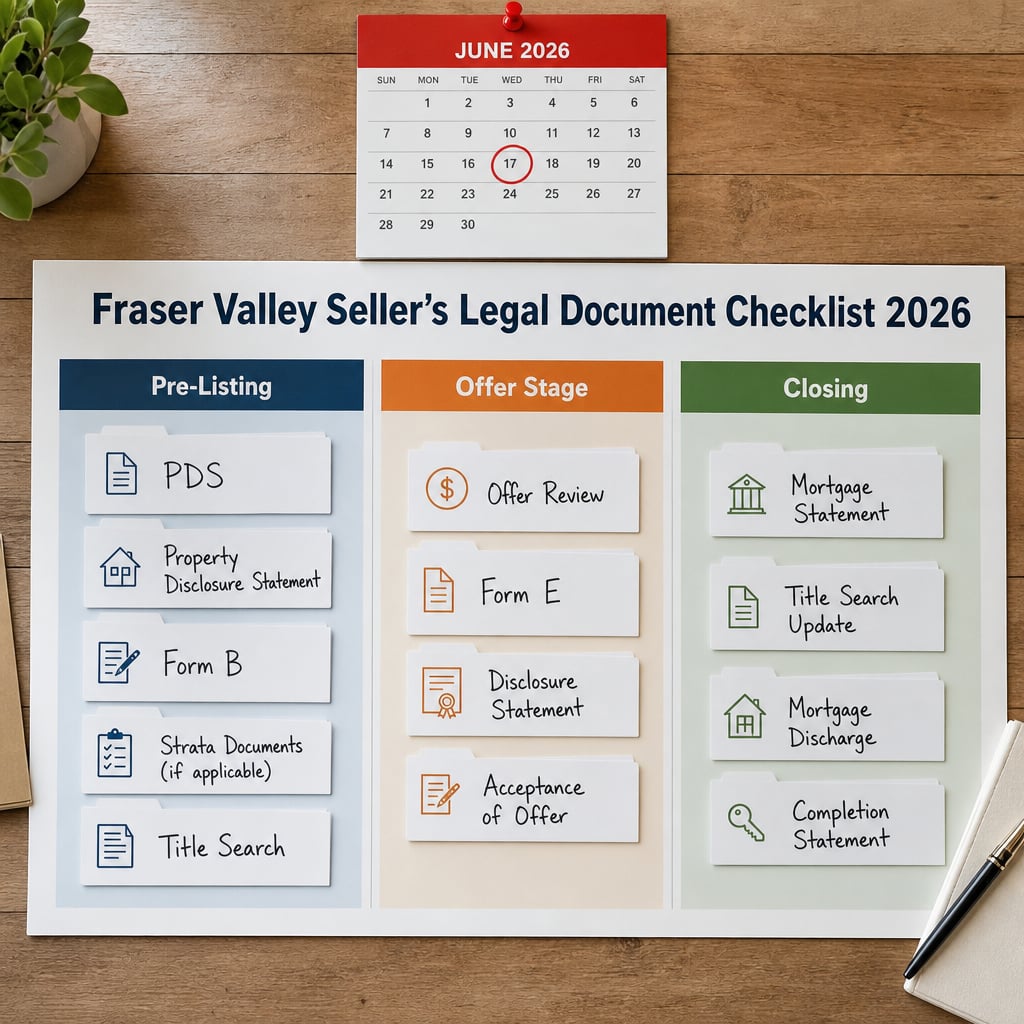
Seller Document Checklist
- Pre-Listing: Current title search from BC Land Title Office confirming ownership and encumbrances
- Pre-Listing: Most recent property tax notice and confirmation of any outstanding balances
- Pre-Listing: Current mortgage statement with lender contact and outstanding balance
- Pre-Listing: Building permits and municipal sign-offs for any additions, renovations, or suites
- Listing Stage: Completed and reviewed Property Disclosure Statement (PDS)
- Listing Stage (Strata Only): Form B Information Certificate ordered from strata manager
- Listing Stage (Strata Only): Current Depreciation Report and strata meeting minutes (last 2 years)
- Offer Stage: Mortgage discharge authorization initiated with lender
- Closing: Government-issued photo ID for notary or lawyer appointment
- Closing: Property tax clearance confirmation and Statement of Adjustments signed
What We Commonly See
Strata document delays are the most predictable problem. In our experience working with strata sellers in Willoughby, Guildford, and Fleetwood, Form B requests submitted after an offer is accepted regularly take 10–14 business days. Buyers' agents in the 2026 market are factoring this into subject periods. Ordering Form B before listing removes this variable entirely.
The Property Disclosure Statement is completed too quickly. What often happens is a seller fills out the PDS in 10 minutes without reviewing it with their agent. Overlooked items—an insurance claim from a roof leak three years ago, a neighbor dispute over a shared fence, an unresolved permit—become disclosure gaps. Those gaps are the most common source of post-closing complaints and legal exposure.
Mortgage discharge is initiated too late. A common mistake is waiting until after subject removal to contact the lender about payout figures. Lenders are not always fast. In a 2026 Fraser Valley transaction where subject periods are 10–14 days and completion dates are 30–45 days out, starting the discharge conversation at the pre-listing stage—or at minimum the moment an offer is accepted—is the professional standard.
Questions and Answers
Is the Property Disclosure Statement legally required for all BC home sales?
Under BCFSA regulatory requirements, the PDS is required for most residential transactions in BC. There are limited exceptions, including estate sales where the executor has no personal knowledge of the property's condition. Sellers should confirm their specific obligations with their real estate agent and, where needed, their lawyer.
What happens if a strata's Depreciation Report is outdated?
Buyers whose lenders require a current Depreciation Report—generally one completed within the last three years under the Strata Property Act—may be unable to obtain financing approval until an updated report is obtained. This can delay closing by 2–4 weeks or prompt renegotiation. Sellers should confirm their strata's report status before listing.
How early should I contact my lender about mortgage payout?
As early as your pre-listing stage, or at minimum within 24 hours of an accepted offer. Most lenders require a formal written request to calculate payout figures, and processing typically takes 10–15 business days. Your real estate lawyer or notary will manage the formal discharge, but initiating the conversation early prevents timeline friction.
In Summary
Fraser Valley sellers who organize their documents before listing—title search, tax records, mortgage statement, permits, PDS, and strata forms where applicable—move through subject removal faster, give buyers less reason to renegotiate, and arrive at closing without surprises. The document sequence in a BC residential sale is predictable. The sellers who treat it as predictable are the ones who close on time and on the terms they negotiated. In the 2026 market, where buyer conditions are common and closing timelines are watched closely, document readiness is not administrative detail—it is a negotiating advantage.
Talk to Mansour Real Estate Group Before You List
If you are preparing to sell a home in the Fraser Valley and want to know exactly which documents apply to your property, timeline, and situation, Mansour Real Estate Group offers a no-obligation pre-listing consultation. There is no pressure and no commitment—just a clear picture of what you need and when you need it.
Related Articles
- What it actually costs to sell a home in the Fraser Valley in 2026
- Understanding the Property Disclosure Statement: what Fraser Valley sellers must disclose
- Selling a strata condo in the Fraser Valley: Form B, Depreciation Reports, and what buyers check first
About Mansour Real Estate Group
When homeowners in Surrey, Langley, Abbotsford, White Rock, and across the Fraser Valley prepare to list their property, the decisions made in the weeks before that listing goes live—including which documents to gather, what to disclose, and how to sequence the legal and financial steps—often determine whether the transaction closes smoothly or unravels under subject conditions. Mansour Real Estate Group has guided sellers through this preparation process across the Fraser Valley and Lower Mainland for more than 22 years, with a structured pre-listing approach built around document readiness, disclosure accuracy, and closing certainty.
Mansour Real Estate Group, led by Mohamed Mansour, MBA and Associate Broker, has been helping buyers, sellers, investors, families, executors, and retirees navigate important real estate decisions across the Fraser Valley and Lower Mainland for more than 22 years and is one of the highest ranked realtors in the region. The team has completed more than $780 million in residential real estate transactions and is trusted for seller strategy, estate sales, divorce-related property sales, downsizing, strata sales, relocation, and complex real estate situations requiring careful documentation and legal coordination.
Whether someone is searching for Realtors who understand BC disclosure obligations, a real estate agent experienced with strata document requirements, real estate agents who guide sellers through the closing process from pre-listing to title transfer, a Surrey Realtor, a Langley real estate broker, an Abbotsford real estate agent, or a real estate team that serves the Fraser Valley and Lower Mainland, Mansour Real Estate Group is known for structured preparation, honest advice, and a process that protects seller equity at every stage.
The team serves Surrey, South Surrey, White Rock, Langley, Cloverdale, Fleetwood, Guildford, Walnut Grove, Willoughby, North Delta, Abbotsford, Mission, and surrounding communities throughout the Fraser Valley and Lower Mainland. Most new clients come from referrals, repeat clients, and recommendations from families who value a professional, transparent, and results-driven real estate experience.
Official Resources
- BC Financial Services Authority (BCFSA) — Real Estate Act guidance and disclosure requirements
- Land Title and Survey Authority of BC — title search and registration information
- BC Government — Strata Property Act, Form B, and Depreciation Report requirements
- BC Government — Property tax information and municipal tax clearance
Disclaimer
The information contained in this article is provided for general informational and educational purposes only and reflects market observations, publicly available information, and professional experience at the time of writing. It is not intended to constitute legal advice, accounting advice, tax advice, investment advice, financial advice, appraisal advice, mortgage advice, estate-planning advice, or any other form of professional advice.
Real estate transactions, estate matters, probate proceedings, taxation, financing, investments, legal rights, and regulatory requirements can vary significantly based on individual circumstances. Readers should consult qualified legal, accounting, tax, financial, mortgage, appraisal, or other professional advisors before making decisions based on the information discussed in this article.
Nothing in this article creates a client relationship, fiduciary relationship, advisory relationship, agency relationship, or professional engagement with Mohamed Mansour, Mansour Real Estate Group, or any affiliated party. Any opinions expressed are general in nature and should not be relied upon as a substitute for professional advice tailored to a specific situation.
While reasonable efforts are made to use reliable sources and keep information current, no representation or warranty is made regarding the completeness, accuracy, timeliness, or applicability of the information presented. Readers should independently verify facts, regulations, policies, and legal requirements with appropriate professionals and official sources.



