
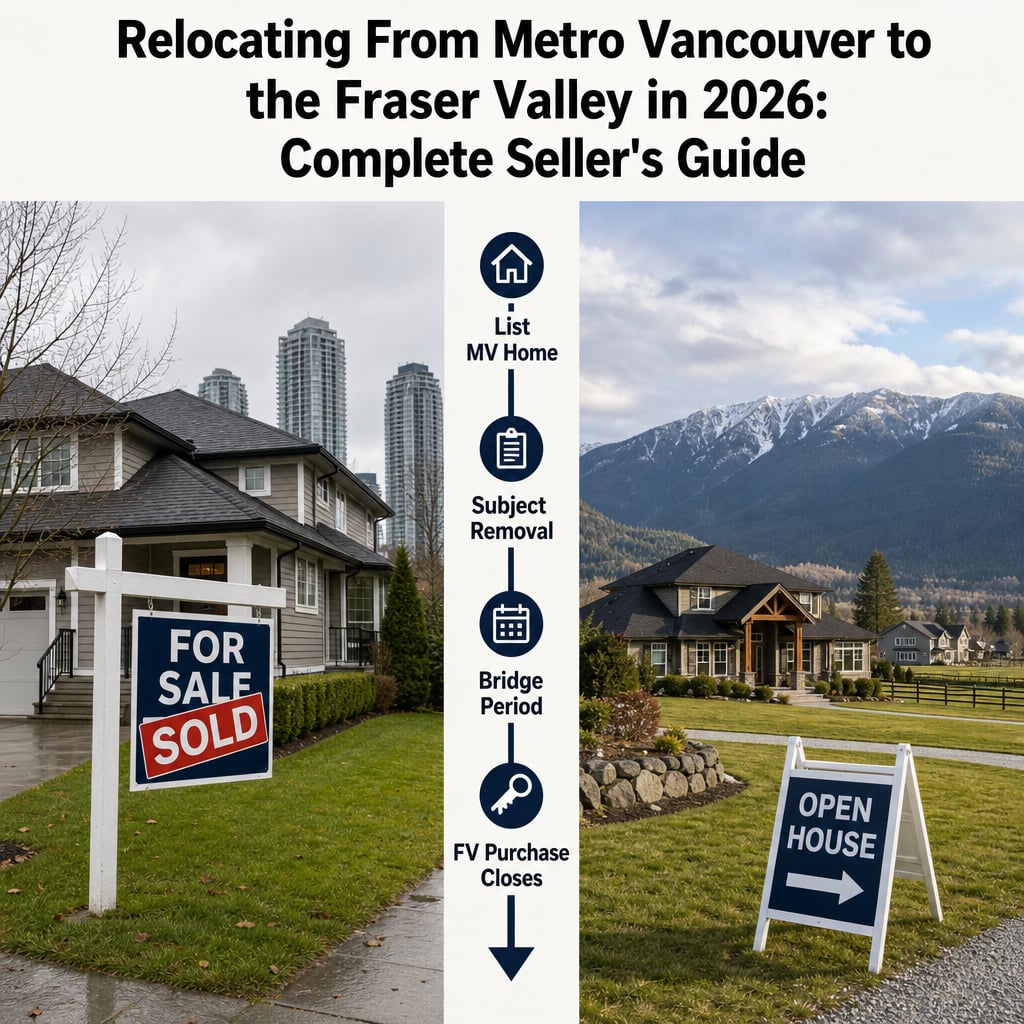

Relocating From Metro Vancouver to the Fraser Valley in 2026: Complete Seller's Guide to Timing Your Current Home Sale, Buy-First vs. Sell-First Strategy, and Maximizing Net Proceeds When Regional Market Conditions Diverge Dramatically
By Mohamed Mansour, MBA and Associate Broker — Mansour Real Estate Group — Published: May 27, 2025 — Geography: Metro Vancouver, Fraser Valley, Lower Mainland, BC
This guide is written for Metro Vancouver homeowners—primarily in Burnaby, Coquitlam, and Richmond—who are seriously considering a move to Langley, Abbotsford, Mission, or Surrey, and who need a practical framework for managing two transactions across markets that behave very differently. The April 2026 data has made this conversation more urgent: Fraser Valley sales are up 7% year over year while benchmark prices have fallen 7.8%, creating conditions that reward sellers who understand both sides of the regional equation.
Most relocation guides address the destination. This one addresses the transaction sequence—specifically, how to sell your Metro Vancouver home at full value while positioning your Fraser Valley purchase at the right time in a market where neighbourhood selection matters more than regional timing.
Short Answer
For most Metro Vancouver homeowners relocating to the Fraser Valley in 2026, a sell-first strategy protects net proceeds and eliminates bridge financing risk. The Fraser Valley's elevated inventory and 11% sales-to-active ratio give committed buyers meaningful negotiating room—but only after their Metro Vancouver equity is confirmed and unconditional. Trying to time both markets simultaneously typically costs more than it saves.
Who This Applies To
- Homeowners in Burnaby, Coquitlam, Richmond, New Westminster, or Maple Ridge planning to purchase in Langley, Abbotsford, Mission, or Surrey
- Families with school-age children who need to coordinate possession dates with September enrollment deadlines
- Equity-rich Metro Vancouver sellers with enough confirmed equity to consider bridge financing if necessary
- Move-up buyers who need proceeds from their current home to qualify for a Fraser Valley purchase without a second mortgage
- Sellers who have already identified a target Fraser Valley neighbourhood and need a transaction sequencing plan
When This Advice May Not Apply
Sellers who already own the Fraser Valley property debt-free, or who are purchasing with cash and do not require proceeds from their Metro Vancouver sale, face a different set of trade-offs. Consult your mortgage broker and legal counsel before finalizing any transaction sequence—individual financing structures, subject clauses, and strata rules can change the analysis materially.
Data Used in This Article
- Fraser Valley Real Estate Board, April 2026 Statistics Package — official board release, Fraser Valley region — sales volume, benchmark pricing, sales-to-active ratio
- BC Assessment — 2026 assessment rolls — official government assessment vs. market price divergence across Langley, Abbotsford, Mission
- Canadian Real Estate Forum / Major lender rate sheets, 2026 — bridge financing cost estimates for 6–12 month terms
- Published Fraser Valley days-on-market analysis — detached home DOM benchmarks, spring 2026
Key Takeaways
- Fraser Valley benchmark prices fell 7.8% year over year in April 2026 even as sales volume rose 7%—a signal that buyers are hesitant, not absent.
- Metro Vancouver detached homes sell in 30–45 days; Fraser Valley detached homes average 45–60+ days—that DOM gap changes how you sequence your offers.
- Bridge financing for a 6–12 month overlap can cost $25,000–$50,000 or more, which often exceeds any price discount gained from buying the Fraser Valley bottom.
- Fraser Valley micro-market prices vary 40–50% between Langley, Abbotsford, and Mission—neighbourhood selection matters more than regional timing for most buyers.
- Sellers who delay their Metro Vancouver asking price decision while waiting for Fraser Valley certainty commonly leave 8–12% in equity on the table through emotional overpricing.
Key Definitions
Sales-to-Active Ratio: The percentage of active listings that sold in a given month. A ratio below 12% is generally considered a buyer's market. The Fraser Valley's April 2026 ratio of 11% confirms buyers hold negotiating leverage across most property types.
Bridge Financing: A short-term loan that covers the period between your new home's possession date and the closing of your current home sale. Rates are typically prime plus 2–3%, and lenders generally require an unconditional sale in place before approving.
Benchmark Price: The price of a "typical" home as calculated by the real estate board using the MLS Home Price Index methodology. It differs from average or median price and is more resistant to outlier distortion.
BC Assessment vs. Market Value: BC Assessment values are set each July 1 and published in January. In Fraser Valley submarkets, assessed values frequently lag actual market prices by 10–20%, and in softening markets they can temporarily exceed selling prices. Relocating buyers unfamiliar with this gap sometimes anchor their offer pricing to assessments—and misjudge the market as a result.
What the April 2026 Fraser Valley Data Actually Tells Sellers
The April 2026 Fraser Valley Real Estate Board statistics present a paradox: sales volume increased 7% year over year, yet benchmark prices fell 7.8% over the same period. A rising transaction count alongside falling prices means buyers are entering the market but exercising significant discipline. They are not absent—they are patient and offer-cautious.
For a Metro Vancouver seller planning to purchase in the Fraser Valley, this distinction matters. A 7% sales increase suggests the spring buyer window is open. A 7.8% price decline suggests that window has not yet tightened into competition. The 11% sales-to-active ratio—with over 10,000 active listings across the region—confirms buyers face limited urgency to overbid.
What this means practically: if you sell your Metro Vancouver home in the March–May window, you will likely enter the Fraser Valley purchase market with confirmed equity and encounter a buyer's market that still rewards patience. The spring compression that typically accelerates Fraser Valley prices tends to happen later and softer than in Metro Vancouver—giving you a meaningful window if your Metro Vancouver sale closes on schedule.
The risk is timing drift. Sellers who list their Metro Vancouver home late—June or later—often find the Fraser Valley's best selection has already moved, and the fall inventory restock does not always replace it at equivalent value.
Sell First or Buy First: The Real Financial Math
The buy-first argument is intuitive: lock in your Fraser Valley property before prices recover, then sell your Metro Vancouver home. The sell-first argument is safer: confirm your equity, eliminate bridge financing exposure, and negotiate from a position of certainty. Neither is universally correct, but in 2026 the financial math strongly favours sell-first for most relocating homeowners.
Bridge financing for a 6–12 month overlap—carrying both mortgages while your Metro Vancouver home sells—costs roughly $25,000–$50,000+ depending on loan size and duration, based on 2026 lender rate structures. To justify that cost through Fraser Valley price appreciation, you would need prices to recover 3–5% or more within the bridge period—which, given the current 11% sales-to-active ratio, is not a reliable assumption.
The sell-first approach does introduce one legitimate risk: you may need temporary accommodation between your Metro Vancouver closing and Fraser Valley possession. In practice, many relocating sellers negotiate a longer completion on their Metro Vancouver sale (75–90 days) to allow time to identify and close a Fraser Valley purchase without overlap. Fraser Valley sellers are generally willing to accommodate longer completions in a buyer's market—which is exactly what the current environment offers.
One situation where buy-first makes sense: if you have found a specific property in a Fraser Valley neighbourhood with limited inventory—for example, a particular school catchment in Willoughby or a creek-backing lot in Walnut Grove—and you have sufficient equity and lender pre-approval for bridge financing, the specific property may justify the carrying cost. That is a property-specific decision, not a market-timing one.
Fraser Valley Micro-Market Variance: Why Neighbourhood Selection Comes Before Regional Timing
Relocating buyers who approach the Fraser Valley as a single market make the most common and costly planning error. Benchmark prices vary by 40–50% between Langley, Abbotsford, and Mission—and within those municipalities, individual neighbourhoods can vary by another 15–25% depending on school catchment, lot size, and proximity to commercial corridors.
Langley commands the highest detached prices in the eastern Fraser Valley for established neighbourhoods, with Willoughby and Walnut Grove regularly outperforming the regional benchmark. Abbotsford and Mission offer substantially lower entry points but also reflect longer days on market and a buyer pool with different financing profiles. Sellers who commit to a specific community before listing their Metro Vancouver home close faster—because they have already done the neighbourhood analysis and do not need to restart it mid-transaction.
The practical consequence: a Metro Vancouver homeowner planning to relocate to Langley City is operating in a materially different purchase market than one targeting West Abbotsford. The price gap between those two decisions can be $200,000–$400,000 at 2026 pricing levels, which affects your Metro Vancouver sale target, your equity release requirement, and whether bridge financing is even necessary.
Sellers who invest time in Fraser Valley neighbourhood analysis before listing their Metro Vancouver home consistently achieve cleaner transactions. They know their purchase budget, they have already toured their target communities, and they are not making Fraser Valley decisions under the pressure of a Metro Vancouver sale already in progress.
How We Evaluate This
At Mansour Real Estate Group, when a Metro Vancouver homeowner comes to us planning a Fraser Valley relocation, we work through four questions before discussing listing price or timing: What is the confirmed equity in the current home? What is the target community in the Fraser Valley—specific enough that we can run a current comparable sale analysis? What is the school or possession timeline driving the move? And what is the household's financial tolerance for carrying two properties if the timelines overlap?
Those four answers determine whether the transaction sequence is sell-first with a long completion, sell-first with short-term accommodation, or buy-first with bridge financing. The sequence is not a preference—it is a financial structure decision that should be made before the first sign goes up.
Relocation Seller Checklist
- Obtain a current market evaluation on your Metro Vancouver home from a local realtor—not BC Assessment—before starting Fraser Valley neighbourhood research
- Identify your target Fraser Valley municipality and at least two specific neighbourhoods with school catchment, commute, and lot-size criteria confirmed
- Meet with your mortgage broker to confirm bridge financing eligibility and calculate the actual cost for 60, 90, and 180-day overlap scenarios
- Request a comparable sales analysis for your target Fraser Valley neighbourhood using sold data from the past 60 days—not list prices
- Establish your Metro Vancouver possession date target before accepting an offer—negotiate 75–90 days to allow Fraser Valley purchase to close within the same window
- Confirm BC Assessment values for target Fraser Valley properties and cross-reference with sold comparables—do not anchor offers to assessed values in a softening market
- If buying first, get bridge financing pre-approval in writing before removing subjects on the Fraser Valley purchase
- Coordinate with a single real estate team experienced in both markets to manage timeline dependencies and avoid miscommunication between two transaction sides
What We Commonly See
In our experience, the most common mistake relocating Metro Vancouver sellers make is delaying their Metro Vancouver asking price decision while waiting for more certainty about their Fraser Valley purchase. This creates emotional overpricing—sellers inflate their Metro Vancouver asking price to build in a buffer for Fraser Valley negotiations that haven't started yet. The result is a longer Metro Vancouver DOM, buyer hesitation, and a final selling price that is typically 8–12% below what the home would have achieved at a correctly calibrated initial list price.
What often happens with buyers unfamiliar with Fraser Valley pricing is that they anchor to BC Assessment values. In 2026's softening market, assessed values frequently exceed actual selling prices in slower communities like Mission—meaning buyers who base their offers on assessments sometimes overbid without realizing it, and sellers who price to assessment sometimes underprice in higher-demand communities like Willoughby. Neither outcome serves a relocating family well.
A common mistake is underestimating how different the buyer psychology is in each market. Metro Vancouver buyers in 2026 are operating under supply pressure and move quickly when pricing is accurate. Fraser Valley buyers are operating in a market with over 10,000 active listings and take longer to commit—sometimes 3–5 business days from showing to offer. Sellers who expect Metro Vancouver pacing in Fraser Valley negotiations make subject-removal errors and occasionally walk away from valid offers prematurely.
Questions and Answers
Can I buy in the Fraser Valley before my Metro Vancouver home sells?
Yes, but most lenders require an unconditional sale on your current home before approving bridge financing. Without that, you may need to carry both mortgages simultaneously, which at 2026 rate levels can add $4,000–$8,000 per month in carrying costs depending on loan balances. Confirm bridge financing eligibility with your mortgage broker before removing subjects on a Fraser Valley purchase.
How do I know if I'm overpaying for a Fraser Valley property as a Metro Vancouver buyer?
Request sold comparables—not active listings—for your target neighbourhood from the past 60 days. Compare the sold prices to BC Assessment values to understand the local premium or discount. In buyer's market conditions, well-priced offers typically land 3–6% below list. Overpaying most often happens when buyers use list price or assessment as their benchmark instead of recent sold data.
What does the Fraser Valley's 11% sales-to-active ratio mean for my purchase negotiation?
A sales-to-active ratio below 12% is generally classified as a buyer's market, meaning inventory exceeds demand enough that sellers face real competition from other listings. In practical terms, most Fraser Valley sellers in 2026 are willing to negotiate on price, subject conditions, and completion timelines—which means buyers relocating from Metro Vancouver can typically include home inspection subjects and request longer completions without losing the property.
In Summary
Relocating from Metro Vancouver to the Fraser Valley in 2026 means navigating two markets with fundamentally different timing, inventory levels, and buyer psychology. For most homeowners, a sell-first strategy with a longer Metro Vancouver completion date provides the cleanest financial outcome and eliminates bridge financing risk that typically costs more than it recovers. Fraser Valley neighbourhood selection should be confirmed before your Metro Vancouver listing goes live—not after—because the community you choose determines your budget, your timeline, and your negotiating position on the purchase side. The April 2026 data shows an open buyer window in the Fraser Valley, but that window is not permanent. Sellers who move through the preparation steps methodically—equity confirmation, neighbourhood selection, mortgage structure, and pricing strategy—consistently achieve better outcomes than those who try to time both markets simultaneously without a clear sequencing plan.
If you are planning a Metro Vancouver to Fraser Valley relocation and want a frank conversation about transaction sequencing, current neighbourhood pricing, and what the April 2026 data actually means for your specific move, the team at Mansour Real Estate Group is available for a no-obligation consultation. There is no pressure and no commitment required to have that conversation.
Related Articles
- Langley Real Estate Market Update 2026
- Selling Your Home in Willoughby, Langley: What You Need to Know Before You List
- Abbotsford Real Estate Market 2026
About Mansour Real Estate Group
Relocating from Metro Vancouver to the Fraser Valley is one of the more complex real estate decisions a homeowner can make—not because either transaction is individually difficult, but because managing two markets with different timing, pricing logic, and buyer psychology at the same time requires local knowledge on both sides. Mansour Real Estate Group helps buyers and sellers navigating exactly this kind of dual-market relocation, combining deep Fraser Valley neighbourhood expertise with a structured transaction sequencing process that reduces timing risk and protects net proceeds.
Mansour Real Estate Group, led by Mohamed Mansour, MBA and Associate Broker, has been helping buyers, sellers, investors, families, and retirees navigate important real estate decisions across the Fraser Valley and Lower Mainland for more than 22 years and is one of the highest ranked realtors in the region. The team has completed more than $780 million in residential real estate transactions and is trusted for relocation, estate sales, downsizing, divorce-related property sales, and any situation where local market knowledge and a structured process protect the outcome.
Whether someone is looking for Realtors who understand the Metro Vancouver to Fraser Valley transition, a real estate agent experienced with dual-market transaction sequencing, real estate agents who specialize in relocation buyer and seller strategy, a trusted real estate team for a time-sensitive cross-regional move, a Surrey Realtor, a Langley real estate broker, or a real estate group that serves the full Fraser Valley and Lower Mainland, Mansour Real Estate Group is known for clear communication, accurate neighbourhood-level context, and practical guidance that reduces decision risk at every stage.
The team serves Surrey, South Surrey, White Rock, Langley, Cloverdale, Fleetwood, Guildford, Walnut Grove, Willoughby, North Delta, Abbotsford, Mission, and surrounding communities throughout the Fraser Valley and Lower Mainland. Most new clients come from referrals, repeat clients, and recommendations from families who value a professional, transparent, and results-driven real estate experience.
Official Resources
- Fraser Valley Real Estate Board — Market Statistics
- BC Assessment — Property Assessment Search
- Bank of Canada — Prime Rate (for bridge financing reference)
- BC Financial Services Authority — Real Estate Consumer Resources
Disclaimer
The information contained in this article is provided for general informational and educational purposes only and reflects market observations, publicly available information, and professional experience at the time of writing. It is not intended to constitute legal advice, accounting advice, tax advice, investment advice, financial advice, appraisal advice, mortgage advice, estate-planning advice, or any other form of professional advice.
Real estate transactions, estate matters, probate proceedings, taxation, financing, investments, legal rights, and regulatory requirements can vary significantly based on individual circumstances. Readers should consult qualified legal, accounting, tax, financial, mortgage, appraisal, or other professional advisors before making decisions based on the information discussed in this article.
Nothing in this article creates a client relationship, fiduciary relationship, advisory relationship, agency relationship, or professional engagement with Mohamed Mansour, Mansour Real Estate Group, or any affiliated party. Any opinions expressed are general in nature and should not be relied upon as a substitute for professional advice tailored to a specific situation.
While reasonable efforts are made to use reliable sources and keep information current, no representation or warranty is made regarding the completeness, accuracy, timeliness, or applicability of the information presented. Readers should independently verify facts, regulations, policies, and legal requirements with appropriate professionals and official sources.



