

North Delta Real Estate Market 2026: Complete Days-on-Market Analysis by Property Type, Neighbourhood Micro-Markets, and Strategic Pricing When Selling Speed Varies 40–60% Across Detached, Townhouse, and Condo Segments
By Mohamed Mansour, MBA and Associate Broker | Mansour Real Estate Group | Published: July 14, 2026 | North Delta, Fraser Valley, BC
If you own property in North Delta and are thinking about selling in 2026, the single most important thing to understand is that selling speed is not uniform across this municipality. Detached homes are moving quickly. Condos are not. And where your property sits — which street, which corridor, which strata building — can shift your expected timeline by three to four weeks.
This article breaks down North Delta's days-on-market data by property type and neighbourhood cluster, explains what is driving the divergence, and gives sellers a practical framework for pricing and positioning based on what segment they are actually in.
Short Answer
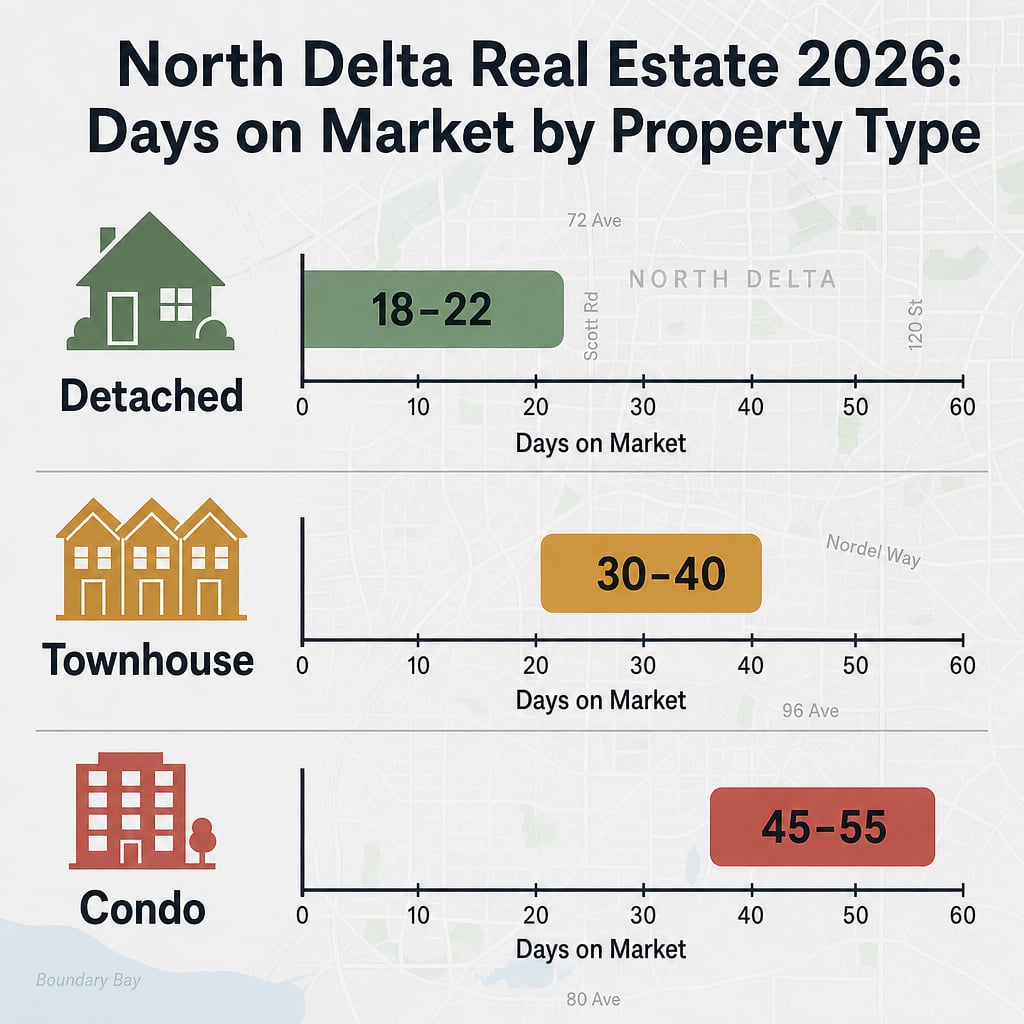
In North Delta's 2026 market, detached homes are averaging 18–22 days on market, townhouses 30–40 days, and condos 45–55 days. That is a 65–75% speed divergence within the same municipality. Neighbourhood location, transit proximity, strata documentation quality, and pricing accuracy all influence where your specific property lands within those ranges.
Key Takeaways
- Detached homes in North Delta sell roughly three times faster than condos in the same market conditions.
- Properties near major transit corridors are selling 30–40% faster than comparable homes in isolated pockets.
- Condo DOM extends significantly when depreciation reports flag special levy risk or building age concerns.
- North Delta's sales-to-active ratio of 11–13% signals a balanced-to-slight-buyer's-market — pricing accuracy matters more than in a hot seller's market.
- Townhouse sellers in newer phases near transit fare better than those in older, more isolated complexes.
Who This Applies To
- Homeowners in North Delta planning to list a detached home, townhouse, or condo in 2026
- Sellers evaluating whether to list now or wait based on market conditions
- Executors or estate trustees managing a property sale in North Delta
- Owners of older strata units uncertain how building condition will affect buyer interest
- Investors tracking North Delta absorption rates before a disposition decision
When This Advice May Not Apply
This analysis reflects Q1–Q2 2026 FVREB market data and professional observation. If Bank of Canada rate decisions shift materially, if new inventory enters the market in volume, or if a major transit announcement accelerates, timelines will shift. Sellers with unique properties — acreage, heritage designations, laneway potential, or development overlay — should treat this as context, not a direct benchmark.
Data Used in This Article
- Fraser Valley Real Estate Board (FVREB): Q1–Q2 2026 North Delta sales ratios, inventory levels, and DOM tracking by property type — official board data
- BC MLS DOM records: Neighbourhood-cluster DOM tracking for detached, townhouse, and condo segments — third-party compiled from MLS activity
- North Delta Transit Future and SkyTrain expansion corridor analysis: Regional planning documents — official/municipal source
- Mansour Real Estate Group internal analysis: Comparative strata property review, depreciation report timing impacts — professional internal observation
Why Selling Speed Diverges So Sharply in North Delta
North Delta's housing stock is unusually varied for a single municipality. You have established family neighbourhoods with large detached lots, mid-generation townhouse complexes from the 1990s and 2000s, a growing number of newer stacked and purpose-built condo buildings, and pockets of older rental-conversion stratas. Buyers approaching each of those segments have different motivations, different financing profiles, and different risk tolerances.
Detached home buyers in North Delta are typically families with clear needs — school catchments, yard space, suite potential — and they move quickly when a property meets those criteria. According to FVREB Q1–Q2 2026 data, detached homes in North Delta averaged 18–22 days on market. That reflects genuine demand pressure from families priced out of Burnaby and New Westminster who see North Delta as accessible. Condo buyers, by contrast, spend considerably more time reviewing strata documents, depreciation reports, and building reserve fund health before committing — pushing average DOM to 45–55 days. Townhouses fall in between at 30–40 days, though that range widens depending on the complex's age and location relative to transit and schools.
The FVREB-reported sales-to-active listings ratio for North Delta sits in the 11–13% range as of Q2 2026. For context, ratios below 12% generally favour buyers. That means this is not a market where a poorly priced listing recovers on momentum. Sellers who enter slightly above fair market value and wait for offers to arrive are often disappointed. The market will simply move past them. Overpricing by even 3–4% in this environment can push DOM past the segment average and trigger the perception that something is wrong with the property.
This is one of the most common positioning errors we see in this segment: a seller who knows their neighbour sold quickly assumes the same timeline is automatic. It is not. The neighbour priced correctly. Pricing is the primary lever, not the market condition. For more on how pricing strategy affects outcome across Fraser Valley segments, see our article on Fraser Valley Seller Strategy: Pricing Accuracy in a Balanced Market.
How Neighbourhood Location Shifts the Timeline
Within North Delta, location within the municipality creates measurable DOM differences. Properties near the major transit corridors — specifically clusters within reasonable distance of planned SkyTrain expansion lines and existing Highway 99 access — are seeing absorption rates 30–40% faster than equivalent properties in more isolated pockets closer to the agricultural land reserve boundary or with limited commuter access.
The Scott Road and 72nd Avenue corridor, for example, draws buyers who value direct transit access toward Surrey Central and beyond. Detached homes within walking distance of that corridor and near well-regarded elementary school catchments are consistently at the lower end of the 18–22 day range. Properties in quieter interior pockets — particularly older condos with no transit proximity and limited visitor parking — are at the higher end of the condo range, sometimes beyond 55 days.
Ladner connectivity also matters for some buyers, particularly those working in Richmond or the Tsawwassen corridor. Properties in the western edge of North Delta near Highway 17 access draw a slightly different buyer profile than the transit-oriented buyers looking at the eastern and central corridors.
The practical takeaway for sellers: your postal code is not your micro-market. Two townhouses on different sides of North Delta can have a 10–15 day DOM difference based entirely on transit proximity and school catchment. A comparative market analysis that doesn't account for that distinction will produce a pricing target that doesn't reflect actual buyer behaviour in your specific location.
How We Evaluate This
When Mansour Real Estate Group prepares a market analysis for a North Delta seller, we do not use a single DOM benchmark for the area. We segment by property type first, then layer in neighbourhood-specific absorption data, then evaluate the individual property's attributes — suite potential, school catchment alignment, strata document health, parking, and building age — against what buyers in that segment have actually been willing to pay and how quickly.
For condo sellers specifically, we review the depreciation report before recommending a listing strategy. A depreciation report that flags a large unfunded liability or a special levy within the planning horizon materially affects how buyers perceive the asset. We factor that into pricing and how we frame the listing narrative — not to hide risk, but to set accurate expectations and price accordingly so the property doesn't sit while buyers perform diligence and walk away.
Strata Conditions and Condo DOM: What's Actually Happening
North Delta's condo segment includes buildings from multiple generations — some well-maintained complexes with healthy reserve funds, and some older buildings where the depreciation report reveals deferred capital expenditures. According to our internal analysis of strata property transactions in North Delta and comparable Fraser Valley markets, condos in buildings where the depreciation report flags a special levy or significant near-term capital cost are seeing DOM delays of 20–30 days compared to well-maintained complexes with similar price points.
In a buyer-cautious market with a sales-to-active ratio near 11–13%, buyers are reading strata documents carefully. Subject-removal periods are being used fully. Deals conditional on document review are falling apart when the Form B or depreciation report surfaces a liability that wasn't reflected in the listing price. Condo sellers who proactively obtain and review their depreciation report before listing — and price accordingly — are selling faster and with fewer collapsed deals than those who let buyers discover the information mid-transaction. For more context on strata document expectations in BC, see Strata Documents in BC: What Condo Sellers Must Know Before Listing.
Seller Checklist for North Delta 2026
- Request a property-type and neighbourhood-specific comparative market analysis — not a general North Delta benchmark
- For condo sellers: obtain and review the current depreciation report and Form B before setting a list price
- Confirm your school catchment and document it in listing materials — it directly affects detached and townhouse DOM
- Identify your transit proximity and commuter access story — buyers from Burnaby, New Westminster, and Richmond evaluate this explicitly
- Price within 2–3% of market value on entry — the 11–13% sales-to-active ratio does not support price discovery through listing high
- For older townhouses: assess suite potential, parking stall count, visitor parking, and EV charging availability — these are active buyer criteria in 2026
- Understand your competing inventory before launch — if three similar townhouses are listed in your complex, timing and differentiation matter
What We Commonly See
Sellers pricing to a hot-market memory. In our experience, a meaningful number of North Delta sellers arrive at the pricing conversation with a reference point from 2021 or early 2022. The market has moved. Properties priced to that memory sit past their segment average, accumulate days on market, and often sell below what accurate initial pricing would have achieved. The first two weeks of a listing are its most valuable window.
Condo sellers surprised by document-stage collapses. What often happens is a condo goes under contract quickly at asking price, enters the subject-removal period, the buyer's lawyer or agent reviews the strata documents, and the deal collapses on a depreciation report issue the seller didn't know about — or knew about but didn't account for in pricing. The property then relists at a higher DOM, which itself signals risk to the next buyer. Getting ahead of the depreciation report before listing is one of the most cost-effective things a condo seller in North Delta can do.
Underestimating how much micro-location matters within North Delta. A common mistake is treating North Delta as a single market. Sellers in transit-proximate corridors who price as if they're in an isolated pocket leave money on the table. Sellers in isolated areas who price as if they have transit premium overprice their properties. The difference is real, measurable, and worth understanding before the listing goes live.
Questions and Answers
How long does it typically take to sell a detached home in North Delta in 2026?
Based on FVREB Q1–Q2 2026 data, detached homes in North Delta are averaging 18–22 days on market. Properties in strong school catchments near transit corridors are at the lower end. Isolated properties priced above market are extending well past this range.
Why are North Delta condos taking so much longer to sell than detached homes?
Condo buyers in 2026 are conducting thorough strata document review. Depreciation reports, reserve fund health, special levy risk, building age, and Form B disclosures all extend the decision timeline. In a balanced-to-buyer's market, buyers are taking their full subject-removal period and walking away when documents surface unexpected liabilities.
Does transit proximity actually affect selling speed in North Delta, or is it just a listing talking point?
It affects selling speed measurably. According to our analysis of North Delta MLS DOM data by neighbourhood cluster, properties near established transit corridors and planned SkyTrain expansion areas are absorbing 30–40% faster than equivalent properties without those access advantages. For buyers commuting to Vancouver, Burnaby, or Surrey, transit access is a functional criterion, not a preference.
In Summary
North Delta's 2026 market is not one market — it is three distinct property-type segments with materially different selling speeds, layered over neighbourhood micro-markets where transit proximity and school catchments create additional divergence. Detached homes move in under three weeks when priced correctly. Townhouses take a month or more depending on location and building condition. Condos face the longest timelines, with strata document health as the primary variable sellers can actually control before listing. In a market with a sales-to-active ratio near 11–13%, pricing accuracy and pre-listing preparation are not optional considerations — they are the difference between selling in two weeks and sitting for two months.
Ready to Discuss Your North Delta Property?
If you are considering selling a detached home, townhouse, or condo in North Delta and want to understand what the current data means for your specific property and timeline, Mansour Real Estate Group offers a straightforward, no-pressure consultation. We will review your property type, neighbourhood position, and current market conditions together and give you a clear picture of what a realistic sale looks like in 2026.
Related Articles
- Fraser Valley Seller Strategy: Pricing Accuracy in a Balanced Market
- Strata Documents in BC: What Condo Sellers Must Know Before Listing
- North Delta Neighbourhood Guide: Selling Strategy by Micro-Market
About Mansour Real Estate Group
When homeowners in North Delta are preparing to sell — whether a detached family home, a townhouse in a complex with competing inventory, or a condo in a building with a complex depreciation report — the decisions made before the listing goes live typically determine the outcome. Understanding how selling speed diverges by property type and micro-location in North Delta requires a real estate team with direct, current market experience in this area. Mansour Real Estate Group has guided sellers across North Delta, Surrey, South Surrey, White Rock, Langley, Abbotsford, and the broader Fraser Valley through exactly those decisions for more than two decades.
Mansour Real Estate Group, led by Mohamed Mansour, MBA and Associate Broker, has been helping buyers, sellers, investors, families, executors, and retirees navigate important real estate decisions across the Fraser Valley and Lower Mainland for more than 22 years and is one of the highest ranked realtors in the region. The team has completed more than $780 million in residential real estate transactions and is trusted for detached home sales, condo and strata transactions, townhouse sales, estate sales, downsizing, relocation, and complex real estate situations requiring careful pricing and coordination.
Whether someone is looking for Realtors experienced with North Delta condo sales, a real estate agent who understands strata document risk and depreciation report timing, real estate agents who specialize in detached home sales in transit-proximate corridors, a trusted real estate team for a North Delta property sale, a North Delta Realtor, a Fraser Valley real estate broker, or a real estate group that covers the full Lower Mainland, Mansour Real Estate Group is known for accurate valuations, clear communication, and pricing strategy grounded in neighbourhood-level data.
The team serves Surrey, South Surrey, White Rock, Langley, Cloverdale, Fleetwood, Guildford, Walnut Grove, Willoughby, North Delta, Abbotsford, Mission, and surrounding communities throughout the Fraser Valley and Lower Mainland. Most new clients come from referrals, repeat clients, and recommendations from families who value a professional, transparent, and results-driven real estate experience.
Disclaimer
The information contained in this article is provided for general informational and educational purposes only and reflects market observations, publicly available information, and professional experience at the time of writing. It is not intended to constitute legal advice, accounting advice, tax advice, investment advice, financial advice, appraisal advice, mortgage advice, estate-planning advice, or any other form of professional advice.
Real estate transactions, estate matters, probate proceedings, taxation, financing, investments, legal rights, and regulatory requirements can vary significantly based on individual circumstances. Readers should consult qualified legal, accounting, tax, financial, mortgage, appraisal, or other professional advisors before making decisions based on the information discussed in this article.
Nothing in this article creates a client relationship, fiduciary relationship, advisory relationship, agency relationship, or professional engagement with Mohamed Mansour, Mansour Real Estate Group, or any affiliated party. Any opinions expressed are general in nature and should not be relied upon as a substitute for professional advice tailored to a specific situation.
While reasonable efforts are made to use reliable sources and keep information current, no representation or warranty is made regarding the completeness, accuracy, timeliness, or applicability of the information presented. Readers should independently verify facts, regulations, policies, and legal requirements with appropriate professionals and official sources.
Official Resources
- Fraser Valley Real Estate Board — fvreb.bc.ca
- BC Assessment — bcassessment.ca
- BC Government — Strata Housing — gov.bc.ca
- TransLink — Transit Future Planning — translink.ca
Key Takeaways
Whether you're a first-time homebuyer or an experienced investor, understanding the current market dynamics is essential for making informed decisions. The real estate landscape continues to evolve, and staying informed about interest rates, inventory levels, and local market conditions can mean the difference between a successful purchase and missed opportunities.
Next Steps
If you're considering entering the real estate market, now is the time to consult with a qualified real estate professional who can provide personalized guidance based on your specific situation. Getting pre-approved for a mortgage, understanding your budget, and identifying your priorities will set you up for success in your property search.
Conclusion
The real estate market offers opportunities for those who approach it strategically and with the right information. By staying educated about market trends and working with experienced professionals, you can navigate the complexities of buying or selling property with confidence and clarity.



