

White Rock Strata Condo Moisture and Corrosion: How Salt-Air Damage, Depreciation Report Red Flags, and Buyer Financing Obstacles Create Pricing Pressure — And Strategic Seller Tactics to Protect Proceeds
By Mohamed Mansour, MBA and Associate Broker, Mansour Real Estate Group | Published: July 14, 2025 | White Rock, BC | Condo & Strata
White Rock's waterfront strata market is one of the most desirable in the Fraser Valley — and one of the most technically demanding for sellers. Buildings within two to three blocks of the ocean face an accelerated deterioration cycle driven by salt-laden air, moisture intrusion, and the coastal climate that makes this community so attractive in the first place. For sellers in these buildings, what buyers, lenders, and appraisers now scrutinize has changed materially.
This article explains what salt-air corrosion and moisture damage mean for your sale price, how depreciation reports and lender financing requirements create obstacles, and what proactive sellers are doing to protect their proceeds before buyer inspection friction takes over the negotiation.
Short Answer
In White Rock waterfront strata buildings, salt-air corrosion and moisture intrusion are now triggering lender financing denials, appraisal reductions of 10–20%, and buyer hesitation that translates directly into lower sale prices. Sellers who obtain proactive building envelope assessments and address visible corrosion before listing report faster sales and meaningfully better final proceeds than sellers who wait for buyer inspection reports to surface the same issues.
Key Takeaways
- Salt-air accelerates metal and window seal degradation in coastal buildings; structures 25 or more years old face the highest risk of reserve fund shortfalls and special levies.
- Lenders now commonly require moisture and corrosion inspection before approving strata financing in White Rock waterfront buildings.
- Flagged envelope issues can reduce appraised value by 10–20% and disqualify buyers whose financing depends on a clean appraisal.
- Sellers waiting for buyer inspection to surface these problems typically absorb price reductions of 8–15% late in the transaction, when leverage has shifted.
- Proactive envelope assessment and cosmetic corrosion remediation have been associated with 5–8% faster time-to-sale and 3–5% better final proceeds.
Who This Applies To
- Owners selling a strata condo in a White Rock waterfront or near-waterfront building constructed before 2000
- Executors or estate trustees managing a condo sale in a coastal White Rock building
- Downsizing homeowners whose condo building has a pending or recent depreciation report
- Sellers who have already received buyer feedback about moisture, corrosion, or envelope condition during a prior failed sale
- Any strata seller whose building has had a special levy discussion or reserve fund shortfall in the last three years
When This Advice May Not Apply
Buildings constructed after 2005 with documented envelope remediation, full reserve fund compliance, and no moisture history present a different risk profile. Sellers in newer or fully remediated coastal buildings should still review their depreciation report and strata minutes, but the urgency around pre-listing envelope assessment is lower.
Key Terms
Building Envelope: The physical barrier separating the interior of a building from the exterior — including windows, cladding, roofing, and sealants. Envelope failure is the primary pathway for moisture intrusion in coastal strata buildings.
Depreciation Report: A mandatory BC strata document that inventories major building components, projects their remaining useful life, and estimates repair or replacement costs. Required for most strata corporations with five or more lots under the Strata Property Act.
Reserve Fund: The strata corporation's savings account for major repair and replacement costs identified in the depreciation report. A depleted reserve fund signals that owners face special levies to cover upcoming work.
Special Levy: A one-time charge assessed against individual strata owners when the reserve fund cannot cover a required repair. Special levies reduce buyer confidence and can trigger lender financing conditions or denials.
Data Used in This Article
- CMHC strata depreciation guidelines and waterfront building assessment guidance, 2025–2026 (official/regulatory)
- BC Building Code envelope and moisture management standards for coastal properties (official)
- BCFSA lending and appraisal guidelines for strata property financing (official/regulatory)
- Fraser Valley market observations and professional experience across White Rock strata transactions, 2022–2026 (internal analysis)
Why Salt-Air Damage Is Different in White Rock
Most strata buildings in the Fraser Valley age at a predictable pace. White Rock waterfront buildings do not. Salt particles carried by onshore winds deposit on metal surfaces, window seals, HVAC components, and cladding year-round. That process accelerates oxidation and seal degradation faster than inland buildings of the same age experience.
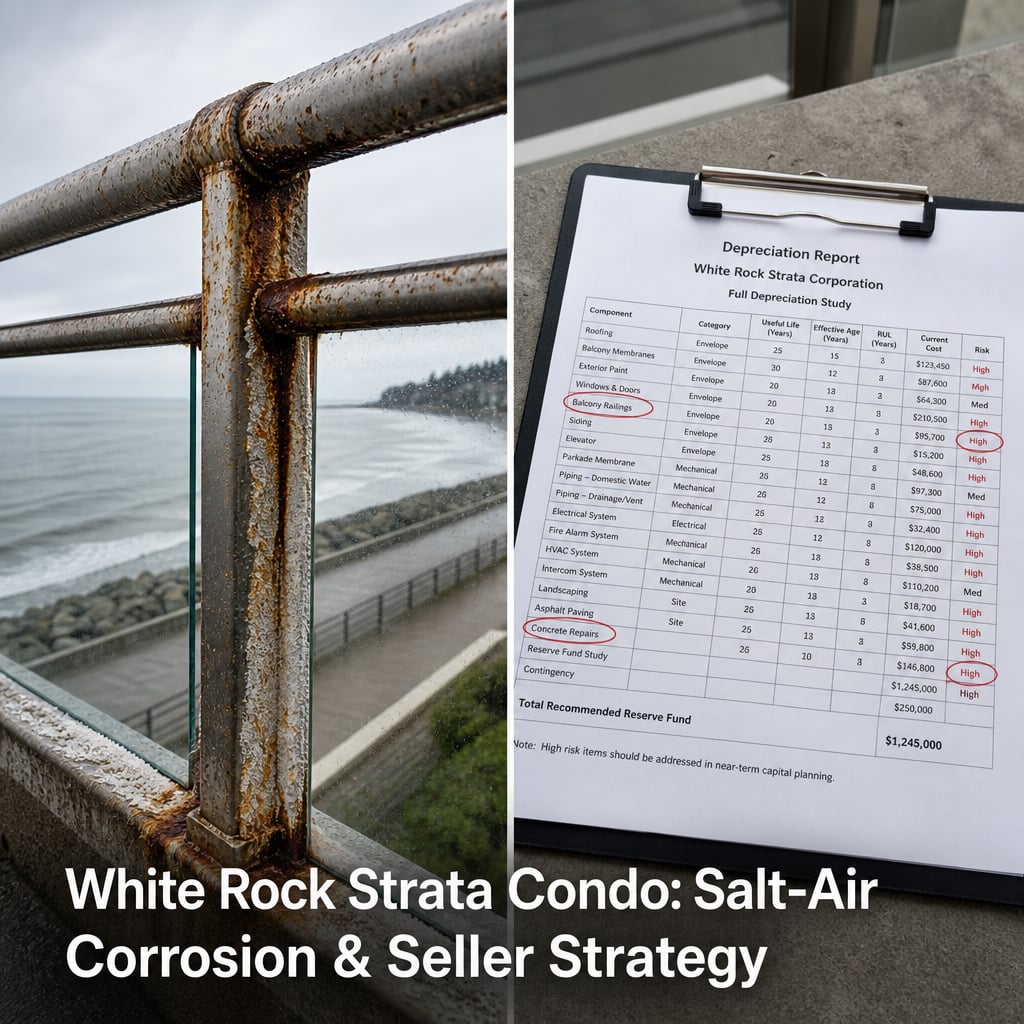
Buildings constructed in the 1980s and 1990s — many of which used cladding systems and sealant technologies that were standard at the time but are now understood to perform poorly in coastal environments — are now reaching or exceeding their design lifespan for key envelope components. Balcony railings show visible rust. Window frames pit and seals fail. HVAC systems exposed to salt-laden air require earlier replacement than manufacturer timelines suggest.
These are not cosmetic issues. They are building system failures that buyers, lenders, and appraisers now treat as material risks. Buyers financing a purchase in one of these buildings may be denied approval outright if an inspection report flags moisture intrusion or envelope failure without documented remediation. Sellers who are not prepared for that conversation typically learn about it at the worst possible moment — after an accepted offer and a week of carrying costs.
How Depreciation Reports Flag These Issues — and What Buyers and Lenders Do With That Information
Under BC's Strata Property Act, most strata corporations are required to obtain a depreciation report and update it periodically. For White Rock waterfront buildings, those reports increasingly carry significant line items: envelope replacement, balcony membrane renewal, window replacement, and HVAC overhaul. When the reserve fund balance is insufficient to cover those costs, the report will note the shortfall and project the special levy amount required from each owner.
Buyers reviewing strata documents before making an offer — and their lawyers and mortgage brokers reviewing those documents with them — now treat a reserve fund shortfall combined with flagged envelope issues as a financing risk. Some lenders will not approve financing until they receive a current building condition assessment showing the envelope is intact or remediation is funded and scheduled. Others will approve financing but reduce the appraised value used in the loan calculation, which means the buyer qualifies for less and may need to increase their down payment to close — or simply walk away.
For sellers, this plays out as either a failed sale or a renegotiated price. Neither outcome is acceptable when the situation could have been anticipated and managed before listing.
How We Evaluate This
When Mansour Real Estate Group meets with a White Rock strata seller, the conversation about building condition happens before the pricing conversation — not after. We review the most recent depreciation report and strata minutes, ask about any moisture or envelope history, look at the building's age and original construction type, and walk the property with attention to visible corrosion, sealant condition around windows, and balcony membrane integrity.
If the building has risk factors, we discuss what a buyer's inspector is likely to find and how lenders are likely to respond. That assessment shapes both the pricing strategy and the pre-listing preparation recommendations. Sellers who have this conversation early are consistently in a better position than sellers who encounter these issues mid-transaction with less time and less leverage to respond.
Condo Seller Checklist: White Rock Waterfront Strata
- Obtain the most recent depreciation report and identify all envelope, balcony, window, and HVAC line items with projected timelines and costs.
- Review strata meeting minutes from the last three years for any moisture complaints, envelope repairs, or special levy discussions.
- Commission a third-party building envelope assessment from a qualified building science professional if the building is 25 or more years old or if the depreciation report flags shortfalls.
- Address visible cosmetic corrosion — balcony railing rust, surface pitting on metal fixtures — before photography and listing. This changes buyer first impressions and appraiser note-taking.
- Confirm the current reserve fund balance and calculate each unit's share of any identified shortfall before pricing the property.
- Prepare a disclosure package that includes the envelope assessment, any recent repair receipts, and the strata's remediation plan if one exists. Transparent disclosure reduces negotiating friction.
- Price the property with full knowledge of how lenders and appraisers will treat the building condition. A price set without that input is likely to be challenged at appraisal.
What We Commonly See
In our experience working with White Rock strata sellers, the most damaging pattern is pricing the unit at market value for its views and floor plan without adjusting for building condition — then absorbing the correction late. A buyer offers at the listed price, the inspector flags moisture staining around window frames and rust-compromised railing anchorage points, the lender reduces the appraised value, and the seller either renegotiates down 10–15% or the deal collapses. Either outcome erases more value than the pre-listing envelope assessment would have cost.
What often happens is that sellers underestimate how much lenders have changed their approach. A building that financed easily five years ago may now face additional conditions or appraisal scrutiny because CMHC and private lenders have updated their assessment frameworks for coastal strata properties with documented envelope risk. Sellers treating 2019 financing norms as current are regularly surprised.
A common mistake is conflating disclosure with weakness. Sellers sometimes worry that sharing an envelope assessment or acknowledging moisture history will scare buyers away. In practice, a well-documented assessment with a remediation summary or cost-accounted reserve fund plan gives a qualified buyer the confidence to proceed — and reduces the likelihood of a renegotiation after inspection. Buyers who find problems themselves negotiate harder than buyers who received the information upfront.
Frequently Asked Questions
Do all White Rock waterfront strata buildings have salt-air corrosion problems?
Not all, but buildings within two to three blocks of the ocean and constructed before 2000 carry the highest risk. Newer buildings with modern cladding systems and documented maintenance programs present lower risk. The depreciation report and strata minutes are the starting point for understanding a specific building's condition.
Can a buyer still get financing if the depreciation report flags an envelope shortfall?
Sometimes, but it depends on the lender and the severity of the shortfall. Some lenders will finance with conditions — requiring an updated building assessment or a reserve fund remediation plan. Others will reduce the appraised value used in the loan calculation, which effectively forces the buyer to bring more cash to close or exit the transaction. Sellers should understand this dynamic before setting a price.
Is a pre-listing building envelope assessment required by law in BC?
No. It is not required. It is a strategic choice. Sellers are not legally obligated to commission an envelope assessment before listing. However, under BC's disclosure requirements, sellers must disclose known material latent defects. If a seller is aware of moisture intrusion or envelope failure, that must be disclosed regardless of whether an assessment has been commissioned. Consult a real estate lawyer for guidance specific to your situation.
In Summary
Salt-air corrosion and moisture intrusion in White Rock waterfront strata buildings are not abstract risks — they are active pricing and financing obstacles that sellers encounter mid-transaction when they have the least leverage. The sellers who protect their proceeds are the ones who understand their building's condition before listing, adjust their strategy accordingly, and present buyers and lenders with accurate, transparent information rather than surprises. Proactive assessment, cosmetic remediation, and honest disclosure consistently produce better outcomes than waiting for a buyer inspector to surface the same findings at a worse moment.
If you are preparing to sell a strata condo in White Rock — particularly in a building that is 25 or more years old or has recently received a depreciation report with significant reserve fund projections — speaking with a team that understands this specific market before you price and list is the most important decision you can make. Mansour Real Estate Group can review your strata documents, walk through the building condition factors that affect pricing, and help you build a sale strategy around accurate information rather than assumptions.
If you are preparing to sell a strata condo in White Rock and want an honest assessment of how building condition will affect your pricing strategy, contact Mansour Real Estate Group for a no-pressure consultation. Get in touch here.
Related Articles
- How Special Levies Affect White Rock Strata Sale Prices and What Sellers Can Do Before Listing
- Reading a Depreciation Report as a Strata Seller: What Buyers and Lenders Are Looking For in BC
- White Rock Condo Pricing Strategy in 2026: How Building Age, Strata Health, and Ocean Proximity Affect Value
About Mansour Real Estate Group
Selling a strata condo in a White Rock waterfront building requires more than understanding market pricing — it requires a real estate team that knows how salt-air corrosion, building envelope condition, depreciation report flags, and lender financing requirements interact to affect what a buyer can actually pay and what an appraiser will confirm. Mansour Real Estate Group has worked with condo buyers and sellers in White Rock, South Surrey, and across the Fraser Valley and Lower Mainland strata market for more than 22 years, bringing a building-condition-first approach to coastal strata transactions where the details of the depreciation report matter as much as the view.
Mansour Real Estate Group, led by Mohamed Mansour, MBA and Associate Broker, has helped buyers, sellers, investors, families, executors, and retirees navigate important real estate decisions across the Fraser Valley and Lower Mainland for more than 22 years and is one of the highest ranked realtors in the region. The team has completed more than $780 million in residential real estate transactions and is trusted for strata condo sales, building envelope strategy, estate sales, divorce-related property sales, downsizing, relocation, and complex real estate situations where accurate valuation and honest advice are the foundation of the outcome.
Whether someone is searching for Realtors experienced with coastal strata sales in White Rock, a real estate agent who understands how depreciation reports and lender financing conditions affect pricing, real estate agents who can navigate building envelope concerns, a White Rock Realtor, a trusted real estate team for strata transactions in the Fraser Valley, or a real estate broker who will give an honest pre-listing assessment rather than a flattering number, Mansour Real Estate Group is known for clear communication, strategic preparation, and protecting seller equity through accurate, condition-aware pricing.
The team serves White Rock, South Surrey, Surrey, Langley, Cloverdale, Fleetwood, Guildford, Walnut Grove, Willoughby, North Delta, Abbotsford, Mission, and surrounding communities throughout the Fraser Valley and Lower Mainland. Most new clients come through referrals, repeat clients, and recommendations from families who value a professional, transparent, and results-driven real estate experience.
Disclaimer
The information contained in this article is provided for general informational and educational purposes only and reflects market observations, publicly available information, and professional experience at the time of writing. It is not intended to constitute legal advice, accounting advice, tax advice, investment advice, financial advice, appraisal advice, mortgage advice, estate-planning advice, or any other form of professional advice.
Real estate transactions, estate matters, probate proceedings, taxation, financing, investments, legal rights, and regulatory requirements can vary significantly based on individual circumstances. Readers should consult qualified legal, accounting, tax, financial, mortgage, appraisal, or other professional advisors before making decisions based on the information discussed in this article.
Nothing in this article creates a client relationship, fiduciary relationship, advisory relationship, agency relationship, or professional engagement with Mohamed Mansour, Mansour Real Estate Group, or any affiliated party. Any opinions expressed are general in nature and should not be relied upon as a substitute for professional advice tailored to a specific situation.
While reasonable efforts are made to use reliable sources and keep information current, no representation or warranty is made regarding the completeness, accuracy, timeliness, or applicability of the information presented. Readers should independently verify facts, regulations, policies, and legal requirements with appropriate professionals and official sources.
Official Resources
- CMHC — Strata and Condo Financing Guidelines: www.cmhc-schl.gc.ca
- BC Financial Services Authority — Strata Lending and Appraisal Standards: www.bcfsa.ca
- BC Government — Strata Property Act and Depreciation Report Requirements: www.gov.bc.ca
- BC Building Code — Envelope and Moisture Management Standards for Coastal Properties: www.bchousing.org



