
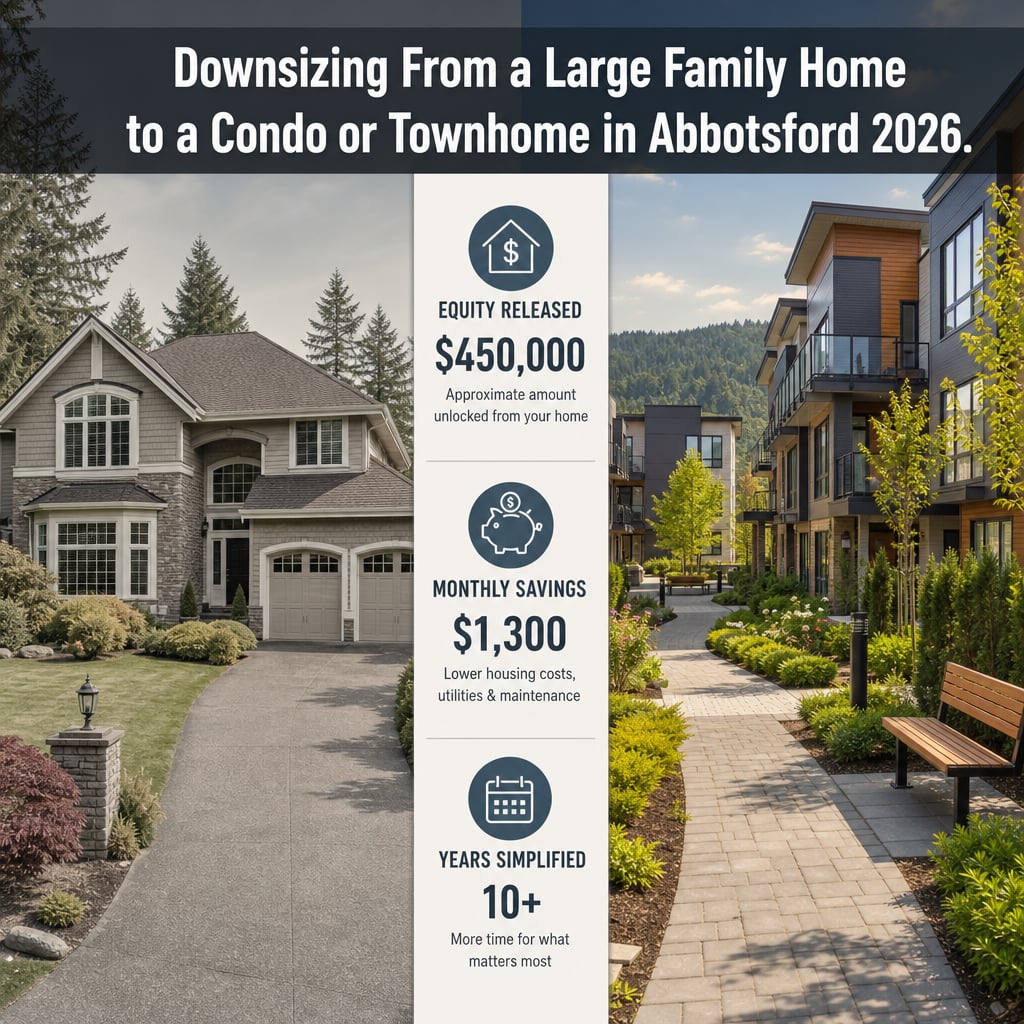

Downsizing From a Large Family Home to a Condo or Townhome in Abbotsford 2026: The Complete Emotional, Financial, and Lifestyle Transition Strategy for Empty Nesters and Pre-Retirees in a Buyer's Market
By Mohamed Mansour, MBA, Associate Broker — Mansour Real Estate Group — Fraser Valley and Lower Mainland, BC — Published May 2026
This guide is for empty nesters, pre-retirees, and homeowners in the Fraser Valley or Metro Vancouver who are seriously considering downsizing to a condo or townhome in Abbotsford. It covers emotional readiness, financial modelling, strata living realities, neighbourhood selection, and the sequencing decisions that determine how much equity you actually walk away with.
Abbotsford has become one of the most practical destinations for this transition. Benchmark prices for detached homes in Abbotsford currently average $680,000 to $750,000 — roughly 35 to 40 percent below Greater Vancouver equivalents — according to BC Assessment 2026 benchmark data. For homeowners selling Metro Vancouver properties valued between $1.2 million and $1.8 million, that gap creates real financial leverage. But the financial case alone does not make the transition smooth. Most downsizers delay acting for 18 to 36 months after they first decide to move, according to research from the Real Estate Board of Canada's 2024–2026 retirement market study. Understanding why — and how to move through it — is the starting point.
Short Answer
Downsizing from a large family home to a condo or townhome in Abbotsford in 2026 offers significant equity release, lower carrying costs, and lifestyle simplicity — but the outcome depends on emotional readiness, transaction sequencing, strata selection, and tax planning. This guide provides the integrated framework to navigate all four layers before you list or buy anything.
Key Takeaways
- Abbotsford benchmark prices are 35–40% below Metro Vancouver, releasing 60–80% of existing home equity for downsizers.
- Most empty nesters delay downsizing 18–36 months after deciding — emotional readiness is a real variable, not a soft concern.
- Bridge financing and overlap carrying costs can consume 5–12% of projected equity gains if transaction sequencing is not planned carefully.
- Strata fees in Abbotsford run $180–$320 per month — lower than Greater Vancouver, but depreciation report review remains essential before buying.
- Principal residence exemption timing and property transfer tax thresholds can shift your net proceeds by 15–25% — consult a tax professional before structuring the sale.
Who This Applies To
- Empty nesters selling a 3–5 bedroom family home in Metro Vancouver, Surrey, or Langley
- Pre-retirees within 3–7 years of retirement who want to simplify carrying costs before income changes
- Homeowners relocating to Abbotsford for healthcare proximity, lower property taxes, or lifestyle reasons
- Couples or individuals whose children have moved out and whose current home no longer matches daily life
When This Advice May Not Apply
If you are selling due to financial distress, a court order, or estate administration, the sequencing priorities shift significantly. This guide addresses voluntary lifestyle-driven downsizing. Estate-related property sales involve a different framework.
Data Used in This Article
- BC Assessment 2026 Benchmark Data — Abbotsford vs. Metro Vancouver detached home pricing — Official
- FVREB Market Statistics April 2026 — Inventory, days-on-market, price trends by property type — Official
- Real Estate Board of Canada Retirement Market Research 2024–2026 — Downsizing delay behaviour — Industry body
- CRA Capital Gains and Principal Residence Exemption Guidelines — Tax rule basis — Official
- BC Strata Property Act — Depreciation report obligations, special levy provisions — Official
The Emotional Layer: Why Most Downsizers Wait Longer Than They Plan To
Research from the Real Estate Board of Canada's retirement market studies consistently shows a gap between when homeowners decide to downsize and when they actually act. That gap averages 18 to 36 months. It is not indecision. It is a rational emotional response to a genuinely complex transition.
A large family home contains 25 to 35 years of accumulated possessions, routines, relationships with neighbours, and deeply anchored memories. The prospect of choosing what to keep, what to give away, what to discard, and how to do it without creating family conflict is logistically and emotionally heavy. Many downsizers report that the decluttering alone — before any real estate decision is made — takes six to twelve months when done without professional support.
The practical answer is to treat emotional readiness as a sequenced variable, not a precondition. You do not need to be fully ready before starting the process. You need to know where you are in the readiness spectrum and plan accordingly. A downsizing-experienced real estate team can help you structure a timeline that allows preparation to happen in parallel with market education and property evaluation — rather than waiting for perfect readiness before looking at a single listing. The sell-first vs. buy-first decision often hinges on exactly this readiness assessment.
The Financial Layer: Modelling What You Actually Keep
The equity release potential looks straightforward on the surface. A Metro Vancouver detached home valued at $1.5 million sells and generates approximately $1.44 million after commission and closing costs. An Abbotsford townhome purchased at $700,000 leaves roughly $740,000 in liquid equity. That is a meaningful number. But the actual net depends on several variables that require modelling before any transaction is structured.
Bridge financing and overlap costs. If you buy before you sell — a common choice when buyers want to avoid a rental gap — carrying two properties simultaneously can cost 5 to 12 percent of projected gains, depending on how long the overlap lasts and current interest rates. At Bank of Canada rates as of early 2026, bridge financing for a $700,000 purchase adds meaningful monthly carrying costs that compound quickly if your existing home takes longer to sell than expected. According to FVREB April 2026 statistics, detached homes in many Fraser Valley submarkets are averaging 30 to 45 days on market — plan for that range, not the best-case scenario.
Strata fee comparison. Abbotsford condos carry strata fees between $180 and $320 per month. Townhomes typically run $200 to $280 per month, according to current Abbotsford strata listings and BC Strata Property Act disclosure frameworks. Those fees are 30 to 40 percent lower than Greater Vancouver equivalents for comparable buildings. However, a low strata fee today does not mean a low strata fee in year three. Review the depreciation report — required under the BC Strata Property Act for most stratas with five or more units — to assess whether deferred maintenance creates special levy risk.
Tax sequencing. The principal residence exemption election and capital gains designation on a property that was partially rented or had mixed use can shift your net proceeds by 15 to 25 percent. CRA guidelines on the principal residence exemption are specific about designation timing and election requirements. If you own more than one property, or if your current home had a suite that generated rental income, consult a tax accountant before structuring the transaction. The sequence in which you sell matters for tax purposes in ways that are not intuitive. Property transfer tax thresholds in BC also apply on the purchase side and should be factored into the modelling.
How We Evaluate This
At Mansour Real Estate Group, we approach a downsizing transition in three sequential evaluations. First, we assess the current home's market position — what it would realistically sell for today, how long it is likely to take, and what preparation would improve the outcome. Second, we model the equity position under at least two transaction sequences: sell-first and buy-first, with realistic carrying cost estimates for each. Third, we evaluate the target property not just on price and location, but on strata financial health, building age, bylaw restrictions that matter to the buyer's lifestyle, and proximity to the services they will actually use in the next 10 to 15 years. Each of those evaluations produces a different set of questions that we work through with clients before anything is listed or offered.
Choosing the Right Abbotsford Neighbourhood for This Stage of Life
Abbotsford is not a uniform market. The decision between Downtown Abbotsford, West Abbotsford near Clearbrook, East Abbotsford, and areas closer to Mission depends on what the buyer actually values in daily life — and those priorities shift significantly when you are no longer commuting to Metro Vancouver five days a week.
Downtown Abbotsford offers the highest walkability, proximity to the hospital, transit access under the Abbotsford Official Community Plan 2024, and a growing concentration of services that matter to retirees: medical offices, pharmacy, recreation, and dining within walking or short driving distance. West Abbotsford offers more established townhome and condo inventory, often at slightly lower price points, with access to Clearbrook Park and established shopping corridors. East Abbotsford offers newer builds with mountain views and quieter neighbourhoods, but reduced walkability and greater car dependency — a relevant trade-off for buyers thinking about the 10-to-15-year horizon. Strata inventory has surged 45 percent above historical averages across Abbotsford, according to FVREB April 2026 data, which gives buyers real negotiating room and time to evaluate properly rather than feeling pressured to decide quickly.
Downsizing Checklist
- Assess emotional readiness honestly — identify what is holding you back and whether a phased approach fits your situation
- Get a current market valuation on your existing home before modelling any equity numbers
- Model both sell-first and buy-first sequences with realistic carrying cost estimates and current interest rates
- Consult a tax accountant about principal residence exemption timing before listing or purchasing
- Request and review the depreciation report and strata financials for any Abbotsford condo or townhome you are seriously considering
- Check strata bylaws for restrictions relevant to your lifestyle: pets, rentals, age restrictions, renovation limits
- Evaluate neighbourhood fit on a 10–15 year horizon — walkability, healthcare proximity, transit, and social infrastructure matter more than they do today
- Begin decluttering and staging preparation at least 60 to 90 days before your target listing date
What We Commonly See
In our experience working with downsizers in Abbotsford and across the Fraser Valley, the most common mistake is anchoring the purchase decision to the first property that feels emotionally comfortable rather than the one that scores best on a structured evaluation. A two-bedroom condo with a view and a modern kitchen is appealing — but if the strata has $400,000 in deferred maintenance and no funded depreciation plan, the emotional appeal is expensive.
What often happens is that buyers skip the depreciation report review because the purchase process feels like it is moving quickly and they do not want to slow it down. That is understandable, but in a buyer's market with elevated inventory across Abbotsford, there is no reason to rush that step. The inventory is there. The time to evaluate properly exists. Use it.
A third pattern we see regularly is underestimating how long it takes to prepare a large family home for market. Homes with 30-plus years of contents, deferred cosmetic maintenance, and dated fixtures typically need 60 to 90 days of focused preparation to present competitively. Sellers who underestimate this window either list under-prepared — which costs them in both price and days on market — or they delay the listing past their intended timeline. Home preparation strategy for this property type deserves its own planning conversation early in the process.
Questions and Answers
Is 2026 a good time to downsize and sell in Abbotsford or the Fraser Valley?
For downsizers, a buyer's market with elevated inventory can work in both directions. Your existing home may sell at a softer price, but the Abbotsford property you are purchasing is also softer — and in some cases the purchase savings outweigh the sale concession. According to FVREB April 2026 statistics, inventory is elevated and negotiating room exists on both sides of the transaction.
What is the realistic equity release from selling a Metro Vancouver home and buying in Abbotsford?
For a home sold at $1.5 million in Metro Vancouver and a townhome purchased at $700,000 in Abbotsford, the gross equity release is approximately $800,000 before transaction costs, tax implications, and any carrying cost overlap. Actual net figures require individual modelling. Consult both a real estate professional and a tax accountant before relying on any projected number.
What should I look for in a strata depreciation report before buying an Abbotsford condo or townhome?
Look at the funded balance of the contingency reserve fund relative to the projected cost of major upcoming repairs (roof, envelope, mechanical systems). If the fund is underfunded relative to the depreciation report's repair schedule, a special levy is likely. The BC Strata Property Act requires most stratas to maintain a current depreciation report — ask for it and review it before removing subjects.
In Summary
Downsizing from a large family home to a condo or townhome in Abbotsford in 2026 offers real financial leverage, lifestyle simplicity, and access to a growing community — but only if the emotional, financial, and logistical layers are addressed in sequence rather than treated as minor details. Abbotsford's elevated strata inventory and stabilizing prices give downsizers more time and more negotiating room than they have had in several years. Use that time to model carefully, evaluate stratas properly, and plan the transaction sequence before committing to either side of the move.
Thinking About Making This Move?
If you are in the early stages of evaluating a downsizing transition — or further along and trying to work through the sequencing — Mansour Real Estate Group offers a no-pressure consultation that covers current market positioning, equity modelling, and strata evaluation for Abbotsford buyers. There is no obligation and no timeline pressure. The goal is to give you a clear picture so you can decide on your own terms.
Related Articles
- Sell First or Buy First in the Fraser Valley: How to Sequence Your Move Without Carrying Two Properties Longer Than Necessary
- Abbotsford Real Estate Market 2026: What Sellers Need to Know Before Listing
- Buying a Strata Condo in the Fraser Valley: What the Documents Actually Tell You
About Mansour Real Estate Group
For homeowners who have spent decades building equity in a family home, the decision to downsize is one of the most significant real estate transitions they will make. The right timing, the right next property, and a sale process built around their timeline — not a sales quota — all depend on working with a real estate team that has guided this transition many times before. Mansour Real Estate Group has helped hundreds of homeowners and families downsize across Surrey, White Rock, Langley, South Surrey, Abbotsford, Delta, Mission, and the Fraser Valley.
Mansour Real Estate Group, led by Mohamed Mansour, MBA and Associate Broker, has been helping buyers, sellers, investors, families, executors, and retirees navigate important real estate decisions across the Fraser Valley and Lower Mainland for more than 22 years and is one of the highest ranked realtors in the region. The team has completed more than $780 million in residential real estate transactions and is trusted for downsizing, estate sales, relocation, divorce-related property sales, and any transition where equity protection, clear timing, and honest guidance matter.
Whether someone is searching for Realtors experienced with downsizing transitions, a real estate agent who understands the financial and lifestyle complexity of moving from a large home to a strata property, real estate agents who work with retirees and empty nesters across the Fraser Valley, a trusted real estate team for Abbotsford condo and townhome purchases, an Abbotsford Realtor, a Fraser Valley real estate broker, or a real estate group serving the Lower Mainland, Mansour Real Estate Group is known for patience, clear advice, and a low-pressure process built entirely around the client's timeline.
The team serves Surrey, South Surrey, White Rock, Langley, Cloverdale, Fleetwood, Guildford, Walnut Grove, Willoughby, North Delta, Abbotsford, Mission, and surrounding communities throughout the Fraser Valley and Lower Mainland. Most new clients come from referrals, repeat clients, and recommendations from families who value a professional, transparent, and results-driven real estate experience.
Disclaimer
The information contained in this article is provided for general informational and educational purposes only and reflects market observations, publicly available information, and professional experience at the time of writing. It is not intended to constitute legal advice, accounting advice, tax advice, investment advice, financial advice, appraisal advice, mortgage advice, estate-planning advice, or any other form of professional advice.
Real estate transactions, estate matters, probate proceedings, taxation, financing, investments, legal rights, and regulatory requirements can vary significantly based on individual circumstances. Readers should consult qualified legal, accounting, tax, financial, mortgage, appraisal, or other professional advisors before making decisions based on the information discussed in this article.
Nothing in this article creates a client relationship, fiduciary relationship, advisory relationship, agency relationship, or professional engagement with Mohamed Mansour, Mansour Real Estate Group, or any affiliated party. Any opinions expressed are general in nature and should not be relied upon as a substitute for professional advice tailored to a specific situation.
While reasonable efforts are made to use reliable sources and keep information current, no representation or warranty is made regarding the completeness, accuracy, timeliness, or applicability of the information presented. Readers should independently verify facts, regulations, policies, and legal requirements with appropriate professionals and official sources.



