
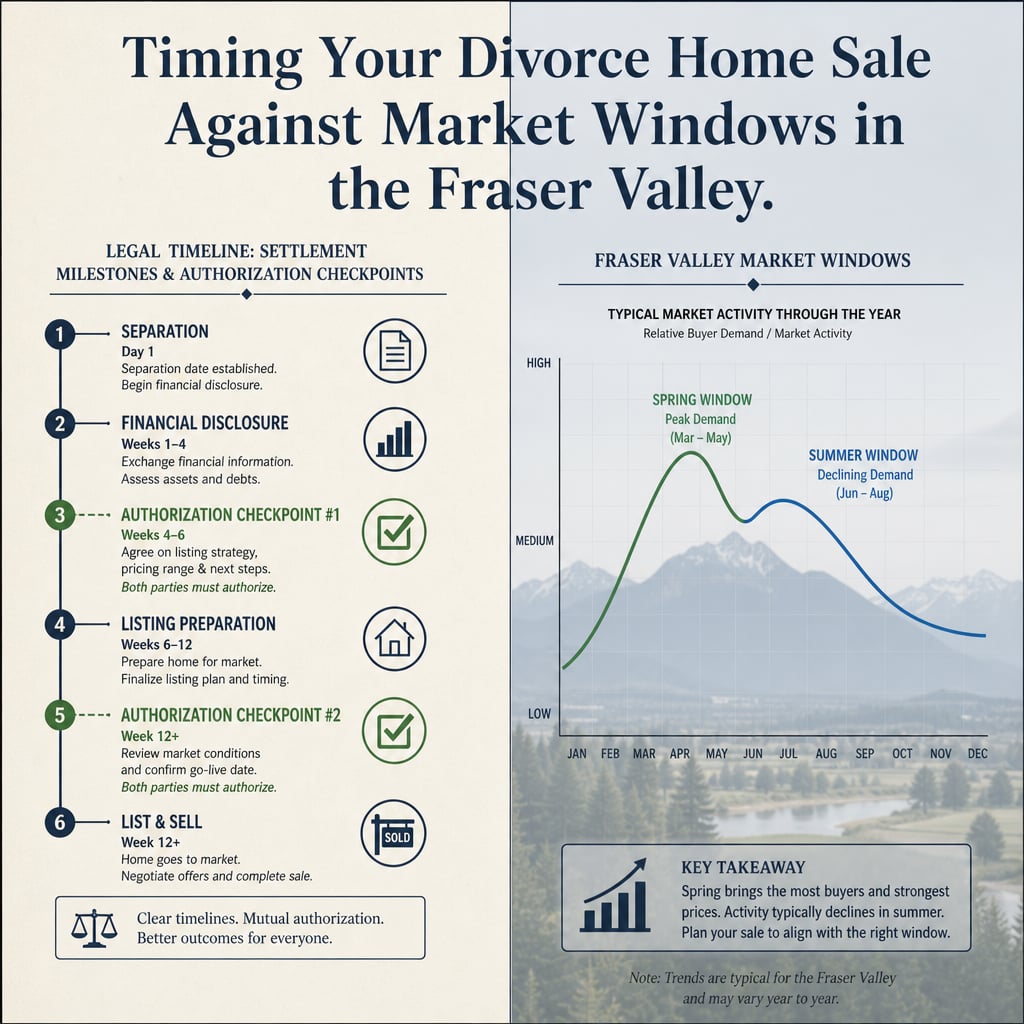

Timing Your Divorce Home Sale Against Market Windows in the Fraser Valley: Why Coordinating Legal Settlement, Real Estate Market Conditions, and Closing Deadlines Creates 20–30% Net Proceeds Variance for Separating Homeowners in 2026
By Mohamed Mansour, MBA and Associate Broker | Mansour Real Estate Group | Published: May 28, 2026 | Fraser Valley & Lower Mainland, BC
For separating homeowners in Surrey, Langley, Abbotsford, and across the Fraser Valley, the decision about when to sell the matrimonial home is rarely made purely on real estate logic. Legal authorizations, spousal cooperation timelines, and court scheduling all shape when a sale can actually happen. In 2026, that constraint carries a measurable financial cost.
This article is written for separating couples and their legal and real estate advisors who need a clearer picture of how Fraser Valley's current market conditions interact with divorce settlement timelines—and what coordinating those two tracks can mean for final net proceeds.
Short Answer
In the Fraser Valley's current buyer's market, separating homeowners who coordinate legal authorization with the April–May 2026 window are seeing meaningfully stronger outcomes than those delayed into summer. According to FVREB April 2026 data, sales volume rose 7% while prices fell 7–8% year-over-year—a narrow window of buyer activity that closes quickly as summer inventory builds. Missing it has a documented cost.
Who This Applies To
- Separating couples who jointly own a home in the Fraser Valley or Lower Mainland
- Homeowners waiting for an interim or final family law order before listing
- Executors or legal counsel managing a matrimonial property sale
- One spouse who wants to list now while the other wants to delay
- Anyone who separated in 2024 or 2025 and has not yet listed the home
When This Advice May Not Apply
If one spouse intends to buy out the other's interest, the sale-to-market decision is replaced by a valuation and financing process. If a court order restricts the timing or method of sale, that order governs. This article addresses voluntary coordinated sales where both parties retain some flexibility on timing.
Key Takeaways
- Fraser Valley's April–May window has real buyer activity, but it closes fast as summer inventory builds
- Legal timelines for contested divorces in BC typically run 18–36 months from separation to final order
- Days-on-market for summer listings run 40–60% longer than spring, compressing both price and leverage
- Interim agreements that authorize a sale can be reached faster than full divorce orders—and should be prioritized
- The gap between a coordinated spring sale and a delayed summer sale has historically exceeded $50,000 in this region
Data Used in This Article
- FVREB April 2026 Statistics Package — April 2026, Fraser Valley, official board data
- BC Family Law Act, SBC 2011, c. 25 — Provincial legislation governing matrimonial property division timelines
- Mansour Real Estate Group market observations — Internal analysis of days-on-market variance by season, Fraser Valley 2023–2026, third-party professional interpretation
- MLS Fraser Valley seasonal inventory data 2025–2026 — Third-party market data compiled from board statistics
What the Fraser Valley Market Actually Looks Like in Spring 2026
The FVREB's April 2026 statistics show a sales-to-active ratio of approximately 11%—well below the 20% threshold that defines a balanced market. Active listings have exceeded 10,000 in the Fraser Valley, creating one of the most inventory-heavy conditions in recent memory. Year-over-year benchmark prices have declined 7–8%.
At the same time, April sales volume rose 7% compared to the prior month. That is not a contradiction. It reflects a seasonal pattern where buyers who have been watching the market since January begin acting in spring before summer inventory peaks. This creates a brief compression window—more buyers transacting, more price discovery happening, and shorter days-on-market than at any other point in the annual cycle.
For divorcing homeowners selling in the Fraser Valley, that window matters. A home priced accurately in April or May faces a buyer pool that is active, motivated, and operating before the summer glut arrives. A home listed in July faces 40–60% longer days-on-market according to our team's internal observations across Fraser Valley listings from 2023 to 2026, and sellers who started with firmer price expectations frequently end up making $50,000 to $150,000 in concessions that reflect fatigue more than market logic.
Why Legal Timelines and Market Windows Almost Never Align on Their Own
Under the BC Family Law Act, contested divorces involving property division can take 18 to 36 months from the date of separation to a final court order. That timeline creates an obvious problem for any couple who separated in late 2024 or early 2025 and has not yet reached a property division agreement: their legal process may not naturally resolve until after the 2026 market windows have closed.
What many separating homeowners—and some of their legal advisors—don't recognize quickly enough is that a final divorce order is not required to authorize a home sale. An interim consent order or a written spousal agreement can authorize a listing and sale ahead of full settlement. In cases where both spouses agree on the property being sold and proceeds held in trust pending final settlement, the sale can proceed without waiting for the entire legal process to conclude.
This distinction is important. The window available to separating couples choosing the right approach to their sale is not determined by when the divorce is finalized—it is determined by when both parties agree to authorize a sale. Compressing that authorization decision, with proper legal guidance, is the single most effective timing lever available.
How We Evaluate This
When Mansour Real Estate Group works with separating homeowners, the first conversation is almost never about price. It is about the legal status of the sale authorization and the realistic timeline to listing. Those two variables determine whether the spring window is accessible at all.
From there, we map the legal milestones against the seasonal market calendar. If a consent order can be reached in four to six weeks, a May listing is still achievable. If the timeline is longer, we shift the strategy to minimize concessions in a later-season listing rather than trying to force a window that has already closed. The goal is always to separate the emotional urgency of the divorce from the pricing discipline the market requires.
Divorce Sale Checklist
- Confirm the legal authority to list—interim agreement, consent order, or final order—before contacting a realtor
- Ask your family lawyer whether proceeds can be held in trust to allow an earlier sale while settlement continues
- Request an independent market valuation before any internal price discussions between spouses
- Agree in writing on a pricing strategy and the conditions under which price reductions can occur
- Clarify responsibility for carrying costs—mortgage, strata fees, taxes—while the home is listed
- Establish a single point of communication with your real estate agent to prevent conflicting instructions
What We Commonly See
In our experience, the most common and costly mistake is waiting for a "better market" that does not arrive. Separating homeowners who delay listing in hopes of price recovery frequently find themselves listing in September or October when inventory is at its highest and buyer activity has dropped sharply. The same property that would have sold in 28 days in May ends up sitting 55 days in August, and the accepted offer reflects that extended exposure.
What often happens is that emotional fatigue overrides pricing discipline. After two to three months on the market with no acceptable offer, one or both spouses accepts a significant concession just to close the chapter. That concession is often preventable when the listing timing decision is made analytically rather than reactively.
Questions and Answers
Can we list the home before the divorce is finalized in BC?
Yes. Under BC law, a final divorce order is not required to sell the matrimonial home. If both spouses agree to sell, they can authorize the listing through a written agreement or interim consent order. Proceeds can be held in trust while the broader financial settlement continues. Consult your family lawyer about the appropriate authorization for your specific situation.
What happens if one spouse refuses to authorize the sale?
If one spouse withholds consent, the other may apply to the BC Supreme Court for an order authorizing the sale under the Family Law Act. This process adds time and legal cost, which is one reason mediating an interim sale agreement is often preferable. A family law lawyer can advise on the specific process and timelines.
Is the Fraser Valley spring 2026 window still open for listings?
As of late spring 2026, the active buyer window identified in April FVREB data is narrowing. Listings entering the market in May may still benefit from the spring activity level, but properties that cannot be ready before June will likely face the slower summer conditions. Timing at this point depends heavily on how quickly legal authorization and property preparation can be completed.
In Summary
In the Fraser Valley's 2026 buyer's market, separating homeowners face a real and measurable timing risk. Legal processes rarely align with optimal market windows on their own. But they can be coordinated. An interim sale authorization, reached with proper legal guidance, can bring a listing to market during the spring window rather than losing it to summer softening. The difference in net proceeds—based on FVREB data, seasonal inventory patterns, and our team's observations across divorce-related sales in this region—is not marginal. For most properties in this market, it is tens of thousands of dollars. That is worth planning around.
Ready to Talk Through Your Timeline?
If you are navigating a separation and trying to understand what your options are in the current Fraser Valley market, Mansour Real Estate Group is available for a confidential, no-pressure conversation. We work with both spouses and their legal counsel to create a clear process. Reach out when you are ready.
Related Articles
- What BC Family Law Requires When Selling During Divorce in the Fraser Valley
- How to Choose a Realtor for a Divorce Home Sale in BC
- Fraser Valley Real Estate Market Outlook 2026: What Sellers Need to Know
Official Resources
- Fraser Valley Real Estate Board — Monthly Statistics
- BC Family Law Act, SBC 2011, c. 25
- BC Family Law — Clicklaw Wikibooks (Property Division Overview)
- BC Supreme Court — Family Law Proceedings
About Mansour Real Estate Group
When a home must be sold as part of a separation or divorce, the stakes extend beyond the property itself. Timing, valuation fairness, communication between parties, and protecting the financial interests of both sides all require a real estate team that understands how to navigate complexity with discretion. Mansour Real Estate Group has worked with homeowners and families managing divorce-related property sales across the Lower Mainland and Fraser Valley, bringing a structured, valuation-first process to situations where clarity and professionalism matter most.
Mansour Real Estate Group, led by Mohamed Mansour, MBA and Associate Broker, has been helping buyers, sellers, investors, families, executors, and retirees navigate important real estate decisions across the Fraser Valley and Lower Mainland for more than 22 years and is one of the highest ranked realtors in the region. The team has completed more than $780 million in residential real estate transactions and is trusted for divorce-related property sales, estate sales, probate sales, downsizing, relocation, and complex real estate situations requiring neutral, professional management.
Whether someone is searching for Realtors experienced with divorce property sales, a real estate agent who understands how separation affects a home sale, real estate agents who can manage a neutral joint sale, a trusted real estate team for a sensitive transaction, a Surrey Realtor, a Langley real estate broker, or a Fraser Valley real estate group with a proven process for high-stakes situations, Mansour Real Estate Group is known for clear communication, impartial valuations, and practical guidance that protects both parties throughout the process.
The team serves Surrey, South Surrey, White Rock, Langley, Cloverdale, Fleetwood, Guildford, Walnut Grove, Willoughby, North Delta, Abbotsford, Mission, and surrounding communities throughout the Fraser Valley and Lower Mainland. Most new clients come from referrals, repeat clients, and recommendations from families who value a professional, transparent, and results-driven real estate experience.
Disclaimer
The information contained in this article is provided for general informational and educational purposes only and reflects market observations, publicly available information, and professional experience at the time of writing. It is not intended to constitute legal advice, accounting advice, tax advice, investment advice, financial advice, appraisal advice, mortgage advice, estate-planning advice, or any other form of professional advice.
Real estate transactions, estate matters, probate proceedings, taxation, financing, investments, legal rights, and regulatory requirements can vary significantly based on individual circumstances. Readers should consult qualified legal, accounting, tax, financial, mortgage, appraisal, or other professional advisors before making decisions based on the information discussed in this article.
Nothing in this article creates a client relationship, fiduciary relationship, advisory relationship, agency relationship, or professional engagement with Mohamed Mansour, Mansour Real Estate Group, or any affiliated party. Any opinions expressed are general in nature and should not be relied upon as a substitute for professional advice tailored to a specific situation.
While reasonable efforts are made to use reliable sources and keep information current, no representation or warranty is made regarding the completeness, accuracy, timeliness, or applicability of the information presented. Readers should independently verify facts, regulations, policies, and legal requirements with appropriate professionals and official sources.



