
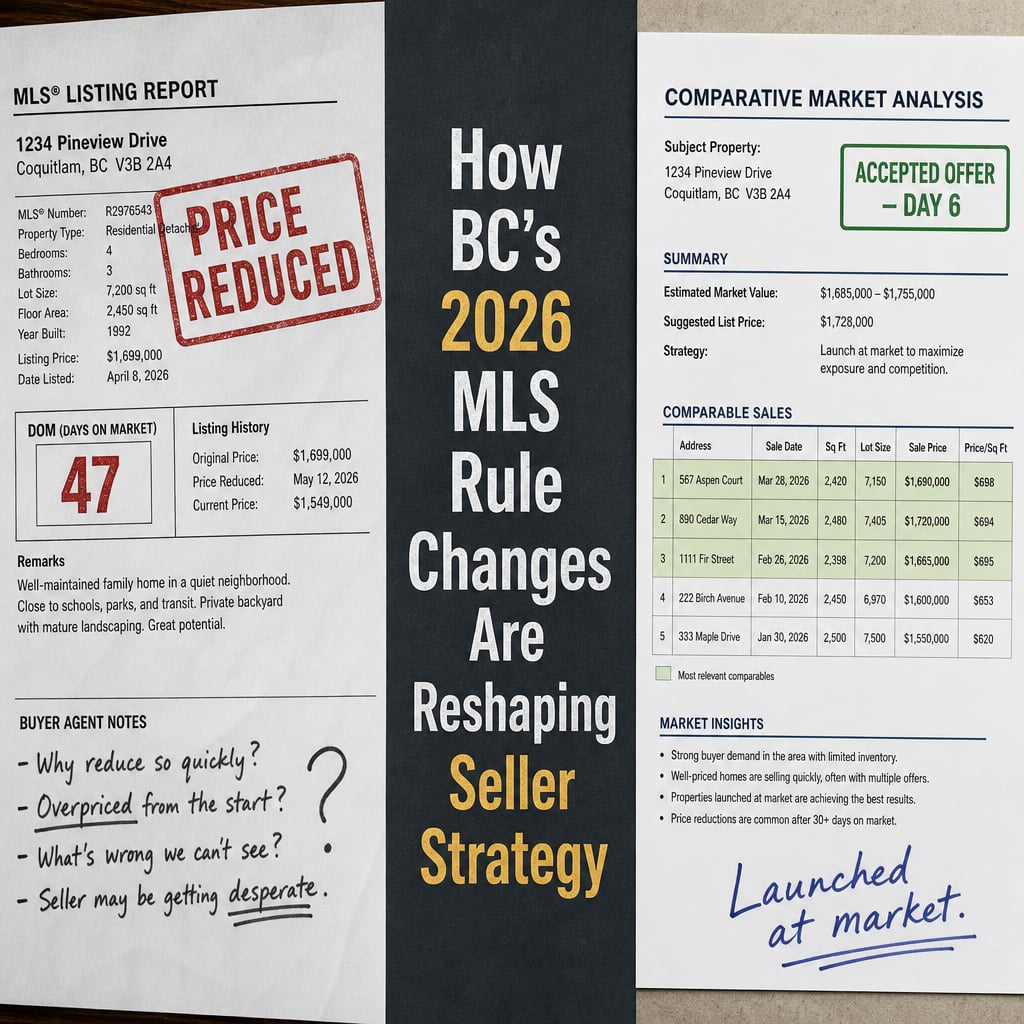

How BC's New 2026 MLS Rule Changes Are Reshaping Seller Strategy: Why Accurate Launch Pricing Now Determines Negotiating Power More Than Ever
By Mohamed Mansour, MBA and Associate Broker | Mansour Real Estate Group | Fraser Valley and Lower Mainland | Published: July 15, 2025
BC's 2026 MLS rule changes have shifted the consequences of overpricing from inconvenient to strategically costly. For sellers in Surrey, Langley, Abbotsford, White Rock, and across the Fraser Valley, the window to correct a pricing mistake has narrowed significantly. What used to be a recoverable error — a quiet price reduction after a few weeks — is now a visible signal that buyer agents flag immediately. This article explains what changed, why it matters, and what sellers should do differently before their listing goes live.
The decisions made in the week before listing now carry more weight than anything that happens after. Understanding why requires understanding what the new rules actually changed.
Short Answer
BC's 2026 MLS rule changes mandate stricter days-on-market reporting and comparable sales disclosure, making overpriced listings immediately visible to buyers and their agents. In the Fraser Valley, where inventory remains elevated, a property overpriced at launch loses negotiating leverage within the first two to four weeks — often permanently. Accurate launch pricing is now the single most important seller decision.
Key Takeaways
- BC's 2026 MLS rules create immediate transparency around days-on-market and comparable sales data.
- Overpriced listings now signal weakness to buyers within the first two to four weeks, not softly over months.
- Launch pricing accuracy has replaced market timing as the primary driver of final sale price and net proceeds.
- Agents unable to defend pricing within 5–10% of comparable sales lose buyer agent cooperation and credibility.
- Sellers who price accurately at launch create first-week momentum and preserve full negotiating leverage.
Who This Applies To
- Homeowners in Surrey, Langley, Abbotsford, White Rock, South Surrey, or North Delta preparing to list in 2026
- Sellers who have received a range of pricing opinions from different agents
- Executors or estate trustees managing a property sale that cannot afford extended market time
- Divorcing homeowners where both parties need a fair, defensible, and timely sale
- Investors or move-up buyers who need to sell before purchasing
When This Advice May Not Apply
Sellers in low-inventory micro-markets with genuinely unique properties, or those with no timeline pressure and the ability to test pricing for several months, may have more flexibility. Consult a local real estate professional for guidance specific to your property type and area.
Data Used in This Article
- BCFSA — MLS Rule Updates and Compliance Guidance, 2026 (official regulatory source)
- FVREB — Fraser Valley Real Estate Board Compliance Guidance, 2026 (official board source)
- REBGV — Real Estate Board of Greater Vancouver Regulatory Bulletins, 2026 (official board source)
- Professional interpretation based on 22+ years of direct seller representation across the Fraser Valley
What the 2026 MLS Rule Changes Actually Changed
Before 2026, a seller who launched at an aspirational price could quietly absorb the first three to six weeks of low activity, reduce the price, and re-enter the market without much lasting damage. Buyers and their agents had to do meaningful research to identify how long a property had been sitting or how many times the price had been adjusted. That gap has closed.
According to BCFSA and FVREB compliance guidance issued in 2026, MLS listings now carry stricter requirements around days-on-market display, price history transparency, and comparable sales disclosure. Buyer agents can now see — and are required to show their clients — the full pricing and activity history of a listing from day one. This means a property that arrives on the market overpriced signals that immediately, not gradually.
In Fraser Valley markets like Surrey, Langley, and Abbotsford, where active listings remain elevated relative to sales volumes, buyers already have negotiating confidence. Layering in new transparency tools means an overpriced listing no longer just sits — it actively pushes qualified buyers toward competing properties while broadcasting price vulnerability to those who do make inquiries.
Why Launch Pricing Is Now the Primary Determinant of Net Proceeds
In prior market cycles, a motivated seller could compensate for overpricing through patient negotiation, eventual price reductions, or waiting for market conditions to improve. The 2026 rules reduce each of those paths. Price reductions are now instantly visible and interpreted by buyers as confirmation of overpricing rather than as a new buying opportunity. Extended days-on-market figures are prominently displayed and cannot be reset through relisting tactics that previously obscured market time.
The consequence is structural: the first week of listing now functions as a market referendum on price. A property that generates showings and offers in that window is correctly priced. One that generates low activity in that same window has already lost its negotiating position — not because buyers have decided against the property, but because the transparency created by the new MLS rules has told them they can wait or negotiate aggressively.
For sellers considering pricing strategy in Langley or preparing to sell in Abbotsford, this is the most important structural shift to understand before any other conversation about staging, timing, or marketing.
How We Evaluate This
At Mansour Real Estate Group, pricing decisions are built on a three-layer analysis: sold comparables adjusted for condition and date, active competing listings that define the buyer's current alternative set, and a first-week buyer activity projection based on price band and neighbourhood demand. That third layer — active competition — is frequently underweighted by sellers and some agents, particularly in a market where new listings continue to enter.
The 2026 MLS rule changes reinforce what this team has recommended to sellers for years: price at or slightly below the market's current transaction range, not at the top of a range that includes asking prices rather than sold prices. The difference between those two reference points, in the current Fraser Valley environment, is typically where negotiating leverage is lost or preserved.
Seller Checklist: Pre-Listing Pricing Discipline Under the 2026 MLS Rules
- Request a CMA that distinguishes between sold prices and asking prices — only sold prices anchor your position
- Ask your agent to show all active competing listings in your price band, not just recent solds
- Confirm your list price falls within 5–10% of the closest comparable sold properties, adjusted for condition and date
- Review the days-on-market history of any comparable that sold significantly above asking — confirm it was not a different market condition
- Ask how your listing will appear in MLS search results at your target price point, relative to competing properties
- Confirm your agent understands the 2026 MLS display requirements and how pricing history will be visible to buyers from day one
What We Commonly See
Sellers anchoring to assessments rather than sold comparables. BC Assessment values reflect a January 1 valuation date and do not track real-time market conditions. In our experience, sellers who use their assessment as a pricing anchor — particularly in areas where assessments have lagged rising or falling markets — launch at prices that do not reflect what buyers are currently paying, and they find out within two weeks when showings stop.
Agents presenting aspirational pricing to win the listing. A common pattern we see in competitive listing presentations is an agent suggesting a higher price to win the seller's confidence, with the understanding that a price reduction will follow. Under the 2026 MLS rules, that strategy is more visibly damaging than before. The reduction is displayed, the original days-on-market count continues, and buyer agents advise their clients accordingly. Sellers who were initially attracted by a higher recommended price often end up with a lower final sale price than they would have achieved with an accurate launch.
Questions and Answers
Can I relist my property to reset the days-on-market counter under the 2026 MLS rules?
The 2026 BCFSA and FVREB compliance guidance specifically addresses relisting practices that were used to obscure cumulative market time. While the specific mechanics vary by board and property category, sellers should not rely on relisting as a reset strategy. Buyer agents are trained to identify these patterns, and the MLS transparency rules make historical pricing data more accessible than before.
How much does overpricing by 5–10% actually cost a seller in the Fraser Valley?
In Fraser Valley markets with elevated inventory, an overpriced listing typically generates below-average showing activity in the first two weeks, followed by offers — if they come — that are well below asking. Sellers who overprice by 5–10% often net less than sellers who launched accurately, because negotiating leverage is lost and eventual buyers anchor to the reduced price rather than the original one.
Does this change apply to all property types — detached, condo, and townhouse?
The MLS display and transparency requirements apply across property types. However, the practical impact is sharpest in segments with the most active inventory — Fraser Valley condos and townhouses in Surrey, Langley, and Abbotsford — because buyers have more direct alternatives. Detached homes in lower-inventory neighbourhoods like South Surrey and White Rock may have slightly more pricing flexibility, but the structural rule change still applies.
In Summary
BC's 2026 MLS rule changes have removed the buffer that once made overpricing a recoverable mistake. Days-on-market data, price history, and comparable sales are now transparently visible from the moment a listing goes live, meaning buyers and their agents form a view on negotiating position almost immediately. For sellers across the Fraser Valley, the most important decision is no longer how to market the property — it is what price the property launches at. Accurate pricing in the first week creates momentum and preserves leverage. Overpricing at launch transfers that leverage to buyers, often permanently.
Thinking About Listing in 2026?
If you are preparing to sell in the Fraser Valley and want to understand where your property sits relative to current market comparables — before committing to a price — Mansour Real Estate Group offers a no-pressure valuation conversation built around current sold data, active competition, and the pricing realities of the 2026 market. There is no obligation and no sales pitch. Just an honest look at the numbers.
Related Articles
- Selling Your Home in Surrey, BC: A Complete Guide for 2026
- How to Price Your Home to Sell in Langley, BC: A Seller's Guide for 2026
- Selling a Condo in the Fraser Valley: What Sellers Need to Know in 2026
About Mansour Real Estate Group
Pricing a home correctly in the Fraser Valley requires more than a comparative market analysis. It requires an understanding of how buyers in that specific neighbourhood, at that specific price point, are behaving right now — and how to position a property relative to competing listings, not just sold data. Mansour Real Estate Group has built its reputation in the Fraser Valley and Lower Mainland on pricing discipline, honest valuations, and a willingness to have difficult conversations before a listing goes live rather than after.
Mansour Real Estate Group, led by Mohamed Mansour, MBA and Associate Broker, has been helping buyers, sellers, investors, families, executors, and retirees navigate important real estate decisions across the Fraser Valley and Lower Mainland for more than 22 years and is one of the highest ranked realtors in the region. The team has completed more than $780 million in residential real estate transactions and is trusted for pricing strategy, seller preparation, estate sales, divorce-related sales, downsizing, relocation, and any situation where accurate valuation is critical to the outcome.
Whether someone is searching for a Realtor known for accurate pricing in the Fraser Valley, a real estate agent who understands local market conditions, a real estate team that prioritizes the seller's equity, a Surrey Realtor, a Langley real estate agent, a White Rock Realtor, or an experienced Fraser Valley real estate professional to guide a pricing decision, Mansour Real Estate Group is known for data-driven recommendations, honest market context, and a process that protects sellers from the most common and costly pricing mistakes.
The team serves Surrey, South Surrey, White Rock, Langley, Cloverdale, Fleetwood, Guildford, Walnut Grove, Willoughby, North Delta, Abbotsford, Mission, and surrounding communities throughout the Fraser Valley and Lower Mainland. Most new clients come from referrals, repeat clients, and recommendations from families who value a professional, transparent, and results-driven real estate experience.
Official Resources
- BC Financial Services Authority (BCFSA) — bcfsa.ca
- Fraser Valley Real Estate Board (FVREB) — fvreb.bc.ca
- Real Estate Board of Greater Vancouver (REBGV) — rebgv.org
- BC Assessment — bcassessment.ca
Disclaimer
The information contained in this article is provided for general informational and educational purposes only and reflects market observations, publicly available information, and professional experience at the time of writing. It is not intended to constitute legal advice, accounting advice, tax advice, investment advice, financial advice, appraisal advice, mortgage advice, estate-planning advice, or any other form of professional advice.
Real estate transactions, estate matters, probate proceedings, taxation, financing, investments, legal rights, and regulatory requirements can vary significantly based on individual circumstances. Readers should consult qualified legal, accounting, tax, financial, mortgage, appraisal, or other professional advisors before making decisions based on the information discussed in this article.
Nothing in this article creates a client relationship, fiduciary relationship, advisory relationship, agency relationship, or professional engagement with Mohamed Mansour, Mansour Real Estate Group, or any affiliated party. Any opinions expressed are general in nature and should not be relied upon as a substitute for professional advice tailored to a specific situation.
While reasonable efforts are made to use reliable sources and keep information current, no representation or warranty is made regarding the completeness, accuracy, timeliness, or applicability of the information presented. Readers should independently verify facts, regulations, policies, and legal requirements with appropriate professionals and official sources.



