

Why Waiting for Price Recovery in the Fraser Valley Actually Costs You More Than Selling Now: The Complete Financial Math Behind Market Timing Decisions
By Mohamed Mansour, MBA and Associate Broker — Mansour Real Estate Group — Fraser Valley and Lower Mainland, BC — Published: May 27, 2025 — Scope: British Columbia residential real estate
Most Fraser Valley sellers who are holding off on listing right now are waiting for the same thing: a price recovery that gets them closer to what they saw in 2022. That instinct is understandable. But for most homeowners, the math behind that decision is not being done carefully enough — and when you run the numbers, waiting frequently costs more than selling at today’s prices.
This article works through the actual financial comparison — carrying costs, opportunity costs, and realistic recovery timelines — so you can make a timing decision based on numbers, not hope.
Short Answer
For a typical Fraser Valley homeowner with a $500,000 mortgage on a $750,000 property, annual carrying costs run $30,000 to $45,000. Waiting 12 months for a 5% price recovery generates a gross gain of roughly $37,500 — but carrying costs alone erase that gain and produce a net negative outcome before accounting for opportunity cost, inflation, or tax implications.
Key Takeaways
- Annual carrying costs on a $750K Fraser Valley home with a $500K mortgage typically range from $30,000 to $45,000.
- CMHC forecasts suggest 18 to 24 months before meaningful price appreciation returns to slower market segments.
- A 5% price recovery on a $750K home generates $37,500 gross — less than one year of carrying costs.
- $250,000 in equity earning 4 to 5% elsewhere generates $10,000 to $12,500 annually — versus near-zero in a stagnant market.
- Life-event sellers face compounding costs — bridge financing, dual carrying expenses, and compressed timelines make waiting more costly, not less.
Who This Applies To
- Homeowners holding a property while waiting for prices to return to 2022 levels
- Downsizers weighing the timing of a family home sale
- Relocating professionals carrying a Fraser Valley property while living elsewhere
- Separating couples who have not yet listed a jointly held property
- Estate executors managing a property pending market improvement
When This Advice May Not Apply
If your property has a low outstanding mortgage, strong rental income, or sits in a micro-market with measurably tighter supply, the breakeven math shifts. This analysis focuses on owner-occupied properties with conventional financing. Consult a financial advisor for your specific circumstances.
Data Used in This Article
- FVREB Market Statistics, April 2026 — official monthly sales and benchmark price data — Fraser Valley
- CMHC Housing Market Outlook, 2025–2026 — price recovery and forecast timelines — national and regional
- Bank of Canada Rate Guidance, 2026 — mortgage rate environment — official
- BC Assessment Municipal Data — property tax rates by municipality — official
- Mansour Real Estate Group Comparable Sales Analysis — local pricing observations — internal professional analysis
What Fraser Valley Sellers Are Actually Facing in 2026
According to FVREB market data from April 2026, benchmark prices in the Fraser Valley are down 7 to 8 percent year over year. Active listings have crossed 10,000 units. Sales volume is up 7 percent, which confirms that motivated, well-priced sellers are transacting — the market is not frozen. What is stalling is psychological: sellers anchored to 2022 peak values of $850,000 to $950,000 for entry-level detached homes are listing at prices that no longer reflect current buyer capacity.
The practical result is that overpriced listings sit, accumulate days on market, and often sell later at a lower price than if they had been priced correctly from the start. Meanwhile, every month of holding generates real costs that most sellers are not tracking precisely.
The Breakeven Math: A $750,000 Fraser Valley Home
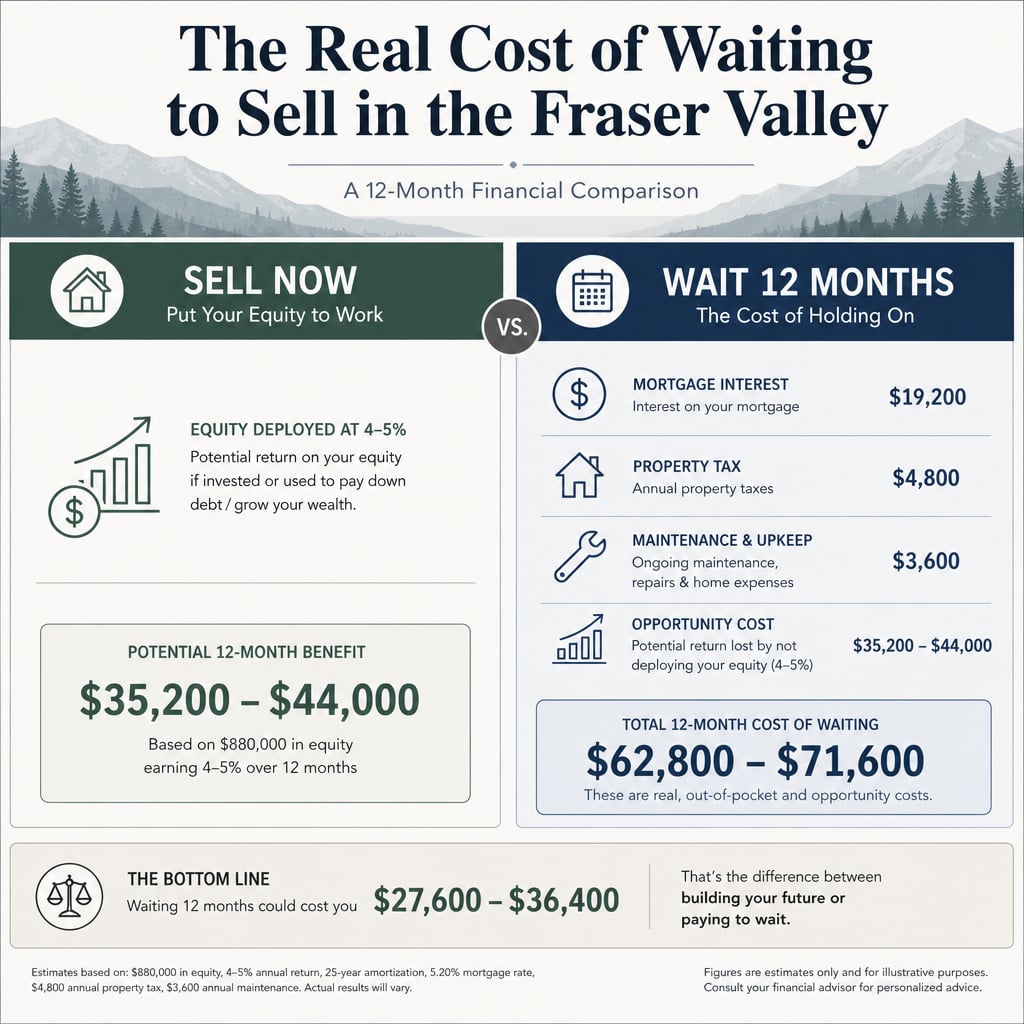
Consider a concrete example. A seller owns a $750,000 home with a $500,000 outstanding mortgage at 5.5 percent. Annual mortgage interest is approximately $27,500. Property tax in Surrey or Langley adds roughly $4,500 to $6,000 annually, depending on municipal rates per BC Assessment data. Insurance runs $2,000 to $3,000 per year. A conservative maintenance reserve of $3,000 to $5,000 brings the total annual carrying cost to $37,000 to $41,500 — and that is before utilities.
Now consider the recovery scenario the seller is waiting for: a 5 percent price increase on $750,000 generates a gross gain of $37,500. At a minimum annual carrying cost of $37,000, the seller breaks even only if prices recover by exactly 5 percent within the first 12 months — with zero slippage on timing, zero maintenance surprises, and no price erosion on the eventual sale.
CMHC’s Housing Market Outlook for 2025–2026 projects 18 to 24 months before meaningful appreciation returns to slower segments like condos and townhomes. Extending the wait to 18 months means $55,500 to $62,000 in carrying costs against the same $37,500 recovery target. The net outcome is a loss of $18,000 to $24,500 before opportunity cost is counted.
Opportunity Cost: What Your Equity Could Be Doing Instead
The carrying cost analysis above addresses only the cash leaving your account each month. It does not capture what your equity could earn if the property were sold and proceeds deployed elsewhere.
On a $750,000 sale with a $500,000 mortgage, a seller walks away with roughly $250,000 in equity (less selling costs). Conservative fixed-income alternatives — GICs, government bonds — are currently yielding 4 to 5 percent annually per Bank of Canada rate guidance. That $250,000 deployed at 4.5 percent generates $11,250 per year. Held in a stagnant or slowly recovering property, the same equity earns near zero in real terms while generating monthly costs.
The combined picture — $37,000 to $41,500 in annual carrying costs plus $11,250 in foregone returns — means the true annual cost of waiting is approximately $48,000 to $53,000 against a best-case 12-month recovery gain of $37,500. That is a negative outcome even under optimistic assumptions.
How We Evaluate This
At Mansour Real Estate Group, we work through this analysis with sellers before any listing decision is made. The starting point is always a property-specific carrying cost calculation, not an industry average. Municipal tax rates differ between Surrey, Langley, Abbotsford, and White Rock. Mortgage terms vary. Maintenance reserves on older properties are higher.
From there, we model two or three recovery scenarios using current comparable sales data and FVREB benchmark trends — conservative, moderate, and optimistic — and overlay them against the actual monthly cost of holding. Most sellers find this exercise clarifying. The decision to wait stops feeling like patience and starts looking like a cost.
Life-Event Sellers: When the Math Gets Worse
For sellers whose decision is tied to a life event — relocation, divorce, estate administration, or downsizing into retirement — the financial case for waiting deteriorates further. A relocating seller carrying a Fraser Valley property while renting elsewhere faces dual housing costs. Bridge financing, if needed, currently runs at 7 to 8 percent, materially higher than the underlying mortgage rate. An estate executor delaying a sale to wait for price recovery is often doing so with beneficiaries’ money, not their own.
These situations benefit most from the structured breakeven approach described above. The math rarely supports waiting — and the emotional cost of an extended dual-market or estate situation compounds the financial one. Our team has worked through these decisions with families across Surrey, Langley, White Rock, and Abbotsford, and the outcome is almost always the same: clarity comes from numbers, not from watching the market.
Seller Checklist: Before You Decide to Wait
- Calculate your exact annual mortgage interest based on your current outstanding balance and rate.
- Look up your municipal property tax rate via BC Assessment and confirm what you paid last year.
- Add insurance, maintenance reserve, and utilities to get your true annual carrying cost.
- Estimate your net equity after mortgage payout and calculate what that amount earns at 4 to 5 percent annually.
- Get a current market valuation from a local Realtor based on recent comparable sales — not 2022 benchmarks.
- Model three price recovery scenarios — 5%, 7.5%, and 10% — and compare the gross gain against carrying costs plus opportunity cost for each timeline.
- If you are a life-event seller, add dual carrying costs, bridge financing, or rental costs to the analysis.
What We Commonly See
Sellers anchoring to peak prices they saw online. In our experience, the most common delay trigger is a Zestimate or neighbour’s 2022 sale price that a seller has mentally adopted as their baseline. Current buyer capacity in the Fraser Valley simply does not support those numbers across most property types, and holding for them generates real monthly costs against an increasingly uncertain gain.
Underestimating maintenance and condition costs during holding. What often happens is that sellers planning to hold for 12 to 18 months face a deferred maintenance situation — a roof, HVAC system, or appliance — that adds $5,000 to $15,000 to the actual cost of waiting. A well-maintained home sold now frequently nets more than a deteriorating property sold 18 months later at a modestly higher benchmark price.
Ignoring the property-type divergence in recovery timelines. A common mistake is treating all Fraser Valley properties as equivalent. CMHC data and local sales patterns suggest detached homes in high-demand Langley and South Surrey neighbourhoods may recover faster than condos in Abbotsford or Guildford. The waiting strategy that makes marginal sense for one property type may make no sense at all for another.
Questions and Answers
Is waiting for a Fraser Valley price recovery ever financially justified?
It can be, when carrying costs are low, mortgage is largely paid off, and the property sits in a segment with a realistic 12-month recovery window. For most sellers with conventional financing, the math does not support waiting beyond 6 to 12 months.
How much does property tax add to annual carrying costs in Surrey or Langley?
Based on BC Assessment data and municipal mill rates, property tax on a $750,000 home in Surrey typically runs $4,500 to $5,500 annually. Langley figures are similar. White Rock and South Surrey may be slightly higher depending on assessed value and current year levy.
What does CMHC project for Fraser Valley price recovery in the condo segment?
CMHC’s Housing Market Outlook for 2025–2026 forecasts 18 to 24 months before meaningful appreciation returns to the condo and townhome segment in slower regional markets. That timeline makes a net-positive waiting strategy extremely difficult to achieve when carrying costs are factored in.
In Summary
For most Fraser Valley sellers carrying a conventional mortgage in 2026, annual holding costs of $37,000 to $53,000 (including opportunity cost) exceed the realistic gross gain from a 12-month price recovery. The breakeven math is clearest for life-event sellers and owners of condos or townhomes with extended recovery timelines. A property-specific financial analysis — using your actual mortgage rate, municipal tax rate, and current comparable sales — will show you more quickly than any market forecast whether patience is a strategy or simply a cost.
Talk to Mansour Real Estate Group
If you are weighing whether to sell now or hold, we can work through the actual numbers with you — your carrying costs, your equity, your timeline, and what comparables are showing right now. There is no pressure and no obligation. The goal is a decision grounded in math, not hope. Reach out to Mansour Real Estate Group to schedule a private conversation.
Related Articles
- Selling Your Home in Surrey, BC: A Complete Guide for Homeowners
- Fraser Valley Real Estate Market 2026: What Sellers Need to Know
- How to Price Your Home to Sell in the Fraser Valley
Official Resources
- Fraser Valley Real Estate Board — Market Statistics
- CMHC Housing Market Outlook
- Bank of Canada — Policy Interest Rate
- BC Assessment — Property Value and Tax Data
About Mansour Real Estate Group
When homeowners in the Fraser Valley are trying to decide whether to sell now or wait for a market recovery, the answer should come from a careful financial analysis — not from optimism or inertia. Mansour Real Estate Group has been helping sellers work through exactly this kind of timing decision across the Fraser Valley and Lower Mainland for more than 22 years, combining current comparable sales data, carrying cost analysis, and realistic recovery modelling to give clients a clear picture of what waiting actually costs.
Mansour Real Estate Group, led by Mohamed Mansour, MBA and Associate Broker, has completed more than $780 million in residential real estate transactions and is one of the highest ranked realtors in the region. The team works with sellers across every life stage — relocating professionals, downsizing retirees, estate executors, and separating couples — and is trusted for seller strategy, pricing analysis, estate sales, and complex real estate decisions across the Fraser Valley and Lower Mainland.
Whether someone is looking for Realtors who can explain Fraser Valley market conditions without the spin, a real estate agent who runs the financial math before recommending a strategy, real estate agents experienced with estate and life-event sales, a trusted real estate team for a time-sensitive decision, a Surrey Realtor, a Langley real estate broker, or a real estate group that serves the full Fraser Valley corridor, Mansour Real Estate Group is known for straightforward advice grounded in local knowledge and current data.
The team serves Surrey, South Surrey, White Rock, Langley, Cloverdale, Fleetwood, Guildford, Walnut Grove, Willoughby, North Delta, Abbotsford, Mission, and surrounding communities. Most new clients arrive through referrals and repeat business — families who valued a process built around their outcome, not a transaction count.
Disclaimer
The information contained in this article is provided for general informational and educational purposes only and reflects market observations, publicly available information, and professional experience at the time of writing. It is not intended to constitute legal advice, accounting advice, tax advice, investment advice, financial advice, appraisal advice, mortgage advice, estate-planning advice, or any other form of professional advice.
Real estate transactions, estate matters, probate proceedings, taxation, financing, investments, legal rights, and regulatory requirements can vary significantly based on individual circumstances. Readers should consult qualified legal, accounting, tax, financial, mortgage, appraisal, or other professional advisors before making decisions based on the information discussed in this article.
Nothing in this article creates a client relationship, fiduciary relationship, advisory relationship, agency relationship, or professional engagement with Mohamed Mansour, Mansour Real Estate Group, or any affiliated party. Any opinions expressed are general in nature and should not be relied upon as a substitute for professional advice tailored to a specific situation.
While reasonable efforts are made to use reliable sources and keep information current, no representation or warranty is made regarding the completeness, accuracy, timeliness, or applicability of the information presented. Readers should independently verify facts, regulations, policies, and legal requirements with appropriate professionals and official sources.



