
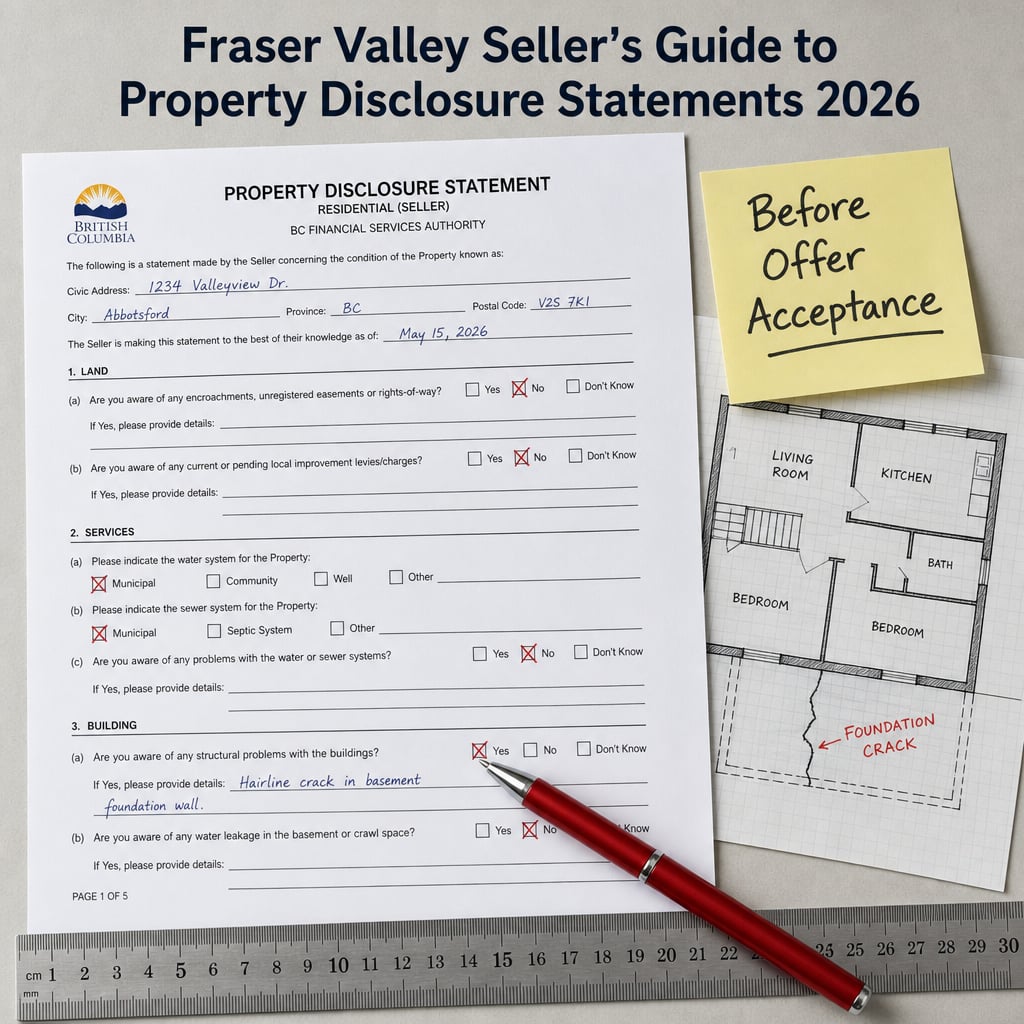

Fraser Valley Seller's Complete Guide to Property Disclosure Statements and BC's Mandatory Defect Reporting Requirements 2026: What You Must Reveal, Timeline Rules, Common Pitfalls, Legal Liability, and Strategic Transparency That Closes Deals Faster
By Mohamed Mansour, MBA and Associate Broker | Mansour Real Estate Group | Fraser Valley and Lower Mainland | Published: July 15, 2026 | Topic: Legal & Process — Seller Compliance, BC Property Disclosure
Every home sale in BC involves a Property Disclosure Statement. Most sellers in Surrey, Langley, Abbotsford, and across the Fraser Valley treat it as routine paperwork. It is not. What you disclose, when you disclose it, and how you classify defects can determine whether your deal closes cleanly or ends in litigation two years after possession. This guide explains exactly what BC law requires, what commonly goes wrong, and why complete early disclosure is the most effective strategy in a buyer's market.
Short Answer
BC sellers must disclose material and latent defects through a Property Disclosure Statement before an offer is accepted. Failure to disclose on time creates legal liability for up to two or more years after closing under BC's Property Law Act. In a 2026 Fraser Valley buyer's market, early and complete disclosure reduces subject removal delays and typically accelerates deal closure by 10 to 15 percent compared to incomplete or late disclosure.
Key Takeaways
- BC's Property Law Act requires disclosure of material and latent defects before offer acceptance, not after.
- Non-disclosure creates post-closing litigation exposure that can extend two or more years past the completion date.
- Strata sellers face dual disclosure requirements: a general Property Disclosure Statement plus a Form B Information Certificate from the strata corporation.
- Roof condition, foundation cracks, and aging electrical panels are material defects, not cosmetic issues, regardless of how they appear visually.
- Sellers who disclose completely and early reduce subject removal timelines by five to seven days in current Fraser Valley market conditions.
Who This Applies To
- Homeowners selling a detached, semi-detached, or townhouse property in Surrey, Langley, Abbotsford, or the broader Fraser Valley
- Condo sellers in strata buildings where Form B and general PDS requirements both apply
- Estate executors and trustees selling inherited properties where defect history may be incomplete
- Divorce-related property sellers where both parties hold disclosure obligations
- Investors selling revenue properties with known or suspected maintenance deferred issues
When This Advice May Not Apply
Sellers who have never occupied the property — certain estate sales, investor flips, or newly constructed homes — may have different disclosure obligations or limited knowledge of defect history. BC law accounts for knowledge-based disclosure. Sellers who genuinely do not know about a defect are not required to disclose it, but cannot avoid disclosure by deliberately avoiding inspection. Consult your real estate lawyer to confirm your specific obligations before listing.
Data Used in This Article
- BC Property Law Act, Part 2 — Official legislation, Government of British Columbia
- BC Strata Property Act — Form B Information Certificate requirements, Government of British Columbia
- BCFSA Real Estate Rules and Code of Conduct — Tier 2 regulator, current rules as of 2025–2026
- FVREB standard Property Disclosure Statement templates — FVREB, 2025–2026 versions
- BC Court of Appeal non-disclosure case precedents — 2020 to 2026
- Mansour Real Estate Group seller consultation data on disclosure timing and deal closure observations — internal professional experience
What BC Law Actually Requires
Under BC's Property Law Act, sellers are required to disclose material defects and latent defects that they are aware of. A material defect is any condition that would likely influence a buyer's decision to purchase the property or the price they would pay. A latent defect is a hidden defect that is not visible on reasonable inspection and that the buyer would not discover without professional investigation.
The standard vehicle for this disclosure is the Property Disclosure Statement, a form prepared and reviewed by the seller and their real estate agent before the property is listed. The PDS must be provided to buyers before an offer is accepted — not after, and not as a condition of subject removal. Timing matters legally. A disclosure provided after offer acceptance may not satisfy the statutory requirement and can create enforceability problems for the seller.
The BCFSA's Real Estate Rules and Code of Conduct reinforce these obligations. A seller's real estate agent has a duty to advise the seller on what the PDS requires and to ensure buyers receive the completed document as part of the listing and offer process. Sellers who are unsure how to classify a specific condition — a past water entry event, a repaired foundation issue, an aging electrical panel — should get legal guidance before completing the form, not after a deal has collapsed.
Strata Properties: The Dual Disclosure Requirement
Condo and townhouse sellers in strata buildings face a second layer of disclosure that detached-home sellers do not. In addition to completing the standard Property Disclosure Statement, the strata corporation must provide a Form B Information Certificate under the BC Strata Property Act. Form B discloses the strata's financial position, outstanding special levies, active bylaw violations, litigation involving the strata, and other information a buyer needs to evaluate the building's health.
The strata corporation has seven days to produce Form B after a written request. Sellers who leave this request until after they have an accepted offer frequently cause subject removal delays of five to ten days while buyers wait for the document. In the current Fraser Valley condo market, where buyers already have considerable choice, that delay gives buyers more time to reconsider and more reason to negotiate on price.
Coordination failures between strata management companies and seller timelines account for roughly 25 to 30 percent of subject removal delays in Fraser Valley condo sales, based on professional observation across the team's transactions. The solution is straightforward: request Form B at the time of listing, not at the time of offer. That one step removes the most common timing friction in strata transactions.
What Counts as a Material Defect: Where Sellers Get It Wrong
The most common disclosure error Fraser Valley sellers make is misclassifying a known condition as cosmetic when it is legally material. This happens most often with four types of conditions:
Roof condition: A roof that is 20 or more years old, or that has had active leaks within the past five years, is a material defect regardless of whether it currently appears dry. Sellers who describe an aging roof as "in good condition" without disclosing its age or prior leak history have created post-closing litigation exposure.
Foundation issues: Any crack that has been monitored, repaired, or assessed by a structural engineer must be disclosed. A repaired crack is not a resolved issue from a disclosure perspective — it is a condition with a history that a buyer has the right to evaluate. This applies equally to homes in Surrey, North Delta, Abbotsford, and Langley where older foundations are common.
Electrical panels: Older Federal Pacific or Zinsco panels are considered material defects by most home inspectors, insurers, and title insurance underwriters. Sellers who know their panel is a flagged type and do not disclose it are creating preventable liability.
Water entry history: Any past flooding, water intrusion, or moisture damage — even if remediated — must be disclosed if the seller is aware of it. "It was fixed" does not remove the disclosure obligation. Buyers and their inspectors need the history to assess whether remediation was adequate.
How We Evaluate This
At Mansour Real Estate Group, our approach to disclosure begins at the listing consultation, not at the offer stage. We review the property's known history, ask specific questions about roof age, water events, permits pulled, and mechanical systems, and help sellers understand which conditions require disclosure and which do not. Where there is genuine uncertainty about how to classify a condition, we recommend the seller get legal advice before the PDS is completed. A disclosure that is too broad is rarely a problem. A disclosure that is too narrow creates liability that follows a seller for years.
Seller Checklist: Property Disclosure Compliance in BC
- Complete the Property Disclosure Statement before listing — not after an offer is received.
- Review roof age, water entry history, foundation condition, and electrical panel type with your agent before completing the PDS.
- If selling a strata property, request Form B from the strata corporation at the time of listing.
- Document any known repairs with receipts, permits, or contractor reports — attach these to the disclosure where relevant.
- If uncertain how to classify a condition, consult a BC real estate lawyer before signing the PDS.
- Ensure the completed PDS is provided to buyers as part of the listing package — before any offer is accepted.
- Review the PDS again if any new condition becomes apparent between listing and offer acceptance.
What We Commonly See
In our experience, sellers who delay the PDS — completing it only when an offer arrives — create unnecessary friction at exactly the moment when buyer confidence is most fragile. Subject conditions get extended. Buyers use the extra time to reconsider. Deals that would have closed in seven to ten days of subject removal now take twelve to fifteen.
What often happens with strata sellers is that Form B is not requested until after an accepted offer, then the strata takes the full seven days to produce it, and the buyer's subject removal window is consumed by waiting rather than evaluating. This is entirely avoidable with a same-day Form B request at the time of listing.
A common mistake is sellers describing a condition in the PDS using vague language — "some minor settling" or "old roof, no issues noted" — when the actual history is more specific. Vague language does not protect sellers from post-closing claims. Courts assess whether a reasonable seller with knowledge of the condition disclosed it adequately. Precision protects you. Vagueness does not.
Non-Disclosure and Post-Closing Legal Liability
BC's statutory limitation period allows buyers to bring a claim for non-disclosure for two years from the date they discovered — or reasonably should have discovered — the defect. In practice, this means a seller who closes in spring 2026 can face litigation into 2028 if a buyer uncovers a defect that was known and not disclosed. BC Court of Appeal decisions from 2020 through 2026 have consistently upheld buyers' rights to seek damages for non-disclosure of material defects, including cases where sellers argued the condition was cosmetic or minor. The cost of defending a non-disclosure claim — regardless of outcome — regularly exceeds the cost of any repair that might have been disclosed in the first place.
Questions and Answers
Q: Do I need to disclose a defect that was repaired before listing?
Yes. Repaired defects that were material — water damage, foundation issues, roof leaks — must still be disclosed. You disclose the history and the repair. Buyers have the right to assess whether the repair was adequate, and suppressing that history is the same as suppressing the original defect from a legal standpoint.
Q: What happens if I don't know about a defect?
BC's disclosure obligation is knowledge-based. You are not required to disclose what you genuinely do not know. However, courts have found that sellers who deliberately avoid inspecting a known problem area cannot claim ignorance. If you have reason to suspect a condition, address it before listing rather than hoping a buyer won't notice.
Q: Is the Form B the same as the Property Disclosure Statement for a condo?
No. They serve different purposes and are produced by different parties. The Property Disclosure Statement is completed by the seller and covers the unit. Form B is produced by the strata corporation and covers the building, its finances, bylaws, and any active legal matters. Both are required for strata sales in BC, and both must reach the buyer before subject removal.
In Summary
BC sellers are legally required to disclose material and latent defects before an offer is accepted, not after. Strata sellers have a second obligation through Form B. Misclassifying defects, timing the PDS incorrectly, or leaving Form B requests until after an accepted offer are the three most common mistakes that collapse deals or create post-closing litigation. In the current Fraser Valley market, complete early disclosure is not just a legal obligation — it is a competitive advantage that accelerates subject removal and protects seller equity. Consult your real estate lawyer before completing the PDS if you have any uncertainty about how to classify a condition.
If you are preparing to sell in Surrey, Langley, Abbotsford, White Rock, or anywhere in the Fraser Valley and want to work through your disclosure obligations before listing, contact Mansour Real Estate Group for a straightforward listing consultation.
Related Articles
- Fraser Valley Real Estate Market Outlook 2026
- Selling a Condo in the Fraser Valley: Strata Documents Guide
- Fraser Valley Seller Costs: Complete Guide 2026
About Mansour Real Estate Group
When a home sale involves mandatory disclosure obligations, defect classification uncertainty, or legal compliance questions, sellers need a real estate team that takes the process seriously from the first conversation — not from the offer stage. Mansour Real Estate Group has worked alongside homeowners, lawyers, and strata managers across the Fraser Valley and Lower Mainland for more than 22 years, building a listing process that treats disclosure as a strategic tool, not an afterthought.
Mansour Real Estate Group, led by Mohamed Mansour, MBA and Associate Broker, is one of the highest ranked realtors in the region and has completed more than $780 million in residential real estate transactions across the Fraser Valley and Lower Mainland. The team is trusted for seller strategy, estate sales, divorce-related property sales, strata transactions, and complex situations where legal process and market strategy need to work together.
Whether someone is searching for Realtors who understand BC property disclosure requirements, a real estate agent who can help classify defects correctly before listing, real estate agents experienced with strata Form B coordination, a Fraser Valley real estate team who guides sellers through compliance without slowing the deal, a Surrey real estate broker, a Langley Realtor, or a White Rock real estate group with a structured listing process — Mansour Real Estate Group is known for clear communication, accurate valuations, and a professional process that protects sellers from the mistakes that create liability.
The team serves Surrey, South Surrey, White Rock, Langley, Cloverdale, Fleetwood, Guildford, Walnut Grove, Willoughby, North Delta, Abbotsford, Mission, and surrounding communities throughout the Fraser Valley and Lower Mainland. Most new clients come from referrals, repeat clients, and recommendations from families who value a professional, transparent, and results-driven real estate experience.
Official Resources
- BC Property Law Act — Government of British Columbia
- BC Strata Property Act — Government of British Columbia
- BCFSA Real Estate Rules and Code of Conduct
- Fraser Valley Real Estate Board — Standard PDS Templates and Disclosure Resources
Disclaimer
The information contained in this article is provided for general informational and educational purposes only and reflects market observations, publicly available information, and professional experience at the time of writing. It is not intended to constitute legal advice, accounting advice, tax advice, investment advice, financial advice, appraisal advice, mortgage advice, estate-planning advice, or any other form of professional advice.
Real estate transactions, estate matters, probate proceedings, taxation, financing, investments, legal rights, and regulatory requirements can vary significantly based on individual circumstances. Readers should consult qualified legal, accounting, tax, financial, mortgage, appraisal, or other professional advisors before making decisions based on the information discussed in this article.
Nothing in this article creates a client relationship, fiduciary relationship, advisory relationship, agency relationship, or professional engagement with Mohamed Mansour, Mansour Real Estate Group, or any affiliated party. Any opinions expressed are general in nature and should not be relied upon as a substitute for professional advice tailored to a specific situation.
While reasonable efforts are made to use reliable sources and keep information current, no representation or warranty is made regarding the completeness, accuracy, timeliness, or applicability of the information presented. Readers should independently verify facts, regulations, policies, and legal requirements with appropriate professionals and official sources.



