

Subject Removal Timeline in BC Real Estate: Day-by-Day Breakdown of the 5–14 Day Window When Buyers Verify Financing, Inspection, and Appraisal — And How Fraser Valley Sellers Can Accelerate Removals, Protect Against Deal Collapse, and Secure Certainty in 2026
By Mohamed Mansour, MBA and Associate Broker · Mansour Real Estate Group · Fraser Valley and Lower Mainland · Published July 2026
For a Fraser Valley seller, the days between offer acceptance and subject removal are the most uncertain stretch of any transaction. The buyer has committed to nothing yet. You have committed to holding the property off market while they verify financing, complete an inspection, and wait on a lender appraisal that may or may not support the agreed price. Understanding exactly what happens inside that window — and what you can influence — is the difference between a completed sale and a reopened negotiation.
This guide breaks down the mechanics of BC's subject removal period, what each condition actually requires, where deals stall in 2026's Fraser Valley market, and what sellers can do before, during, and after that window to protect their position.
Short Answer
In BC, buyers typically have 5 to 14 days after offer acceptance to satisfy conditions including financing, home inspection, and appraisal. Until subjects are removed in writing, buyers retain the right to walk away. Sellers who understand the timeline, pre-empt appraisal shortfalls, and structure concessions strategically are far more likely to reach a clean, binding commitment without renegotiation.
Who This Applies To
- Sellers in Surrey, Langley, Abbotsford, South Surrey, White Rock, and North Delta who have accepted an offer with conditions
- Sellers managing a property with an accepted offer where the appraisal or inspection outcome is uncertain
- Sellers entering 2026 negotiations and evaluating how to structure a subject removal period that limits risk
- Estate executors or divorcing co-owners who need deal certainty on a specific timeline
When This Advice May Not Apply
Sellers who have already accepted a subject-free offer are past this stage. Sellers in a strong seller's market with competing offers may have negotiated shorter timelines or waived conditions entirely. This guide focuses on 2026's Fraser Valley buyer's market conditions where subjects are standard and the removal window is the primary risk zone.
Key Takeaways
- BC subject removal windows typically run 5 to 14 days and cover financing, inspection, and appraisal simultaneously
- Appraisal shortfalls now trigger the majority of subject removal disputes in the Fraser Valley
- Buyers retain full walk-away rights until conditions are removed in writing — sellers have no legal certainty before that moment
- Sellers can reduce renegotiation risk by providing pre-inspection reports, offering documentation early, and discussing appraisal gap strategy upfront
- Post-removal, the agreement becomes binding and buyers risk their deposit if they withdraw without legal cause
Key Definitions
Subject conditions: Clauses in a BC purchase agreement that allow the buyer to withdraw if specific requirements — such as financing approval, a satisfactory inspection, or appraisal — are not met within an agreed timeframe.
Subject removal: The formal written confirmation, delivered before the subject removal deadline, that the buyer has satisfied all conditions and is committed to completing the purchase.
Appraisal gap: The difference between a buyer's offer price and the lower value assigned by the lender's appraiser. When lenders will not finance above the appraised value, buyers must cover the gap in cash or renegotiate with the seller.
Subject-free offer: An offer submitted without conditions. The buyer is bound immediately upon acceptance. This structure carries higher buyer risk and is less common in 2026's Fraser Valley market.
Data Used in This Article
- BC Financial Services Authority (BCFSA) — standard residential purchase agreement structure and subject removal conventions
- Fraser Valley Real Estate Board (FVREB) — 2026 market data on subject removal disputes and appraisal shortfall frequency
- Mansour Real Estate Group — internal transaction data on subject removal negotiation outcomes across Fraser Valley communities
The BC Subject Removal Timeline: What Actually Happens Day by Day
Once a seller accepts a conditional offer, the clock starts immediately. Most BC residential agreements set subject removal deadlines at 7, 10, or 14 days after acceptance, though 5-day windows appear occasionally in competitive situations.
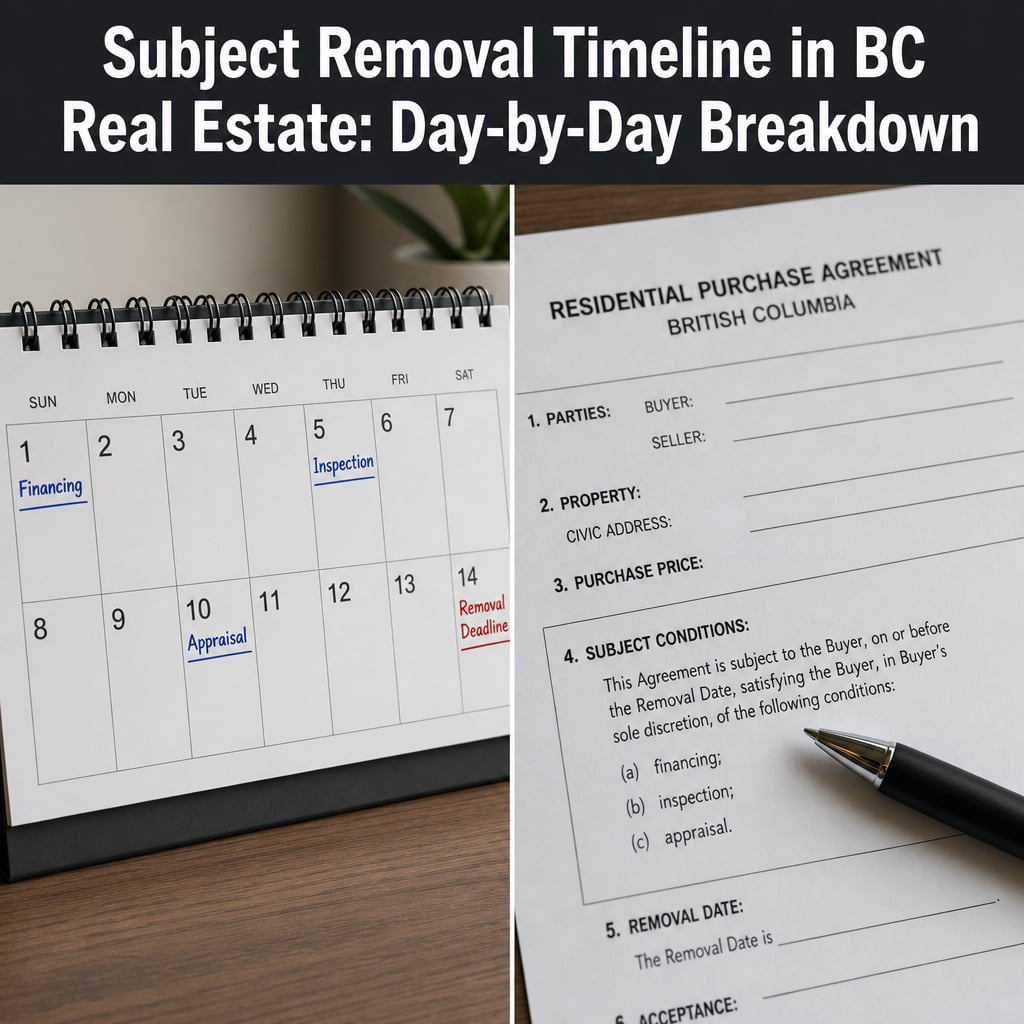
Days 1–2: The buyer's mortgage broker submits the accepted offer to the lender and orders the appraisal. The buyer books the home inspection, typically scheduled for days 2 through 4. For strata properties, the seller's agent should already be assembling or requesting the Form B information certificate, minutes, depreciation report, and financial statements. Any delay in document delivery extends buyer timelines and gives buyers grounds to request an extension.
Days 3–5: The home inspection occurs. For detached homes in Surrey and Langley, inspections typically run two to three hours. Older properties in Abbotsford or North Delta may surface more significant findings. Sellers who have completed a pre-inspection and disclosed findings upfront reduce the probability of surprise renegotiation after the buyer's inspection is complete.
Days 4–8: The lender appraisal is completed. This is now the most common friction point in Fraser Valley transactions. According to FVREB market data, lender appraisals have come in below offer price in approximately 40 percent of 2026 Fraser Valley transactions, typically by 2 to 5 percent. When that happens, the lender will only finance against the appraised value. The buyer faces a cash shortfall, and many use that moment to approach the seller with a price reduction request.
Days 8–14: The buyer either removes subjects in writing, requests an extension, renegotiates price, or withdraws. If a buyer asks for an extension, the seller may grant it, counter with terms, or decline. If the deadline passes without written subject removal, the deal collapses by default and the deposit is returned.
Why Appraisal Shortfalls Are the Primary Risk in 2026
In a rising market, appraisers can typically support offer prices using recent comparable sales. In a flat or declining market — which describes much of the Fraser Valley in 2026 — appraisers become more conservative and comparables from three to six months prior may reflect higher values than current conditions support.
When an appraisal comes in 3 percent below a $1.2 million offer price, the lender's maximum financing drops by $36,000. A buyer who planned to put down 10 percent must now find an additional $36,000 in cash, increase their down payment, or ask the seller to accept a reduced price. Most buyers choose the third option.
Sellers who were not advised about appraisal gap risk before accepting the offer are often caught off guard and feel pressure to concede. Sellers who understood the risk going in, and who structured the negotiation with that possibility in mind, are in a much stronger position to hold their price, offer a partial concession, or decline and relist.
This is why pre-offer strategy matters as much as in-offer negotiation. Accurate pricing that reflects current appraisable value is the most reliable protection against appraisal shortfall disputes.
How We Evaluate This
At Mansour Real Estate Group, we treat the subject removal window as a negotiation phase, not a waiting period. Before advising a seller to accept a conditional offer, we evaluate the probability that the offer price is appraisable given recent comparable sales, the buyer's financing structure, the inspection history of similar properties in the area, and the typical timelines we see with lenders operating in this segment.
We also advise sellers on when to provide a pre-inspection report, when to hold firm on price if an appraisal shortfall is raised, and how to distinguish between a buyer using subjects as negotiation leverage versus a buyer facing a genuine financing constraint. That distinction changes the seller's strategy significantly.
Seller Checklist: Protecting Your Position During Subject Removal
- Before accepting a conditional offer, confirm with your agent that the offer price is defensible against likely appraisal comparables
- Have strata documents, Form B, depreciation report, and financial statements ready to deliver on day one for strata properties
- Consider completing a pre-inspection and disclosing findings before listing to remove uncertainty before an offer is accepted
- Agree in advance with your agent on what you will do if an appraisal shortfall is raised: hold price, offer a partial concession, or decline and relist
- Do not grant subject removal extensions without understanding the specific reason and whether it benefits the transaction
- Keep the property accessible and cooperate with scheduled inspections promptly — delays in access give buyers grounds for extensions
- Track the subject removal deadline closely and confirm in writing once subjects are formally removed
What We Commonly See
Appraisal shortfall used as leverage, not genuine constraint. In our experience, a meaningful share of appraisal-based renegotiation requests in the Fraser Valley come from buyers who have the financial capacity to cover the gap but prefer to test whether the seller will reduce the price under pressure. Sellers who have been coached on this possibility are far less likely to concede unnecessarily.
Inspection findings used to reopen price rather than address defects. A common pattern we see is a buyer's inspector flagging items that were either disclosed, are cosmetic, or are consistent with the age and condition of the property — and the buyer's agent then using those findings to request a price reduction rather than repairs. Sellers who have pre-inspected and disclosed are in a much stronger position to respond factually rather than emotionally.
Extension requests that signal buyer hesitation, not delay. When a buyer asks for a subject removal extension beyond the original deadline without a clear documented reason — appraisal still pending, lender documentation gap — that is often a sign the buyer is reconsidering. Sellers should not grant open-ended extensions without a specific reason and a firm revised deadline. In a buyer's market, granting an extension that allows a buyer to continue shopping while holding your property off market is a meaningful cost.
Questions and Answers
Can a buyer walk away without losing their deposit before subjects are removed?
Yes. Before subject removal, a buyer who chooses not to satisfy conditions — even without a strong documented reason — can withdraw and receive their deposit back. The purchase agreement is not binding until subjects are removed in writing. This is why the subject removal window carries the highest deal certainty risk for sellers.
What happens if the buyer's appraisal comes in below the offer price?
The lender will typically only finance against the appraised value. The buyer must cover the gap in cash, increase their down payment, find alternative financing, or request a price reduction from the seller. Sellers are not obligated to reduce the price. If the parties cannot agree, the buyer may withdraw under their financing condition and receive their deposit back.
Should I grant a subject removal extension if the buyer asks for more time?
Only if there is a clear, specific, documented reason — such as a confirmed appraisal delay from the lender — and the extension is short and time-limited. Extensions without a documented cause give buyers additional time to reconsider while keeping your property off market. Your agent should evaluate each extension request on its specific merits before advising you to agree.
In Summary
The 5 to 14 day subject removal window in BC is not a formality — it is an active negotiation phase where deal certainty, final price, and seller net proceeds can all shift. In 2026's Fraser Valley market, appraisal shortfalls and inspection-based renegotiation requests are the primary risk. Sellers who understand the mechanics, prepare their documentation in advance, price to appraisable value, and have a clear plan for responding to buyer pressure come through that window in a far stronger position. The sellers who do not are the ones who feel blindsided by requests they could have anticipated.
Talk to a Fraser Valley Real Estate Team That Manages This Process Every Day
If you have an accepted offer with conditions, or you are preparing to list and want to understand how to structure your sale to reduce subject removal risk, Mansour Real Estate Group can walk you through the current appraisal environment, inspection patterns, and negotiation strategy specific to your property type and neighbourhood. There is no obligation — just a direct conversation with a team that handles this regularly.
Related Articles
- How to Price Your Home to Sell in the Fraser Valley in 2026
- Fraser Valley Real Estate Market Update 2026
- Selling Your Home in Surrey BC: Complete Guide for Sellers in 2026
About Mansour Real Estate Group
When a seller in Surrey, Langley, Abbotsford, or anywhere across the Fraser Valley reaches the subject removal window, the decisions made in those 5 to 14 days — how to respond to an appraisal shortfall, whether to grant an extension, how to handle inspection-based renegotiation — require a real estate team with direct, current experience managing these situations. Mansour Real Estate Group advises sellers through the full conditional period, not just the listing and offer stages.
Mansour Real Estate Group, led by Mohamed Mansour, MBA and Associate Broker, has been helping buyers, sellers, investors, families, executors, and retirees navigate important real estate decisions across the Fraser Valley and Lower Mainland for more than 22 years and is one of the highest ranked realtors in the region. The team has completed more than $780 million in residential real estate transactions and is trusted for seller strategy, estate sales, divorce-related sales, downsizing, and complex transactions requiring careful coordination.
Whether someone is looking for Realtors who understand subject removal negotiations in a buyer's market, a real estate agent who can advise on appraisal gap strategy, real estate agents familiar with Fraser Valley inspection patterns, a trusted real estate team for conditional period management, a Surrey Realtor, a Langley real estate broker, or a real estate group that serves the broader Fraser Valley and Lower Mainland, Mansour Real Estate Group brings structured process, accurate valuations, and direct local experience to every stage of the transaction.
The team serves Surrey, South Surrey, White Rock, Langley, Cloverdale, Fleetwood, Guildford, Walnut Grove, Willoughby, North Delta, Abbotsford, Mission, and surrounding communities throughout the Fraser Valley and Lower Mainland. Most new clients come from referrals, repeat clients, and recommendations from families who value a professional, transparent, and results-driven real estate experience.
Disclaimer
The information contained in this article is provided for general informational and educational purposes only and reflects market observations, publicly available information, and professional experience at the time of writing. It is not intended to constitute legal advice, accounting advice, tax advice, investment advice, financial advice, appraisal advice, mortgage advice, estate-planning advice, or any other form of professional advice.
Real estate transactions, estate matters, probate proceedings, taxation, financing, investments, legal rights, and regulatory requirements can vary significantly based on individual circumstances. Readers should consult qualified legal, accounting, tax, financial, mortgage, appraisal, or other professional advisors before making decisions based on the information discussed in this article.
Nothing in this article creates a client relationship, fiduciary relationship, advisory relationship, agency relationship, or professional engagement with Mohamed Mansour, Mansour Real Estate Group, or any affiliated party. Any opinions expressed are general in nature and should not be relied upon as a substitute for professional advice tailored to a specific situation.
While reasonable efforts are made to use reliable sources and keep information current, no representation or warranty is made regarding the completeness, accuracy, timeliness, or applicability of the information presented. Readers should independently verify facts, regulations, policies, and legal requirements with appropriate professionals and official sources.



