

Why Fraser Valley Benchmark Prices Have Diverged From Actual Selling Prices in 2026: How Sellers Should Recalibrate Pricing Strategy When Official BC Assessments Mask True Market Reality
By Mohamed Mansour, MBA and Associate Broker | Mansour Real Estate Group | Fraser Valley and Lower Mainland, BC | Published: July 14, 2026
This article is for homeowners in Surrey, Langley, Abbotsford, White Rock, and across the Fraser Valley who are preparing to sell in 2026 and are trying to make sense of a confusing gap: their BC Assessment says one number, recent sales in their neighbourhood say something noticeably lower, and they are not sure which one to trust.
The short answer is that both numbers are real — but only one reflects what a buyer will pay today. Understanding why those numbers diverge, and how to use each one correctly, is the difference between a property that sells and one that stalls.
Short Answer
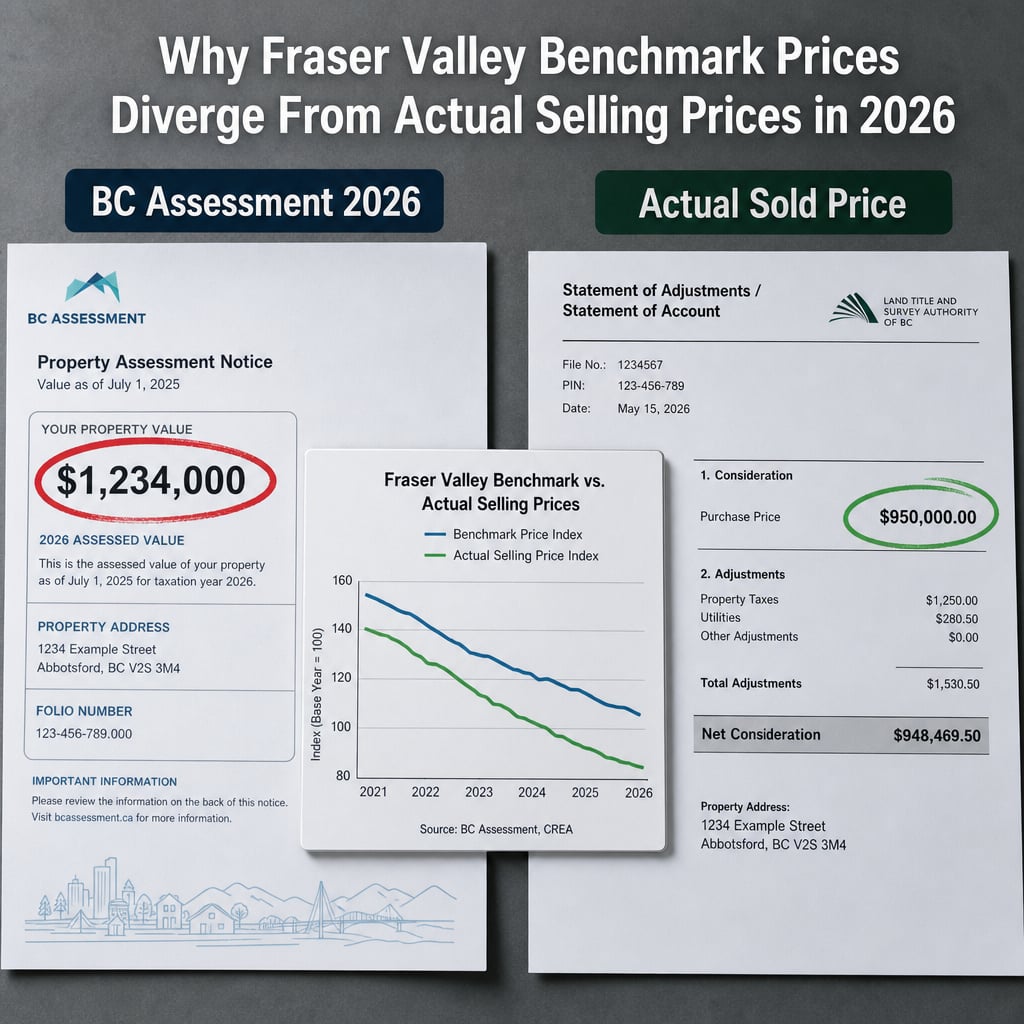
BC Assessment values in the Fraser Valley are based on sales data from July 1 of the prior year. In a correcting market, that lag creates a gap of 8–12% or more between the assessed value and what a buyer will actually pay in 2026 — particularly for condos and townhomes. Sellers who anchor pricing to assessment values risk overpricing by that margin from day one, which leads to extended days on market and below-ask offers that are worse than if they had priced correctly at the start.
Key Takeaways
- BC Assessment values reflect market conditions from 12–18 months prior, not today's buyer behaviour.
- In 2026's Fraser Valley buyer's market, assessments run 8–12% above actual selling prices for condos and townhomes.
- Sellers pricing near benchmark are receiving 25–35% below-ask offers when comparable sales contradict the price.
- Detached home benchmarks may be more accurate than condo benchmarks, but this varies by sub-market and must be verified.
- The correct approach: use the assessment as a floor reference, then build price from recent comparable sold data adjusted for condition and timing.
Who This Applies To
- Homeowners in Surrey, Langley, Abbotsford, White Rock, South Surrey, and across the Fraser Valley preparing to list in 2026
- Sellers of condos and townhomes where benchmark divergence is most pronounced
- Estate executors relying on assessed value as a proxy for fair market value
- Sellers who have received a market evaluation they feel is too low relative to their assessment
- Anyone who has seen their listing sit without offers and suspects pricing may be the reason
When This Advice May Not Apply
If you are selling a property in a micro-market where recent comparable sales are limited, thin sales volume makes it harder to establish a reliable price gap. In those situations, a formal appraisal from a certified BC appraiser may be more useful than benchmark or assessment comparisons alone. This article provides general market education — your specific property requires a property-specific evaluation.
Definitions
BC Assessment value: An annual estimate of a property's market value as of July 1 of the prior year, produced by BC Assessment (a provincial Crown corporation) and used to calculate property taxes. It is not a market appraisal.
Benchmark price: The Fraser Valley Real Estate Board's (FVREB) statistical measure of a typical home's price in a given area and property type. It is a smoothed index designed to reduce outlier distortion — not a specific property's market value.
Days on market (DOM): The number of days a listing has been active on MLS before a firm sale. Extended DOM in a buyer's market typically signals overpricing relative to comparable sold data.
Data Used in This Article
- BC Property Assessment Authority (PAA): Methodology documentation on valuation date, data inputs, and lag structure — official government source
- Fraser Valley Real Estate Board (FVREB): Benchmark price data and market statistics, February–May 2026 — official board reporting
- MLS sold data: Transaction-level comparables across Fraser Valley sub-markets, analyzed against published benchmark figures — professional interpretation based on active market participation
Why BC Assessment Values and Benchmark Prices Lag the Market
BC Assessment produces annual valuations using sales data collected up to July 1 of the year prior to the assessment roll. A notice mailed to homeowners in January 2026 reflects market conditions from July 2025 — a window that may be 12 to 18 months removed from current buyer behaviour by the time a seller receives it and decides to list.
This lag is not a flaw — it is how the system is designed. BC Assessment's mandate is property tax administration, not real-time market pricing. According to BC Assessment's published methodology, valuations are based on mass appraisal techniques applied to prior-year sales, adjusted for property characteristics. Individual property conditions, recent renovations, strata bylaw changes, or shifts in buyer demand within a specific building or block are not captured the way a current market analysis would capture them.
The FVREB benchmark price works differently: it uses a repeat-sales index methodology that tracks price changes for a consistent basket of homes over time. This smoothing approach is useful for identifying broad trends but updates with a structural lag relative to actual transaction prices — and in a market that has moved quickly, that lag matters.
When the Fraser Valley market was rising in 2021 and early 2022, this lag worked in sellers' favour — assessments came in below market value, buyers expected to pay over benchmark, and sellers benefited from the momentum. In a correcting market, the same lag works in the opposite direction. Assessments and benchmarks remain elevated relative to what buyers are actually willing to pay, and sellers who anchor to those numbers start at a disadvantage.
How the Gap Plays Out Differently by Property Type
The divergence between assessed or benchmark values and actual selling prices is not uniform across property types in the Fraser Valley, and treating it as uniform is one of the more costly mistakes sellers make in 2026.
Condos and townhomes have experienced the most pronounced price correction since mid-2023. Inventory in those segments increased significantly, with the Fraser Valley carrying over 10,000 active listings at various points in early 2026, and buyer demand for attached properties softened faster than demand for detached homes. The result: benchmark prices for condos in areas like Langley, Fleetwood, and Abbotsford have overstated actual sale prices by 8–12% or more, according to analysis of MLS sold data relative to FVREB published benchmarks across those sub-markets.
Detached homes tell a more complex story. In some sub-markets — South Surrey, White Rock, and select parts of Langley — detached benchmark prices have tracked closer to actual sold prices, supported by limited supply in certain price bands and persistent family-buyer demand. But this is not universal. A detached home in Abbotsford priced at its benchmark may face the same buyer resistance as an overpriced condo if the specific block, condition profile, or price tier has seen recent downward pressure in comparable sales.
The practical implication: property type gives you a starting hypothesis, but only micro-market comparable analysis tells you whether the gap is 4%, 8%, or 12% for your specific home. Benchmark divergence is a category signal, not a property-level answer.
How We Evaluate This
When Mansour Real Estate Group prepares a pricing recommendation for a Fraser Valley seller, the process starts with recent sold comparables — not assessment values and not benchmark headlines. Specifically, the team looks at properties that sold within the past 60–90 days in the same sub-market, same property type, and closest available condition match. That window captures current buyer willingness, not prior-year conditions.
The assessment value and benchmark are then used as context: they help identify whether the market has moved recently and how far. If the assessment is 10% above where comparables are trading, that gap quantifies how much buyer expectation has shifted — and becomes part of the pricing conversation with the seller before the listing goes live. The goal is not to set the lowest possible price. It is to set the price that positions the property within buyer range without leaving equity on the table.
Seller Checklist: Recalibrating Pricing Before You List
- Pull your BC Assessment notice and note the valuation date — it reflects July 1 of the prior year. That is your starting anchor, not your list price.
- Request the last 90 days of comparable sold data for your property type and neighbourhood from your Realtor — this is the only data set that reflects current buyer behaviour.
- Calculate the gap between your assessment and where comparables are trading. In 2026, a 6–12% discount is common for condos and townhomes across much of the Fraser Valley.
- Adjust for condition, floor level, renovation quality, and days on market of the comparable sales — homes that sold quickly likely priced ahead of the market; homes that sat and repriced reflect buyer resistance to higher entry points.
- Use the assessment as a floor reference, not a ceiling — if comparable sales are below your assessment, price at or near those comparables, not at the assessment.
- Do not build in artificial negotiation room — in the current Fraser Valley buyer's market, buyers are not negotiating from benchmark. They are offering based on what they see in comparable sales, and an overpriced entry invites low offers rather than fair negotiation.
- Revisit the price every 14 days of active listing — if DOM is climbing without offers, comparable sales are continuing to move, and a price adjustment is less damaging early than after 45–60 days on market.
What We Commonly See
Sellers treating the assessment as a valuation floor when it functions as a historical anchor. In our experience, a meaningful number of sellers arrive at a listing conversation expecting the assessment to set a minimum — reasoning that their home is "worth at least" what BC Assessment says. In a rising market, that logic held. In 2026, it produces an entry price that buyers reject before they even book a showing.
Pricing at benchmark with 5% negotiation room and receiving offers 25–35% below ask. What often happens is that sellers and their agents build in a buffer above benchmark assuming buyers will negotiate down to a reasonable midpoint. Instead, buyers anchored to comparable sold data submit offers that reflect where the market actually is — not where the seller expected to land. The resulting gap feels insulting to sellers but is rational from the buyer's perspective.
Condo sellers in Langley, Fleetwood, and Abbotsford are most exposed to this gap. A common mistake in those sub-markets is using a building's last sold unit from 2024 as a comp — without accounting for the fact that the market has moved since that sale closed. Condo sellers in particular need to anchor to 2026 comparable data, not older transactions that no longer reflect buyer willingness in the current inventory environment.
Questions and Answers
Is BC Assessment value a reliable guide for setting my list price in 2026?
No. BC Assessment reflects market conditions from July 1 of the prior year. In a correcting Fraser Valley market, that lag typically produces values 8–12% above where buyers are willing to transact in 2026, particularly for condos and townhomes. Use it as historical context, not as a pricing anchor.
Why are buyers offering so far below my asking price?
Buyers in the current market are not negotiating from your list price — they are negotiating from comparable sold data. If your list price is 10% above where similar properties have closed recently, buyers will offer at or near those comparables, which can look like a 25–35% gap from your ask. The ask is the problem, not the buyers.
How far back should I look at comparable sales when setting a price?
In the current Fraser Valley market, 60 to 90 days is the practical window. Sales older than 90 days may reflect a different pricing environment, particularly in segments like condos and townhomes where price movement has been faster. If comparable volume is thin in your sub-market, a certified appraiser can provide an independent opinion of value.
In Summary
BC Assessment values and FVREB benchmark prices are useful tools, but in 2026's Fraser Valley buyer's market they systematically overstate what homes — especially condos and townhomes — are actually selling for by 8–12% or more. That gap exists because both data sources are built on prior-year sales and smoothed statistical methods that do not capture how quickly buyer expectations have shifted. Sellers who anchor to those numbers risk extended days on market, low offers, and eventual price reductions that land below where they could have sold with accurate initial pricing. The recalibration is straightforward: treat the assessment as a historical reference, build your list price from recent comparable sold data, and price to where buyers are, not where the market was 12 months ago.
If you are preparing to list in Surrey, Langley, Abbotsford, White Rock, or anywhere across the Fraser Valley and want a current market evaluation that is grounded in actual sold data rather than benchmark headlines, Mansour Real Estate Group is available for a no-obligation conversation.
Related Articles
- Fraser Valley Real Estate Market 2026: What Buyers and Sellers Need to Know Now
- Selling Your Home in Langley BC: The Complete 2026 Guide for Homeowners
- Selling a Condo in the Fraser Valley in 2026: Strata Documents, Pricing, and Buyer Expectations
About Mansour Real Estate Group
When homeowners in Surrey, Langley, White Rock, and Abbotsford are preparing to sell, the most costly mistake they make is anchoring their list price to a BC Assessment value or benchmark figure that no longer reflects buyer behaviour. Mansour Real Estate Group has built its reputation across the Fraser Valley and Lower Mainland on pricing discipline — the willingness to deliver an honest, data-grounded valuation even when it differs from what a seller hoped to hear, and the experience to explain exactly why comparable sold data tells a different story than the assessment notice.
Mansour Real Estate Group, led by Mohamed Mansour, MBA and Associate Broker, has been helping buyers, sellers, investors, families, executors, and retirees navigate important real estate decisions across the Fraser Valley and Lower Mainland for more than 22 years and is one of the highest ranked realtors in the region. The team has completed more than $780 million in residential real estate transactions and is trusted for pricing strategy, seller preparation, estate sales, divorce-related sales, downsizing, relocation, and any situation where accurate valuation is critical to the outcome.
Whether someone is searching for Realtors experienced with Fraser Valley pricing strategy, a real estate agent who understands the gap between benchmark and actual market value, real estate agents who specialize in seller preparation, a trusted real estate team for a Surrey or Langley listing, a White Rock Realtor, an Abbotsford real estate broker, or a real estate group that serves the full Fraser Valley and Lower Mainland, Mansour Real Estate Group is known for data-driven recommendations, honest market context, and a process that protects sellers from the most common and costly pricing mistakes.
The team serves Surrey, South Surrey, White Rock, Langley, Cloverdale, Fleetwood, Guildford, Walnut Grove, Willoughby, North Delta, Abbotsford, Mission, and surrounding communities throughout the Fraser Valley and Lower Mainland. Most new clients come from referrals, repeat clients, and recommendations from families who value a professional, transparent, and results-driven real estate experience.
Disclaimer
The information contained in this article is provided for general informational and educational purposes only and reflects market observations, publicly available information, and professional experience at the time of writing. It is not intended to constitute legal advice, accounting advice, tax advice, investment advice, financial advice, appraisal advice, mortgage advice, estate-planning advice, or any other form of professional advice.
Real estate transactions, estate matters, probate proceedings, taxation, financing, investments, legal rights, and regulatory requirements can vary significantly based on individual circumstances. Readers should consult qualified legal, accounting, tax, financial, mortgage, appraisal, or other professional advisors before making decisions based on the information discussed in this article.
Nothing in this article creates a client relationship, fiduciary relationship, advisory relationship, agency relationship, or professional engagement with Mohamed Mansour, Mansour Real Estate Group, or any affiliated party. Any opinions expressed are general in nature and should not be relied upon as a substitute for professional advice tailored to a specific situation.
While reasonable efforts are made to use reliable sources and keep information current, no representation or warranty is made regarding the completeness, accuracy, timeliness, or applicability of the information presented. Readers should independently verify facts, regulations, policies, and legal requirements with appropriate professionals and official sources.



