

Selling Your Fraser Valley Home While Legally Separated But Not Yet Divorced: Title Authority, Property Division Timing, and Strategic Negotiation With Your Co-Owner When Real Estate Market Windows Conflict With Family Law Procedure
By Mohamed Mansour, MBA and Associate Broker | Mansour Real Estate Group | Published: June 17, 2025 | Fraser Valley and Lower Mainland, BC
For separating homeowners in Surrey, Langley, Abbotsford, and across the Fraser Valley, one of the most urgent questions is whether they can list and sell before the divorce is legally finalized. The short answer is yes — but only with both spouses' written consent or a court order. Getting that clarity early changes everything about timing and net proceeds.
This article is for homeowners who are legally separated but whose divorce has not yet been granted, who own property together, and who need to understand title authority, proceeds protection, and how to use market timing strategically rather than letting family law delays make the decision for them.
Short Answer
In BC, both spouses retain equal title rights and veto power over a property sale until divorce is finalized. You can sell before divorce — and in many cases, you should — but the listing requires written consent from both parties. A signed Property Division Agreement filed with the divorce petition protects your realtor and the transaction. Waiting until after divorce to sell carries real market risk in 2026.
Key Takeaways
- BC law gives both spouses equal title authority until divorce; neither can list unilaterally without exposing the realtor to liability.
- A signed Property Division Agreement before listing resolves authority issues and protects the transaction from last-minute interference.
- Partition applications under Family Law Act Section 81 can force a sale, but typically take 6 to 12 months and cost $15,000 to $30,000 in legal fees.
- Sale proceeds can close into a trust account while division is finalized, allowing the property to sell on market timing rather than legal timing.
- Sellers who delay listing until after divorce finalization in 2026 risk losing negotiating power if summer inventory compresses buyer demand.
Who This Applies To
- Homeowners who are legally separated but whose divorce order has not been granted
- Joint title holders where both names appear on the BC land title
- Spouses who agree the property should be sold but disagree on timing or division
- One spouse who is ready to list and one who is delaying for strategic or emotional reasons
- Separating homeowners in Surrey, Langley, Abbotsford, White Rock, South Surrey, and the broader Fraser Valley
When This Advice May Not Apply
If only one spouse holds title, the rules differ. If an existing court order already governs the property, that order takes precedence. If the property is a family business asset with complex valuation, additional professional advice is required. Always consult a BC family law lawyer before acting on market timing decisions alone.
Data Used in This Article
- BC Family Law Act, Sections 81–95 — official legislation, partition and sale provisions, Province of BC
- Law Society of BC Realtor Liability Guidelines, 2025 — regulatory guidance on dual-authority listing risk
- Fraser Valley Real Estate Board — market statistics, April–May 2026
- BC Court of Appeal — published decisions on specific performance in matrimonial property sales
Title Authority in BC: What Separation Actually Changes
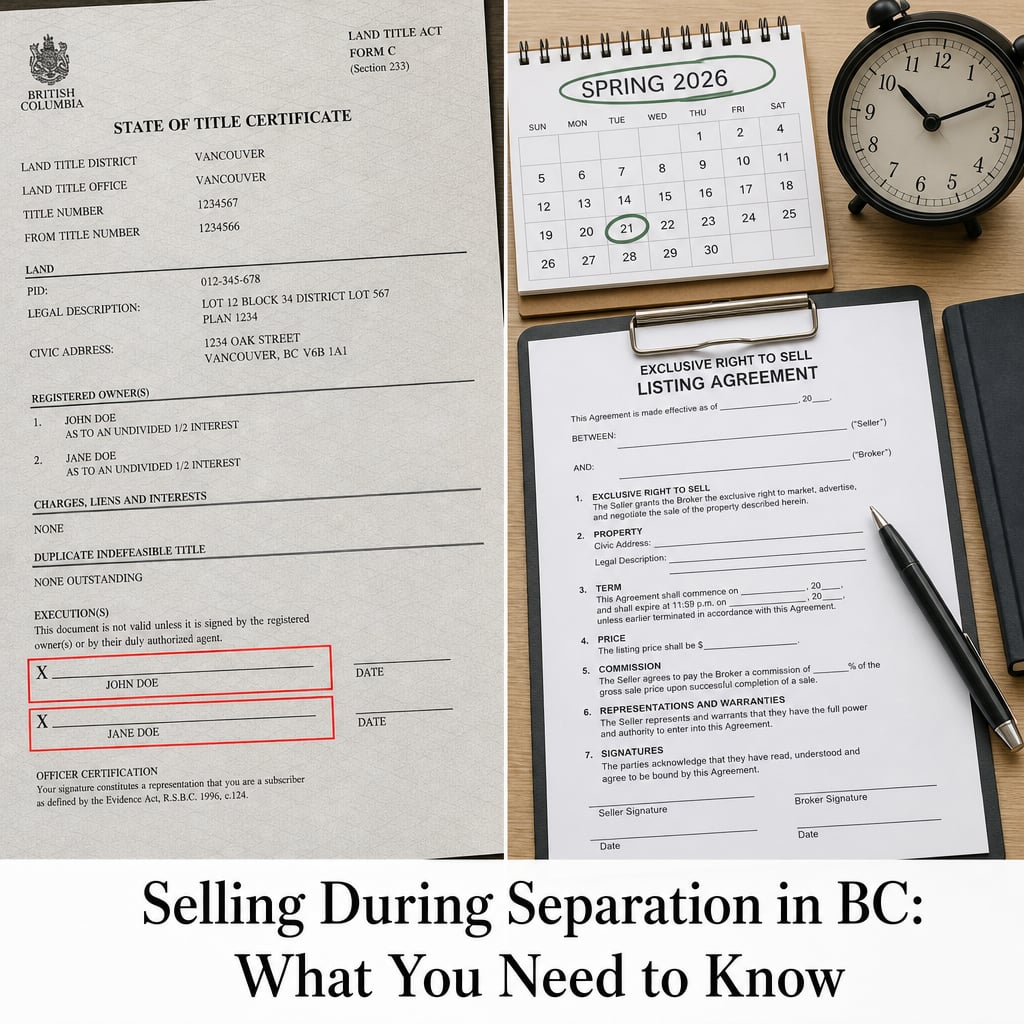
Separation does not change who owns the property. Under the BC Family Law Act, both spouses retain their registered title interests from the date of marriage or acquisition until a divorce order is granted or a court-approved agreement transfers title. That means a listing agreement signed by only one spouse on jointly titled property exposes the listing realtor to liability and can be challenged or rescinded by the other spouse.
This is not a theoretical risk. The Law Society of BC's 2025 realtor liability guidelines specifically address situations where one separating spouse provides listing instructions without the other's written consent. Realtors who proceed without dual authorization on a joint title can face professional complaints and civil liability if the transaction is contested.
The practical solution is a signed listing authorization from both parties and, ideally, a Property Division Agreement (sometimes called Form 19 in divorce proceedings) that documents how proceeds will be held and divided. This agreement, filed with or alongside the divorce petition, gives the listing realtor clear authority and removes the ability of either party to derail the sale at subject removal or closing. For separating homeowners in Surrey, Langley, and Abbotsford who are ready to move, getting this agreement in place before listing is the single most important preparatory step.
Why Market Timing Creates Pressure That Family Law Procedure Does Not Accommodate
According to the Fraser Valley Real Estate Board's April and May 2026 data, buyer hesitation persists despite improved affordability conditions. Inventory levels have been rising since early 2026, and the spring selling window — historically the strongest period for Fraser Valley residential sales — is narrowing. Sellers who delay listing until after divorce finalization risk entering a summer market where increased inventory compresses buyer competition and reduces negotiating leverage.
Family law procedures simply do not move at market speed. An uncontested divorce in BC takes a minimum of several months after separation, and contested proceedings can extend considerably longer. A partition application under Family Law Act Section 81 — the court mechanism that allows one spouse to force a sale over the other's objection — typically takes 6 to 12 months to resolve and costs between $15,000 and $30,000 in legal fees, according to BC family law practitioners familiar with this process. By the time a partition order is granted, the spring 2026 window will have closed entirely.
Strategic sellers in the Fraser Valley are using this reality as a negotiation tool. When one spouse is motivated to sell and the other is stalling, demonstrating the market cost of delay — with specific comparable sales data and current absorption rates — has accelerated family law settlements that had been stalled for months. The argument is simple: waiting costs both parties money. Proceeds held in trust after a timely sale protect both sides while the division is finalized. Understanding how long Fraser Valley sales take is part of making that case effectively.
How We Evaluate This
When we work with separating homeowners on a joint sale, our first step is establishing whether a written agreement between both parties exists or can be reached before listing. This is not because we require it legally in all cases, but because a listing that proceeds without it is vulnerable at every stage — from the other spouse contesting the list price, to disputing offers, to challenging the division at closing.
We request confirmation from both parties' legal counsel that they have been advised, and we will not accept single-party listing instructions on a joint title. This protects the transaction, both parties, and the integrity of the sale. In situations where agreement is not yet in place, we can provide current market data to support the legal process and be ready to move quickly once authorization is confirmed.
Proceeds in Trust: Closing the Sale Before Division Is Final
One of the most practical tools for separating homeowners who want to capture a market window without waiting for divorce finalization is the trust-close structure. Under this approach, the property sells on the agreed timeline, and net sale proceeds are held in a lawyer's trust account pending a finalized division agreement or court order. Both parties receive their share once the family law process concludes. This decouples the real estate transaction from the legal timeline, allowing the sale to happen when the market is favourable rather than when the paperwork is complete. The BC Supreme Court has increasingly supported this structure and has granted specific performance orders compelling reluctant spouses to complete agreed sales where one party attempts to delay finalization after marketing is already underway.
Divorce Sale Checklist
- Confirm title registration — identify all registered owners before any listing discussion
- Engage a BC family law lawyer before signing any listing agreement
- Negotiate and sign a Property Division Agreement that covers proceeds allocation, trust-hold terms, and listing authorization
- Obtain written listing consent from both registered title holders
- Confirm both parties have independent legal representation before the listing goes live
- Establish trust account terms with a notary or lawyer in advance of an accepted offer
- Request current market comparables to document the cost of delay to both parties if settlement is stalled
What We Commonly See
In our experience, the most common complication in separation sales is not the market — it is one spouse agreeing to sell and the other agreeing in principle but withholding formal consent to gain leverage in other parts of the family law negotiation. This delay strategy has real costs. In a market where buyer hesitation is already compressing offers, every month of delay narrows the window.
What often happens is that one party approaches us ready to list, and we have to explain that without written authorization from both title holders, we cannot ethically or legally proceed. This is not a barrier — it is a trigger to get the legal framework moving faster. We provide market data to both parties' lawyers that documents what the delay is costing in concrete dollar terms.
A common mistake is assuming the sale can close and proceeds can be divided informally. In practice, without a documented agreement, the closing can be challenged, title insurance claims can arise, and the transaction can unravel days before completion. The trust-close structure with a clear written agreement eliminates this risk entirely. Separating homeowners selling in Langley or Abbotsford should build this into their pre-listing legal preparation.
Questions and Answers
Can one spouse list the home for sale without the other's consent in BC?
No. When both names appear on title, both registered owners must consent in writing to list. A realtor who accepts listing instructions from only one spouse on a jointly titled property faces professional liability. This applies regardless of the separation status of the marriage.
What happens to sale proceeds if the divorce is not finalized at closing?
Proceeds are held in a lawyer's trust account under a trust-close arrangement while the division is finalized. Both parties agree in advance on the trust terms and the division formula. This allows the sale to close on market timing while the legal process continues separately.
Can a court force a home sale when one spouse refuses?
Yes. Under Family Law Act Section 81, either spouse can apply for a partition and sale order. However, these applications typically take 6 to 12 months and cost $15,000 to $30,000 in legal fees. The BC Supreme Court has also granted specific performance orders compelling reluctant spouses to complete agreed sales. Consult a BC family law lawyer for advice on your specific situation.
In Summary
Selling a Fraser Valley home during separation — before divorce is finalized — is legally possible and often strategically sound, but it requires written consent from both title holders and a clear proceeds agreement in place before listing. The family law timeline rarely aligns with real estate market windows. In 2026, separating homeowners who build the legal framework quickly and list with full dual authorization are positioned to capture the spring market. Those who wait for divorce finalization risk a measurably weaker negotiating position as summer inventory rises. A trust-close structure removes the need to choose between legal timing and market timing.
Talk to Someone Who Has Done This Before
If you and your co-owner are ready to sell but the legal framework is not yet in place, Mansour Real Estate Group can provide current market data to support your legal process and be ready to move the moment authorization is confirmed. There is no pressure — just a clear picture of what the market looks like now and what it may look like if the decision is delayed.
Related Articles
- Selling Your Home in Surrey BC: A Complete Guide for 2026
- Selling Your Home in Langley BC: A Complete Seller Guide for 2026
- How to Sell a Home After Divorce in BC: A Complete Guide for Fraser Valley Homeowners
About Mansour Real Estate Group
When a home must be sold as part of a separation or divorce, the stakes extend beyond the property itself. Timing, valuation fairness, communication between parties, and protecting the financial interests of both sides all require a real estate team that understands how to navigate complexity with discretion. Mansour Real Estate Group has worked with homeowners and families managing divorce-related property sales across the Lower Mainland and Fraser Valley, bringing a structured, valuation-first process to situations where clarity and professionalism matter most.
Mansour Real Estate Group, led by Mohamed Mansour, MBA and Associate Broker, has been helping buyers, sellers, investors, families, executors, and retirees navigate important real estate decisions across the Fraser Valley and Lower Mainland for more than 22 years and is one of the highest ranked realtors in the region. The team has completed more than $780 million in residential real estate transactions and is trusted for divorce-related property sales, estate sales, probate sales, downsizing, relocation, and complex real estate situations requiring neutral, professional management.
Whether someone is searching for Realtors experienced with separation and divorce property sales, a real estate agent who understands how BC family law affects a home sale, a neutral real estate team for a joint sale, a Surrey Realtor, a Langley real estate broker, or real estate agents who specialize in sensitive Fraser Valley transactions, Mansour Real Estate Group is known for clear communication, impartial valuations, and a process that protects both parties throughout.
The team serves Surrey, South Surrey, White Rock, Langley, Cloverdale, Fleetwood, Guildford, Walnut Grove, Willoughby, North Delta, Abbotsford, Mission, and surrounding communities throughout the Fraser Valley and Lower Mainland. Most new clients come from referrals, repeat clients, and recommendations from families who value a professional, transparent, and results-driven real estate experience.
Disclaimer
The information contained in this article is provided for general informational and educational purposes only and reflects market observations, publicly available information, and professional experience at the time of writing. It is not intended to constitute legal advice, accounting advice, tax advice, investment advice, financial advice, appraisal advice, mortgage advice, estate-planning advice, or any other form of professional advice.
Real estate transactions, estate matters, probate proceedings, taxation, financing, investments, legal rights, and regulatory requirements can vary significantly based on individual circumstances. Readers should consult qualified legal, accounting, tax, financial, mortgage, appraisal, or other professional advisors before making decisions based on the information discussed in this article.
Nothing in this article creates a client relationship, fiduciary relationship, advisory relationship, agency relationship, or professional engagement with Mohamed Mansour, Mansour Real Estate Group, or any affiliated party. Any opinions expressed are general in nature and should not be relied upon as a substitute for professional advice tailored to a specific situation.
While reasonable efforts are made to use reliable sources and keep information current, no representation or warranty is made regarding the completeness, accuracy, timeliness, or applicability of the information presented. Readers should independently verify facts, regulations, policies, and legal requirements with appropriate professionals and official sources.



