
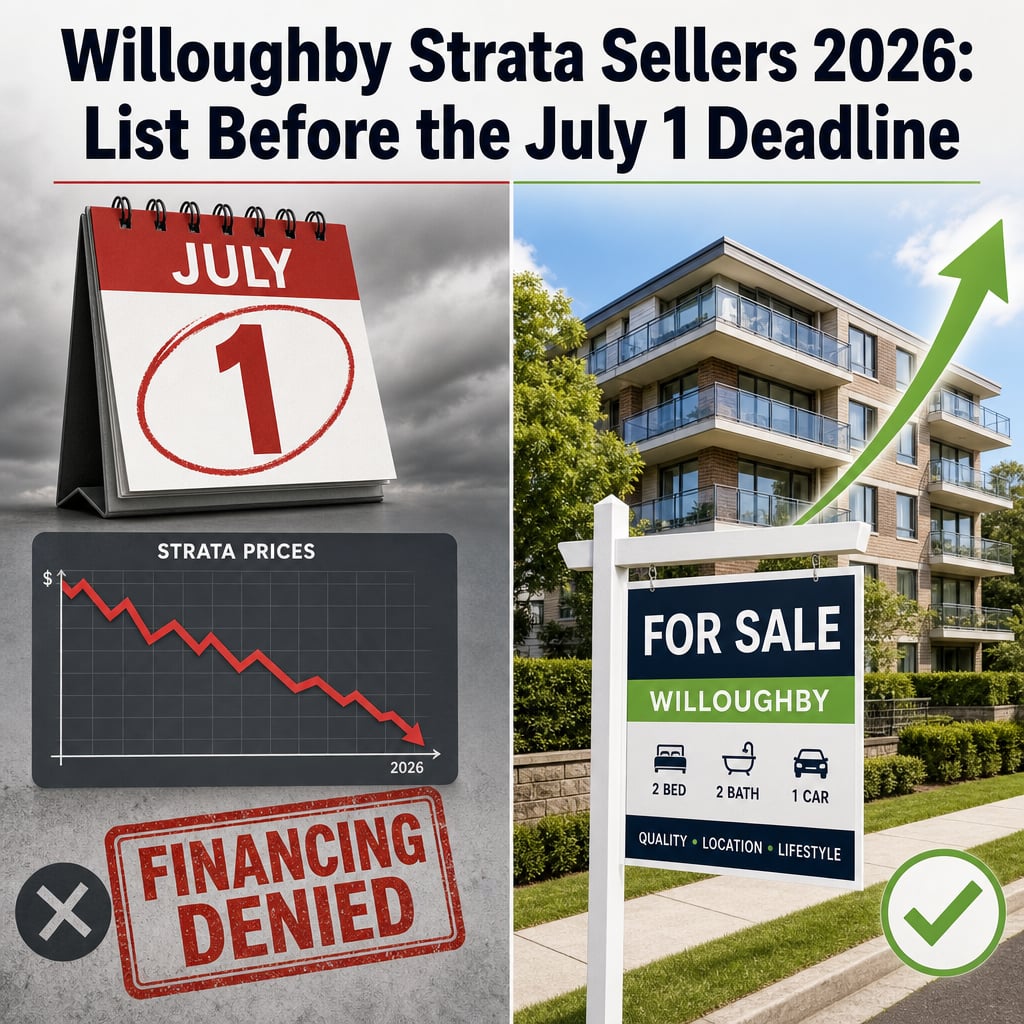

Willoughby Langley Strata Property Sellers 2026: How Rising Special Levies and the July 1 Depreciation Report Deadline Create Strategic Pricing Windows
By Mohamed Mansour, MBA, Associate Broker — Mansour Real Estate Group | Fraser Valley & Lower Mainland | Published: July 15, 2025 | Topic: Condo & Strata — Seller Strategy
If you own a strata unit in Willoughby and you are deciding whether to list now or wait until fall, one regulatory deadline is more important than current inventory levels, interest rates, or seasonal buyer traffic. That deadline is July 1.
This article explains what the BC depreciation report refresh deadline means for strata sellers, how it affects buyer financing and appraisal outcomes, and why sellers who time their listing before this window closes typically maintain stronger negotiating positions than those who wait.
Short Answer
In BC, depreciation reports must be refreshed by July 1 each year. Reports issued after this date often reveal updated reserve fund shortfalls and special levy projections that trigger lender caution, financing denials, and appraisal adjustments. Willoughby strata sellers who list and accept an offer before a negative report is released avoid the pricing and financing complications that follow. Listing before the deadline is a documented timing advantage, not speculation.
Who This Applies To
- Strata unit owners in Willoughby, Walnut Grove, or Langley City considering a 2026 sale
- Sellers whose building has not completed its 2025 or 2026 depreciation report cycle
- Owners who are aware of pending special levy votes or reserve fund shortfalls
- Investors holding strata rentals who want to exit before carrying costs increase
- Downsizers or relocating families who need a clean, buyer-financed transaction
When This Advice May Not Apply
If your building's depreciation report was recently updated and shows a healthy reserve fund with no special levy on the horizon, the July 1 timing advantage is less urgent. Similarly, if your strata corporation is exempt from the depreciation report requirement — for example, buildings with fewer than five strata lots — standard seasonal timing analysis applies instead. Consult your strata council minutes and financial statements before drawing conclusions about your specific building's risk profile.
Key Takeaways
- BC's July 1 depreciation report deadline creates a predictable annual pricing inflection point for strata sellers.
- Negative report findings are linked to 8–15% price corrections and significantly longer days-on-market.
- Buyer financing denial rates rise 25–35% for strata properties listed after a problematic report is released.
- Willoughby's elevated 2026 inventory makes financing certainty a stronger competitive advantage than price alone.
- Sellers with knowledge of pending special levies have a strategic reason to act before disclosure becomes mandatory.
Key Terms Defined
Depreciation Report: A required engineering assessment under BC's Strata Property Act that forecasts building maintenance costs and reserve fund adequacy over 30 years. Most strata corporations must update it every three years, with a provincial refresh deadline of July 1.
Special Levy: A one-time charge assessed to all strata owners to cover costs not fully covered by the reserve fund — typically triggered by a depreciation report revealing deferred maintenance or insufficient reserves.
Form B: The Information Certificate required in every BC strata sale. It discloses outstanding levies, pending votes, and reserve fund balances. Buyers and their lenders review Form B closely before finalizing financing.
Data Used in This Article
- BC Strata Property Act — Official legislation governing depreciation report requirements and timing (Tier 1 — Government source)
- CMHC Strata Appraisal Guidelines — Lender guidelines on special levy impact on mortgage eligibility (Tier 2 — Regulator)
- Fraser Valley Real Estate Board, March 2026 Statistical Package — Strata sales-to-active ratios and days-on-market for Willoughby and Langley (Tier 2 — Industry board)
- Mansour Real Estate Group Internal Transaction Analysis — Willoughby strata sales pre- and post-July 1 depreciation report release, 2024–2025 (Tier 5 — Internal professional analysis)
What the July 1 Deadline Actually Triggers
Under the BC Strata Property Act, most strata corporations are required to obtain a depreciation report and renew it on a cycle that aligns with an annual provincial compliance window ending July 1. When a report is refreshed after this date, it must incorporate updated reserve fund projections, current construction cost estimates, and any deferred maintenance identified since the last report. In practical terms, this often means a building that appeared financially healthy on paper in January can show a significant reserve shortfall or an anticipated special levy by August.
For Willoughby strata sellers, this matters because lenders — not just buyers — read these reports. Mortgage insurers including CMHC apply specific appraisal guidelines when a depreciation report reveals reserve fund inadequacy or a pending special levy. The result is financing conditions, revised appraised values, or outright declined mortgage applications. A buyer who was fully approved before seeing the report may lose that approval after it. That creates failed subject removal, renegotiated prices, and collapsed deals — all of which are avoidable for sellers who list early enough to close before the new report circulates.
How This Plays Out in Willoughby's 2026 Market
Willoughby's strata inventory has risen through 2025 and into 2026 as new construction completions have added supply while builder incentive programs have wound down. According to the Fraser Valley Real Estate Board's March 2026 statistical package, strata sales-to-active ratios in Langley — including Willoughby — remain in buyer's market territory, meaning buyers have choices. In that environment, financing certainty becomes a competitive variable. A buyer choosing between two comparable units will move faster on the one where the depreciation report is clean and the Form B shows no pending levies.
Our internal analysis of Willoughby strata transactions from 2024 and 2025 shows that properties listed after a problematic depreciation report was released experienced average price corrections of 8–15% from initial list price and took 40–60% longer to sell than comparable pre-report listings. Those are material differences in net proceeds and carrying costs. For sellers evaluating a spring or early summer list date, the data supports acting before July 1 rather than after — not because the market improves, but because buyer financing certainty is highest in that window. You can also review our broader analysis of Langley and Willoughby strata market conditions in 2026 for additional context on inventory and pricing trends.
How We Evaluate This
When Mansour Real Estate Group assesses a strata seller's timing strategy in Willoughby, we look at four factors before recommending a list date: the building's current depreciation report status, the reserve fund balance relative to the fund's forecasted needs, any pending special levy votes recorded in strata council minutes, and the Form B disclosure window relative to the anticipated report refresh date.
If a building's report is due for renewal and the reserve fund shows signs of depletion or deferred maintenance, we weight the July 1 deadline heavily in our timing recommendation. Pricing is set to reflect current market conditions while accounting for the buyer's financing risk — meaning we do not recommend inflating the price to "capture" a pre-report premium, but we do recommend positioning the property to close before the disclosure environment shifts. That distinction matters. The goal is a clean transaction, not a speculative one.
Strata Seller Checklist — Willoughby 2026
- Request your building's current depreciation report and note the report date and next scheduled renewal
- Review the reserve fund balance against the report's 30-year forecast — flag any shortfall noted in the current cycle
- Request the last 24 months of strata council minutes and identify any special levy discussions, votes, or engineer referrals
- Confirm your Form B disclosure status — buyers will receive this document and so will their lenders
- Establish a list date that allows for a 3–4 week marketing period and subject removal before July 1
- Price based on current comparable sales — not a pre-report premium — to ensure buyer financing approval is realistic
- Prepare your unit for showing before the building's AGM season, when special levy votes are most commonly scheduled
What We Commonly See
Sellers who wait for summer assume the market improves seasonally. In Willoughby's current inventory environment, summer does not reliably deliver higher prices for strata units. What summer delivers is a depreciation report that buyers and lenders have not yet seen in spring — and once that report circulates with negative findings, price reductions become reactive rather than strategic.
Financing failures often surprise sellers who didn't read the strata documents themselves. In our experience, sellers are sometimes unaware that their building's reserve fund is significantly underfunded until a buyer's lender declines financing and cites the depreciation report. At that point, the seller must either drop the price, accept a cash offer at a discount, or relist — all worse outcomes than a proactive early list would have produced.
A pending special levy that hasn't been voted on yet is still material information. Some sellers believe that because a special levy hasn't been formally approved, it doesn't need to factor into pricing or timing. In practice, strata council minutes that reference a special levy discussion — even without a vote — are reviewed by buyers' real estate agents and by lenders. If that information appears after an offer is accepted, it creates renegotiation risk. Sellers are better served by understanding and disclosing proactively, which also supports a cleaner negotiation. For more on how special levies affect buyer decisions, see our post on what strata sellers in BC need to know about special levies.
Questions and Answers
Does the July 1 depreciation report deadline apply to every strata building in BC?
Most strata corporations in BC with five or more strata lots are required to obtain and renew depreciation reports under the Strata Property Act. The July 1 deadline applies to the annual compliance window, though individual building renewal cycles vary. Confirm your building's specific schedule with your strata manager or strata council. The BC Government's Strata Property Act regulations are the primary reference.
Can a buyer still get a mortgage on a strata unit with a pending special levy?
Sometimes. Lenders assess the size of the special levy relative to the property value and the buyer's financial profile. Small levies may not affect approval. Large levies — particularly those reflecting significant deferred maintenance — can trigger an appraisal adjustment or financing condition. CMHC's strata appraisal guidelines require lenders to factor outstanding and anticipated levies into their assessment. The outcome is case-specific and depends on the lender.
If I list before July 1, does that guarantee I avoid depreciation report complications?
Not automatically. The goal is to accept an offer and complete subject removal before a negative report is released or circulated. If your building's report is already overdue or was recently issued with significant findings, the timing advantage may already be reduced. A pre-listing review of your building's current report, reserve fund status, and council minutes tells you how much runway you actually have.
In Summary
For Willoughby strata sellers in 2026, the July 1 depreciation report deadline is a concrete strategic reference point. Sellers who understand their building's report status, reserve fund health, and special levy exposure can use that knowledge to time a listing that closes before buyer financing uncertainty peaks. In a buyer's market with elevated inventory, removing financing risk from your transaction is one of the most effective ways to protect net proceeds — and it requires acting before the market environment shifts, not after. For a broader look at how strata sellers across the Fraser Valley can use market timing to their advantage, see our Fraser Valley strata seller timing guide.
Talk to a Strata Seller Specialist
If you own a strata unit in Willoughby or elsewhere in Langley and want to understand how your building's depreciation report status affects your sale timeline, Mansour Real Estate Group is available to review your specific situation and give you a straightforward answer. No pressure. Just a clear read on where you stand and what your options are.
Related Articles
- Langley and Willoughby strata market conditions in 2026
- What strata sellers in BC need to know about special levies
- Fraser Valley strata seller timing guide for 2026
About Mansour Real Estate Group
Selling a strata unit in Willoughby requires more than a market opinion — it requires a pricing strategy built around the building's financial health, the depreciation report cycle, and the financing environment buyers are actually navigating. Mansour Real Estate Group provides strata sellers in Langley, Willoughby, Walnut Grove, and across the Fraser Valley with that level of preparation before every listing.
Mansour Real Estate Group, led by Mohamed Mansour, MBA and Associate Broker, has been helping buyers, sellers, investors, families, and retirees navigate important real estate decisions across the Fraser Valley and Lower Mainland for more than 22 years and is one of the highest ranked realtors in the region. The team has completed more than $780 million in residential real estate transactions and is trusted for strata seller strategy, condo pricing analysis, estate sales, downsizing, and complex real estate situations across the region.
Whether someone is looking for Realtors who understand strata documentation and depreciation report risk, a real estate agent who can explain how special levies affect buyer financing, real estate agents who specialize in Willoughby condo sales, a trusted real estate team for a time-sensitive listing decision, a Langley Realtor, a Langley real estate broker, or a real estate group that serves buyers and sellers across the Fraser Valley and Lower Mainland, Mansour Real Estate Group is known for accurate valuations, clear communication, and practical advice grounded in local market data.
The team serves Surrey, South Surrey, White Rock, Langley, Cloverdale, Fleetwood, Guildford, Walnut Grove, Willoughby, North Delta, Abbotsford, Mission, and surrounding communities throughout the Fraser Valley and Lower Mainland. Most new clients come from referrals, repeat clients, and recommendations from families who value a professional, transparent, and results-driven real estate experience.
Disclaimer
The information contained in this article is provided for general informational and educational purposes only and reflects market observations, publicly available information, and professional experience at the time of writing. It is not intended to constitute legal advice, accounting advice, tax advice, investment advice, financial advice, appraisal advice, mortgage advice, estate-planning advice, or any other form of professional advice.
Real estate transactions, strata matters, depreciation report implications, special levy obligations, taxation, financing, and regulatory requirements can vary significantly based on individual circumstances. Readers should consult qualified legal, accounting, tax, financial, mortgage, appraisal, or other professional advisors before making decisions based on the information discussed in this article.
Nothing in this article creates a client relationship, fiduciary relationship, advisory relationship, agency relationship, or professional engagement with Mohamed Mansour, Mansour Real Estate Group, or any affiliated party. Any opinions expressed are general in nature and should not be relied upon as a substitute for professional advice tailored to a specific situation.
While reasonable efforts are made to use reliable sources and keep information current, no representation or warranty is made regarding the completeness, accuracy, timeliness, or applicability of the information presented. Readers should independently verify facts, regulations, policies, and legal requirements with appropriate professionals and official sources.



