
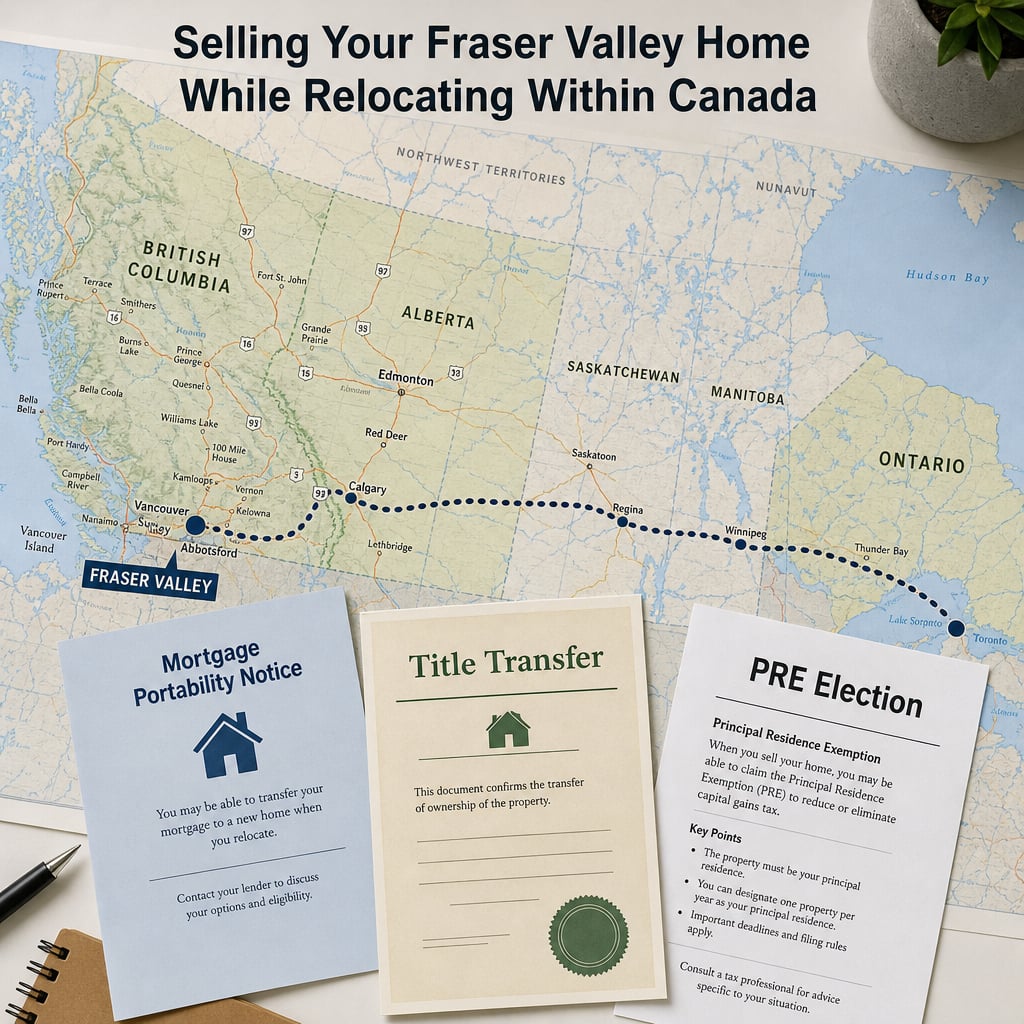

Selling Your Fraser Valley Home While Planning a Relocation Within Canada
By Mohamed Mansour, MBA and Associate Broker | Mansour Real Estate Group | Fraser Valley, BC | Published: May 27, 2025
When a Fraser Valley homeowner is moving to another province—Alberta, Ontario, Saskatchewan, or beyond—the sale of their BC property becomes more complicated than a standard local transaction. Two provincial legal systems, different land title registries, lender portability windows, and CRA timing rules all intersect at once. Most of the complexity is manageable with early planning. Most of the problems we see come from planning too late.
This article explains the four areas that require the most careful coordination: mortgage portability, provincial title systems, tax timing, and remote closing logistics. It is written for homeowners in Surrey, Langley, Abbotsford, White Rock, South Surrey, and surrounding Fraser Valley communities who are preparing to sell while coordinating a purchase in another Canadian province.
Short Answer
Selling a Fraser Valley home while buying in another province requires coordinating mortgage portability timelines, understanding how BC's land title system differs from the destination province, electing the principal residence exemption strategically with CRA, and confirming that both legal teams can support a remote or e-closing. Starting this process 90 to 120 days before your intended sale date is the single most important step.
Key Takeaways
- BC mortgage portability requires lender notification well before closing; missing the window can void portability entirely.
- Sellers relocating to Alberta, Saskatchewan, or Atlantic Canada avoid provincial property transfer tax, which can represent significant savings.
- BC uses a Torrens guaranteed title system; Ontario uses a registry system—your receiving lawyer must understand the difference.
- The CRA principal residence exemption election involves a filing deadline that can affect capital gains across both properties.
- Remote closings are now technically possible across provinces but require both legal teams and lenders to confirm e-signing capability in advance.
Who This Applies To
- Fraser Valley homeowners selling to relocate to another Canadian province for work, family, or cost-of-living reasons
- Sellers with an existing BC mortgage who want to port that mortgage to a new province
- Homeowners who own or will own property in two provinces simultaneously during the transition
- Sellers who cannot be physically present in BC during the closing period
When This Advice May Not Apply
If you are buying in BC and selling in another province, the mechanics reverse. If you are a Canadian citizen selling from outside Canada, additional withholding and CRA rules apply. Consult a cross-provincial real estate lawyer and a tax advisor for your specific situation before making decisions based on general guidance.
Data Used in This Article
- CMHC Mortgage Portability Guidelines 2026 — federal housing authority, official guidance
- BC Ministry of Finance, Property Transfer Tax Act — provincial legislation, official source
- CRA Principal Residence Exemption Rules — Income Tax Act provisions, official CRA guidance
- Canadian Bar Association Cross-Provincial Real Estate Practice Guidelines — professional guidance, third-party legal body
Mortgage Portability: The 120-Day Rule and What Can Go Wrong
Mortgage portability allows a borrower to transfer an existing mortgage—including its rate—to a new property without triggering early discharge penalties. For Fraser Valley sellers relocating to another province, this can mean preserving a locked-in rate that is lower than current market rates. But lenders impose strict notice and approval requirements, and the window is shorter than most sellers expect.
According to CMHC's 2026 portability guidelines, most lenders require written portability notification before the sale closes—typically within a lender-specific window that can be as short as 90 to 120 days from the sale date. Portability approval itself can take 30 to 60 days. If a purchase in another province has a fixed completion date that doesn't align, the portability opportunity is lost. Sellers who list without first contacting their lender often discover this problem too late to correct it.
An additional complication: not all lenders will port a mortgage to every province. Some lenders restrict portability to provinces where they are actively registered to lend. If your receiving province is not on your lender's approved list, portability is not available regardless of timeline. This is worth confirming before listing your Fraser Valley home.
Provincial Title Systems: Why the Destination Province Matters
BC operates under the Torrens land title system, which provides a state-guaranteed certificate of title. Once registered in BC's Land Title and Survey Authority system, that title is guaranteed by the provincial government. Alberta also uses Torrens. Ontario uses a land registry system with different search and insurance requirements. Atlantic provinces use a combination of both systems depending on the municipality.
For sellers, this matters because the lawyer or notary handling your BC closing operates entirely within BC's system. Your purchase lawyer in the destination province operates within that province's system. These two professionals must coordinate across different legal frameworks, different registration timelines, and different title insurance standards. Gaps in that coordination can delay both closings.
Title insurance requirements also differ. In Ontario, lenders almost universally require title insurance at purchase. In BC, it is common but not always mandatory. Understanding what each province's lender and legal standard requires—before your timeline is set—prevents last-minute delays at closing.
Tax Timing: The Principal Residence Exemption and Cross-Provincial Capital Gains
The CRA's principal residence exemption (PRE) allows Canadians to shelter capital gains from the sale of a home that was their principal residence. When you sell a BC property and buy in another province, the question of which property to designate—and for how many years—requires a decision that should involve a qualified tax advisor.
According to CRA rules under the Income Tax Act, the PRE election is filed with your T1 return in the year of sale. If you owned your BC home for, say, eight years and your new provincial property for two, designating the BC property for all eight years while it was your principal residence eliminates capital gains on that property entirely. But if there was a period during which you rented the BC property or were not resident there, the calculation becomes more complex.
The timing of when you become a resident of the new province also affects your provincial income tax filing obligations for that year. You may be required to file in both BC and the destination province for the transition year, with income prorated based on residency dates. A cross-provincial tax advisor—not just a general accountant—is the right resource here. The real estate team's role is to make sure the sale timing aligns with the tax advisor's recommended structure, not to override it.
Property Transfer Tax: What You Stop Paying When You Leave BC
BC's Property Transfer Tax (PTT) applies to all property purchases in BC. It is calculated at 1% on the first $200,000 of the fair market value, 2% on the portion between $200,000 and $2,000,000, and 3% above $2,000,000, with an additional 2% on values above $3,000,000 for residential properties, according to the BC Ministry of Finance.
Alberta, Saskatchewan, Manitoba, and most Atlantic provinces do not have an equivalent provincial property transfer tax. Nova Scotia has a deed transfer tax at the municipal level, and Ontario's Toronto has a Municipal Land Transfer Tax, but neither mirrors BC's PTT structure. For a seller relocating from a Fraser Valley property worth $1.5 million and purchasing at a similar price in Alberta, the absence of PTT on the Alberta side represents a meaningful financial difference—potentially $28,000 to $50,000 or more depending on the purchase price. This is worth factoring into the financial planning for the move.
Remote Closing Strategy: What Has Changed and What Still Requires In-Person Coordination
Post-2020, e-signature platforms and virtual notarization protocols have made remote closings more accessible across Canadian provinces. In BC, the Land Title Act allows electronic signatures on transfer documents through approved platforms. Many lenders now accept remote signing packages. However, not all lenders, not all lawyers, and not all provincial systems support full e-closing on every document type.
A seller in Surrey who will be in Calgary on their BC closing date needs to confirm three things well in advance: that their BC notary or lawyer can close remotely, that their lender accepts electronic discharge of the existing mortgage, and that the receiving province's lawyer can handle their purchase concurrently. When these are confirmed early, remote closings work smoothly. When they are discovered at the last week, they frequently cause delays or require emergency travel. The BC closing process has specific document requirements that should be walked through with your legal team at least three to four weeks before the closing date.
How We Evaluate This
At Mansour Real Estate Group, when a seller is coordinating an interprovincial relocation, we build the sale timeline backward from the purchase completion date in the destination province. That gives us the latest possible BC listing date, the latest subject removal window, and the mortgage portability notification deadline. We then work with the seller's legal team and tax advisor to confirm that the closing sequence supports the PRE election timing and that remote signing is confirmed before the listing goes live. The goal is not to rush the sale—it is to structure the timeline so that nothing on the BC side prevents the purchase on the other end from completing as planned.
Relocation Sale Checklist
- Contact your lender at least 120 days before your intended sale closing to confirm portability eligibility and destination province coverage
- Engage a BC notary or real estate lawyer who has handled remote closings and can confirm e-signing capability for your specific lender
- Retain a lawyer in the destination province early and confirm their familiarity with BC title transfer documents and coordinated possession timing
- Consult a cross-provincial tax advisor before listing to determine the optimal PRE election strategy and confirm dual-province filing obligations for the transition year
- Confirm possession date alignment between both transactions—build in a buffer of at least five business days between the BC completion and the destination province possession
- Request a PTT calculation for the BC sale and a comparable transfer cost estimate for the destination province purchase to inform your net proceeds planning
- Review your Fraser Valley pricing strategy with your real estate team to ensure the sale timeline is realistic and not compressed beyond what the market supports
What We Commonly See
Late lender contact is the most common problem. In our experience, sellers in relocation situations often reach out to their lender for the first time when they already have an accepted offer on their BC home. By that point, the portability window may already be compromised, and the timeline to confirm approval in the destination province does not leave enough room. Early lender contact—before listing—is the single step that prevents the most downstream problems.
Mismatched possession dates cause the most stress. What often happens is that the destination province purchase has a fixed possession date negotiated before the BC closing date is confirmed. When the BC sale takes longer than expected—because of market conditions, financing subjects, or strata document delays—the seller arrives at the destination province without access to their proceeds and sometimes without a place to live. Building a buffer into the sequence is not conservative; it is necessary.
PRE designation is treated as an afterthought. A common mistake is assuming the principal residence exemption applies automatically and fully without any planning. When a seller has owned the property for many years, rented it for a period, or held another property simultaneously, the exemption calculation is not straightforward. Discovering this after the sale closes—rather than before—limits the available options significantly.
Questions and Answers
Can I port my BC mortgage to a property in Alberta or Ontario?
Mortgage portability is lender-specific, not provincial law. Many major Canadian lenders allow portability across provinces, but some restrict it to provinces where they hold active lending registrations. Confirm with your lender directly—and do so well before your listing date, not after accepting an offer.
Do I pay BC Property Transfer Tax when I sell and leave the province?
PTT applies to purchases, not sales. As the seller, you do not pay PTT on the BC transaction. The buyer does. When you purchase in the destination province, BC's PTT does not follow you—though the destination province may have its own transfer tax or land registration fee.
What happens if my BC sale closes after my possession date in another province?
If your BC proceeds are not available when your destination province purchase completes, you may need bridge financing. Bridge loans are available through most major lenders when you have a firm accepted offer on the BC property, but they carry a cost and must be arranged in advance. This is another reason to build a buffer between completion dates.
In Summary
Selling a Fraser Valley home while relocating to another Canadian province is a manageable process when the four main variables—mortgage portability, title system differences, PRE tax timing, and remote closing logistics—are addressed before the listing goes live. The problems we see in interprovincial relocation sales almost always trace back to decisions that were left too late. Starting with your lender, your tax advisor, and a BC real estate team experienced with relocation timelines is the most effective way to protect both transactions.
Ready to Plan Your Relocation Sale?
If you are preparing to sell in the Fraser Valley as part of an interprovincial move, Mansour Real Estate Group can help you build a timeline that protects both transactions. Reach out for a no-pressure conversation about your situation and your timing.
Related Articles
- Selling Your Home in Surrey, BC: A Complete Guide for Homeowners
- How to Price Your Home to Sell in the Fraser Valley
- What to Expect on Closing Day in BC: A Step-by-Step Guide for Sellers
Official Resources
- CMHC — Mortgage Portability Guidelines
- BC Ministry of Finance — Property Transfer Tax
- CRA — Designating a Property as Your Principal Residence
- Land Title and Survey Authority of BC
About Mansour Real Estate Group
When a Fraser Valley homeowner is selling as part of an interprovincial relocation, the real estate team guiding that sale needs to understand more than local pricing. Coordinating possession dates across two provinces, aligning the sale timeline with mortgage portability windows, and ensuring the closing process can be completed remotely all require experience with the specific decisions that relocation sales involve. Mansour Real Estate Group has helped buyers and sellers relocating within or into the Lower Mainland and Fraser Valley for more than two decades, building sale timelines that protect the purchase on the other end.
Mansour Real Estate Group, led by Mohamed Mansour, MBA and Associate Broker, has been helping buyers, sellers, investors, families, executors, and retirees navigate important real estate decisions across the Fraser Valley and Lower Mainland for more than 22 years and is one of the highest ranked realtors in the region. The team has completed more than $780 million in residential real estate transactions and is trusted for relocation sales, estate sales, downsizing, divorce-related property sales, and complex situations where local market knowledge and a structured process protect the outcome.
Whether someone is searching for Realtors experienced with interprovincial relocation sales, a real estate agent who understands Fraser Valley market timing, real estate agents who can coordinate a remote closing, a trusted real estate team for an out-of-province move, a Surrey Realtor, a Langley real estate broker, or a real estate group serving the Fraser Valley and Lower Mainland, Mansour Real Estate Group is known for clear communication, accurate valuations, and practical advice that makes complex transitions more manageable.
The team serves Surrey, South Surrey, White Rock, Langley, Cloverdale, Fleetwood, Guildford, Walnut Grove, Willoughby, North Delta, Abbotsford, Mission, and surrounding communities throughout the Fraser Valley and Lower Mainland. Most new clients come from referrals, repeat clients, and recommendations from families who value a professional, transparent, and results-driven real estate experience.
Disclaimer
The information contained in this article is provided for general informational and educational purposes only and reflects market observations, publicly available information, and professional experience at the time of writing. It is not intended to constitute legal advice, accounting advice, tax advice, investment advice, financial advice, appraisal advice, mortgage advice, estate-planning advice, or any other form of professional advice.
Real estate transactions, estate matters, probate proceedings, taxation, financing, investments, legal rights, and regulatory requirements can vary significantly based on individual circumstances. Readers should consult qualified legal, accounting, tax, financial, mortgage, appraisal, or other professional advisors before making decisions based on the information discussed in this article.
Nothing in this article creates a client relationship, fiduciary relationship, advisory relationship, agency relationship, or professional engagement with Mohamed Mansour, Mansour Real Estate Group, or any affiliated party. Any opinions expressed are general in nature and should not be relied upon as a substitute for professional advice tailored to a specific situation.
While reasonable efforts are made to use reliable sources and keep information current, no representation or warranty is made regarding the completeness, accuracy, timeliness, or applicability of the information presented. Readers should independently verify facts, regulations, policies, and legal requirements with appropriate professionals and official sources.



