
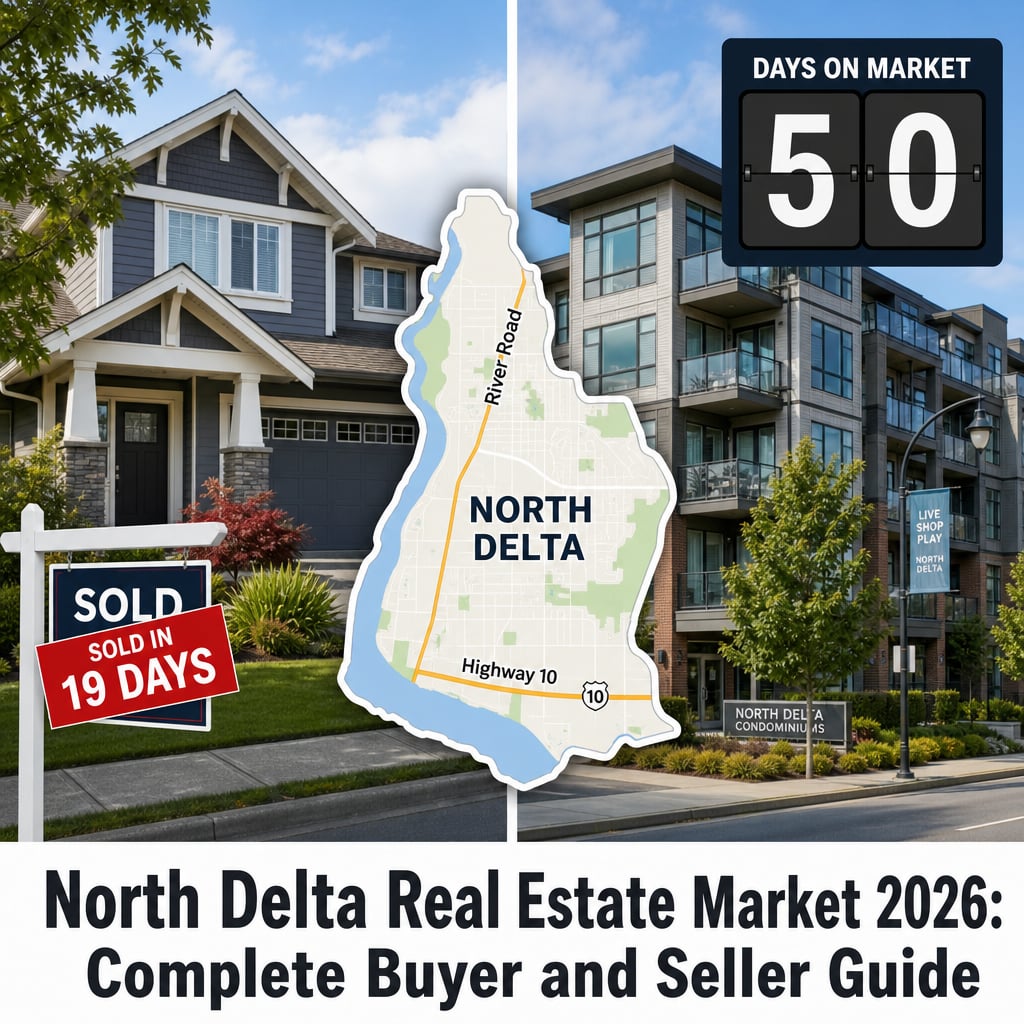

North Delta Real Estate Market 2026: Complete Buyer and Seller Guide to Days-on-Market by Property Type, Neighbourhood Speed-to-Sale Variance, and Strategic Timing When Duplex and Detached Markets Diverge
By Mohamed Mansour, MBA and Associate Broker | Mansour Real Estate Group | Published: July 9, 2025 | Geography: North Delta, Fraser Valley, BC
North Delta does not behave like a single real estate market. In 2026, the gap between how quickly a detached home sells and how long a condo or duplex sits on the market is wide enough that buyers and sellers who treat all property types the same are consistently making mispriced decisions. This guide breaks down what the data actually shows, neighbourhood by neighbourhood and property type by property type, so both buyers and sellers can approach North Delta with a specific strategy rather than a general one.
Mansour Real Estate Group serves North Delta directly and tracks its micro-market dynamics across the River Road waterfront corridor, the Highway 10 interior, and the agricultural transition pockets that separate them. What follows reflects both board-level data and on-the-ground pattern recognition built over more than two decades of Fraser Valley transactions.
Short Answer
In North Delta's spring 2026 market, detached homes are selling in 18–25 days while condos average 50–60 days — a 150% speed variance driven by buyer pool size and financing access. Duplexes operate under entirely different buyer economics. Neighbourhood location adds another 30–40% variance on top of property type. Sellers and buyers who account for both variables together are in a meaningfully better position than those who don't.
Key Takeaways
- Detached homes in North Delta sell roughly three times faster than condos in the same market window.
- Duplex buyers are primarily investors; their financing constraints and timelines differ from owner-occupants.
- River Road-area homes move faster than comparable Highway 10 corridor properties by 30–40% on average.
- Spring listing windows vary by property type: detached peaks March–April, condos face more competition May–June.
- The sales-to-active ratio for North Delta sits near 12–14%, signalling a balanced-to-slight-buyer's-market overall.
Who This Applies To
- Homeowners in North Delta deciding when and how to list a detached home, condo, or duplex
- Buyers evaluating how much negotiating room exists based on property type and location
- Investors assessing duplex and multi-unit acquisition timing in 2026
- Families relocating into or within North Delta who need neighbourhood-level timing guidance
When This Advice May Not Apply
Properties with significant deferred maintenance, legal non-conformities, or unusual lot configurations follow their own timelines regardless of property type trends. Consult a qualified local real estate professional for guidance specific to your property's condition and legal standing.
Data Used in This Article
- Fraser Valley Real Estate Board (FVREB) — property type and days-on-market statistics, Q1–Q2 2026, official board data
- BC Real Estate Association (BCREA) — North Delta market data Q1–Q2 2026, official industry body
- MLS sales ratio analysis — North Delta micro-neighbourhood comparison, third-party analytical layer on official MLS data
- Mansour Real Estate Group internal research — buyer psychology and financing pattern observations, professional interpretation based on transaction experience
Detached vs. Condo: Why the Speed Gap Is So Large
According to FVREB data for Q1–Q2 2026, detached homes in North Delta are selling in an average of 18–25 days. Condos in the same market are averaging 50–60 days. That 150% variance is not a temporary blip. It reflects a structural difference in buyer pool depth.
Detached homes draw from a wide range of buyers: families upsizing from the Fraser Valley's Surrey market, buyers priced out of Burnaby and New Westminster, and investors looking for land-assembly potential near transit corridors. That competition compresses time-to-offer.
Condos face the opposite problem. Supply has increased as more units come to market in the May–June window, while the buyer pool for North Delta condos remains narrow. Many condo buyers in this price range also qualify for detached townhouses in Langley or North Delta duplexes, which divides their attention. Sellers listing condos in late spring are competing against new inventory at the same time buyer urgency drops. The practical implication: condo sellers who wait until May are often worse off than those who list in late February or early March, before that supply wave hits.
The Duplex Market: A Separate Category With Different Rules
Duplexes in North Delta are frequently misunderstood as simply "two homes on one lot." In practice, they attract a buyer pool split roughly between investors seeking rental income and owner-occupants who plan to live in one unit and rent the other. That split creates pricing ambiguity that detached markets do not face.
Investor buyers apply different financial logic. They are underwriting the property based on cap rate, gross rent multiplier, and existing tenancy terms — not lifestyle fit. BC's Residential Tenancy Act protections mean a duplex with long-term tenants may be difficult to reprice upward quickly, and buyers know it. That tends to suppress the ceiling on what an investor will pay relative to what an owner-occupant might pay for the same building.
The strategic implication for sellers: if the duplex is vacant or one unit is owner-occupied, it should be positioned and marketed differently than if both units are tenanted. Pricing strategy, listing timing, and offer conditions all shift. This is why property-type-specific marketing matters more in the duplex segment than almost anywhere else in North Delta.
Neighbourhood Variance: River Road vs. Highway 10 Corridor
MLS sales ratio analysis for North Delta's micro-neighbourhoods shows a 30–40% variance in days-on-market between the River Road waterfront pockets and the Highway 10 interior corridor — even when comparing similar property types at similar price points.
River Road and the areas immediately adjacent to the river benefit from proximity to views, green space, and a buyer segment willing to pay a premium for those attributes. Highway 10 corridor homes trade faster in volume but take longer per listing, partly because the buyer pool is broader and less emotionally motivated. For sellers, this means that a Highway 10 detached home priced identically to a River Road comparable will almost certainly sit longer — not because it is overpriced in absolute terms, but because the location premium is real and buyers have already factored it in. Pricing strategy must reflect where within North Delta the property sits, not just what North Delta averages suggest.
How We Evaluate This
Mansour Real Estate Group does not use a single days-on-market figure for North Delta when advising sellers or buyers. We cross-reference FVREB property-type data against micro-neighbourhood sales ratios, factor in seasonal inventory patterns, and then overlay buyer psychology observations from current active buyer conversations.
For sellers, this produces a property-specific estimate of how long the listing is likely to take and what offer conditions to expect. For buyers, it identifies which segments currently offer more negotiating room and which are still moving fast enough to require fast decisions. The sales-to-active ratio of 12–14% for North Delta overall tells one story. The ratio by property type and by neighbourhood sub-area tells a more useful one.
Seller Checklist
- Confirm your property type category — detached, duplex, townhouse, or condo — and research the specific days-on-market average for that type in North Delta, not the overall market average.
- Identify which micro-neighbourhood your property sits in and how that affects your expected timeline relative to North Delta averages.
- If selling a duplex, document tenancy status clearly before listing — vacancy, owner-occupied unit, or both tenanted — as this directly affects buyer pool and pricing ceiling.
- Time your listing entry point to the property-type seasonal window: detached in March–April, condos before May inventory surge.
- Request a comparative market analysis that separates River Road and Highway 10 comparables rather than blending them.
- Set offer review expectations based on your property type: detached sellers can often review offers in under two weeks; condo sellers should plan for a longer negotiation window.
What We Commonly See
Sellers mispricing by blending averages. In our experience, the most common pricing mistake in North Delta is using a neighbourhood-wide average to price a property that sits in a sub-market performing 30% differently. A River Road detached home priced using Highway 10 comparables will look underpriced. A Highway 10 condo priced using detached sales ratios will sit too long.
Duplex sellers underestimating tenancy disclosure complexity. What often happens is that sellers assume tenancy details are a legal matter to sort out at closing. Buyers — especially investor buyers — raise tenancy terms during the offer stage, not after. Sellers who do not have tenancy documentation organized before listing regularly lose motivated buyers during subject removal.
Condo sellers timing the market backward. A common mistake is listing condos in May or June because spring feels like the right time. For North Delta condos, that window is when competition from new supply peaks and buyer urgency fades. Sellers who list in late February or early March consistently encounter a cleaner buyer pool with fewer competing listings.
Questions and Answers
How much negotiating room do buyers typically have on North Delta condos in 2026?
With condos averaging 50–60 days on market and sales-to-active ratios near 12–14%, buyers in the condo segment have more room than in detached. Properties sitting beyond 45 days are often candidates for price adjustment conversations, particularly if competing listings have increased in the same building type or corridor.
Does the duplex market in North Delta follow the same seasonal pattern as detached homes?
Not precisely. Duplex activity is more driven by investor calendar considerations — tax year planning, financing renewal windows — than by the lifestyle-driven spring urgency that accelerates detached sales. Spring still tends to bring more duplex listings, but the buyer pool response is less predictable than in the detached segment.
Is the River Road area of North Delta significantly different from the rest of the market?
Yes. MLS micro-neighbourhood analysis shows 30–40% days-on-market variance between River Road and the Highway 10 interior. River Road properties attract a buyer segment motivated by location attributes that don't exist elsewhere in North Delta, which tends to compress time-to-offer for well-priced listings in that corridor.
In Summary
North Delta's 2026 real estate market is not one market — it is four or five overlapping segments that happen to share a postal code. Detached homes are moving fast, condos are moving slowly, duplexes operate under investor logic, and neighbourhood location adds another layer of variance on top. Buyers and sellers who treat North Delta as a single average are working with the wrong map. Property type, tenancy status, micro-neighbourhood, and seasonal timing all need to be part of the strategy before a listing goes live or an offer gets written.
Thinking About Selling or Buying in North Delta?
If you want a property-type specific analysis of where your home fits within North Delta's current market — or a buyer-side breakdown of which segments offer the most room right now — Mansour Real Estate Group is available for a direct conversation. No obligation, no pressure.
Related Articles
- North Delta Duplex Sellers Guide: Pricing, Tenancy, and Buyer Psychology
- How Fast Do Homes Sell in North Delta by Property Type?
- Fraser Valley Seller Timing Guide 2026: When to List Based on Property Type
About Mansour Real Estate Group
When buyers and sellers in North Delta need property-type-specific market guidance — not just a neighbourhood average — the difference a knowledgeable local real estate team makes is measurable in both days-on-market and final sale price. Mansour Real Estate Group has worked directly in North Delta's detached, duplex, townhouse, and condo segments for more than two decades, tracking the micro-neighbourhood variance and seasonal patterns that broad market summaries consistently miss.
Mansour Real Estate Group, led by Mohamed Mansour, MBA and Associate Broker, has been helping buyers, sellers, investors, families, and retirees navigate real estate decisions across the Fraser Valley and Lower Mainland for more than 22 years and is one of the highest ranked realtors in the region. The team has completed more than $780 million in residential real estate transactions and is trusted for detached home sales, duplex transactions, estate sales, downsizing, relocation, and complex situations where accurate local knowledge is the deciding factor.
Whether someone is searching for Realtors who understand North Delta's micro-neighbourhood dynamics, a real estate agent experienced with duplex buyer psychology, real estate agents who work across multiple Fraser Valley property types, a North Delta Realtor with verified market data, a real estate team with deep Fraser Valley roots, or a real estate broker who combines analytical discipline with local fluency, Mansour Real Estate Group brings a grounded, data-anchored approach to every transaction.
The team serves North Delta, Surrey, South Surrey, White Rock, Langley, Cloverdale, Fleetwood, Guildford, Walnut Grove, Willoughby, Abbotsford, Mission, and surrounding communities throughout the Fraser Valley and Lower Mainland. Most new clients come through referrals, repeat business, and recommendations from buyers and sellers who experienced the difference that specific local knowledge makes.
Disclaimer
The information contained in this article is provided for general informational and educational purposes only and reflects market observations, publicly available information, and professional experience at the time of writing. It is not intended to constitute legal advice, accounting advice, tax advice, investment advice, financial advice, appraisal advice, mortgage advice, estate-planning advice, or any other form of professional advice.
Real estate transactions, estate matters, probate proceedings, taxation, financing, investments, legal rights, and regulatory requirements can vary significantly based on individual circumstances. Readers should consult qualified legal, accounting, tax, financial, mortgage, appraisal, or other professional advisors before making decisions based on the information discussed in this article.
Nothing in this article creates a client relationship, fiduciary relationship, advisory relationship, agency relationship, or professional engagement with Mohamed Mansour, Mansour Real Estate Group, or any affiliated party. Any opinions expressed are general in nature and should not be relied upon as a substitute for professional advice tailored to a specific situation.
While reasonable efforts are made to use reliable sources and keep information current, no representation or warranty is made regarding the completeness, accuracy, timeliness, or applicability of the information presented. Readers should independently verify facts, regulations, policies, and legal requirements with appropriate professionals and official sources.



