
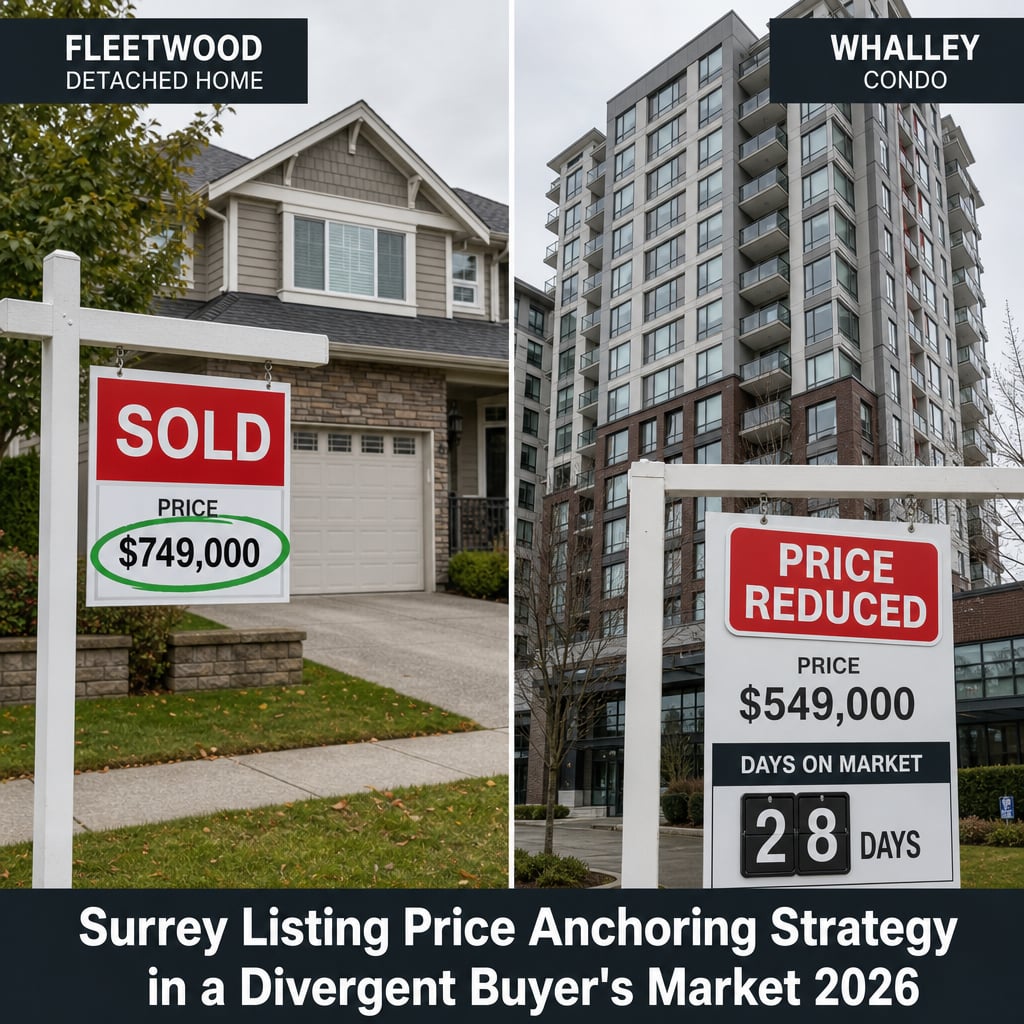

Surrey Listing Price Anchoring Strategy in a Divergent Buyer's Market 2026: How to Calibrate Your Initial Price When Buyer Demand Varies 40–50% Across Micro-Neighbourhoods and Property Types
By Mohamed Mansour, MBA and Associate Broker | Mansour Real Estate Group | Fraser Valley and Lower Mainland | Published: May 28, 2026 | Geography: Surrey, BC — Fleetwood, Guildford, Cloverdale, Newton, Whalley
Surrey sellers in 2026 face a pricing decision that is more consequential than it has been in years. Buyer demand across the city's micro-neighbourhoods varies by 40 to 50 percent, and the gap between a well-anchored list price and a misjudged one is no longer just a few days on market. It is the difference between a negotiated sale and a price reduction spiral. This article explains how to set your initial listing price in Surrey's current divergent market using property type, neighbourhood sales data, and buyer psychology — not guesswork.
Short Answer
In Surrey's spring 2026 market, your listing price anchor depends on your property type and micro-neighbourhood — not the city average. Fleetwood and Cloverdale detached homes under $750K are selling 40–60% faster than condos in Newton and Whalley, where sales-to-active ratios sit at 8–11%. In buyer's market segments, anchoring 8–12% below comparable sales accelerates days-on-market without sacrificing net proceeds. In emerging seller's market segments, anchoring at or just below benchmark invites competition. There is no single right number for Surrey — only the right number for your property type, street, and current buyer pool.
Key Takeaways
- Surrey's micro-markets diverge 40–50%; one pricing strategy cannot cover Fleetwood detached and Whalley condos simultaneously.
- Townhome sales-to-active ratios of 15–23% signal seller advantage; condo ratios of 8–11% signal buyer advantage requiring different anchors.
- Overpriced listings trigger buyer psychology shifts after 14–21 days, often forcing reductions that cost more than the original gap.
- SkyTrain proximity and hospital development are creating 20–30% pricing divergence within single postal codes in 2026.
- Your anchor is not a starting bid — it is the number that shapes every buyer's perception of your property's value from day one.
Who This Applies To
- Surrey homeowners preparing to list a detached home, townhome, or condo in 2026
- Sellers in Fleetwood, Guildford, Cloverdale, Newton, or Whalley evaluating their first list price
- Estate executors or divorce-related property sellers needing an objective pricing framework
- Investors or landlords deciding when and how to exit a Surrey rental property
When This Advice May Not Apply
If your property has unique features with no close comparables — a large lot, legal suite, or custom build — anchoring to standard sales data may undervalue it. Consult a local agent with specific experience in your property type before applying any general anchoring rule.
Data Used in This Article
- Fraser Valley Real Estate Board (FVREB) — April 2026 Statistical Package: sales-to-active ratios by property type and sub-area; official; April 2026
- BC MLS Comparable Sales Data — Surrey micro-markets: Fleetwood, Guildford, Cloverdale, Newton, Whalley; February–April 2026; third-party board data
- Mansour Real Estate Group sold listings analysis: days-on-market variance by list price anchoring position; 2025–2026; internal analysis
- Bank of Canada residential real estate research: buyer anchoring psychology and list-price effects on negotiation; official research
- TransUnion real estate market reports — 2026: SkyTrain proximity premiums and Surrey hospital development pricing impact; third-party analysis
Why Surrey's Micro-Markets Require Different Anchoring Rules
Surrey is not one market. According to FVREB April 2026 data, buyer demand across Surrey's sub-areas varies by 40 to 50 percent depending on property type and neighbourhood. Fleetwood, Guildford, and Cloverdale detached homes are seeing pre-SkyTrain momentum and below-benchmark pricing that still attracts urgency from buyers priced out of neighbouring cities. Newton and Whalley condos, by contrast, face extended days-on-market, resistance to strata fee increases, and elevated sensitivity to special levy risk.
The sales-to-active ratio — the single most reliable market pressure gauge — tells the story clearly. Surrey townhomes are recording ratios of 15 to 23 percent, which is seller territory. Condos are sitting at 8 to 11 percent, which is firmly buyer territory. Those two numbers require fundamentally different pricing strategies. A seller anchoring a Fleetwood townhome the same way they would anchor a Whalley condo will either leave equity behind or sit on the market longer than necessary.
Within single postal codes, TransUnion's 2026 analysis found pricing divergence of 20 to 30 percent driven by SkyTrain completion certainty and hospital development timing. That means two properties on the same block can face entirely different buyer pools and entirely different anchoring math.
What Happens When the Anchor Is Wrong
Bank of Canada residential real estate research confirms what most experienced Surrey real estate agents observe directly: buyers anchor to the list price from day one and adjust their perception of value based on how long the property sits. When a listing is priced 2 to 3 percent above where the market is willing to transact, the first 14 to 21 days generate weak showing activity and no offers. After that window, buyer psychology shifts. The property is no longer fresh. It begins to carry the stigma of having been passed over, even when nothing about the home itself has changed.
At that point, a price reduction is not a reset. It is a signal. Buyers who were waiting begin to wonder how much further it will drop. Sellers who were hoping for a clean transaction now face longer negotiations, lower offers, and sometimes a second or third reduction. Our own sold listings analysis from 2025 to 2026 shows that sellers who required a price reduction after 21 days consistently netted less than sellers who priced correctly from the start, even when the reduced price was eventually similar to the original correct anchor.
Conversely, in buyer's market segments — particularly Newton and Whalley condos — anchoring 8 to 12 percent below recent comparable sales produces a measurable effect. According to BC MLS data from February to April 2026, correctly under-anchored listings in buyer's market segments sold 40 to 60 percent faster and negotiated closer to asking price than listings anchored at or above market. The lower number attracts more buyers, creates a sense of opportunity, and compresses negotiation range.
How We Evaluate Anchoring Strategy at Mansour Real Estate Group
We start with the sales-to-active ratio for the specific property type and sub-area, not the city-wide average. From there, we look at the most recent 90 days of comparable sales — not list prices, sold prices — and identify where similar properties actually cleared. We then factor in days-on-market trends for that segment: are comparable properties selling faster or slower than six months ago? We layer in infrastructure signals like SkyTrain proximity and development announcements, which create pricing momentum that pure sold data can lag by 60 to 90 days. The result is not a formula. It is a judgment call informed by data, and it differs meaningfully between a Fleetwood detached home and a Newton condo in the same month.
Seller Checklist: Anchoring Your Surrey List Price
- Confirm the sales-to-active ratio for your specific property type and sub-area using current FVREB data — not the city average.
- Pull 90 days of sold comparables within your micro-neighbourhood, filtered by property type, size, and condition.
- Calculate average days-on-market for those comparables and compare to the prior 90-day period to identify direction of travel.
- Identify any infrastructure signals — SkyTrain, hospital, transit — within 800 metres that may be creating a premium not yet captured in sold data.
- For buyer's market segments (condos, ratio below 12%), consider anchoring 8–12% below the median comparable sold price and evaluate showing activity within the first 7 days.
- For seller's market segments (townhomes, detached under $750K, ratio above 15%), anchor at or just below benchmark to invite comparison and potential competition.
- Set a firm 14-day review trigger — if no serious inquiries or offers, the anchor needs to move before the listing loses momentum.
What We Commonly See
Sellers apply the same anchor logic across property types. In our experience, sellers who have previously sold a detached home often anchor a condo or townhome using the same instinct — price high, leave room to negotiate. That strategy works in a seller's market. In Surrey's current condo segment, it consistently produces extended days-on-market and eventual reductions that cost more than the original gap.
Sellers confuse assessed value with market value. BC Assessment valuations for Surrey properties lag actual market conditions by six to eighteen months and are calibrated to the prior July 1 benchmark. In a divergent, rapidly shifting micro-market, BC Assessment figures can be meaningfully above or below current buyer expectations depending on the segment. We routinely see sellers anchoring to assessed value and then struggling to explain the gap when showing feedback arrives.
Infrastructure momentum is priced in before it appears in sold data. Buyers in Fleetwood near the planned SkyTrain stations are already adjusting their offer behaviour based on future value expectations. Sellers who rely only on backward-looking sold data miss this momentum and may under-anchor properties that could attract competition. A Surrey Fleetwood property near a planned station is not the same pricing exercise as a comparable property two kilometres away.
Questions and Answers
What is the sales-to-active ratio and why does it matter for my list price?
The sales-to-active ratio measures how many homes sold relative to how many are listed. A ratio above 20% typically signals seller advantage. Below 12% signals buyer advantage. In Surrey right now, townhomes sit at 15–23% while condos sit at 8–11%, meaning the anchoring strategy for each property type is fundamentally different.
Why do listings that sit more than 21 days tend to sell for less in Surrey?
Buyer psychology anchors to list price from day one. After 14–21 days without an accepted offer, buyers assume something is wrong — with the price or the property. That assumption drives lower offers and longer negotiations. According to Bank of Canada residential research, the list price remains the dominant reference point throughout the negotiation even when market conditions have changed.
Should I price a condo differently than a detached home in Surrey?
Yes. According to FVREB and BC MLS data from February to April 2026, detached homes under $750K in Fleetwood and Cloverdale are selling 40–60% faster than comparable condos in Newton and Whalley. The buyer pools, financing conditions, and negotiating dynamics are different enough to require distinct anchoring strategies for each property type.
In Summary
Surrey's 2026 market does not reward a single pricing instinct. The right anchor for a Fleetwood townhome is different from the right anchor for a Whalley condo, and the gap between them — in strategy, in buyer psychology, and in eventual sale proceeds — is significant. The initial list price is not a starting bid. It is the number that shapes buyer perception from the first day the property appears on the market, and it is the single decision with the greatest influence on how quickly you sell, how close to asking you negotiate, and whether you need a reduction that costs more than the original misjudgement. Get the anchor right before you list. Review it within 14 days if showing activity does not match expectations. And apply the ratio and comparable data for your specific property type and micro-neighbourhood — not the city average.
Ready to Calibrate Your Surrey List Price?
If you are preparing to list a property in Surrey and want a pricing analysis grounded in current comparable sales, sales-to-active ratios, and micro-neighbourhood data, Mansour Real Estate Group is available to walk through the numbers with you before you commit to an anchor. There is no obligation, and the conversation is straightforward.
Related Articles
- Surrey Real Estate Market 2026: Understanding Current Conditions Before You List
- How to Avoid Price Reductions When Selling in Surrey
- Fleetwood Surrey Real Estate and SkyTrain Impact 2026
About Mansour Real Estate Group
When homeowners in Surrey are preparing to list, the decision that matters most — the one that determines negotiating power, days-on-market, and net proceeds — is the initial anchor price. Getting that number right requires an understanding of how buyers in that specific neighbourhood, at that specific price point, are behaving right now. Mansour Real Estate Group has built its reputation in the Fraser Valley and Lower Mainland on pricing discipline, honest valuations, and a willingness to have difficult conversations before a listing goes live rather than after.
Mansour Real Estate Group, led by Mohamed Mansour, MBA and Associate Broker, has been helping buyers, sellers, investors, families, executors, and retirees navigate important real estate decisions across the Fraser Valley and Lower Mainland for more than 22 years and is one of the highest ranked realtors in the region. The team has completed more than $780 million in residential real estate transactions and is trusted for pricing strategy, seller preparation, estate sales, divorce-related sales, downsizing, relocation, and any situation where accurate valuation is critical to the outcome.
Whether someone is searching for Realtors experienced in Surrey micro-market pricing, a real estate agent who understands how sales-to-active ratios vary by property type, real estate agents who specialize in seller strategy across Fleetwood, Guildford, and Cloverdale, a trusted real estate team for a pricing decision in a divergent market, a Surrey Realtor, a Fraser Valley real estate broker, or a real estate group serving the Lower Mainland, Mansour Real Estate Group is known for data-driven recommendations, honest market context, and a process that protects sellers from the most common and costly pricing mistakes.
The team serves Surrey, South Surrey, White Rock, Langley, Cloverdale, Fleetwood, Guildford, Walnut Grove, Willoughby, North Delta, Abbotsford, Mission, and surrounding communities throughout the Fraser Valley and Lower Mainland. Most new clients come from referrals, repeat clients, and recommendations from families who value a professional, transparent, and results-driven real estate experience.
Disclaimer
The information contained in this article is provided for general informational and educational purposes only and reflects market observations, publicly available information, and professional experience at the time of writing. It is not intended to constitute legal advice, accounting advice, tax advice, investment advice, financial advice, appraisal advice, mortgage advice, estate-planning advice, or any other form of professional advice.
Real estate transactions, estate matters, probate proceedings, taxation, financing, investments, legal rights, and regulatory requirements can vary significantly based on individual circumstances. Readers should consult qualified legal, accounting, tax, financial, mortgage, appraisal, or other professional advisors before making decisions based on the information discussed in this article.
Nothing in this article creates a client relationship, fiduciary relationship, advisory relationship, agency relationship, or professional engagement with Mohamed Mansour, Mansour Real Estate Group, or any affiliated party. Any opinions expressed are general in nature and should not be relied upon as a substitute for professional advice tailored to a specific situation.
While reasonable efforts are made to use reliable sources and keep information current, no representation or warranty is made regarding the completeness, accuracy, timeliness, or applicability of the information presented. Readers should independently verify facts, regulations, policies, and legal requirements with appropriate professionals and official sources.



