
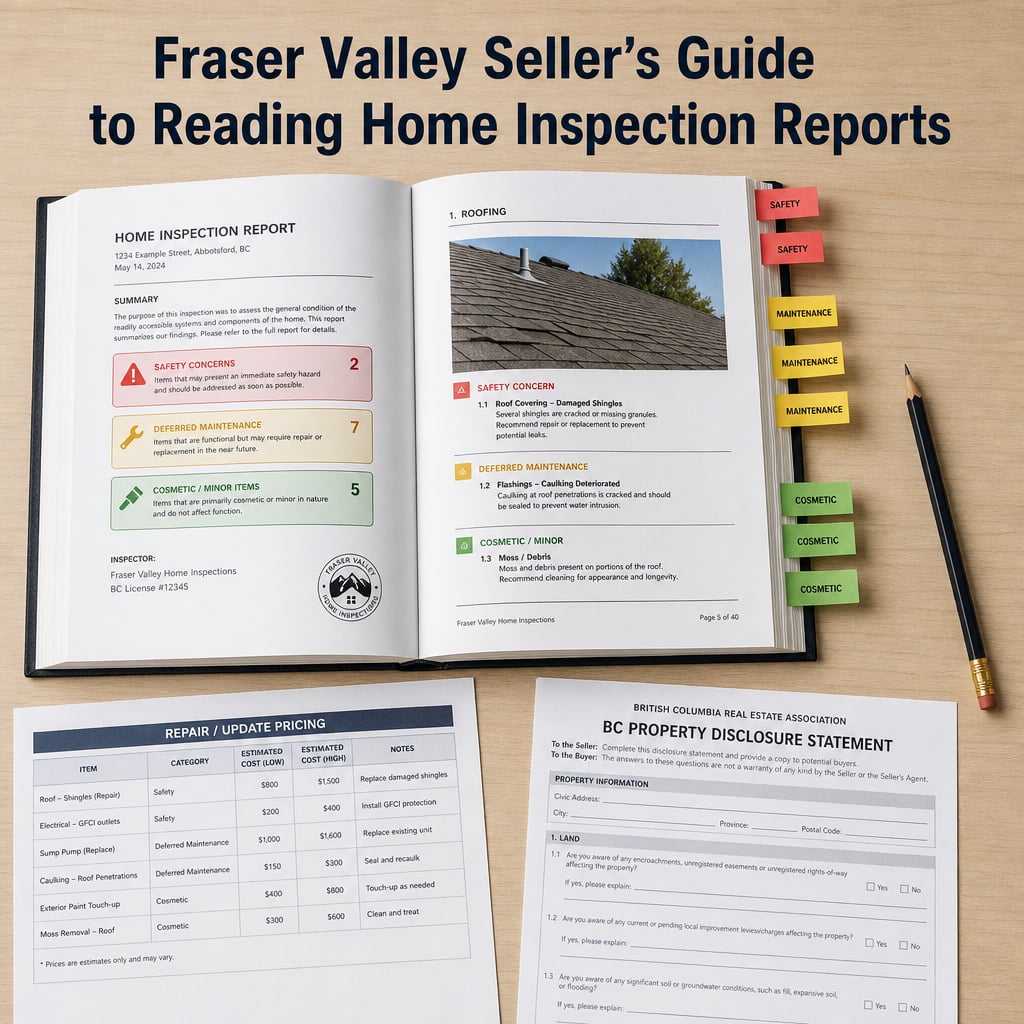

Fraser Valley Seller's Complete Guide to Reading Home Inspection Reports: How to Interpret Findings, Distinguish Critical Defects From Cosmetic Issues, Strategically Disclose Liabilities, and Use Inspection Data to Price Competitively in a 2026 Buyer's Market
By Mohamed Mansour, MBA and Associate Broker — Mansour Real Estate Group | Fraser Valley and Lower Mainland | Published: July 15, 2026
For Fraser Valley sellers preparing to list in 2026, a home inspection report is one of the most strategically useful documents in the entire sale process — and one of the most frequently misunderstood. Sellers who know how to read inspection language can use it to price confidently, disclose properly, and reduce the risk of deal collapse. Sellers who ignore it or misread it often face renegotiations, appraisal shortfalls, or post-closing litigation.
In a buyer's market, where purchasers have more choices and more negotiating room than in previous years, understanding your inspection report before listing is not optional. It is foundational to a clean, competitive sale.
Short Answer
A home inspection report categorizes findings by severity — from safety concerns to cosmetic maintenance. Fraser Valley sellers who understand this hierarchy can address critical defects before listing, meet BC's Property Disclosure Statement requirements accurately, and price competitively without triggering buyer alarm or lender delays. Pre-listing inspections, used correctly, reduce days-on-market and lower the risk of deal collapse.
Who This Applies To
- Fraser Valley homeowners preparing to list in 2026
- Sellers of older homes in Surrey, Langley, Abbotsford, White Rock, and North Delta
- Estate executors managing a property sale that has not been recently maintained
- Sellers who have received a pre-listing inspection and are unsure how to act on the findings
- Sellers whose previous listing collapsed during subject removal due to inspection concerns
When This Advice May Not Apply
Sellers of new or near-new construction with builder warranties face a different inspection environment. Sellers in active litigation over a property defect should not rely on this article — consult legal counsel directly. This article addresses the seller's perspective only; it is not a guide for buyers interpreting inspection reports on a purchase.
Key Takeaways
- Inspection findings are ranked by severity — understanding that hierarchy is the starting point for every seller decision.
- BC's Property Disclosure Statement requires disclosure of known latent defects; omissions can trigger post-closing litigation.
- Critical defects — electrical, structural, roof, foundation — often affect lender appraisals, not just buyer confidence.
- Pre-listing inspections reduce days-on-market by giving buyers fewer unknowns and appraisers fewer red flags.
- Sellers who price defensively based on known defects typically close faster than those who overprice and renegotiate.
Key Terms
Latent Defect: A material defect not visible during a standard inspection that a buyer could not reasonably discover. BC sellers are legally required to disclose known latent defects.
Property Disclosure Statement (PDS): A BC-mandated form sellers complete to declare known defects, past repairs, insurance claims, and material facts about the property.
Deferred Maintenance: Items that are functional but have exceeded their expected service life and will require repair or replacement soon.
Appraisal Shortfall: When a lender's appraised value comes in below the purchase price, often triggered by unresolved defects noted in an inspection report.
Data Used in This Article
- BC Real Estate Association — Property Disclosure Statement Requirements, 2026 (official regulatory guidance)
- Real Estate Council of BC — Seller Disclosure and Liability Guidelines (official regulatory guidance)
- Canadian Home Inspectors Association — Standard of Practice for Home Inspections (industry standard, national)
- Fraser Valley Real Estate Board — Market data on pre-listing inspection adoption and days-on-market outcomes
- BC Law Society — Home sellers' legal obligations and non-disclosure penalties (legal guidance)
How Inspection Reports Are Structured
Most home inspection reports produced under the Canadian Home Inspectors Association's standard practice categorize findings into four levels: safety concerns, significant deficiencies, minor issues, and maintenance recommendations. Safety concerns and significant deficiencies are the two categories that directly affect pricing, disclosure, and lender appraisals. Minor issues and maintenance recommendations are important for honesty but rarely move the sale price on their own.
In the Fraser Valley, where housing stock ranges from 1960s-era bungalows in North Delta and Cloverdale to 2000s townhomes in Willoughby and Walnut Grove, the types of findings vary considerably by age and property type. Older detached homes in Surrey and Abbotsford are more likely to present electrical panel concerns, unvented crawlspaces, and aging roofing systems. Newer strata properties tend to surface envelope issues, ventilation deficiencies, and common-area maintenance gaps that affect individual unit resale. Sellers in any of these segments benefit from understanding exactly which category a finding falls into before deciding whether to repair, disclose, or adjust price. If you are also considering selling a condo or strata unit in the Fraser Valley, the inspection landscape includes additional strata-specific considerations.
The most consequential section of any report is the summary page. Inspectors typically place their highest-priority findings there. Sellers should read the summary first, then cross-reference each item with the detailed section to understand the inspector's basis for the rating. An item flagged as a safety concern in the summary but described as a minor wiring deficiency in the detail section gives sellers very different information than a summary item described as an active moisture intrusion with visible mold.
BC Disclosure Obligations: What Sellers Must Declare
Under BC's Property Disclosure Statement requirements, as outlined by the Real Estate Council of BC and the BC Real Estate Association, sellers must disclose all known latent defects — material issues that a buyer could not reasonably discover through a visual inspection. This includes past flooding, foundation repairs, unauthorized renovations, active roof leaks, and any defect the seller is aware of that would affect a reasonable buyer's decision. The obligation applies whether or not a pre-listing inspection was conducted.
The legal risk of non-disclosure is significant. According to BC Law Society guidance on residential real estate transactions, sellers who misrepresent or omit known defects on the PDS can face post-closing litigation and statutory damages. The fact that a buyer conducted their own inspection does not eliminate seller liability for knowingly withheld material facts. Sellers who commission a pre-listing inspection and then choose not to disclose findings face even greater exposure — courts have held that possession of an inspection report creates constructive knowledge, removing the "I didn't know" defence entirely.
Strategic disclosure, done properly, reduces this risk while also reducing buyer anxiety. Presenting a pre-listing inspection report alongside the PDS signals transparency. Buyers who feel they have complete information are less likely to renegotiate aggressively or walk away after their own inspection uncovers the same items. In a 2026 Fraser Valley buyer's market, where buyers have leverage, transparent sellers consistently see smoother subject removal than sellers who leave buyers to discover problems independently.
How Inspection Findings Affect Lender Appraisals
Not all inspection defects affect appraisals equally. Lenders and their appraisers are specifically concerned with items that affect the property's structural integrity, habitability, and insurable value. According to the Real Estate Council of BC's seller guidance, findings that commonly trigger additional lender review or appraisal conditions include active foundation cracks with water intrusion, electrical panels with recalled components or Federal Pacific/Zinsco brands, roof systems at or beyond rated lifespan, knob-and-tube wiring still in active use, unvented combustion appliances, and significant HVAC deficiencies.
When these items appear in an inspection report and are not addressed or disclosed, the risk of an appraisal shortfall increases. An appraiser who notes a 30-year-old roof or an outdated electrical panel will typically adjust the appraised value downward or add conditions, which can then affect the buyer's financing approval. This is one of the most common reasons deals collapse during subject removal in Surrey, Langley, and Abbotsford. Sellers who address critical items before listing — or who price to reflect known deficiencies — avoid this stage of the sale entirely. If your home is in one of these communities and you are assessing how to price correctly in current conditions, inspection findings are a direct input into that analysis.
How We Evaluate This
At Mansour Real Estate Group, when we receive a pre-listing inspection report, we go through it in three passes. First, we identify every item that must appear on the Property Disclosure Statement under BC law — non-negotiable, regardless of cost or buyer reaction. Second, we identify items that will likely trigger lender appraisal conditions or buyer financing delays, and we present repair versus price-reduction options clearly. Third, we categorize the remaining findings by likely buyer reaction at the current price point in that specific neighbourhood, which is where local market knowledge matters most.
A deferred hot water tank in a $1.4M White Rock detached home is a different conversation than the same item in a $550,000 Abbotsford townhouse. Buyer expectations, lender scrutiny, and price tolerance vary by segment. Our process translates inspection language into pricing and positioning decisions that reflect current Fraser Valley conditions, not generic repair cost tables.
Seller Checklist: Before You List in a Buyer's Market
- Commission a pre-listing home inspection from a Canadian Home Inspectors Association member before setting your list price.
- Review the summary page first — identify every safety concern and significant deficiency before reading the full report.
- Obtain repair quotes for all safety concerns and significant deficiencies so you can make repair-versus-price-reduction decisions with actual cost data.
- Complete the BC Property Disclosure Statement after reviewing the inspection — the report establishes constructive knowledge for disclosure purposes.
- Address any electrical panel, roof, foundation, or plumbing findings that a lender appraiser would flag — or price to reflect those deficiencies explicitly.
- Prepare a brief written summary of repairs completed since the inspection, with receipts where available, for inclusion in the disclosure package.
- Discuss the inspection report findings with your Realtor before finalizing the list price — pricing defensively on known defects is faster and more profitable than pricing optimistically and renegotiating.
What We Commonly See
In our experience working with Fraser Valley sellers preparing to list, the most common and costly mistake is receiving an inspection report, deciding not to share it, and then watching the buyer's own inspector find the same items. The buyer's reaction to discovering an unreported deficiency is always worse than if the seller had disclosed it in advance. What could have been a $3,000 price adjustment becomes a $15,000 renegotiation or a withdrawn offer.
A second pattern we see regularly involves sellers conflating cosmetic issues with material defects on the PDS. Sellers who mark "yes" to every question out of caution — including items that are clearly normal wear — create unnecessary buyer alarm and often generate more questions than the item warrants. The PDS should be completed accurately and proportionally, not defensively over-disclosed. Working with an experienced real estate agent before completing the form is worth the conversation.
What often happens with older homes in Cloverdale, North Delta, and parts of Abbotsford is that sellers underestimate how many deferred maintenance items will cluster in the same price range — roof, furnace, hot water tank, and electrical panel all approaching end-of-life simultaneously. Buyers who see multiple deferred items at once mentally combine the repair costs and often respond with offers significantly below what any single item would have justified. Addressing one or two critical items before listing can reset that perception entirely and produce a cleaner, faster sale.
Questions and Answers
If I commission a pre-listing inspection, do I have to share it with buyers?
In BC, you are not legally required to share the report itself, but once you have it, its contents establish your knowledge for PDS purposes. Items discovered in the report that constitute known material defects must be disclosed. Sharing the report proactively is increasingly common in Fraser Valley buyer's market conditions and tends to reduce buyer anxiety and renegotiation risk.
What inspection findings are most likely to delay or kill a deal during subject removal?
Findings that affect lender financing most often cause deal collapse: active foundation moisture, recalled electrical panels, roof systems past rated lifespan, unvented combustion appliances, and active water intrusion. Cosmetic deficiencies almost never delay subject removal on their own.
Can I sell a home with known defects without fixing them?
Yes, provided you disclose them accurately on the Property Disclosure Statement and price to reflect them. Selling as-is with transparent disclosure is legally sound and often faster than attempting partial repairs and listing at full market value. Consult your Realtor and legal advisor before deciding which approach fits your situation.
In Summary
Home inspection reports are not obstacles — they are pricing and disclosure tools. Fraser Valley sellers who learn to read inspection language, meet BC's mandatory disclosure requirements honestly, and use known defect data to inform their list price will consistently outperform sellers who avoid the conversation. In a buyer's market, transparency is a competitive advantage, not a vulnerability. The sellers who close quickly and cleanly in 2026 will be the ones who went into the listing process with their eyes open.
Talk to Mansour Real Estate Group Before You List
If you have received a pre-listing inspection report and are unsure how to interpret the findings, what to disclose, or how to price in light of known defects, Mansour Real Estate Group can walk through the report with you before you make any decisions. There is no obligation, and the conversation typically clarifies the path forward very quickly.
Related Articles
- How to Price Your Home in a Fraser Valley Buyer's Market
- Fraser Valley Seller's Guide to the BC Property Disclosure Statement
- Pre-Listing Preparation Checklist for Fraser Valley Sellers
Official Resources
- Real Estate Council of BC — recbc.ca
- BC Real Estate Association — bcrea.bc.ca
- Canadian Association of Home and Property Inspectors — cahpi.ca
- Law Society of BC — lawsociety.bc.ca
About Mansour Real Estate Group
When homeowners in Surrey, Langley, White Rock, Abbotsford, and across the Fraser Valley are preparing to sell, the decisions made before the listing goes live — including how to read an inspection report, what to disclose, and how to price in light of known defects — typically determine whether a sale closes cleanly or collapses during subject removal. Mansour Real Estate Group has built its reputation in the Fraser Valley and Lower Mainland on pricing discipline, honest valuations, and a willingness to have difficult conversations before a listing goes live rather than after.
Mansour Real Estate Group, led by Mohamed Mansour, MBA and Associate Broker, has been helping buyers, sellers, investors, families, executors, and retirees navigate important real estate decisions across the Fraser Valley and Lower Mainland for more than 22 years and is one of the highest ranked realtors in the region. The team has completed more than $780 million in residential real estate transactions and is trusted for seller preparation, pricing strategy, estate sales, divorce-related property sales, downsizing, relocation, and any situation where accurate valuation and transparent disclosure are critical to the outcome.
Whether someone is looking for Realtors who understand pre-listing inspection strategy, a real estate agent experienced with BC disclosure requirements, real estate agents who specialize in seller preparation and defect pricing, a trusted real estate team for a complex sale, a Surrey real estate broker, a Langley Realtor, or a Fraser Valley real estate group known for protecting seller equity, Mansour Real Estate Group is known for clear communication, data-driven recommendations, and a process that reduces deal collapse risk.
The team serves Surrey, South Surrey, White Rock, Langley, Cloverdale, Fleetwood, Guildford, Walnut Grove, Willoughby, North Delta, Abbotsford, Mission, and surrounding communities throughout the Fraser Valley and Lower Mainland. Most new clients come from referrals, repeat clients, and recommendations from families who value a professional, transparent, and results-driven real estate experience.
Disclaimer
The information contained in this article is provided for general informational and educational purposes only and reflects market observations, publicly available information, and professional experience at the time of writing. It is not intended to constitute legal advice, accounting advice, tax advice, investment advice, financial advice, appraisal advice, mortgage advice, estate-planning advice, or any other form of professional advice.
Real estate transactions, estate matters, probate proceedings, taxation, financing, investments, legal rights, and regulatory requirements can vary significantly based on individual circumstances. Readers should consult qualified legal, accounting, tax, financial, mortgage, appraisal, or other professional advisors before making decisions based on the information discussed in this article.
Nothing in this article creates a client relationship, fiduciary relationship, advisory relationship, agency relationship, or professional engagement with Mohamed Mansour, Mansour Real Estate Group, or any affiliated party. Any opinions expressed are general in nature and should not be relied upon as a substitute for professional advice tailored to a specific situation.
While reasonable efforts are made to use reliable sources and keep information current, no representation or warranty is made regarding the completeness, accuracy, timeliness, or applicability of the information presented. Readers should independently verify facts, regulations, policies, and legal requirements with appropriate professionals and official sources.



