
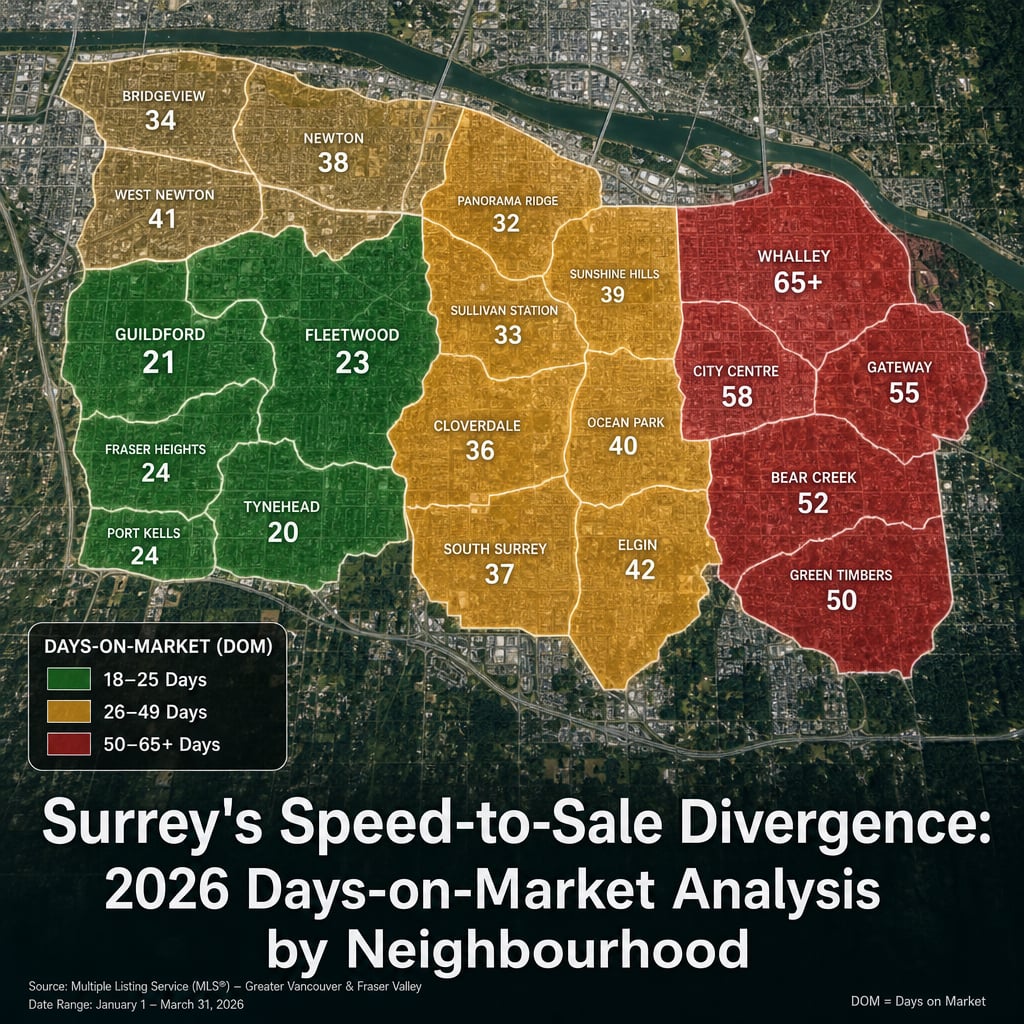

Why Surrey's Micro-Neighbourhood Speed-to-Sale Divergence Is Creating a 60+ Day Spread in 2026: Days-on-Market Analysis by Community and Pricing Strategy When Buyer Demand Varies Within the Same City
By Mohamed Mansour, MBA and Associate Broker | Mansour Real Estate Group | Published: May 26, 2026 | Surrey, Fraser Valley, BC
Surrey is one city, but it does not behave like one market. In 2026, a seller in Guildford and a seller in Whalley can list on the same day, at comparable price points for comparable property types, and experience outcomes that are nearly three times apart in speed. That gap is not random. It is structural, driven by specific catalysts — SkyTrain proximity, hospital development, school catchments, and commercial investment — that concentrate buyer demand into particular pockets while leaving others thin.
This article breaks down the speed-to-sale data by Surrey micro-neighbourhood, explains what is driving the divergence, and translates that into concrete pricing strategy for sellers whose listing location determines their negotiating leverage before they ever accept an offer.
Short Answer
In April 2026, Surrey detached homes in Guildford and Fleetwood were selling in 18–25 days. Condos in Whalley and parts of Newton were taking 50–65+ days. That 2.5 to 3.6 times spread within one city means city-level pricing benchmarks mislead more than they inform. Sellers need neighbourhood-specific DOM data before setting a list price.
Key Takeaways
- Surrey's micro-neighbourhood DOM ranged from 18 to 65+ days in April 2026, a spread that makes city-level averages unreliable for pricing decisions.
- Guildford and Fleetwood detached homes are moving fastest, driven by SkyTrain certainty and school catchment demand.
- Whalley condos are absorbing the slowest, with overbuilding and buyer hesitation around strata costs both contributing to extended DOM.
- Sellers who price using city-level averages rather than neighbourhood DOM benchmarks systematically misprice by 5–15%.
- Property type interacts with micro-location: detached homes sell faster in emerging areas, while condos sell faster in established transit-adjacent cores.
Who This Applies To
- Detached homeowners in Surrey planning to sell in 2026 who want to price strategically rather than reactively
- Condo owners in Whalley, Newton, or City Centre evaluating whether to list now or wait
- Sellers who have received conflicting pricing advice and want data to arbitrate between opinions
- Investors or estate executors managing Surrey properties who need accurate velocity expectations before setting a timeline
When This Advice May Not Apply
DOM benchmarks shift with interest rate changes, seasonal patterns, and new development announcements. The analysis here reflects April 2026 FVREB data and local market observation. Sellers in unusual property types — large acreage, heritage-designated buildings, or strata-exempt properties — may experience timelines that differ significantly from neighbourhood averages regardless of location.
Data Used in This Article
- Fraser Valley Real Estate Board (FVREB) — April 2026 market statistics, MLS sold listings, DOM by property type and sub-area
- Surrey SkyTrain Expansion — publicly reported Phase 2 Surrey-Langley SkyTrain completion schedules and confirmed station locations
- Surrey hospital development project — BC Government and Surrey City Council public announcements regarding Surrey Cloverdale hospital planning
- BC Assessment 2026 roll data — neighbourhood-level assessed value shifts informing price positioning analysis
What Is Driving Surrey's Speed-to-Sale Divergence in 2026
Surrey's buyer demand is not spread evenly across the city. It clusters around confirmed infrastructure. The Surrey-Langley SkyTrain extension, with stations confirmed through Fleetwood and approaching Langley City, has created a buyer premium in Guildford and Fleetwood that accelerates sales velocity independently of price point. Detached homes within walkable distance of confirmed stations in those areas were averaging 18–25 days on market in April 2026, according to FVREB sold data.
The hospital development trajectory in Surrey and Cloverdale is creating a secondary concentration of buyer interest in family-sized homes near anticipated employment and services. Areas with confirmed hospital catchment adjacency are seeing shorter DOM for three-bedroom and four-bedroom detached properties in particular.
At the other end of the spectrum, Whalley's condo market is absorbing slowly in 2026. Contributing factors include a high concentration of active listings, buyer concern about strata fees in aging buildings, and relative uncertainty around the pace of the City Centre's commercial development. Condos in Whalley recorded DOM in the 50–65 day range in April 2026, based on FVREB sub-area MLS data.
Newton sits in the middle of the divergence, with detached homes performing moderately and condos facing similar absorption challenges to Whalley. The absence of a confirmed SkyTrain station in Newton's core means its buyer pool relies more heavily on commuting infrastructure improvements that remain on longer timelines.
How Property Type Interacts With Micro-Location in Surrey
The relationship between property type and micro-location is one of the most misunderstood dynamics in Surrey's 2026 market. Detached homes and condos do not behave the same way in the same neighbourhood, and that distinction carries direct pricing implications.
Detached homes are selling approximately 40% faster in emerging infrastructure areas like Fleetwood and Guildford than in established areas like South Surrey or Panorama Ridge — which, while desirable, draw a narrower, more selective buyer pool at higher price thresholds. The emerging areas attract buyers who want to get in ahead of full SkyTrain completion and school build-out, which compresses their decision timelines.
Condos show the reverse pattern. Established transit-adjacent buildings in Surrey City Centre or near King George Station — where transit access is already operational and walkability is proven — absorb faster than condos in areas where the transit promise is still a construction timeline. A condo in a confirmed-transit node selling in 30–35 days outpaces the same unit in a pre-completion area by 20+ days.
This means a seller's pricing strategy should account not just for their neighbourhood, but for their property type's specific demand profile in that neighbourhood. Applying a detached-home DOM benchmark to a condo pricing decision in the same postal code will produce an inaccurate price expectation. Sellers in Guildford selling condos, for example, will face a different buyer timeline than their detached-home neighbours even on the same street.
How We Evaluate This
At Mansour Real Estate Group, pricing in Surrey starts with a sub-area DOM analysis before any comparable selection begins. City-level averages tell us the direction of the market. Neighbourhood-level DOM tells us how much time a correctly priced property has before buyer attention shifts to the next new listing.
We overlay three data layers: FVREB active and sold inventory by sub-area, confirmed infrastructure timelines for that neighbourhood, and the property-type-specific absorption rate. That combination produces a price positioning recommendation that reflects actual buyer velocity in that pocket — not the city, not the region, and not last quarter's data carried forward. For sellers in areas with 18–25 day DOM, we use a tighter pricing band that captures competitive pressure quickly. For areas with 50+ day DOM, we build a pricing strategy that accounts for carrying costs and negotiation range from the start.
Seller Checklist: Pricing for Surrey's Micro-Neighbourhood DOM Reality
- Request a sub-area DOM breakdown from FVREB data for your specific neighbourhood — not Surrey as a whole
- Confirm which infrastructure catalysts (SkyTrain stations, hospital proximity, school openings) are confirmed and which are still projected for your area
- Separate your comparable analysis by property type — do not use detached DOM data to set expectations for a condo sale or vice versa
- Calculate your monthly carrying costs (mortgage, strata, property tax, utilities) to set a realistic DOM tolerance before adjusting your list price
- Review active competing listings in your specific postal code, not just your broader neighbourhood, before finalizing list price
- If your neighbourhood DOM benchmark is 50+ days, build negotiation range into the list price from day one rather than reducing after 30 days
What We Commonly See
In our experience working with Surrey sellers in 2026, the most consistent mistake is pricing based on a neighbour's sale from a different market condition. A detached home that sold in Guildford in January 2026 reflects that neighbourhood's buyer urgency in winter. Using that number to price a Whalley condo in spring applies the wrong DOM benchmark, the wrong buyer pool psychology, and often the wrong price band entirely.
What often happens in slow-DOM neighbourhoods is that sellers list at a number that assumes 25-day buyer urgency, then sit for 45+ days before reducing. That price reduction signals to buyers that the property failed the market test, which weakens the seller's negotiating position on the second attempt. A more accurate starting price — even if slightly lower — typically generates faster offers and stronger net proceeds than a high-then-reduce strategy in a soft-velocity neighbourhood.
We also see sellers in fast-DOM neighbourhoods leave value on the table by under-pricing out of caution. In Fleetwood and Guildford, where buyers are competing on compressed timelines, a list price set too conservatively can generate offers below the property's actual ceiling. The DOM data tells you how much buyer energy exists in your neighbourhood. Pricing strategy should reflect that energy — not ignore it.
Questions and Answers
Which Surrey neighbourhoods have the fastest days-on-market for detached homes in 2026?
Based on FVREB April 2026 data, Guildford and Fleetwood are recording the shortest DOM for detached homes, averaging 18–25 days. SkyTrain station certainty and strong school catchments are the primary drivers of that speed.
Why are Whalley condos taking so long to sell in 2026?
Whalley's condo market faces a combination of high active listing inventory, buyer concern about strata fees in older buildings, and uncertainty around the pace of City Centre commercial development. These factors extend DOM to 50–65+ days for many listings.
Does it matter whether I use Surrey-wide data or neighbourhood-specific data to price my home?
It matters significantly. Surrey-wide averages blend fast and slow neighbourhoods into a number that accurately describes none of them. Sellers pricing on city averages risk overpricing in slow-DOM areas, which leads to carrying costs and price reductions, or underpricing in fast-DOM areas, which leaves negotiating room uncaptured.
In Summary
Surrey's 2026 speed-to-sale data shows a 60+ day divergence between its fastest and slowest micro-neighbourhoods — a gap driven by infrastructure certainty, school catchments, and property type, not overall market conditions. Sellers who rely on city-level averages to set a list price are working from a number that may not describe their neighbourhood at all. Neighbourhood-specific DOM data, combined with a property-type-adjusted pricing strategy, gives Surrey sellers the most accurate foundation for a list price that reflects actual buyer velocity in their specific pocket of the city. For sellers in Fleetwood, Guildford, Whalley, or Newton, the difference between a city average and a neighbourhood benchmark can translate directly into weeks of carrying costs or thousands of dollars in negotiating leverage.
If you are preparing to sell in Surrey and want a pricing recommendation anchored to your neighbourhood's actual DOM data — not the city average — Mansour Real Estate Group can provide a neighbourhood-specific market assessment. There is no obligation to list. The goal is to give you accurate information before you decide.
Related Articles
- Guildford Real Estate Market 2026: What Sellers Need to Know
- Selling a Home in Fleetwood, Surrey: What the Market Actually Looks Like in 2026
- Surrey Home Pricing Strategy 2026: How to Set the Right List Price in a Mixed Market
About Mansour Real Estate Group
Pricing a Surrey home correctly in 2026 requires more than pulling comparable sales from the same city. It requires knowing which micro-neighbourhood those comparables came from, what DOM benchmark applies to that specific pocket, and whether the buyer demand driving those sales still exists at the same level today. Mansour Real Estate Group has built its reputation in the Fraser Valley and Lower Mainland on exactly that kind of pricing discipline — neighbourhood-specific, data-anchored, and honest before the listing goes live.
Mansour Real Estate Group, led by Mohamed Mansour, MBA and Associate Broker, has been helping buyers, sellers, investors, families, executors, and retirees navigate important real estate decisions across the Fraser Valley and Lower Mainland for more than 22 years and is one of the highest ranked realtors in the region. The team has completed more than $780 million in residential real estate transactions and is trusted for pricing strategy, seller preparation, estate sales, divorce-related sales, downsizing, relocation, and any situation where accurate valuation determines the outcome.
Whether someone is searching for Realtors who understand Surrey's micro-neighbourhood pricing dynamics, a real estate agent with neighbourhood-specific DOM data, real estate agents who specialize in seller strategy for Fraser Valley properties, a Surrey Realtor, a Surrey real estate broker, a Guildford real estate team, or a Fleetwood real estate group, Mansour Real Estate Group is known for data-driven recommendations, honest market context, and a process that protects sellers from the most common and costly pricing mistakes.
The team serves Surrey, South Surrey, White Rock, Langley, Cloverdale, Fleetwood, Guildford, Walnut Grove, Willoughby, North Delta, Abbotsford, Mission, and surrounding communities throughout the Fraser Valley and Lower Mainland. Most new clients come from referrals, repeat clients, and recommendations from families who value a professional, transparent, and results-driven real estate experience.
Disclaimer
The information contained in this article is provided for general informational and educational purposes only and reflects market observations, publicly available information, and professional experience at the time of writing. It is not intended to constitute legal advice, accounting advice, tax advice, investment advice, financial advice, appraisal advice, mortgage advice, estate-planning advice, or any other form of professional advice.
Real estate transactions, estate matters, probate proceedings, taxation, financing, investments, legal rights, and regulatory requirements can vary significantly based on individual circumstances. Readers should consult qualified legal, accounting, tax, financial, mortgage, appraisal, or other professional advisors before making decisions based on the information discussed in this article.
Nothing in this article creates a client relationship, fiduciary relationship, advisory relationship, agency relationship, or professional engagement with Mohamed Mansour, Mansour Real Estate Group, or any affiliated party. Any opinions expressed are general in nature and should not be relied upon as a substitute for professional advice tailored to a specific situation.
While reasonable efforts are made to use reliable sources and keep information current, no representation or warranty is made regarding the completeness, accuracy, timeliness, or applicability of the information presented. Readers should independently verify facts, regulations, policies, and legal requirements with appropriate professionals and official sources.



