
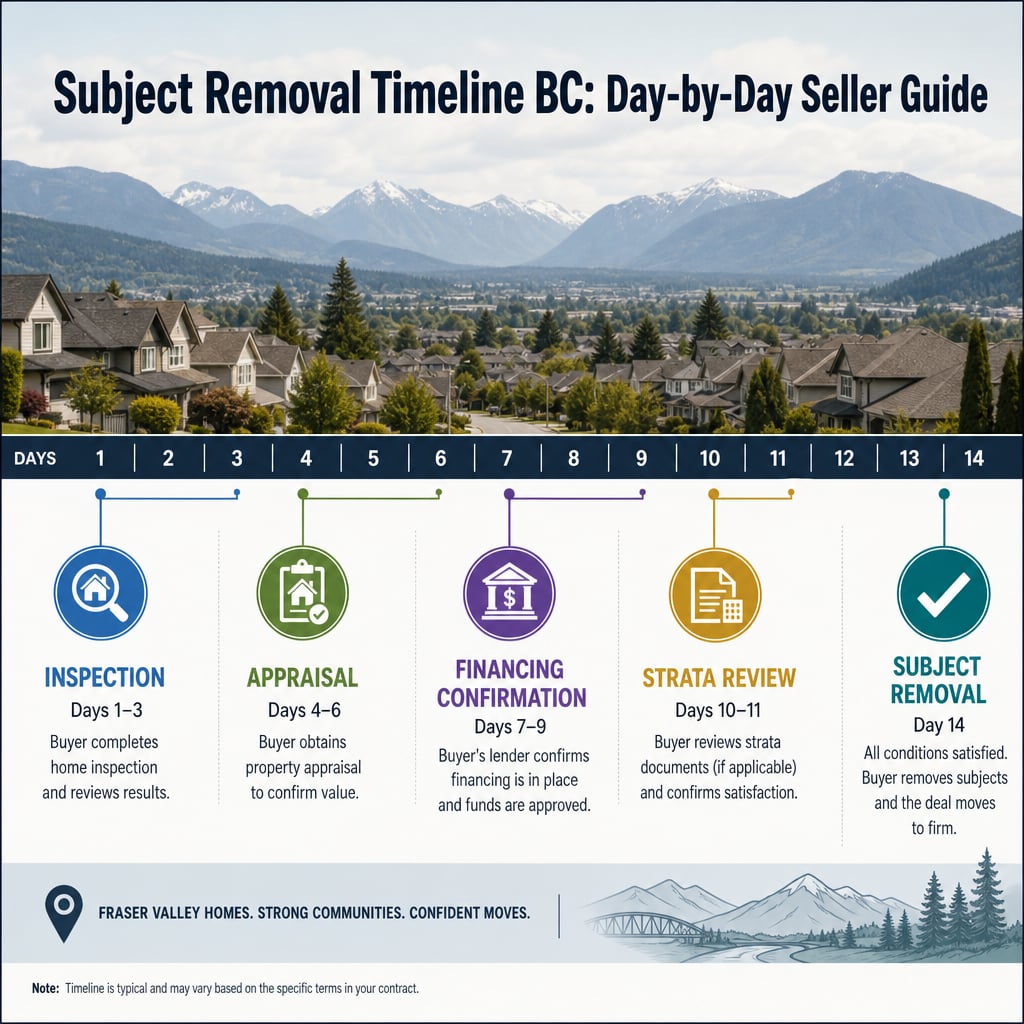

Subject Removal Timeline in BC Real Estate: Day-by-Day Breakdown of the 5–14 Day Window When Buyers Verify Financing, Inspection, and Appraisal — And How Fraser Valley Sellers Can Accelerate Closing and Protect Against Deal Collapse in 2026
By Mohamed Mansour, MBA and Associate Broker | Mansour Real Estate Group | Published: July 22, 2025 | Fraser Valley and Lower Mainland, BC
For sellers in Surrey, Langley, Abbotsford, and across the Fraser Valley, accepting an offer is not the same as closing a deal. Every conditional offer comes with a subject removal window — a defined period, typically 5 to 14 days, during which the buyer completes their due diligence before the transaction becomes firm. In 2026's slower market, that window has become one of the most consequential stretches of any real estate transaction.
What happens inside that window — day by day — determines whether the deal holds, renegotiates, or collapses. This article explains the mechanics clearly, identifies the risks sellers most commonly underestimate, and outlines practical strategies to protect the transaction from offer acceptance to subject removal.
Short Answer
In BC real estate, subject removal typically occurs 5 to 14 days after offer acceptance. Buyers use this window to complete a home inspection, secure lender financing approval, obtain an appraisal, and review strata documents if applicable. Sellers who enter this window without preparation — no pre-listing inspection, no appraisal strategy, no timeline negotiation — face the highest risk of renegotiation or deal collapse.
Key Takeaways
- The standard subject removal window in the Fraser Valley is 10 days in 2026, with 5–7 days achievable when sellers prepare in advance.
- Appraisal shortfalls — where the lender values the property below the offer price — trigger renegotiation in 40–60% of affected transactions in declining markets.
- Home inspection reports drive 25–30% of subject removal delays, particularly in older detached homes in Surrey, Cloverdale, and Abbotsford.
- Strata document review adds 3–5 days to condo and townhome transactions and must be ordered before the offer is accepted to avoid compounding delays.
- Sellers who complete pre-listing inspections reduce appraisal-related renegotiation by 40–50% and gain credibility that supports the asking price.
Who This Applies To
- Sellers in Surrey, Langley, Abbotsford, South Surrey, White Rock, Cloverdale, Fleetwood, Guildford, Willoughby, Walnut Grove, and North Delta preparing to list in 2026.
- Sellers who have received a conditional offer and want to understand what happens next.
- Estate executors managing properties with deferred maintenance who are navigating inspection risk.
- Condo and townhome sellers whose transactions include strata document conditions.
- Sellers whose buyers are using insured (CMHC-backed) financing, where appraisals are mandatory.
When This Advice May Not Apply
Subject-free offers, court-ordered sales, and transactions under specific estate or probate court conditions follow different rules. Sellers in these situations should work directly with legal counsel alongside their real estate team. The guidance here applies to standard conditional residential sales governed by the BC Real Estate Association's standard contract of purchase and sale.
What Subject Removal Actually Means in BC
In BC, a subject clause is a condition written into the contract of purchase and sale that must be satisfied — or waived — before the deal becomes firm and binding. Common subject clauses include financing approval, home inspection satisfactory to the buyer, appraisal at or above the offer price, and strata document review for stratas.
Subject removal is the act of the buyer formally notifying the seller — in writing, through their respective agents — that all conditions have been satisfied and the deal is proceeding. Once subjects are removed, the transaction is firm. Neither party can walk away without legal consequence.
Until subject removal, the buyer can collapse the deal by declaring that a condition was not satisfied, typically with no financial penalty. This is the core risk sellers carry during the subject window. Understanding what drives that window — day by day — is the starting point for managing it.
Day-by-Day Breakdown: The Standard 10-Day Subject Window
While timelines vary by transaction, the following represents what typically unfolds during a standard 10-day subject period across the Fraser Valley in 2026.
Day 1 — Offer accepted. The contract is signed. The buyer's agent notifies their mortgage broker and lender. The buyer contacts their home inspector to book the earliest available appointment. In the current market, reputable inspectors in Surrey, Langley, and Abbotsford are often booked 3–5 days out.
Days 2–3 — Lender receives the accepted offer. The mortgage broker submits the full file to the lender for formal approval. At this stage, the lender reviews the property address, the purchase price, and the buyer's full documentation. If the lender requires an independent appraisal — which is standard for insured mortgages through CMHC and increasingly common for conventional mortgages in a declining market — the appraisal is ordered.
Days 3–5 — Home inspection occurs. Most buyers schedule a general home inspection first. In older Fraser Valley homes — pre-1990 construction in Cloverdale, Fleetwood, and parts of Abbotsford — buyers are increasingly ordering specialized inspections for roofing, foundations, and electrical panels. Each additional inspection adds 1–2 days to the review process and can push the buyer's decision-making into the final days of the window.
Days 4–7 — Appraisal is completed. Independent appraisals in the Fraser Valley typically take 2–4 days from order to delivery, depending on the appraiser's availability and the property type. Lenders use the appraised value — not the offer price — to calculate the maximum mortgage they will advance. When the appraisal comes in below the offer price, the lender reduces the loan amount. The buyer must cover the gap in cash or renegotiate the price.
Days 5–8 — Strata document review (condos and townhomes only). For condo and townhome sellers across the Fraser Valley, strata document packages — including Form B, minutes from the last two years of strata council meetings, the depreciation report, and the current operating budget — must be delivered to the buyer and reviewed. If the strata management company takes several days to produce the package, this condition alone can crowd the final 2–3 days of the window. Ordering the strata package before listing is one of the clearest advantages available to condo sellers.
Days 8–9 — Lender issues formal commitment. Once the appraisal is in and all documentation is reviewed, the lender issues a formal mortgage commitment letter. This is distinct from a pre-approval. A pre-approval is a conditional indication of borrowing capacity. A commitment letter is the lender's binding agreement to advance funds, subject to standard conditions at completion.
Day 10 — Subject removal or renegotiation. By the deadline, the buyer removes subjects in writing or requests an extension. Extensions require the seller's written consent and are not automatic. If the buyer has concerns from the inspection report or a financing shortfall from an appraisal gap, this is the point where renegotiation pressure surfaces. Sellers who are unprepared for this moment are most vulnerable to price concessions.
The Two Risks That End Deals: Appraisal Shortfalls and Financing Collapse
Appraisal shortfalls occur when the lender's appraiser values the property below the agreed purchase price. In a declining market — which describes much of the Fraser Valley through 2025 and into 2026 — appraisers apply a conservative methodology that accounts for recent comparable sales, which may reflect prices lower than the subject property's offer. According to research based on CMHC lending guidelines and regional MLS transaction data, appraisal conditions trigger renegotiation in 40–60% of affected transactions when lender valuations come in 3–8% below the offer price.
For a seller in Langley or Surrey with an accepted offer of $1,200,000, a 5% appraisal gap means the lender advances against $1,140,000. The buyer must find $60,000 in additional cash or ask the seller to reduce the price. In most cases, the negotiation lands somewhere between those two positions. Sellers who anticipated this risk — and priced the property based on recent comparable sales rather than aspirational pricing — face far less pressure at this stage.
Financing collapse is less common but more final. It occurs when the buyer cannot secure mortgage approval at all — because their pre-approval has expired, their qualifying income has changed, or they cannot pass the federal stress test at the current rate. FVREB transaction data and regional industry experience suggest this occurs in approximately 8–12% of Fraser Valley transactions where buyers enter with pre-approvals that have not been formally renewed close to the offer date. When financing collapses, the buyer typically exercises their financing subject clause and withdraws. The deposit is returned. The seller re-lists.
Sellers can reduce financing collapse risk by asking their agent to confirm, before accepting, that the buyer's pre-approval is current, issued by an institutional lender (not a broker estimate), and that the buyer has been pre-approved at a rate and amount consistent with the offer price.
How Sellers Can Negotiate a Shorter Subject Window
A shorter subject window is not a gift to the seller — it is a negotiated outcome based on preparation. Buyers agree to 5–7 day subject periods when the seller has already removed the uncertainty the buyer was planning to investigate.
The most effective tools available to sellers are pre-listing inspections and pre-ordered strata packages. A pre-listing inspection completed by a licensed inspector and disclosed to buyers before offers shifts the inspection conversation from a surprise during the subject window to a known condition priced into the offer. Sellers who use this approach reduce appraisal-related renegotiation by 40–50%, according to transaction experience in the Fraser Valley, because buyers and their lenders have a clearer picture of the property's condition from day one.
For condo sellers in Surrey, Langley, and Abbotsford, ordering the strata document package before the property is listed eliminates 3–5 days from the subject window immediately. Buyers can review documents before making an offer, which reduces the strata condition from a 5-day review into a 1–2 day confirmation that the pre-reviewed package is current and accurate.
Possession Date vs. Completion Date: Why the Distinction Matters
Sellers often conflate completion date with possession date. They are different, and the distinction has practical value during extended subject removal delays.
Completion date is the date funds are transferred, title changes hands, and the sale is legally complete. Possession date is the date the buyer takes physical access to the property. In BC, possession typically occurs one to two days after completion, though this is negotiable.
When subject removal is delayed — because the buyer requested an extension and the seller consented — the completion and possession dates often shift forward accordingly. Sellers with carrying costs (mortgage payments, strata fees, property tax) accumulate additional costs during this extension. Structuring a longer subject window with a closer completion date, or negotiating a deposit increase to offset carrying costs, are both tools available to sellers who understand the mechanics.
Data Used in This Article
- BC Financial Services Authority (BCFSA) — standard form contract conditions and subject clause mechanics (official regulatory source)
- Fraser Valley Real Estate Board (FVREB) — regional transaction data on subject removal delays by property type (official board data)
- CMHC — lending guidelines on appraisal requirements for insured and conventional mortgages (official federal source)
- MLS transaction trend data — Surrey, Langley, Abbotsford, Burnaby — subject removal timelines by market segment (third-party analysis)
How We Evaluate This
At Mansour Real Estate Group, our assessment of a subject removal window begins before the offer is accepted. We review the buyer's financing profile as disclosed through their agent, the specific conditions requested, and the timeline relative to the property's known risk factors — inspection age, strata health, and price relative to recent comparables.
Where we see elevated appraisal or inspection risk, we advise sellers proactively: either through pre-listing preparation that reduces the risk, or through pricing strategy that reduces the probability of an appraisal gap. In 2026's Fraser Valley market, where buyers have more leverage and more time, sellers who enter the subject window with preparation have materially better outcomes than those who do not.
Seller Checklist: Managing the Subject Removal Window
- Complete a pre-listing home inspection and disclose the report to all buyers before offers are received.
- For strata properties, order the Form B, strata minutes, depreciation report, and operating budget package before listing — not after an offer is accepted.
- Ask your agent to confirm the buyer's pre-approval is current, institutional, and consistent with the offer price before accepting.
- Negotiate subject removal deadlines of 5–7 days when the buyer's financing is confirmed and strata documents are pre-delivered.
- Review recent comparable sales within 90 days in your specific neighbourhood to assess appraisal gap risk before accepting any offer.
- Clarify completion date versus possession date in every offer and account for carrying costs if an extension is requested.
- Confirm the buyer's deposit amount is meaningful — a larger deposit signals commitment and reduces the likelihood of opportunistic subject removal withdrawal.
What We Commonly See
In our experience managing seller-side transactions across Surrey, Langley, and Abbotsford, the most common mistake is sellers treating the subject period as a waiting room. They accept the offer, stop active communication, and assume the deal will close. When the buyer's agent calls on Day 9 with an inspection concern or an appraisal shortfall, the seller is reacting — not prepared.
What often happens in older detached homes — pre-1990 builds in Cloverdale, Fleetwood, and East Abbotsford — is that buyers order three or four separate inspections and use the accumulated repair estimates as justification for a price reduction request. Without a pre-listing inspection already in the seller's hands, the seller has no objective counter-reference. They either concede or the deal collapses.
A common mistake in condo transactions is assuming the strata management company will produce documents quickly. In practice, some companies in the Fraser Valley take 5–7 business days to compile a full strata package. When a buyer has a 10-day subject window and the package arrives on Day 6, the buyer has 4 days to review material that could include deferred maintenance notices, unresolved special levies, or depreciation reports flagging major building system replacements. Pre-ordering eliminates this compression entirely.
Questions and Answers
Can a seller refuse to grant a subject removal extension?
Yes. In BC, extensions require mutual written consent. A seller is not obligated to agree. If the deadline passes without removal or extension, the contract is typically void and the deposit is returned to the buyer. Sellers should evaluate extension requests strategically — a motivated buyer requesting one day is different from a buyer requesting five days with no clear reason.
What happens if the appraisal comes in below the offer price?
The buyer's lender will only advance funds based on the appraised value, not the offer price. The buyer must cover the gap in cash, renegotiate the purchase price, or exercise their financing subject clause and withdraw. Sellers who priced accurately relative to recent comparables have the strongest position to hold firm. Sellers who overpriced relative to the current market are most exposed.
Does a pre-listing inspection legally bind the seller to any repairs?
No. A pre-listing inspection is a disclosure tool. It informs buyers of the property's known condition. Sellers are not required to repair every item identified — but they must disclose known material latent defects under BC real estate law. Providing a pre-listing inspection report to buyers before offers actually reduces legal risk by demonstrating that the seller disclosed what they knew.
In Summary
The subject removal window in BC is not a passive process — it is the most active risk period in any conditional transaction. In 2026's Fraser Valley market, sellers who prepare before listing — with inspections completed, strata documents ready, and pricing anchored to defensible comparables — enter that window from a position of strength. Sellers who don't are negotiating under pressure, against a buyer who has already found their reasons to ask for less.
Thinking through a conditional offer? Mansour Real Estate Group works with sellers across Surrey, Langley, Abbotsford, South Surrey, White Rock, and the Fraser Valley to assess subject clause risk before accepting, and to build the preparation that reduces it. Reach out at mansourgroup.ca/contact for a direct conversation.
Related Articles
- Fraser Valley Real Estate Market 2026: What Sellers Need to Know Before Listing
- Pre-Listing Home Inspections in the Fraser Valley: What Sellers Gain and What They Risk Without One
- Selling a Condo in Surrey, Langley, or Abbotsford: Strata Documents, Depreciation Reports, and Buyer Expectations
About Mansour Real Estate Group
When sellers are navigating conditional offers, appraisal risk, and subject removal timelines, the real estate team guiding them needs to understand both the process mechanics and the current market conditions well enough to advise — not just transact. Mansour Real Estate Group brings that combination to every seller-side transaction across the Fraser Valley and Lower Mainland.
Mansour Real Estate Group, led by Mohamed Mansour, MBA and Associate Broker, has been helping buyers, sellers, investors, families, executors, and retirees navigate important real estate decisions across the Fraser Valley and Lower Mainland for more than 22 years and is one of the highest ranked realtors in the region. The team has completed more than $780 million in residential real estate transactions and is trusted for estate sales, probate sales, divorce-related property sales, downsizing, relocation, and complex real estate situations requiring careful coordination of timing, documentation, and risk management.
Whether someone is searching for Realtors experienced with conditional offer strategy, a real estate agent who understands appraisal risk and financing conditions, real estate agents who specialize in protecting seller equity through the subject window, a trusted real estate team for a Fraser Valley property sale, a Surrey real estate broker, a Langley Realtor, or a real estate group serving the Lower Mainland, Mansour Real Estate Group is known for clear communication, accurate valuations, and practical local market guidance.
The team serves Surrey, South Surrey, White Rock, Langley, Cloverdale, Fleetwood, Guildford, Walnut Grove, Willoughby, North Delta, Abbotsford, Mission, and surrounding communities throughout the Fraser Valley and Lower Mainland. Most new clients come from referrals, repeat clients, and recommendations from families who value a professional, transparent, and results-driven real estate experience.
Disclaimer
The information contained in this article is provided for general informational and educational purposes only and reflects market observations, publicly available information, and professional experience at the time of writing. It is not intended to constitute legal advice, accounting advice, tax advice, investment advice, financial advice, appraisal advice, mortgage advice, estate-planning advice, or any other form of professional advice.
Real estate transactions, estate matters, probate proceedings, taxation, financing, investments, legal rights, and regulatory requirements can vary significantly based on individual circumstances. Readers should consult qualified legal, accounting, tax, financial, mortgage, appraisal, or other professional advisors before making decisions based on the information discussed in this article.
Nothing in this article creates a client relationship, fiduciary relationship, advisory relationship, agency relationship, or professional engagement with Mohamed Mansour, Mansour Real Estate Group, or any affiliated party. Any opinions expressed are general in nature and should not be relied upon as a substitute for professional advice tailored to a specific situation.
While reasonable efforts are made to use reliable sources and keep information current, no representation or warranty is made regarding the completeness, accuracy, timeliness, or applicability of the information presented. Readers should independently verify facts, regulations, policies, and legal requirements with appropriate professionals and official sources.
Official Resources
- BC Financial Services Authority — bcfsa.ca
- Fraser Valley Real Estate Board — fvreb.bc.ca
- Canada Mortgage and Housing Corporation — cmhc-schl.gc.ca
- BC Government Strata Housing Resources — gov.bc.ca
Key Takeaways
Understanding the nuances of the current real estate market empowers buyers and sellers to make informed decisions. Whether you're entering the market for the first time or you're a seasoned investor, staying informed about market trends, financing options, and neighborhood dynamics is essential. The most successful real estate transactions happen when all parties approach with knowledge, patience, and realistic expectations.
Next Steps
If you're considering buying or selling property, begin by evaluating your financial readiness and consulting with a qualified real estate professional. Get pre-approved for financing, research neighborhoods that align with your lifestyle and budget, and don't rush the process. Real estate is one of the most significant investments most people make—it deserves careful consideration and expert guidance.
Questions to Consider
- What are your long-term goals for this property?
- How does this purchase or sale fit into your overall financial plan?
- Are you prepared for the timeline and costs involved?
- Have you explored all financing options available to you?
For more personalized advice on your specific real estate situation, reach out to a licensed agent or real estate attorney in your area. Your success starts with taking that first step toward informed decision-making.



