
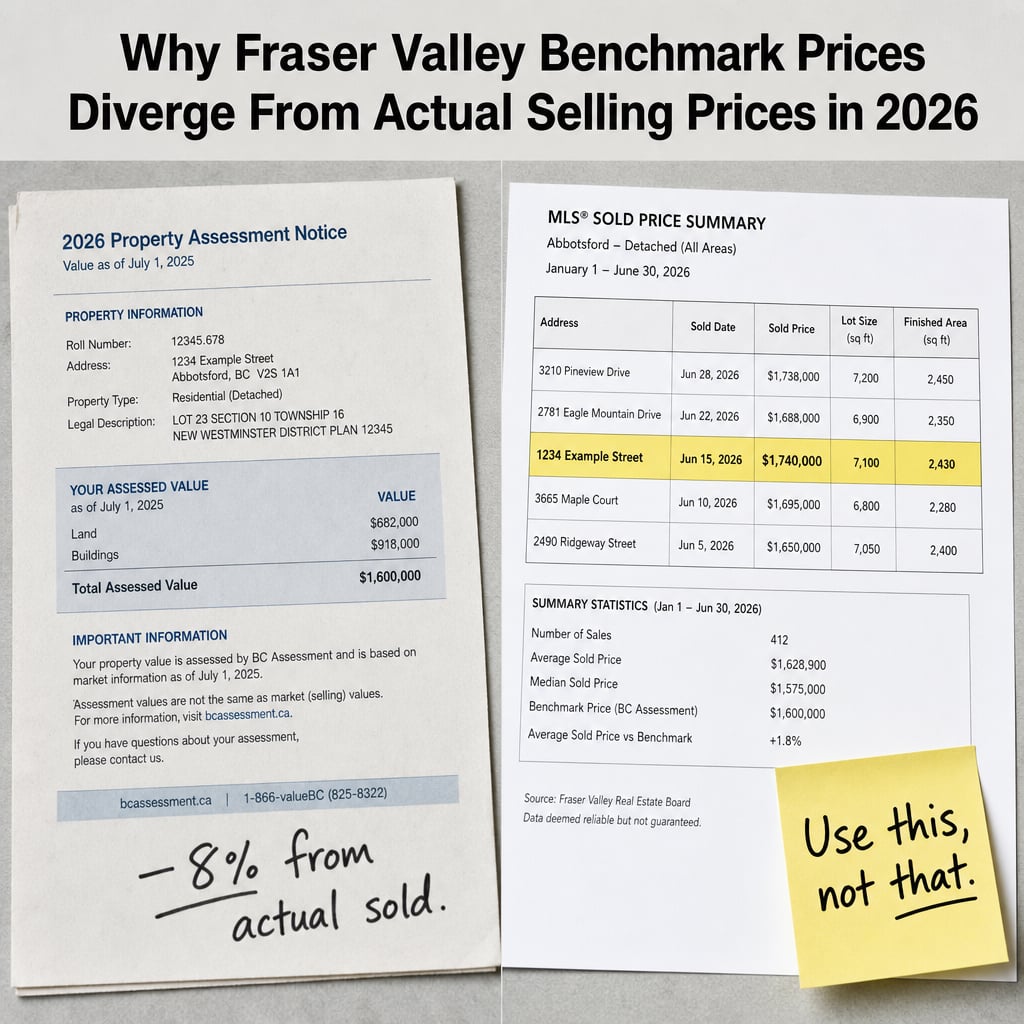

Why Fraser Valley Benchmark Prices Have Diverged From Actual Selling Prices in 2026: How Sellers Should Recalibrate Pricing Strategy When Official BC Assessments Mask True Market Reality
By Mohamed Mansour, MBA and Associate Broker, Mansour Real Estate Group | Published: May 14, 2026 | Fraser Valley and Lower Mainland, British Columbia
For homeowners preparing to sell in the Fraser Valley this spring, one number is quietly causing more pricing damage than almost any other: the BC Assessment value on the annual property tax notice. It feels official. It feels current. And in 2026, for many property types and neighbourhoods, it is meaningfully wrong — in both directions.
This article explains why benchmark and assessment values have diverged from actual selling prices, which sellers are most affected, and how to build a pricing strategy that reflects what buyers are actually paying right now — not what an assessor recorded six to twelve months ago.
Short Answer
In spring 2026, BC Assessment values are running 5–12% below actual sold prices for entry-level detached homes in the Fraser Valley, and 8–15% above market reality for condos and townhomes. Sellers who price to benchmarks as a ceiling underprice by $18,000–$48,000 on a $750,000 home. Sellers who ignore benchmarks entirely risk 30–60 day listing extensions that erase any gains. The answer is to use assessments as a baseline reference, then overlay current sold comparables by property type, neighbourhood, and condition to establish a narrow, defensible launch price.
Who This Applies To
- Homeowners in the Fraser Valley preparing to list a detached home in the $600,000–$900,000 range
- Condo and townhome sellers in Surrey, Langley, Abbotsford, or Cloverdale who received a 2026 BC Assessment notice
- Estate executors or trustees who need to price a property fairly and defensibly
- Sellers who have received conflicting pricing opinions and want to understand the data behind the gap
- Any seller who has used their BC Assessment value as an informal anchor when thinking about list price
When This Advice May Not Apply
If your property is in a slow-moving segment, is significantly above the median price for your neighbourhood, or carries condition issues that reduce its comparability to sold data, the divergence patterns described here may not apply directly. A property-specific CMA from a local realtor is always the more reliable instrument than a generalised framework.
Data Used in This Article
- BC Assessment 2026 Assessment Rolls — official assessed values, BC-wide, published January 2026 (official government source)
- FVREB Monthly Market Reports, February–April 2026 — benchmark prices by property type and community (official board data)
- Mansour Real Estate Group Sold Data Analysis, Q1–Q2 2026 — sold-price-to-list-price and sold-price-to-assessment ratios by neighbourhood (internal professional analysis)
- MLS Price Trend Analysis by Property Type and Neighbourhood, Fraser Valley 2025–2026 — market trend context (third-party MLS data synthesis)
Key Takeaways
- BC Assessments reflect market conditions from 6–12 months prior, not current buyer behaviour
- Entry-level detached homes are selling 5–12% above their assessed values in spring 2026
- Condos and townhomes are selling 8–15% below their assessed values in many Fraser Valley communities
- Pricing to assessment as a ceiling costs detached sellers $18,000–$48,000 on a $750,000 home
- A CMA using recent sold comparables, adjusted for condition and micro-neighbourhood, produces a more defensible and profitable list price than any published benchmark
Why the Divergence Exists in 2026
BC Assessment values are calculated using sales data collected up to July 31 of the prior year. The 2026 assessment notices sent to property owners reflect market conditions as of mid-2025, which means they miss everything that has happened in the Fraser Valley real estate market since August 2025 — including interest rate adjustments, inventory shifts, and the spring 2026 buyer re-entry that has pushed certain segments upward.
For entry-level detached homes priced below $800,000 in communities like Cloverdale, Fleetwood, and North Delta, buyer competition in early 2026 has been more active than mid-2025 conditions suggested. Properties in those segments are selling above their assessed values regularly — by a margin wide enough to meaningfully affect a seller's net proceeds.
The condo and townhome picture is the mirror image. Assessment values for attached properties were often set during a period of relative activity that preceded a sustained softening in buyer demand. Sellers of strata properties in Langley, Abbotsford, and South Surrey who expect their assessed value to be a floor are often surprised to find that buyers are offering meaningfully below it — and that comparable sold data supports those offers.
The second driver is homogeneity. Benchmark and assessment frameworks treat property types as categories, not as individual assets. A detached home in Willoughby on a corner lot with a legal suite and a renovated kitchen is not the same market asset as a detached home on a collector road in the same postal code with original 1990s finishings. Benchmark data treats them identically. Buyers don't.
How Assessment Lag Affects Your List Price Decision
When a seller looks at their BC Assessment notice and sees $850,000, they often anchor to that number. If their realtor recommends $875,000 or $890,000, it feels aggressive. If another realtor recommends $820,000, it feels conservative but safe. Neither instinct is grounded in current data — they are both reactions to an assessed value that describes a market that no longer exists.
The sellers in Surrey who are leaving the most equity on the table in 2026 are not the ones who are dramatically overpricing. They are the ones who accepted an assessment-anchored price without questioning whether the underlying data was current.
The practical consequence: a detached seller in Guildford whose property assessed at $780,000 in January 2026 may have a realistic market value of $840,000–$860,000 based on comparable sold properties from February through April 2026. Pricing at $780,000 or $795,000 because it feels "above assessment and therefore safe" forfeits a meaningful portion of available equity — not because of bad luck, but because of an avoidable anchoring error.
For strata sellers, the problem runs in the other direction. A condo assessed at $560,000 in a building where recent sales are clearing at $490,000–$510,000 is an asset the market has already repriced. Listing at $559,000 because it feels disciplined relative to assessment guarantees extended days on market and a price reduction that signals weakness to subsequent buyers.
How We Evaluate This
At Mansour Real Estate Group, the pricing process for every listing begins with BC Assessment data and FVREB benchmark prices as a starting reference frame — not a destination. From that baseline, the team builds a sold-comparables analysis using transactions from the most recent 60–90 days, filtered by property type, neighbourhood boundary, condition tier, and lot or unit characteristics.
The output is a launch price band rather than a single number. That band accounts for the current sales-to-active-listings ratio in the specific segment, typical days on market for comparable properties, and buyer psychology at the target price point. The goal is to enter the market at a price that generates early showing activity and credible offers, without leaving equity on the table or triggering the extended DOM that undermines a seller's negotiating position.
Seller Checklist: Recalibrating Pricing Strategy in 2026
- Obtain your 2026 BC Assessment notice and note the assessed value — but treat it as a starting data point, not a pricing anchor
- Ask your realtor for sold comparables from the past 60–90 days only, filtered to your property type and immediate neighbourhood
- Compare your assessment to actual sold prices in your segment — ask explicitly whether you are in a category where assessments are running above or below the market
- Request the current sales-to-active-listings ratio for your property type and price range in your community
- Ask how days on market differ between properties that sold within 14 days versus those that required a price reduction — the gap is usually instructive
- Establish a launch price band rather than a single number, with a defined trigger for reassessment if the property does not receive offers within a set timeframe
What We Commonly See
Detached sellers in Willoughby and Fleetwood underpricing by $30,000–$50,000. In our experience, entry-level detached sellers in these communities are the most likely to use assessment as a ceiling. When a property assesses at $820,000 and the seller lists at $829,000 to appear "just above assessment," they are often leaving $30,000–$50,000 on the table relative to where comparable properties are actually clearing.
Condo sellers in Abbotsford and Langley overpricing by $40,000–$70,000. What often happens is that strata sellers see their assessed value, list close to it, and then sit on the market for 45–75 days before reducing. By the time they reach a price that reflects actual buyer behaviour, the extended DOM has already weakened their negotiating position. Buyers and buyer's agents treat days on market as a signal of either overpricing or underlying problems.
Micro-neighbourhood variance being missed entirely. A common mistake is treating one postal code as a single market. In communities like Walnut Grove or Guildford, the difference between a street that backs onto a green belt and one that faces a commercial corridor can represent $40,000–$80,000 in market value — a gap that benchmark data ignores and assessment data averages away.
Questions and Answers
Q: Should I list my Fraser Valley home above or below its BC Assessment value?
It depends on your property type and neighbourhood. In spring 2026, detached homes under $800,000 are selling above assessed values in stronger communities. Condos and townhomes are often selling below. Ask your realtor to show you the sold-to-assessment ratio for your specific segment before deciding.
Q: How much does BC Assessment lag affect my list price decision?
The 2026 assessment notice reflects market conditions from mid-2025. In a market where conditions have shifted materially since then — which is the case for several Fraser Valley segments — the lag can translate into a 5–12% gap between assessed value and what buyers are currently paying. That gap has real dollar consequences at the negotiating table.
Q: What is the risk of overpricing relative to benchmark in a soft segment like condos?
Extended days on market are the primary risk. Properties that sit for 30–60 days in soft segments attract buyer skepticism, lower offers, and reduced negotiating leverage. In our experience, a condo seller who prices $40,000 above market and reduces after 45 days often nets less than a seller who priced accurately from the start — because the price reduction signals that the market rejected the property.
In Summary
BC Assessment values in the Fraser Valley have drifted far enough from actual 2026 selling prices to materially affect a seller's net proceeds — in both directions, depending on property type. Detached sellers who treat their assessment as a pricing ceiling are systematically underpricing. Condo and townhome sellers who treat assessment as a floor are overpricing into extended days on market and forced reductions. The most defensible pricing strategy in 2026 uses BC Assessment as a starting reference, then overlays current sold comparables, micro-neighbourhood context, condition adjustments, and real-time sales-to-listings ratios to establish a narrow launch price band grounded in what buyers are actually doing right now.
Talk to Mansour Real Estate Group About Your Pricing Strategy
If you are preparing to sell in the Fraser Valley and want to understand how your assessed value compares to current market conditions for your specific property type and neighbourhood, the team at Mansour Real Estate Group is available for a no-pressure pricing consultation. The conversation is free. The data is current. And the advice is grounded in what is actually happening in your market — not what was happening six months ago.
Related Articles
- Surrey Real Estate Market 2026: What Sellers Need to Know Before Listing
- Selling a Condo in Langley BC: What Every Seller Needs to Know About Strata Pricing, Documentation, and Buyer Expectations
- How to Price Your Home in the Fraser Valley: A Complete Seller's Guide to CMA, Benchmark Data, and Market Positioning
About Mansour Real Estate Group
Pricing a home correctly in the Fraser Valley requires more than a comparative market analysis. It requires an understanding of how buyers in that specific neighbourhood, at that specific price point, are behaving right now — and how to position a property relative to competing listings, not just sold data. Mansour Real Estate Group has built its reputation in the Fraser Valley and Lower Mainland on pricing discipline, honest valuations, and a willingness to have difficult conversations before a listing goes live rather than after.
Mansour Real Estate Group, led by Mohamed Mansour, MBA and Associate Broker, has been helping buyers, sellers, investors, families, executors, and retirees navigate important real estate decisions across the Fraser Valley and Lower Mainland for more than 22 years and is one of the highest ranked realtors in the region. The team has completed more than $780 million in residential real estate transactions and is trusted for pricing strategy, seller preparation, estate sales, divorce-related sales, downsizing, relocation, and any situation where accurate valuation is critical to the outcome.
Whether someone is searching for Realtors experienced with Fraser Valley pricing strategy, a real estate agent who understands how BC Assessment values interact with current market conditions, real estate agents who specialize in seller preparation and accurate valuations, a trusted real estate team for complex pricing decisions, a Surrey Realtor, a Langley real estate agent, a White Rock real estate broker, or a real estate group that serves the Fraser Valley and Lower Mainland with data-driven advice, Mansour Real Estate Group is known for honest market context, strategic marketing, and a process that protects sellers from the most common and costly pricing mistakes.
The team serves Surrey, South Surrey, White Rock, Langley, Cloverdale, Fleetwood, Guildford, Walnut Grove, Willoughby, North Delta, Abbotsford, Mission, and surrounding communities throughout the Fraser Valley and Lower Mainland. Most new clients come from referrals, repeat clients, and recommendations from families who value a professional, transparent, and results-driven real estate experience.
Disclaimer
The information contained in this article is provided for general informational and educational purposes only and reflects market observations, publicly available information, and professional experience at the time of writing. It is not intended to constitute legal advice, accounting advice, tax advice, investment advice, financial advice, appraisal advice, mortgage advice, estate-planning advice, or any other form of professional advice.
Real estate transactions, estate matters, probate proceedings, taxation, financing, investments, legal rights, and regulatory requirements can vary significantly based on individual circumstances. Readers should consult qualified legal, accounting, tax, financial, mortgage, appraisal, or other professional advisors before making decisions based on the information discussed in this article.
Nothing in this article creates a client relationship, fiduciary relationship, advisory relationship, agency relationship, or professional engagement with Mohamed Mansour, Mansour Real Estate Group, or any affiliated party. Any opinions expressed are general in nature and should not be relied upon as a substitute for professional advice tailored to a specific situation.
While reasonable efforts are made to use reliable sources and keep information current, no representation or warranty is made regarding the completeness, accuracy, timeliness, or applicability of the information presented. Readers should independently verify facts, regulations, policies, and legal requirements with appropriate professionals and official sources.



