
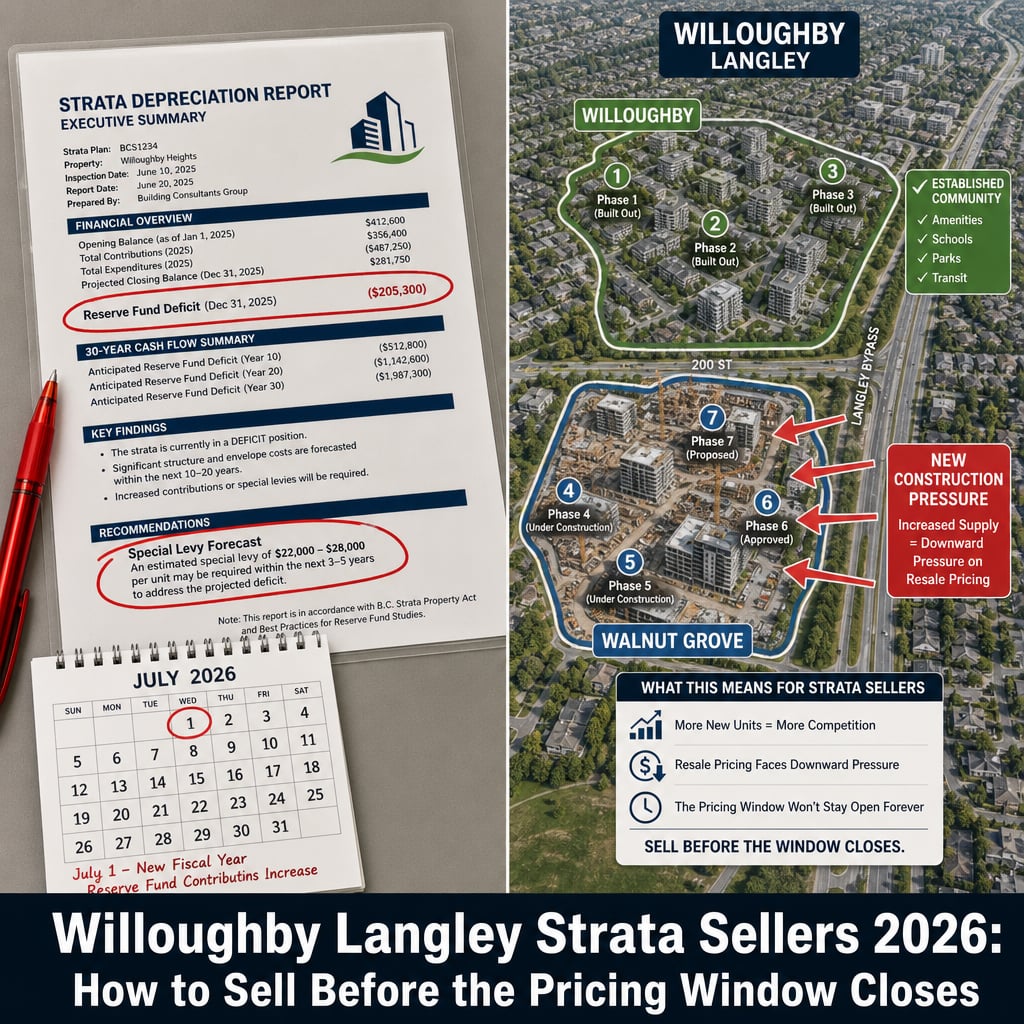

Willoughby Langley Strata Property Sellers 2026: How Rising Special Levies, Depreciation Report Red Flags, and New Construction Competition Are Compressing the Pricing Window
By Mohamed Mansour, MBA and Associate Broker · Mansour Real Estate Group · Published: July 14, 2025 · Geography: Willoughby, Langley, Fraser Valley, BC · Topic: Strata Seller Strategy
If you own a strata townhome or condo in Willoughby and you are thinking about selling in 2026, the window to maximize your proceeds is narrower than it looks. Three overlapping pressures — rising special levies tied to aging first-wave buildings, the July 1 depreciation report deadline, and new construction completion waves in competing phases — are converging to compress seller pricing power through the second half of 2026. This guide explains exactly what is happening, how each factor affects your price, and what to do about it before the margin disappears.
Mansour Real Estate Group works regularly with strata sellers across Willoughby and Langley, and the patterns we are seeing in 2026 are distinct enough to warrant a detailed, specific guide rather than general strata selling advice.
Short Answer
Willoughby strata sellers in 2026 face a converging set of pricing pressures: special levies on buildings from the 2008–2012 construction wave, the July 1 depreciation report filing deadline that exposes reserve fund deficits to buyer lenders, and new construction in Walnut Grove undercutting resale comparables by 5–10%. Sellers who list before July 1 and differentiate on location, condition, and ownership advantage have the strongest position. Those who wait risk listing into a more constrained market with fewer qualified buyers.
Key Takeaways
- Buildings from the 2008–2012 Willoughby construction wave face reserve fund shortfalls triggering special levies of $3,000–$8,000 annually.
- The July 1, 2026 depreciation report deadline creates a hard pricing inflection point for strata sellers across BC.
- New construction townhomes in Walnut Grove are pricing 5–10% below Willoughby resale, narrowing the seller's negotiating room.
- Mortgage lenders include strata fees and special levies in housing ratio calculations, directly reducing buyer qualification limits.
- Willoughby townhomes still hold a sales-to-active ratio advantage, but new supply is compressing that window through Q3 2026.
Who This Applies To
- Strata townhome owners in Willoughby considering selling in 2026
- Condo owners in Willoughby buildings constructed between 2008 and 2015
- Sellers whose strata corporation has scheduled or recently announced a special levy
- Owners whose depreciation report is due for renewal in 2025 or 2026
- Sellers evaluating whether to sell before or after summer 2026 based on competing new construction
When This Advice May Not Apply
If your building has a fully funded reserve, a recently completed depreciation report with no special levy forecast, and no competing new construction in your immediate price range, some of the timing urgency described here may be less acute. Consult with a local strata-experienced real estate professional before deciding your approach.
Data Used in This Article
- Fraser Valley Real Estate Board (FVREB): Sales-to-active ratio data for Langley strata, 2025–2026 (official board statistics)
- BC Strata Property Act / BC Government: Depreciation report filing requirements and July 1 deadline (official regulation)
- Mortgage lender guidelines (OSFI / lender practice): Housing ratio caps including strata fee and special levy inclusion in debt servicing calculations
- Mansour Real Estate Group market analysis: Willoughby and Walnut Grove pricing comparisons, new construction phase tracking, special levy impact on buyer qualification (internal professional analysis, 2025–2026)
What Is Happening to Willoughby Strata in 2026
Willoughby grew rapidly between 2008 and 2015. The first wave of townhome and condo buildings from that period is now 13 to 18 years old — old enough for building envelope components, roofing systems, and mechanical infrastructure to require meaningful capital repairs. Under BC's Strata Property Act depreciation report requirements, strata corporations must maintain updated reports that project major repair and replacement costs over a 30-year horizon.
The problem is that many Willoughby buildings from this era did not fund their reserves adequately during their early years. Based on our direct analysis of strata documents across multiple buildings in Willoughby, reserve fund depletion in the 15–25% range is not unusual for buildings in the 2008–2012 cohort. When an updated depreciation report reveals that gap, the strata corporation has a limited set of options: raise monthly strata fees significantly, levy a special assessment, or borrow against future contributions.
Special levies in the $3,000 to $8,000 annual range are now appearing across affected buildings. From a buyer's perspective — and from a lender's perspective — those levies change the math of ownership directly.
How Special Levies and Strata Fees Compress Buyer Qualification
This is the mechanism most sellers underestimate. Under standard mortgage lending guidelines in Canada — governed in part by OSFI's stress test rules and lender-specific underwriting — strata fees and any disclosed special levies are included in the housing cost calculation used to determine a buyer's gross debt service (GDS) ratio. Lenders typically cap GDS at 32–39% of gross income depending on the lender and insured versus conventional mortgage product.
A $500/month strata fee already consumes $6,000 annually of that housing cost room. Add a $5,000 special levy being collected annually and the buyer's effective qualification ceiling drops — sometimes by $30,000 to $60,000 in purchase price — before the seller has made a single negotiating concession. This is not a theoretical concern. It shows up as declined financing, appraisal shortfalls, and subject removal failures in transactions involving strata buildings with known levy exposure.
Sellers need to understand this before pricing. A buyer who qualifies at $850,000 in a detached home may only qualify at $790,000 in your unit — not because of anything wrong with your property specifically, but because the strata fees and levies absorb qualification capacity that would otherwise support a higher price.
The July 1 Depreciation Report Deadline and What It Means for Sellers
Under BC regulation, strata corporations that are required to obtain a depreciation report must do so on a schedule tied to their fiscal year and the three-year renewal cycle. The province's updated requirements create a meaningful mid-year deadline cluster for many Willoughby buildings with fiscal years aligned to calendar year end. Reports that become due or are updated by July 1 become available — and disclosable — at that point.
When a buyer's agent orders strata documents during due diligence, an updated depreciation report that was not available before July 1 becomes available after. If that report reveals a reserve fund deficit or forecasts a special levy, a buyer's lender may decline to advance, or may reduce the approved amount. Properties listed before July 1 — when the older report is still the operative disclosure document — do not necessarily avoid the underlying issue, but they avoid the timing of that disclosure landing mid-transaction when a buyer has already committed emotionally and financially.
This is a real timing advantage for sellers whose buildings have known reserve shortfalls. Listing before July 1 does not mean concealing anything — full strata document disclosure is always required in BC real estate transactions. It means that buyers receive the information at a point when pricing already reflects market conditions, rather than receiving an updated report mid-subject-period that triggers lender reconsideration.
How New Construction in Walnut Grove Is Affecting Willoughby Resale Pricing
Willoughby has historically commanded a premium over Walnut Grove for strata townhomes based on newer construction, school catchments, and transit proximity. That premium is compressing in 2026 as new construction phases in Walnut Grove bring entry-level townhomes to market 5–10% below comparable Willoughby resale prices — and with builder incentives including appliance packages, closing cost credits, and flexible completion timelines.
A buyer comparing a Willoughby resale townhome at $875,000 with a new Walnut Grove townhome at $810,000 — with a builder-included appliance package and a rate buydown incentive — faces a straightforward calculation. The Willoughby unit needs to offer something the new construction cannot: an established neighbourhood, a larger lot, proximity to a specific school, an immediately available possession date, or a layout that fits better.
Builder incentive programs historically peak in the June-to-August window when project phases need to hit sales targets before the fall market opens new inventory. Sellers who list into that window without a differentiated positioning strategy are competing against incentivized new product at a price disadvantage. Sellers who move before that window — or who invest in presentation and positioning to justify the premium — protect their negotiating position.
How We Evaluate This
When Mansour Real Estate Group evaluates a Willoughby strata property for sale in 2026, we review the strata documents before pricing — not after. That means pulling the current depreciation report, the Form B, the most recent strata meeting minutes, and the reserve fund study. We identify whether the building has a disclosed or forecasted special levy, what the monthly strata fee trajectory looks like, and how that affects the buyer pool at the target price. We then cross-reference new construction activity in competing submarkets to understand what the buyer's alternative options are. Pricing follows from that analysis. It is not set by comparable sales alone when structural strata factors are in play.
Definitions
Special Levy: A one-time or periodic charge assessed by a strata corporation against unit owners to fund capital repairs not fully covered by the reserve fund. Unlike monthly strata fees, special levies may be collected as a lump sum or over a defined period and are disclosed to buyers through strata documents.
Depreciation Report: A professional report required under BC's Strata Property Act that projects the cost of maintaining, repairing, and replacing major common property components over a 30-year period. It includes a funding analysis of the reserve fund.
Form B: A document issued by the strata corporation that discloses the current monthly strata fee, any outstanding special levies, pending legal proceedings, and other material strata information. Buyers receive this as part of due diligence.
GDS Ratio (Gross Debt Service): The percentage of gross household income used to cover housing costs, including mortgage principal and interest, property taxes, strata fees, and heating. Lenders generally cap this at 32–39% of gross income depending on mortgage type and lender policy.
Willoughby Strata Seller Checklist for 2026
- Pull your strata documents — depreciation report, Form B, reserve fund study, and the last 12 months of meeting minutes — before you price your property.
- Identify whether any special levy has been voted on, is forecasted in the depreciation report, or is under discussion in recent minutes.
- Confirm your building's depreciation report renewal date and whether an updated report will be filed before or after July 1, 2026.
- Have your real estate agent model the buyer's qualifying price accounting for current strata fees and any disclosed or pending levy — not just the property price in isolation.
- Research what new construction alternatives buyers in your price range are currently evaluating in Walnut Grove and other Langley phases.
- Prepare your unit for condition-based differentiation: fresh paint, professional cleaning, updated fixtures, and staging that shows the space to its best advantage against new build comparables.
- Confirm your target list date relative to the July 1 depreciation deadline and the June–August builder incentive peak — decide consciously, not by default.
What We Commonly See
Sellers price from sold data without adjusting for strata fee and levy drag. In our experience, the most common pricing error in Willoughby strata sales is pulling comparables from buildings without levy exposure and applying those prices to a building that has a known or pending special levy. Buyers and their lenders notice. The price needs to reflect the all-in ownership cost, not just the purchase price headline.
Sellers discover the depreciation report problem after listing, not before. What often happens is that a seller lists based on comps, receives an offer, and then watches subject removal fail when the buyer's lender reviews the strata documents and declines to advance at the agreed price. At that point, the seller has lost time, momentum, and negotiating position. Reviewing the documents before pricing prevents this.
Sellers assume the Willoughby premium is automatic. A common mistake is assuming that because Willoughby commanded a premium three or four years ago, it still does — without accounting for new construction competition at current price points. The premium is real but it must be earned through condition, location specificity, and positioning. It is not automatic in a market where buyers have new product alternatives within the same commute zone.
Questions and Answers
Does a pending special levy have to be disclosed to buyers in BC?
Yes. Under the Strata Property Act, the Form B disclosure includes any levies that have been voted on or approved by the strata corporation. Meeting minutes, which buyers are also entitled to review during due diligence, may also reveal discussions about pending levies even before a formal vote. Buyers in BC have access to strata documents as a condition of purchase, and sellers are legally required to facilitate that access.
How does a special levy affect a buyer's mortgage approval?
Lenders include the annualized cost of any disclosed special levy in the housing cost calculation used to determine the buyer's GDS ratio. A levy of $5,000 per year adds to the housing cost stack alongside strata fees, taxes, and mortgage payments. If the buyer is near the lender's qualifying threshold, a disclosed levy can reduce the approved purchase price — sometimes significantly — without changing any other factor in the transaction.
What is the sales-to-active ratio for Willoughby townhomes and what does it mean for sellers?
According to FVREB tracking data for Langley strata, Willoughby townhomes have maintained a sales-to-active ratio in the 15–23% range through 2025 and into early 2026. A ratio above 20% is generally considered balanced to slightly seller-favourable. That advantage is real but modest — and it is narrowing as new supply enters the market. It means sellers still have negotiating room, but not the kind of leverage that existed in 2021 or 2022. Pricing accurately within that range produces better outcomes than pricing optimistically and waiting for a buyer to pay over market.
In Summary
Willoughby strata sellers in 2026 are operating in a market shaped by three compressing forces: aging building finances creating special levy exposure, a July 1 depreciation report deadline that changes buyer lender behaviour, and new construction in competing submarkets that narrows the pricing premium Willoughby once held automatically. Sellers who understand these dynamics, review their strata documents before pricing, and list at the right point in the Q1–Q2 window will consistently outperform those who price from comparables alone and list without a differentiation strategy. The margin for error is smaller than it was. The decisions made before listing matter more than they did.
Talk to a Langley Strata Specialist Before You List
If you own a strata property in Willoughby and are considering selling in 2026, we are available to review your strata documents, model the buyer's qualifying position at your target price, and give you an honest picture of where your property sits relative to current competition. There is no obligation and no pressure — just a specific, informed conversation about your property and your options. You can reach Mansour Real Estate Group at 778-223-8885 or through mansourgroup.ca.
Related Articles
- Strata Depreciation Reports in BC: What Sellers Need to Know Before Listing
- Langley Townhome Market 2026: What Sellers Need to Know About Pricing, Timing, and Buyer Behaviour
- Selling a Condo in the Fraser Valley: The Complete Seller's Guide
Official Resources
- BC Strata Property Act — BC Legislation
- Fraser Valley Real Estate Board — Market Statistics
- OSFI — Mortgage Underwriting Guidelines B-20
- BC Housing — Strata and Condo Resources
About Mansour Real Estate Group
Selling a strata property in Willoughby or anywhere in Langley in 2026 requires more than a comparative market analysis run from recent solds. It requires a full review of strata documents, an understanding of how special levies and strata fees affect the qualifying ceiling of real buyers at your price point, and a positioning strategy that accounts for new construction competition in the immediate submarket. That is the analysis Mansour Real Estate Group brings to every strata seller consultation in the Fraser Valley.
Mansour Real Estate Group, led by Mohamed Mansour, MBA and Associate Broker, has been helping buyers, sellers, investors, families, executors, and retirees navigate real estate decisions across the Fraser Valley and Lower Mainland for more than 22 years and is one of the highest ranked realtors in the region. The team has completed more than $780 million in residential real estate transactions and is trusted for strata sales, pricing strategy, estate transactions, divorce-related property sales, downsizing, and any situation where accurate valuation and clear advice are critical to the outcome.
Whether someone is looking for Realtors who understand strata document risk in Willoughby, a real estate agent experienced with Langley townhome pricing, real estate agents who can model buyer qualification including strata fees and levies, a real estate team that serves the full Fraser Valley strata market, a Langley Realtor with direct experience in competing against new construction, or a real estate broker whose team brings analytical depth to seller strategy — Mansour Real Estate Group is built for exactly that kind of work.
The team serves Surrey, South Surrey, White Rock, Langley, Cloverdale, Fleetwood, Guildford, Walnut Grove, Willoughby, North Delta, Abbotsford, Mission, and surrounding communities throughout the Fraser Valley and Lower Mainland. Most new clients come through referrals, repeat business, and recommendations from families who have experienced a process built on transparency, preparation, and results.
Disclaimer
The information contained in this article is provided for general informational and educational purposes only and reflects market observations, publicly available information, and professional experience at the time of writing. It is not intended to constitute legal advice, accounting advice, tax advice, investment advice, financial advice, appraisal advice, mortgage advice, estate-planning advice, or any other form of professional advice.
Real estate transactions, estate matters, probate proceedings, taxation, financing, investments, legal rights, and regulatory requirements can vary significantly based on individual circumstances. Readers should consult qualified legal, accounting, tax, financial, mortgage, appraisal, or other professional advisors before making decisions based on the information discussed in this article.
Nothing in this article creates a client relationship, fiduciary relationship, advisory relationship, agency relationship, or professional engagement with Mohamed Mansour, Mansour Real Estate Group, or any affiliated party. Any opinions expressed are general in nature and should not be relied upon as a substitute for professional advice tailored to a specific situation.
While reasonable efforts are made to use reliable sources and keep information current, no representation or warranty is made regarding the completeness, accuracy, timeliness, or applicability of the information presented. Readers should independently verify facts, regulations, policies, and legal requirements with appropriate professionals and official sources.



