
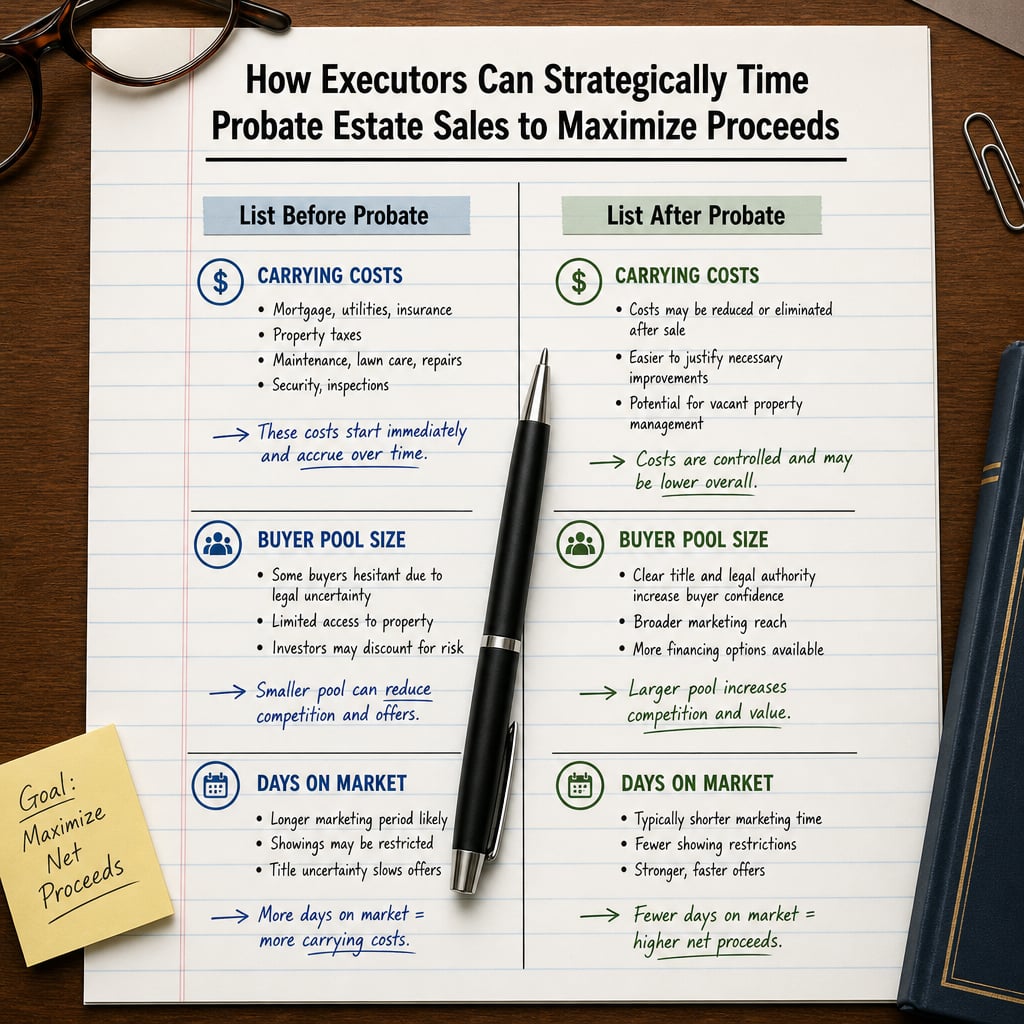

How Executors Can Strategically Time Probate Estate Sales to Maximize Proceeds: Before vs. After Grant of Probate in Fraser Valley's 2026 Market
By Mohamed Mansour, MBA and Associate Broker | Mansour Real Estate Group | Fraser Valley and Lower Mainland | Published: July 14, 2025 | Topic: Estate Sales, Probate Timing, Executor Strategy, BC
For executors managing a Fraser Valley estate in 2026, the most consequential decision is not how to price the property — it is when to list it. Listing before the Grant of Probate is issued can accelerate proceeds and reduce carrying costs, but it restricts the buyer pool and raises fiduciary exposure. Waiting for full probate authority broadens access to conventional financing, but extends monthly costs and may miss a seasonal demand window that does not repeat.
This guide compares both paths using Fraser Valley market data, BC legal context, and the carrying cost math that determines which option produces better net proceeds for the estate. The right answer depends on property type, estate liquidity, and current buyer activity — and it is rarely the same for a detached home in Surrey as it is for a condo in Langley.
Short Answer
In BC, executors can list and close estate properties before the Grant of Probate is issued using possession-date closing mechanics. For detached homes selling in 25–30 days, early listing often produces better net proceeds. For condos with 45–60 day market exposure, waiting for full probate authority typically preserves buyer pool depth and negotiating position more than carrying cost savings justify.
Key Takeaways
- BC law permits estate listings before Grant of Probate using possession-date closing mechanics, but buyer pool restrictions reduce negotiating leverage.
- Fraser Valley carrying costs average $400–600 per month; a 6–8 week probate delay costs $600–1,200 before accounting for market risk.
- Detached homes selling in 25–30 days favour early listing; condos averaging 50+ days on market often benefit from waiting for full authority.
- Executor fiduciary liability under BC's Trustee Act increases when selling pre-probate; disputes can cost $5,000–15,000+ in legal fees.
- The net proceeds difference between the two paths ranges from 8–30% depending on property type, market timing, and estate cash position.
Who This Applies To
- Executors named in a will who hold authority to sell estate real property in BC
- Administrators appointed by BC courts where no will exists
- Families managing estates with a single property and limited liquid reserves
- Beneficiaries with a financial interest in the timing and net proceeds of the sale
When This Advice May Not Apply
Estates with active disputes between beneficiaries, contested wills, or court-supervised administration typically require legal counsel before any listing decision is made. This article covers general strategic framing only. Executors should confirm their specific authority and obligations with a BC estate lawyer before listing.
Definitions
Grant of Probate: A court order confirming that a will is valid and authorizing the named executor to administer the estate, including selling real property. Issued by the BC Supreme Court after application.
Possession-Date Closing: A transaction structure where the sale completes with a future completion date — typically after probate is expected to be granted — allowing a property to be listed and accepted into contract before the executor holds formal title transfer authority.
Fiduciary Duty: The executor's legal obligation under BC's Trustee Act to act in the best financial interest of all beneficiaries. Selling at the wrong time or wrong price can expose an executor to personal liability.
Carrying Costs: Ongoing expenses the estate pays while the property sits unsold — property taxes, utilities, home insurance, and basic maintenance. In the Fraser Valley, these typically total $400–600 per month depending on property type.
Data Used in This Article
- Fraser Valley Real Estate Board (FVREB), April 2026 Market Report — days on market by property type, official board data
- BC Trustee Act, RS.B.C. 1996, c. 464 — executor fiduciary duty and authority to sell, primary legislation
- BC Land Title Act — possession-date closing mechanics and title insurance context, primary legislation
- Mansour Real Estate Group internal database — Fraser Valley estate sale timelines and carrying cost ranges, proprietary professional analysis
How the Decision Actually Works in Practice
BC law does not prohibit listing a property before probate is granted. Under possession-date closing mechanics, an executor can accept an offer with a completion date set 8–12 weeks out — far enough in the future that probate is expected to be in place before the title transfers. This structure is legal and is used regularly in Fraser Valley estate transactions.
The problem is not legality. The problem is buyer pool compression. Many buyers whose lenders require clear title or title insurance that excludes probate-in-progress properties cannot complete on a possession-date closing. Depending on the property and the buyer market, this restriction can eliminate 20–40% of qualified buyers from the offer pool. Fewer buyers means less competition. Less competition means lower offers or longer days on market — or both.
Based on estate transactions managed by Mansour Real Estate Group across Surrey, Langley, White Rock, and Abbotsford, the negotiating power reduction associated with pre-probate listings typically falls in the 8–12% range compared to equivalent properties selling with clear title. That is a meaningful number on a $900,000 home — roughly $72,000–108,000 left on the table before carrying cost savings are factored in.
This does not mean early listing is always wrong. It means the math must be run before the decision is made, and the math changes materially by property type.
Why Property Type Changes the Calculation Entirely
According to FVREB April 2026 data, detached homes in the Fraser Valley are selling in an average of 25–30 days. Condos are averaging 45–60 days. That gap is not cosmetic — it is the core variable in the executor timing decision.
For a detached home in South Surrey or North Delta, early listing into a fast-moving segment often makes sense. The property attracts multiple buyers quickly, possession-date mechanics are less likely to eliminate the strongest buyer, and the estate avoids 6–8 weeks of carrying costs at $400–600 per month. The carrying cost savings and market velocity together frequently outweigh the reduced negotiating position.
For a condo in Langley or Fleetwood, the calculus flips. A condo already averaging 50+ days on market will not benefit from a buyer pool that is further reduced by financing restrictions. Waiting 6–8 weeks for full probate authority opens the listing to all qualified buyers, improves lender flexibility, and removes the price discount associated with possession-date closings. The carrying cost of that wait — approximately $600–1,200 total — is typically far less than the proceeds improvement from broader buyer access.
Executors managing estate property sales in BC should ask their real estate team to model both scenarios by property type before committing to a listing date.
How We Evaluate This
When Mansour Real Estate Group advises executors on listing timing, the analysis starts with three inputs: current days-on-market for the specific property type and neighbourhood, the estate's monthly carrying cost, and the estimated buyer pool compression from pre-probate mechanics.
We then model two scenarios — early listing versus waiting for the Grant of Probate — and compare net proceeds after carrying costs, negotiating position, and estimated time to close. The model is property-specific and neighbourhood-specific. A decision framework built on Fraser Valley averages is a starting point. A decision framework built on what that exact property type is doing in that exact submarket is what actually protects the estate.
Fiduciary Risk: What Executors Must Understand Before Listing Early
Under BC's Trustee Act (RS.B.C. 1996, c. 464), executors hold a fiduciary duty to act in the financial interest of all beneficiaries. Selling too early — or at a price a beneficiary later challenges — can expose the executor to personal liability. Legal costs defending an estate dispute in BC courts typically range from $5,000 to $15,000 or more, eroding estate proceeds by 2–4% on a mid-range property.
Pre-probate listings carry higher fiduciary risk not because the sale price is necessarily wrong, but because the executor is acting without the court's formal confirmation that the will is valid and their authority is uncontested. If a beneficiary later disputes the sale price or timing, the absence of probate authority weakens the executor's legal position.
This does not make pre-probate listing imprudent in all cases. It does mean that when an executor chooses early listing, the pricing and market analysis behind that decision needs to be documented, defensible, and conducted by a team with demonstrated experience in executor-managed estate sales in the Fraser Valley.
Estate Sale Timing Checklist
- Confirm the executor's legal authority to list and sell under BC's Trustee Act with estate counsel before any listing agreement is signed
- Calculate current monthly carrying costs — property taxes, utilities, insurance, and maintenance — to establish the cost of waiting
- Obtain current days-on-market data for this property type in this specific neighbourhood from FVREB board data
- Model net proceeds under both scenarios: early listing with possession-date mechanics versus waiting for Grant of Probate
- Assess estate liquidity — if the estate cannot fund carrying costs from reserves, accelerated listing may be necessary regardless of buyer pool impact
- Confirm title insurance availability and lender restrictions for possession-date closings in this specific transaction structure
- Document the pricing rationale and market analysis used to support the listing price, regardless of timing chosen
- Confirm that all beneficiaries have been informed of the listing strategy and timing decision before the property goes live
What We Commonly See
In our experience, the most common executor mistake is defaulting to early listing because beneficiaries want proceeds quickly, without modelling whether the buyer pool compression costs more than the carrying cost savings recover. For detached properties, this often works out. For condos in slower segments, it frequently produces a lower net result than waiting 6–8 weeks would have.
What often happens is that executors underestimate how much possession-date mechanics affect financing. A buyer who qualifies for a property under normal title conditions may not qualify — or may not proceed — when their lender adds conditions around a pre-probate close. That hesitation shows up as reduced offers, longer negotiation periods, or conditions that fall through, adding weeks to the process and erasing the carrying cost advantage of early listing.
A less visible risk is seasonal window loss. An executor who delays listing a detached home through February and March waiting for probate authority may miss the spring demand window entirely, pushing the sale into a slower summer period. The carrying cost of waiting is real, but the opportunity cost of missing peak seasonal demand in a fast-moving segment can be larger. This is why the decision requires current submarket data, not general averages.
Questions Executors Ask About Estate Sale Timing
Can I sign a listing agreement before probate is granted in BC?
Yes. BC law permits executors named in a valid will to list estate property before probate is granted. The listing can proceed and an offer can be accepted, with the completion date structured to fall after the Grant of Probate is expected. Executors should confirm their specific authority with estate counsel before signing.
How much does waiting for probate typically cost in carrying expenses?
Fraser Valley carrying costs typically run $400–600 per month depending on property size, utility usage, and insurance type. A 6–8 week delay to wait for probate authority costs approximately $600–1,200 in direct carrying expenses, before any market timing impact is factored in.
What if beneficiaries are pressuring me to list immediately?
Beneficiary pressure is common and understandable, but executor fiduciary duty runs to the estate as a whole — not to the loudest beneficiary. Listing before probate to satisfy cash flow pressure, when that decision reduces net proceeds, can create liability exposure. Document the analysis. Consult estate counsel. Let the numbers drive the decision, not the pressure.
In Summary
Executors in BC can list estate properties before the Grant of Probate using possession-date mechanics, but the decision requires property-specific financial modelling, not a general rule. Detached homes selling in 25–30 days often justify early listing. Condos averaging 50+ days on market usually benefit from waiting for full probate authority. The net proceeds difference between the two paths can be substantial — and the fiduciary risk of getting it wrong falls on the executor personally. Running the numbers before the listing date is set is the most important step in the process.
Thinking Through the Timing Decision?
Mansour Real Estate Group prepares property-specific net proceeds models for executors managing estate sales across the Fraser Valley. If you are weighing early listing against waiting for probate authority, a conversation with the team can clarify what the numbers look like for your specific property type and neighbourhood before you commit to a listing date.
Related Articles
- Fraser Valley Estate Property Sales: What Executors and Families Need to Know
- How to Sell an Estate Property in BC Before Probate Is Granted
- What Affects Net Proceeds on an Estate Sale in the Fraser Valley
About Mansour Real Estate Group
When a property must be sold as part of an estate or probate process, the real estate team managing the transaction needs to understand more than market pricing. Executors face legal obligations, beneficiary expectations, carrying cost pressure, and market timing decisions that all affect net proceeds simultaneously. Mansour Real Estate Group has guided families and executors through estate and probate-related real estate sales across Surrey, White Rock, Langley, Abbotsford, Mission, Delta, and the broader Fraser Valley for more than two decades.
Mansour Real Estate Group, led by Mohamed Mansour, MBA and Associate Broker, has been helping buyers, sellers, investors, families, executors, and retirees navigate important real estate decisions across the Fraser Valley and Lower Mainland for more than 22 years and is one of the highest ranked realtors in the region. The team has completed more than $780 million in residential real estate transactions and is trusted for estate sales, probate sales, executor-managed transactions, divorce-related sales, downsizing, and complex situations requiring careful coordination between legal, financial, and market timelines.
Whether someone is searching for Realtors experienced with executor-managed estate sales, a real estate agent who understands possession-date mechanics and probate timelines, real estate agents who specialize in minimizing carrying costs while protecting net proceeds, a Surrey Realtor with estate sale experience, a White Rock real estate broker, or a real estate team serving the Fraser Valley and Lower Mainland, Mansour Real Estate Group is known for accurate valuations, transparent process, and clear communication that keeps executors and beneficiaries informed at every stage.
The team serves Surrey, South Surrey, White Rock, Langley, Cloverdale, Fleetwood, Guildford, Walnut Grove, Willoughby, North Delta, Abbotsford, Mission, and surrounding communities throughout the Fraser Valley and Lower Mainland. Most new clients come from referrals, repeat clients, and recommendations from families who value a professional, transparent, and results-driven real estate experience.
Official Resources
- BC Trustee Act (RS.B.C. 1996, c. 464) — Executor Authority and Fiduciary Duty
- BC Land Title Act — Title Transfer and Closing Mechanics
- Fraser Valley Real Estate Board — Monthly Market Reports
- BC Courts — Probate Registry and Estate Administration
Disclaimer
The information contained in this article is provided for general informational and educational purposes only and reflects market observations, publicly available information, and professional experience at the time of writing. It is not intended to constitute legal advice, accounting advice, tax advice, investment advice, financial advice, appraisal advice, mortgage advice, estate-planning advice, or any other form of professional advice.
Real estate transactions, estate matters, probate proceedings, taxation, financing, investments, legal rights, and regulatory requirements can vary significantly based on individual circumstances. Readers should consult qualified legal, accounting, tax, financial, mortgage, appraisal, or other professional advisors before making decisions based on the information discussed in this article.
Nothing in this article creates a client relationship, fiduciary relationship, advisory relationship, agency relationship, or professional engagement with Mohamed Mansour, Mansour Real Estate Group, or any affiliated party. Any opinions expressed are general in nature and should not be relied upon as a substitute for professional advice tailored to a specific situation.
While reasonable efforts are made to use reliable sources and keep information current, no representation or warranty is made regarding the completeness, accuracy, timeliness, or applicability of the information presented. Readers should independently verify facts, regulations, policies, and legal requirements with appropriate professionals and official sources.



