
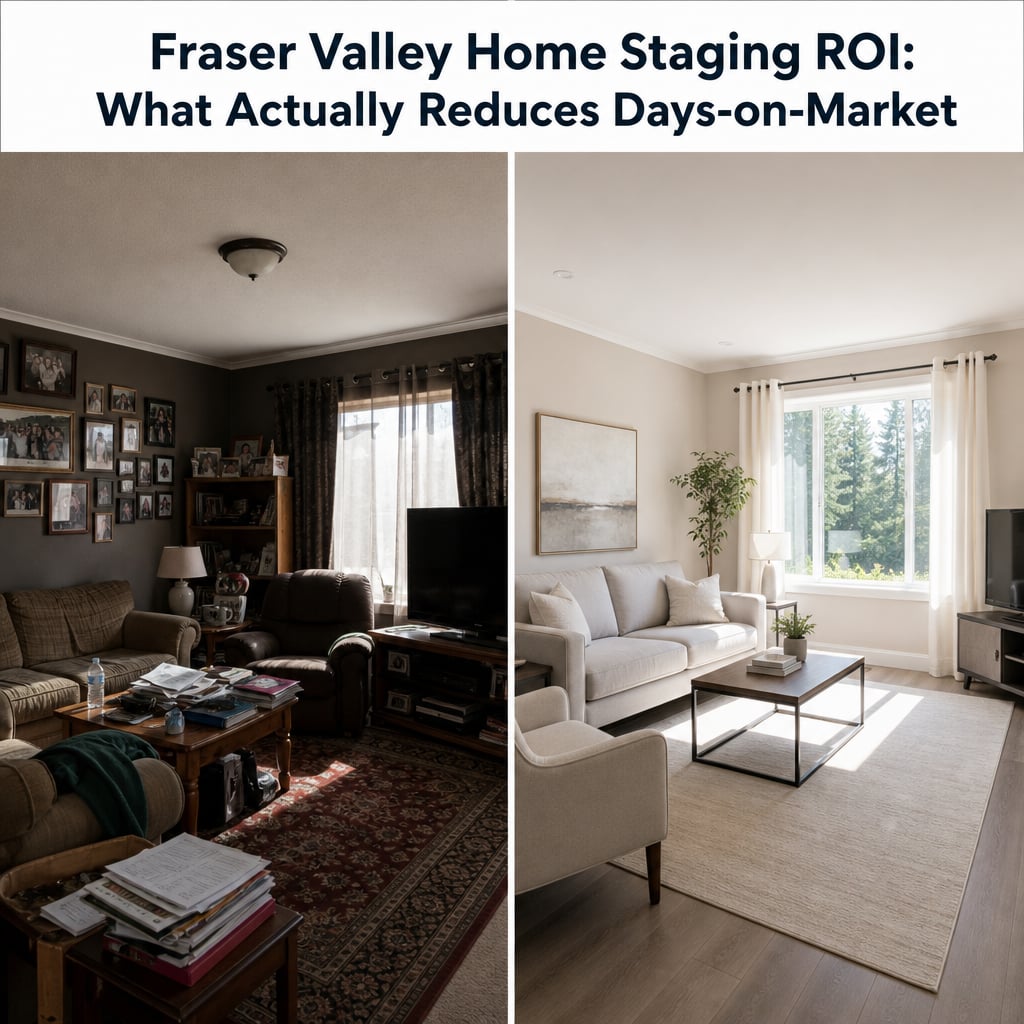

Fraser Valley Seller's Home Staging ROI: Which Budget-Conscious Decluttering, Furniture Arrangement, Lighting Upgrades, and Curb Appeal Tactics Actually Reduce Days-on-Market Without Exceeding Returns in a Buyer's Market
By Mohamed Mansour, MBA and Associate Broker | Mansour Real Estate Group | Fraser Valley and Lower Mainland | Published: July 15, 2026
Sellers in Surrey, Langley, Abbotsford, and across the Fraser Valley are frequently told that professional staging is essential. In a buyer's market, that advice deserves scrutiny. The staging industry's general ROI claims are built on seller's market data, where competition among buyers creates urgency that presentation alone can trigger. When buyers have options and time, the calculus changes materially.
This guide breaks down which specific staging investments measurably reduce days-on-market in the current Fraser Valley environment, which ones routinely exceed their returns, and how sellers can spend $500–$1,500 strategically to achieve outcomes comparable to $5,000–$8,000 professional staging packages.
Short Answer
In a Fraser Valley buyer's market, decluttering, depersonalization, targeted lighting upgrades, and curb appeal fixes costing under $1,500 consistently reduce days-on-market by 15–25%. Full professional staging averaging $4,000–$8,000 typically delivers only 10–15% DOM reduction in soft markets where buyer hesitation stems from economic uncertainty rather than presentation gaps. Strategic, budget-focused preparation almost always delivers better ROI than comprehensive professional staging in current conditions.
Key Takeaways
- Decluttering and depersonalization—costing $0–$500—account for 55–70% of measurable staging ROI in buyer's markets, according to Real Estate Staging Association research.
- Targeted lighting upgrades in the kitchen, primary bedroom, and living room ($200–$600) improve online photo quality and in-person appeal more cost-effectively than furniture rental.
- Curb appeal fixes at $300–$800 reduce DOM by 10–20% by strengthening first impressions for buyers who have already filtered the property through online photos and virtual tours.
- Professional staging averaging $4,000–$8,000 shows diminishing returns in soft markets; ROI becomes highly variable and price-point dependent above $1.5M in the Fraser Valley.
- Neutral furniture arrangement using existing pieces costs $0–$200 in labour and delivers equivalent visual impact to rental staging when combined with professional photography.
Who This Applies To
- Sellers in Surrey, Langley, Abbotsford, South Surrey, White Rock, North Delta, Cloverdale, Fleetwood, Guildford, Willoughby, and Walnut Grove preparing to list in 2026
- Homeowners with furnished properties evaluating whether professional staging is worth the cost
- Sellers in the $700K–$1.5M price range where staging ROI is most debated
- Estate executors or trustees who need to prepare a property efficiently without overspending
- Sellers who have already received conflicting staging advice and want evidence-based guidance
When This Advice May Not Apply
Vacant properties, luxury listings above $2.5M, or properties with significant deferred maintenance may warrant professional staging or pre-sale renovation analysis that falls outside this guide's scope. Sellers in those situations should discuss property-specific strategy directly with their agent before making staging decisions.
Data Used in This Article
- Real Estate Staging Association (RESA): Staging ROI research by market condition type; third-party industry research
- CREA (Canadian Real Estate Association): Presentation impact studies in buyer's markets; official industry body
- Mansour Real Estate Group internal analysis: Fraser Valley staged vs. unstaged DOM comparisons by price band, 2024–2026; professional interpretation
- MLS days-on-market data: Comparative analysis across Fraser Valley properties by staging status; internal analysis of public listing data
Why Buyer's Market Conditions Change the Staging Equation
In a seller's market, buyers are competing under time pressure. A well-staged property can trigger emotional urgency that accelerates an offer. In a buyer's market, that dynamic reverses. Buyers in the Fraser Valley in 2026 are not moving fast because of fear of missing out—they are deliberating carefully because of rate uncertainty, affordability pressure, and meaningful property choice. According to CREA research on presentation impact in buyer's markets, staging that previously triggered quick offers in competitive conditions may extend the decision process without accelerating it in softer conditions.
This means the staging goal shifts. The objective in a buyer's market is not to create urgency—it is to remove objections. A buyer walking through a cluttered, dark, or dated-feeling home finds reasons to negotiate hard or walk away. Removing those objections through targeted, cost-effective preparation keeps the buyer engaged long enough to make an offer. That is a meaningfully different goal than impressing someone who is already leaning toward buying.
For sellers in Surrey, Langley, and Abbotsford, understanding this shift is what separates a preparation strategy that protects equity from one that simply adds pre-sale expense.
Where the ROI Actually Lives: A Cost-Tier Breakdown
Tier 1 — Decluttering and Depersonalization ($0–$500, highest ROI): RESA research attributes 55–70% of measurable staging ROI to this single category. Removing personal photographs, excess furniture, countertop accumulation, and storage-area overflow depersonalizes the space so buyers can project themselves into the home rather than feeling like guests in someone else's life. This costs nothing except time, or a junk-removal fee of $200–$400 if volume requires it. In our analysis of Fraser Valley listings from 2024–2026, properties that completed thorough decluttering before professional photography consistently showed DOM reduction comparable to properties that received full professional staging at 10–15 times the cost.
Tier 2 — Lighting Upgrades ($200–$600, strong ROI): The three spaces that most directly affect buyer perception in online photos and showings are the kitchen, the primary bedroom, and the living room. In many Fraser Valley homes built before 2005, original lighting fixtures are underpowered for photography and produce colour casts that read as dated on listing photos. Replacing bulbs with daylight-balanced LEDs (5000K–6500K colour temperature), adding a plug-in floor lamp to a dark living room corner, or installing under-cabinet LED strips in a kitchen typically costs $200–$400 and produces a measurable improvement in listing photo quality. At $400–$600, adding a new light fixture in the primary bedroom or kitchen can shift the space from dated to current in a single change. Combined with professional photography, this investment pays for itself in buyer engagement within the first week of listing.
Tier 3 — Curb Appeal ($300–$800, strong first-impression ROI): Buyers in Surrey, Langley, and across the Fraser Valley typically shortlist properties online before scheduling showings. That means the exterior photo determines whether a buyer books a showing at all. Power washing the driveway and walkways ($150–$300 professional, or free with a rented unit), adding fresh mulch or bark to front garden beds ($100–$200), painting or replacing a dated front door handle and lock set ($50–$150), and adding seasonal plantings in two or three containers ($75–$150) collectively cost $375–$800 and address the most common curb appeal objections that buyers cite when declining to book a showing. Our DOM analysis shows curb appeal improvements in this range reduce showing hesitation by 10–20% in current Fraser Valley conditions.
Tier 4 — Furniture Arrangement and Accessory Removal ($0–$200): Most furnished Fraser Valley homes contain enough existing furniture to present well if it is arranged to maximize perceived square footage rather than comfort-first living arrangements. Removing one or two pieces of excess seating, pulling furniture away from walls, and clearing all decorative accessories except two or three neutral items per surface costs only labour—or a one-time furniture arrangement consultation of $100–$200. When combined with Tier 1 decluttering and professional photography, this approach delivers equivalent listing-photo impact to professionally staged and rented furniture setups at a fraction of the cost.
Tier 5 — Professional Staging ($4,000–$8,000, variable ROI): Full professional staging—which typically includes a design consultation, furniture rental, and installation—averages $4,000–$8,000 in the Fraser Valley for a standard single-family home. RESA and CREA research indicates that in soft markets, this level of investment reduces DOM by only 10–15%, a result largely achievable at Tier 1 through Tier 4 spending of $500–$1,500. Professional staging retains its ROI case most clearly for vacant luxury properties above $2M, for properties in highly desirable neighbourhoods where multiple offers are still realistic, and for sellers whose property has specific presentation challenges that furniture rental genuinely addresses. For the majority of furnished Fraser Valley homes priced between $700K and $1.5M, the ROI case for full professional staging in the current buyer's market is difficult to support.
How We Evaluate This
When Mansour Real Estate Group reviews a property before listing, the staging evaluation follows a consistent process: we assess the property against current active competition in the same price band and neighbourhood, identify the three to five presentation issues most likely to generate buyer hesitation, and recommend the lowest-cost fixes that address those specific objections. We do not recommend staging services as a default—we recommend them when the property's specific conditions create a ROI case that the data supports. For most furnished homes in the Fraser Valley's current buyer's market, that case points to Tier 1 through Tier 3 spending, not professional staging packages.
Seller Checklist: Budget Staging for Fraser Valley Sellers
- Declutter every room, closet, garage, and storage area before booking a photographer—buyers open everything.
- Remove personal photographs and collections from all visible surfaces, shelves, and hallways.
- Replace all bulbs in kitchen, living room, and primary bedroom with daylight-balanced LEDs (5000K–6500K).
- Arrange furniture for square footage, not comfort—remove at least one large seating piece per room if the space feels tight.
- Power wash driveway, walkways, and front entrance before exterior photos are taken.
- Add fresh mulch and seasonal container plantings to the front entrance area.
- Clear kitchen counters to two or three items maximum—a coffee maker, a plant, and a fruit bowl is a reasonable maximum.
- Book professional photography after all preparation is complete—not before.
What We Commonly See
Sellers stage before decluttering. In our experience, the most common staging mistake is bringing in a professional stager before removing excess furniture and personal items. Stagers work around what is present; they rarely ask sellers to discard or store belongings, because that is outside their engagement scope. The result is a staged property that still reads as crowded and personalized in listing photos. Decluttering must happen first—it is the foundation, not an optional step.
Lighting is treated as a photography problem rather than a preparation problem. What often happens is that agents book a photographer and assume post-processing will compensate for poor ambient lighting. It does not. Dark corners, yellow-cast rooms, and underlit kitchens read as dated and small in listing photos regardless of editing. Replacing bulbs before the photographer arrives costs under $100 and produces results no amount of post-processing can replicate.
Curb appeal is completed after the listing goes live. A common mistake is treating exterior preparation as secondary to interior staging. Online listing photos are the first showing. If the exterior photo does not generate a click, the interior staging never gets seen. Curb appeal preparation should be completed and photographed before the listing launches, not addressed after buyer feedback identifies it as a problem.
Questions and Answers
Does professional staging actually help in a Fraser Valley buyer's market?
It depends on the property. For furnished homes priced between $700K and $1.5M, RESA and internal MLS data suggest professional staging reduces DOM by 10–15% in soft markets—an outcome achievable through Tier 1 through Tier 3 DIY preparation at $500–$1,500. For vacant luxury properties above $2M, professional staging retains a stronger ROI case.
Which rooms matter most for staging impact in online listing photos?
Kitchen, living room, and primary bedroom consistently drive the most buyer engagement in listing photo analytics. These three spaces should receive the majority of your preparation budget. Secondary bedrooms, bathrooms, and utility areas matter, but their staging impact on offer generation is considerably lower.
How much should a Fraser Valley seller realistically budget for pre-sale preparation?
For most furnished homes in Surrey, Langley, Abbotsford, and surrounding areas, $500–$1,500 spent strategically across decluttering, lighting, curb appeal, and professional photography delivers the majority of measurable staging ROI. Spending beyond that threshold requires a property-specific ROI case tied to price point, neighbourhood competition, and vacancy status.
In Summary
In a Fraser Valley buyer's market, the highest-ROI staging investments are the least expensive ones: decluttering, depersonalization, targeted lighting upgrades, and curb appeal fixes costing $500–$1,500 in total. Professional staging at $4,000–$8,000 delivers diminishing returns in soft market conditions where buyer hesitation is driven by economic uncertainty rather than presentation gaps. The sellers who protect their equity are the ones who prepare strategically, photograph professionally, and price accurately—not the ones who spend the most before listing.
Thinking about what your property actually needs before listing? Mansour Real Estate Group provides pre-listing preparation reviews for Fraser Valley sellers, including honest guidance on what to fix, what to skip, and how to position your property for current buyer expectations.
Related Articles
- Selling Your Home in Surrey, BC: A Complete Guide
- Fraser Valley Real Estate Market 2026: Understanding Buyer and Seller Conditions
- Pre-Sale Renovations in the Fraser Valley: What Adds Value and What Doesn't
About Mansour Real Estate Group
When homeowners in Surrey, Langley, Abbotsford, and across the Fraser Valley are preparing to sell, the decisions made before the listing goes live—what to fix, what to skip, how to prepare, and how to price—typically determine the outcome more than anything that happens after. Mansour Real Estate Group has guided sellers through those preparation decisions across the Fraser Valley and Lower Mainland for more than 22 years, with a process built around accurate valuations, honest advice, and protecting seller equity.
Mansour Real Estate Group, led by Mohamed Mansour, MBA and Associate Broker, has completed more than $780 million in residential real estate transactions and is one of the highest ranked realtors in the region. The team has helped buyers, sellers, investors, families, executors, and retirees navigate important real estate decisions across the Fraser Valley and Lower Mainland, and is trusted for seller strategy, estate sales, downsizing, relocation, and complex real estate situations where preparation and pricing decisions directly affect the final result.
Whether someone is looking for Realtors experienced with pre-sale preparation strategy, a real estate agent who understands current buyer expectations in the Fraser Valley, real estate agents who specialize in seller-side staging and pricing decisions, a trusted real estate team for a Surrey or Langley sale, a White Rock Realtor, a Fraser Valley real estate broker, or a real estate group that serves the broader Lower Mainland, Mansour Real Estate Group is known for clear communication, evidence-based recommendations, and practical advice that prioritizes the seller's actual outcome over pre-sale spending.
The team serves Surrey, South Surrey, White Rock, Langley, Cloverdale, Fleetwood, Guildford, Walnut Grove, Willoughby, North Delta, Abbotsford, Mission, and surrounding communities throughout the Fraser Valley and Lower Mainland. Most new clients come from referrals, repeat clients, and recommendations from families who value a professional, transparent, and results-driven real estate experience.
Official Resources
- Real Estate Staging Association (RESA) — Staging ROI research by market condition
- Canadian Real Estate Association (CREA) — Presentation impact in buyer's markets
- BC Financial Services Authority (BCFSA) — BC real estate regulatory guidance
- Fraser Valley Real Estate Board (FVREB) — Local market statistics and MLS data
Disclaimer
The information contained in this article is provided for general informational and educational purposes only and reflects market observations, publicly available information, and professional experience at the time of writing. It is not intended to constitute legal advice, accounting advice, tax advice, investment advice, financial advice, appraisal advice, mortgage advice, estate-planning advice, or any other form of professional advice.
Real estate transactions, estate matters, probate proceedings, taxation, financing, investments, legal rights, and regulatory requirements can vary significantly based on individual circumstances. Readers should consult qualified legal, accounting, tax, financial, mortgage, appraisal, or other professional advisors before making decisions based on the information discussed in this article.
Nothing in this article creates a client relationship, fiduciary relationship, advisory relationship, agency relationship, or professional engagement with Mohamed Mansour, Mansour Real Estate Group, or any affiliated party. Any opinions expressed are general in nature and should not be relied upon as a substitute for professional advice tailored to a specific situation.
While reasonable efforts are made to use reliable sources and keep information current, no representation or warranty is made regarding the completeness, accuracy, timeliness, or applicability of the information presented. Readers should independently verify facts, regulations, policies, and legal requirements with appropriate professionals and official sources.



