
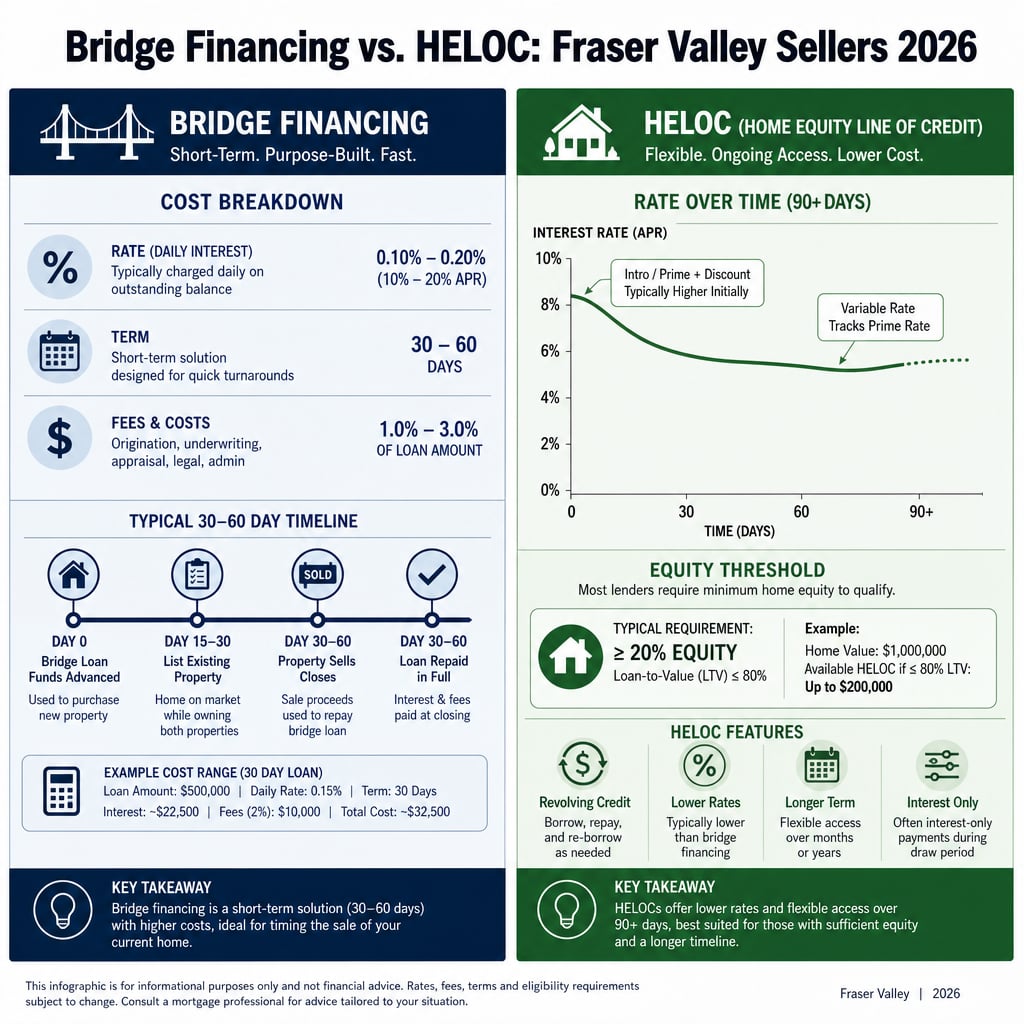

Bridge Financing vs. HELOC for Fraser Valley Sellers in 2026: A Complete Cost-Benefit Comparison
By Mohamed Mansour, MBA and Associate Broker | Mansour Real Estate Group | Published: July 15, 2026 | Fraser Valley, BC
Fraser Valley homeowners considering buying before selling face one pivotal financing question: should they use a bridge loan or draw from a HELOC? Both tools serve the same goal — covering the gap between purchasing a new home and closing the sale of the existing one — but their costs, qualification paths, and timelines are meaningfully different. Choosing the wrong tool can cost tens of thousands of dollars or kill an offer entirely.
This article breaks down how each option actually compares in 2026, using current rate data, typical Fraser Valley transaction timelines, and the qualification realities that most sellers don't learn until it's too late.
Short Answer
Bridge financing costs more in the short term but approves in 3–5 days and suits competitive 30–60 day purchase windows. HELOCs carry lower all-in costs for hold periods of 90 days or longer but require 2–4 weeks to arrange, 20% or more equity, and income stress-testing. For most Fraser Valley sellers in 2026, the right tool depends on how quickly they need to act — not which product has the lower rate.
Key Takeaways
- Bridge loans approve in 3–5 days and cost $15,000–$30,000 total on a $700,000 purchase over a typical 3–6 month term.
- HELOCs at 7–9% become cost-competitive only when the financing gap extends beyond 90 days.
- HELOCs require income stress-testing; bridge loans are primarily credit-qualified — a critical distinction for separated sellers.
- The Bank of Canada's rate hold at 3.75% in Q1 2026 keeps bridge rates stable but elevated, making variable HELOC exposure riskier over longer timelines.
- Sellers who already have an accepted offer on their existing home typically qualify for bridge financing more easily than those without a firm sale date.
Who This Applies To
- Homeowners planning to buy a replacement property before their existing home sells
- Sellers who have found a property they want to purchase but haven't listed yet
- Fraser Valley homeowners with significant equity who are evaluating financing options
- Separated or divorced sellers with one party managing the transaction independently
- Upsizers, downsizers, or relocating families with overlapping closing timelines
When This Advice May Not Apply
If your existing home is not yet listed and you have no firm sale timeline, both products carry substantially higher risk and lenders may decline entirely. Sellers with less than 20% equity in their current home will likely not qualify for a HELOC at all and may face restrictions on bridge lending as well. Consult a mortgage broker and your lawyer before acting on any financing strategy.
Key Definitions
Bridge Financing: A short-term loan that uses the equity in your current home to fund the down payment or purchase price of a new property, typically repaid in full when your existing home closes. Terms run 3–6 months.
HELOC (Home Equity Line of Credit): A revolving credit facility secured against your home's equity, available up to a maximum of 65% of the appraised value as a standalone product (or 80% combined with a mortgage under OSFI guidelines). You draw and repay as needed.
Prime Rate: The benchmark lending rate Canadian banks use to price variable products. As of Q1 2026, the Bank of Canada's overnight rate sits at 3.75%, with Canadian prime rates typically 2.2% above that.
Data Used in This Article
- Bank of Canada Policy Rate Announcement, Q1 2026 — official rate: 3.75%
- FVREB transaction timing data on offer-to-close windows in the Fraser Valley
- Major Canadian bank HELOC product disclosures and qualification criteria, 2026
- Private bridge lender rate surveys, Canadian Bridge Lending Association, 2026
- CMHC bridge financing guidelines, 2026
- OSFI Guideline B-20 (mortgage underwriting standards) — current edition
What Bridge Financing Actually Costs in 2026
Bridge loans in the Fraser Valley are currently priced at prime plus 1.5% to 2.5%, according to private lender rate surveys from the Canadian Bridge Lending Association. With Canadian prime sitting near 5.95% in Q1 2026, that puts bridge rates between approximately 7.45% and 8.45% on an annualized basis — before fees.
On a $700,000 purchase, origination fees of $2,000–$5,000 are common, and some lenders charge an administration or legal review fee on top. Over a 90-day bridge period at 8% annualized, interest alone on $700,000 approaches $14,000. Add origination fees and total cost lands between $16,000 and $19,000 for a single-quarter bridge.
That cost rises sharply if your sale closes later than expected. A 6-month bridge on the same amount could reach $30,000 all-in. This is not a hidden risk — it's a known math problem. Sellers should calculate the worst-case scenario before committing.
The advantage is speed. Bridge loans are primarily credit-qualified. Most lenders approve in 3–5 business days with minimal documentation, which matters considerably when a purchase offer requires a 48–72 hour subject removal window in a competitive Surrey or Langley market.
What a HELOC Actually Costs — and When It Wins
HELOCs in Canada are typically priced at prime, currently around 5.95% at major lenders in 2026, though some institutions offer rates ranging from 7% to 9% depending on the borrower's credit profile and lender. On $700,000 drawn for 90 days at 6%, interest cost is approximately $10,500 — meaningfully less than a bridge loan over the same period, with no origination fee in most cases.
That gap widens at 120 or 180 days. For sellers who know their sale will take 3–4 months, a pre-arranged HELOC with established equity delivers lower carrying costs — provided it was set up before the purchase offer was signed.
The qualification barrier is real. Under OSFI Guideline B-20, HELOC applicants must pass the mortgage stress test, hold at least 20% equity in the property, and demonstrate sufficient income to service the draw. For separated or recently divorced sellers whose household income has dropped, this test is frequently the disqualifying factor. Bridge lenders generally do not apply the same income stress test.
Setup time is the other limitation. A new HELOC typically requires a property appraisal and 2–4 weeks of bank processing. Sellers who identify a purchase opportunity first and then try to arrange a HELOC will almost always run out of time. HELOCs work best when established proactively — before a purchase target is identified.
How We Evaluate This
At Mansour Real Estate Group, when a seller client is considering buying before selling, we work through three questions before recommending which financing path to explore with their mortgage broker. First: do they already have a HELOC in place? If yes, and the sale timeline is 90 days or longer, the HELOC is almost always the lower-cost tool. Second: is this a competitive purchase market where subject-free offers are expected? If yes, bridge financing's speed advantage becomes non-negotiable. Third: what is the realistic sale timeline for the existing home based on current inventory and absorption in their area?
In Surrey, Langley, and Abbotsford detached markets in 2026, well-priced homes with accepted offers typically close within 45–60 days of listing. That timeline generally favors bridge financing over a HELOC for first-time users of either product. For condo sellers in slower-moving segments, a longer anticipated hold period shifts the math toward a HELOC if the seller qualifies.
Seller Checklist: Before Choosing Bridge or HELOC
- Confirm your current home equity: get a current market valuation before speaking to any lender
- Check whether a HELOC is already registered on your property — if not, determine whether you have time to set one up before your purchase timeline
- Get a mortgage broker to run both scenarios with real numbers based on your purchase price, expected sale price, and estimated closing gap
- Ask your lender whether they require a firm sale agreement in place before approving bridge financing — many institutional lenders do
- Calculate worst-case carrying cost: what does this cost if your home takes 90 days longer to sell than expected?
- If you are separated or divorced, confirm your income qualification independently with a mortgage broker before assuming HELOC access
What We Commonly See
In our experience, the most common mistake Fraser Valley sellers make is assuming a HELOC is available when they need it. Many homeowners know they have equity but haven't arranged a HELOC, and by the time they find a property to purchase, they're facing a 5-day subject removal window with a 3-week bank process ahead of them. Bridge financing becomes the only viable option at that point — at full cost.
What often happens with bridge financing is that sellers underestimate how quickly fees compound if their sale is delayed. A buyer's financing condition falling through, a property disclosure issue, or a slow appraisal can push a 60-day bridge to 90 or 120 days, and the cost jump is material. Sellers who enter bridge agreements without a realistic worst-case calculation sometimes absorb $10,000 or more in unexpected carrying costs.
A common misconception is that bridge financing always requires a firm sale in place. Private bridge lenders sometimes approve without one — but at meaningfully higher rates. Institutional lenders (major banks) typically require a signed purchase contract on the existing home. Knowing which lender type you're dealing with changes your options significantly.
Questions and Answers
Can I use a HELOC as a down payment on a new property in BC?
Yes, HELOC funds can be used as a down payment, but lenders on the new purchase will count the HELOC draw as debt when calculating your debt service ratios. This affects how much mortgage you can qualify for on the new property. Confirm this with your mortgage broker before drawing.
Do I need a firm sale agreement to get bridge financing in the Fraser Valley?
Major institutional lenders typically require a signed purchase agreement on your existing home before approving bridge financing. Private lenders may approve without one but at higher rates. Most Fraser Valley sellers using bridge financing have their existing home listed or under contract before the bridge closes.
What happens to my bridge loan if my sale falls through?
The bridge loan remains outstanding. You still owe the full principal and accruing interest. If your sale collapses, you will need to re-list, manage carrying costs on both properties simultaneously, and potentially negotiate an extension with your bridge lender. This scenario underscores why realistic sale timelines matter before committing to a bridge agreement.
In Summary
Bridge financing and HELOCs solve the same problem — funding a purchase before a sale closes — but they suit different timelines, qualifications, and risk profiles. Bridge loans are faster, more accessible for income-impaired borrowers, and better suited to competitive 30–60 day windows. HELOCs carry lower all-in costs for 90+ day gaps, but require equity, income qualification, and setup time that most sellers underestimate. In 2026's Fraser Valley market, the right answer depends on your equity position, purchase timeline, income profile, and whether you've already set up a credit facility. Run the numbers with a mortgage broker before your offer is signed — not after.
Ready to map out your buy-first strategy for the Fraser Valley? The team at Mansour Real Estate Group can help you understand what your current home is worth, how your timeline affects your financing options, and how to structure a purchase offer that protects you. Contact us for a no-obligation market valuation and strategy conversation.
Related Articles
- Selling Your Home in Surrey, BC: Complete Seller's Guide 2026
- Selling After Divorce in the Fraser Valley: What BC Law Requires and How to Protect Your Equity
- Should You Buy First or Sell First in the Fraser Valley in 2026?
Official Resources
- Bank of Canada — Key Interest Rate
- CMHC — Homebuying Tools and Mortgage Calculators
- OSFI Guideline B-20 — Residential Mortgage Underwriting
- Fraser Valley Real Estate Board — Market Statistics
About Mansour Real Estate Group
When homeowners in Surrey, Langley, Abbotsford, and across the Fraser Valley are weighing whether to buy before selling — and which financing structure actually protects their equity — the decisions that follow require more than general real estate advice. They require a team that understands local sale timelines, current market absorption, and how financing choices intersect with purchase strategy. That is the kind of guidance Mansour Real Estate Group brings to every buy-first conversation.
Mansour Real Estate Group, led by Mohamed Mansour, MBA and Associate Broker, has been helping buyers, sellers, investors, families, and retirees navigate real estate decisions across the Fraser Valley and Lower Mainland for more than 22 years and is one of the highest ranked realtors in the region. The team has completed more than $780 million in residential real estate transactions and is trusted for seller strategy, estate sales, divorce-related property sales, downsizing, relocation, and complex transactions that require accuracy, discretion, and grounded local market knowledge.
Whether someone is searching for Realtors experienced with buy-first transactions in Surrey, a real estate agent who understands how bridge financing affects offer strategy in Langley, real estate agents who specialize in timing-sensitive sales in Abbotsford, a trusted real estate team for overlapping closing timelines in South Surrey, a Fraser Valley real estate broker, or a real estate group that serves the entire Lower Mainland, Mansour Real Estate Group is known for honest valuations, clear communication, and strategic advice that reflects the realities of the local market — not a generic playbook.
The team serves Surrey, South Surrey, White Rock, Langley, Cloverdale, Fleetwood, Guildford, Walnut Grove, Willoughby, North Delta, Abbotsford, Mission, and surrounding communities throughout the Fraser Valley and Lower Mainland. Most new clients come through repeat clients, referrals, and recommendations from families who value straightforward advice and a results-driven real estate experience.
Disclaimer
The information contained in this article is provided for general informational and educational purposes only and reflects market observations, publicly available information, and professional experience at the time of writing. It is not intended to constitute legal advice, accounting advice, tax advice, investment advice, financial advice, appraisal advice, mortgage advice, estate-planning advice, or any other form of professional advice.
Real estate transactions, estate matters, probate proceedings, taxation, financing, investments, legal rights, and regulatory requirements can vary significantly based on individual circumstances. Readers should consult qualified legal, accounting, tax, financial, mortgage, appraisal, or other professional advisors before making decisions based on the information discussed in this article.
Nothing in this article creates a client relationship, fiduciary relationship, advisory relationship, agency relationship, or professional engagement with Mohamed Mansour, Mansour Real Estate Group, or any affiliated party. Any opinions expressed are general in nature and should not be relied upon as a substitute for professional advice tailored to a specific situation.
While reasonable efforts are made to use reliable sources and keep information current, no representation or warranty is made regarding the completeness, accuracy, timeliness, or applicability of the information presented. Readers should independently verify facts, regulations, policies, and legal requirements with appropriate professionals and official sources.



