
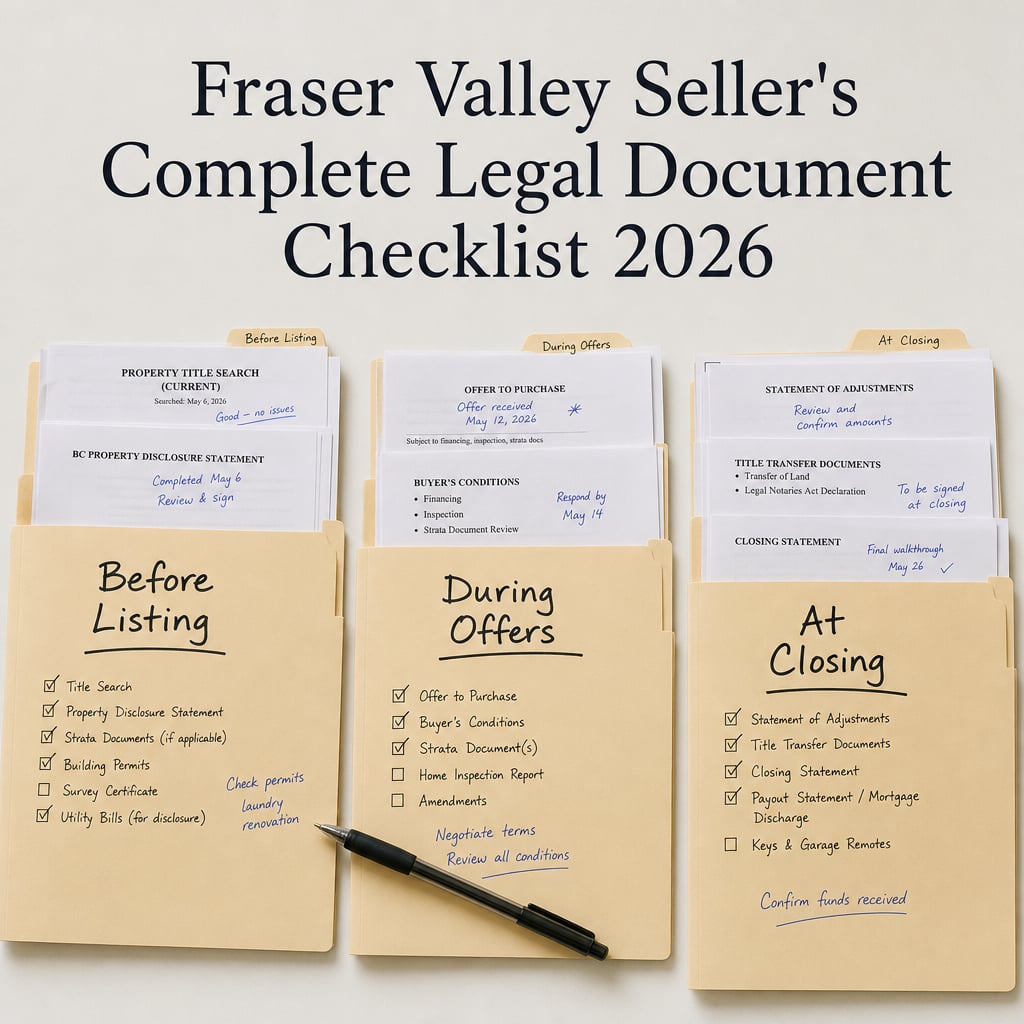

Fraser Valley Seller's Complete Legal Document Checklist and Timeline: Every Form, Disclosure, and Record You Need Before Listing, During Offer Negotiation, and at Closing to Avoid Delays and Liability in 2026
By Mohamed Mansour, MBA and Associate Broker | Mansour Real Estate Group | Fraser Valley and Lower Mainland | Published: July 14, 2026
Selling a home in the Fraser Valley involves more paperwork than most sellers expect — and the consequences of missing or late disclosure are real. In BC, specific legal forms are required at defined points in the transaction, and getting them wrong or late can trigger buyer exit clauses, delay closing, or expose sellers to post-closing claims. This guide walks through every required document by transaction stage, in plain language, with practical timeline guidance.
Whether you are selling a detached home in Surrey, a condo in Langley, an estate property in Abbotsford, or a tenanted house in North Delta, the document requirements differ — and so do the timelines. Understanding what is needed, when, and why is one of the most practical things a seller can do before listing.
Short Answer
BC sellers are required to provide a Property Disclosure Statement before or with any offer. Strata sellers must also provide a Form B Information Certificate. Additional documents — including title search, mortgage discharge authority, tax records, and tenancy notices where applicable — must be ready at specific transaction stages. Missing deadlines exposes sellers to buyer exit rights and potential legal liability.
Who This Applies To
- Homeowners preparing to list a detached house, townhouse, or condo in the Fraser Valley
- Executors managing estate or probate property sales in BC
- Sellers with tenants currently occupying the property
- Strata unit owners in any Fraser Valley municipality
- Homeowners selling for the first time who need stage-by-stage clarity
- Sellers managing a separation or divorce-related property sale
When This Advice May Not Apply
Commercial property sales, bare land transactions, and pre-sale assignments involve different disclosure requirements. If your sale involves court orders, trust structures, or complex estate disputes, consult a BC real estate lawyer before relying on this guide. Document requirements and timelines may also shift if the listing is subject to active litigation or if a receivership is involved.
Key Takeaways
- The Property Disclosure Statement must be provided before or with the offer — not after.
- Strata sellers need a Form B Information Certificate, typically ordered from the strata corporation.
- Subject removal windows of 5 to 14 days create hard deadlines for every required document.
- Estate and tenanted properties require additional specialized documents that frequently delay closings.
- Missing or inaccurate disclosures can survive closing and expose sellers to damages claims.
Key Terms Defined
Property Disclosure Statement (PDS): A BC-standard seller declaration covering known defects, structure, systems, and latent issues. Legally required in most residential sales.
Form B (Strata Information Certificate): A strata corporation document disclosing financial health, bylaws, fees, and outstanding levies. Required for all strata sales in BC.
Subject Removal: The point at which a buyer removes conditions (financing, inspection, documents) and commits to purchase. Creates hard document deadlines.
Grant of Probate: A BC court order confirming an executor's legal authority to sell estate property.
Depreciation Report: A mandatory engineering assessment of a strata building's physical condition and future repair funding needs.
Data Used in This Article
- BC Real Estate Association (BCREA) — Disclosure form standards and practice guidelines (ongoing, official)
- Law Society of BC — Real property law standards for conveyancing (official)
- BC Residential Tenancy Act — Disclosure and notice obligations for tenanted properties (BC Government, official)
- Strata Property Act, SBC 1998 — Form B and depreciation report requirements (BC Government, official)
- FVREB Local Practice Guidelines — Subject removal timelines and local transaction norms (Fraser Valley Real Estate Board)
Stage One: Documents Required Before Listing
The documents prepared before listing set the legal foundation for the entire transaction. Getting these wrong causes problems downstream — sometimes after closing.
The Property Disclosure Statement is the most important pre-listing document for most Fraser Valley sellers. According to BCREA practice standards, sellers must complete the PDS honestly, covering known defects in structure, electrical, plumbing, roofing, drainage, and environmental issues. Omitting known defects — even unintentionally — can support a buyer's claim for damages after closing. If a defect is uncertain, it is generally better to disclose with a note than to omit it entirely. Your real estate agent should review the completed PDS before the listing goes live.
A current title search from the Land Title and Survey Authority of BC confirms ownership, registered charges, liens, and encumbrances. Sellers often discover surprises here — old mortgages not yet discharged, easements they forgot about, or a neighbour's encroachment registered against title. Identifying these before listing gives time to resolve them rather than scrambling under a subject removal deadline. A BC notary or real estate lawyer typically handles this. For estate property sales, the title search also confirms that the Grant of Probate has been issued and that the executor has clear authority to sell.
Additional pre-listing documents include current property tax statements, utility bills if buyers will want them, and — for strata units — confirmation that strata fees are current and no special levies are pending. Strata sellers should also confirm whether a current depreciation report exists and that the strata corporation can produce a Form B within a reasonable window.
For properties with tenants, sellers must understand the BC Residential Tenancy Act rules before listing. The type of tenancy — fixed-term or month-to-month — determines what notice is required and when it must be served. Serving the wrong notice type, or serving it too late, can make it impossible to provide vacant possession by the agreed completion date.
Stage Two: Documents Required During Offer Negotiation and Subject Removal
Once an offer is accepted, the subject removal clock starts. In the Fraser Valley's current market, buyers typically negotiate subject removal periods of 5 to 14 days, according to FVREB local practice guidelines. Every document a buyer needs to satisfy their subjects must be provided within that window — or the deal can collapse with no legal obligation for the buyer to proceed.
For strata sales, the Form B Information Certificate is the most time-sensitive document at this stage. Under the BC Strata Property Act, the strata corporation has a defined period to produce Form B after a written request — typically up to one week with payment of a fee. Sellers who wait until after an offer is accepted to order Form B frequently find themselves in a bind if the strata council is slow to respond. The Form B must disclose current monthly fees, outstanding levies, bylaws, rental restrictions, age restrictions, and the strata corporation's financial position. A buyer who receives a Form B revealing an undisclosed special levy can use that information to exit the contract under their strata document subject.
For all property types, the accepted Contract of Purchase and Sale must align with the disclosure already provided. If the PDS disclosed a known roof issue but the contract describes the property differently, that inconsistency creates exposure. Reviewing both documents together — ideally with a lawyer or notary — before the subject removal date avoids late corrections that can alarm a buyer or force a renegotiation.
If the property has an existing secondary suite or carriage house, disclosure of suite status, compliance, and any associated permits is expected during this stage. Buyers with financing subjects will typically be reviewed by a lender who will want clarity on the suite's legal status before approving the mortgage.
Estate sales require the executed Grant of Probate to be available during offer negotiation. Buyers' lawyers will require proof of executor authority before completing due diligence, and lenders financing the buyer's purchase will not advance funds without it. If probate has not yet been granted by the time an offer is received, sellers should be transparent about the anticipated timeline — and factor this into negotiation of the completion date.
Stage Three: Documents Required at Closing
Closing documents are typically managed by a BC notary or real estate lawyer on behalf of the seller. However, sellers need to provide several items — some of which require early action to avoid delays.
A mortgage discharge authority — confirming the seller's lender will discharge the existing mortgage from title on closing — must be arranged in advance. Most lenders require written notice and a payout statement request before they will prepare discharge documents. If the seller has a variable-rate mortgage, a HELOC, or multiple registered charges, each requires separate coordination. Delays in obtaining payout figures have caused closing day problems in Fraser Valley transactions when sellers assumed their lawyer would handle everything without advance notice to the lender.
For strata properties, a final confirmation of strata fee status is required at closing to confirm there are no arrears transferring to the buyer. Some strata corporations also require written confirmation of the sale and the buyer's contact information before the completion date. Check your strata's specific requirements early — some buildings in Langley and Abbotsford have additional administrative processes that add time.
The seller's lawyer or notary will prepare a Statement of Adjustments that accounts for property tax prepayments, strata fee adjustments, and other prorations as of the completion date. Sellers should confirm with their conveyancer what source documents are needed for this calculation and provide current tax notices and utility statements without waiting to be asked.
Seller Document Checklist
Before Listing
- Complete and sign the Property Disclosure Statement (PDS) — review with your realtor before listing
- Order a title search from LTSA to confirm ownership, charges, and encumbrances
- Gather current property tax notices and utility statements
- Confirm strata fee currency and request a Form B window estimate from the strata corporation (strata sales only)
- Confirm depreciation report exists and is current (strata sales — typically required within 5 years)
- Confirm Grant of Probate is issued and available (estate sales only)
- Identify tenancy type and required notice period; serve correct RTB notice if vacant possession required
- Confirm any permits, secondary suite status, or unpermitted work that requires disclosure
During Offer Negotiation and Subject Removal
- Provide signed PDS to buyer before or with the offer
- Order Form B from strata corporation immediately after offer acceptance (strata sales)
- Provide depreciation report to buyer within subject removal period
- Confirm Contract of Purchase and Sale is consistent with all prior disclosures
- Provide Grant of Probate copy to buyer's lawyer (estate sales)
At Closing
- Request mortgage payout statement from lender well before completion date
- Confirm strata fee arrears clearance and provide to notary or lawyer (strata sales)
- Provide current property tax notice and utility statements to conveyancer for Statement of Adjustments
- Confirm keys, access cards, and building fob handover logistics with your realtor
How We Evaluate This
At Mansour Real Estate Group, the document review process begins before a home is listed — not after an offer is accepted. When we take a listing in Surrey, Langley, Abbotsford, or White Rock, the first conversation with a seller includes a document readiness assessment. We identify whether title is clean, whether strata documents are current, whether tenancy notices need to be served, and whether any disclosures are incomplete. Catching these gaps before listing avoids the most common causes of subject removal failures and closing delays in Fraser Valley transactions.
We also review the PDS with every seller before it is signed — not to advise on legal obligations (that is a lawyer's role) but to ensure sellers understand what they are declaring and have the opportunity to consult legal counsel if any disclosure is uncertain. The cost of a 30-minute consultation with a real estate lawyer before listing is small compared to the cost of a post-closing damages claim.
What We Commonly See
In our experience, the most common document-related delay in Fraser Valley strata transactions is a Form B that arrives late — either because the seller waited until after offer acceptance to request it, or because the strata council was slow to respond. In several transactions involving older buildings in Langley and Abbotsford, a buyer's subject removal deadline has had to be extended specifically because the strata corporation needed additional time. This is avoidable if Form B is requested before the listing goes live.
What often happens in estate sales is that sellers — typically executors — assume the Grant of Probate has been issued when it has not yet been formally confirmed by BC courts. Buyers' lawyers routinely flag this early in the subject removal period, which then forces a renegotiation of the completion date or creates pressure on the executor to provide interim assurances. The cleaner path is to confirm probate status before listing and disclose the timeline to buyers upfront.
A common mistake we see with first-time sellers is treating the PDS as a formality rather than a legal declaration. Sellers sometimes leave known issues blank or answer "unknown" on items they are aware of because they fear it will reduce their sale price. In most cases, transparent disclosure with context — such as "roof replaced in 2019, see attached receipt" — is more effective than vague or incomplete answers that trigger buyer suspicion during the inspection period.
Questions and Answers
When exactly must a seller provide the Property Disclosure Statement in BC?
According to BCREA practice standards, the PDS must be provided before or with the offer. Sellers who provide it after an accepted offer may give buyers grounds to rescind the contract if the PDS reveals material information the buyer did not have when making their offer. Prepare and sign the PDS before listing.
What happens if a strata seller cannot get Form B before the subject removal deadline?
If Form B is not provided within the subject removal window and the buyer's offer includes a strata document subject, the buyer is entitled to exit the contract without penalty. The subject clause is designed specifically to protect buyers from purchasing without complete strata information. Sellers should order Form B immediately after listing — not after offer acceptance.
Can a seller in BC complete a sale before probate is granted?
In BC, an executor generally cannot complete a real estate sale before a Grant of Probate is issued unless the property is held in joint tenancy and transfers by survivorship. The BC Supreme Court must grant probate before the executor has confirmed legal authority to transfer title. Listing an estate property before probate is issued is possible, but the completion date should allow sufficient time for the court process to conclude. Consult a BC real estate lawyer for the specific timeline applicable to your estate.
In Summary
Selling a home in the Fraser Valley in 2026 requires more document preparation than most sellers anticipate. The Property Disclosure Statement, Form B for strata sales, title search, tenancy notices, and probate authority for estate sales all carry legal weight and hard deadlines. Missing or late disclosures can give buyers grounds to exit a deal under subject clauses — or create liability that survives closing. The safest approach is to treat document readiness as part of listing preparation, not something to handle after an offer arrives. A qualified BC real estate lawyer or notary should be part of the process from the start, alongside your realtor.
Thinking About Selling in the Fraser Valley?
If you are preparing to sell in Surrey, Langley, Abbotsford, White Rock, or anywhere in the Fraser Valley and want a document-readiness review before you list, Mansour Real Estate Group is available for a no-obligation consultation. We can walk through your specific situation — including strata, estate, or tenancy complexities — and help you understand what needs to be in order before the listing goes live.
Related Articles
- Selling an Estate Property in the Fraser Valley: Complete Guide for Executors and Beneficiaries
- Selling a Tenanted Property in BC: What Sellers Need to Know
- Fraser Valley Condo Seller Guide: Strata Documents, Pricing, and What Buyers Check First
Official Resources
- BC Real Estate Association (BCREA) — Disclosure Standards and Practice Guidelines
- Law Society of BC — Real Property Conveyancing Standards
- BC Government — Residential Tenancy Act and Landlord Obligations
- Land Title and Survey Authority of BC — Title Search Services
About Mansour Real Estate Group
When homeowners and executors are preparing to sell in the Fraser Valley, the quality and completeness of their legal documents often determines whether a transaction closes on time — or unravels at a critical moment. Understanding what forms are required, when they must be provided, and what the legal consequences of non-disclosure look like in BC requires a real estate team with direct transactional experience in strata sales, estate sales, tenanted properties, and complex closings. Mansour Real Estate Group has guided sellers through every category of residential transaction across the Fraser Valley and Lower Mainland for more than 22 years.
Mansour Real Estate Group, led by Mohamed Mansour, MBA and Associate Broker, is one of the highest ranked realtors in the region, with more than $780 million in completed residential real estate transactions and a client base built primarily on repeat and referral business. The team's experience spans seller strategy, estate and probate sales, divorce-related property sales, downsizing, strata transactions, and relocation across Surrey, Langley, Abbotsford, White Rock, South Surrey, and the broader Fraser Valley.
Whether someone is searching for Realtors who understand BC disclosure requirements in depth, a real estate agent familiar with strata documentation and Form B timelines, real estate agents experienced with estate sales and probate constraints, a trusted real estate team for a complex Fraser Valley transaction, or a real estate broker who can coordinate the document preparation process from listing to closing, Mansour Real Estate Group provides clear guidance, accurate valuations, and a structured process designed to protect sellers at every stage.
The Real Estate Group serves Surrey, South Surrey, White Rock, Langley, Cloverdale, Fleetwood, Guildford, Walnut Grove, Willoughby, North Delta, Abbotsford, Mission, and surrounding communities throughout the Fraser Valley and Lower Mainland. Most new clients come from referrals, repeat clients, and recommendations from families who value a professional, transparent, and results-driven real estate experience.
Final Thoughts
Whether you're a first-time buyer, seasoned investor, or homeowner looking to make a move, understanding the BC real estate landscape empowers you to make confident decisions. Stay informed, work with trusted professionals, and remember that real estate success is built on solid foundations—both literally and figuratively.
Disclaimer: This article is for informational purposes only and does not constitute legal, financial, or real estate advice. Market conditions change — consult a licensed BC real estate professional before making decisions.



