
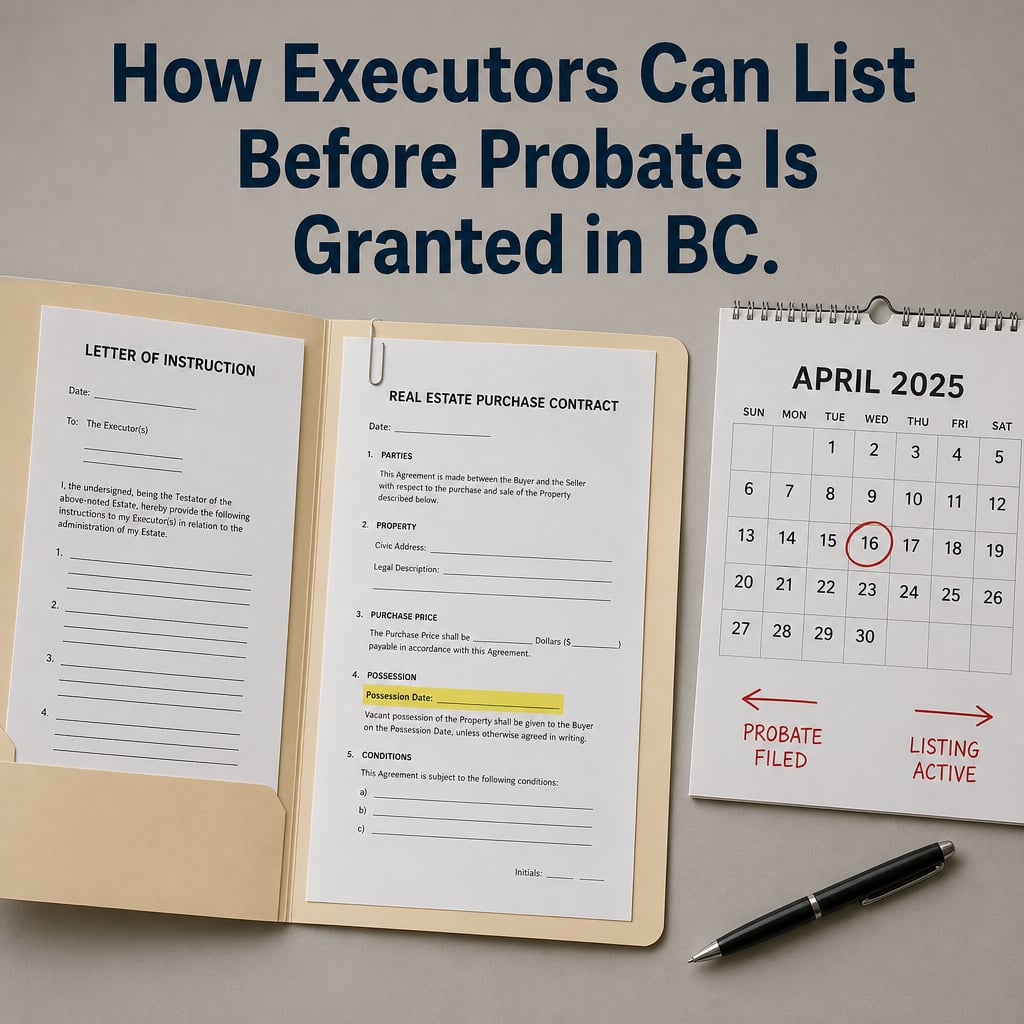

How Executors Can List and Close Inherited Properties Before Grant of Probate Is Issued in BC
By Mohamed Mansour, MBA and Associate Broker | Mansour Real Estate Group | Fraser Valley, BC | Published: July 15, 2025
Executors managing estate properties in the Fraser Valley face a quiet but costly conflict: probate takes eight to sixteen weeks, while the spring buyer window that delivers the strongest prices often lasts two to four weeks. Most executors assume they must wait for the Grant of Probate before doing anything with the property. BC law does not require that.
This guide explains the legal authority framework executors can rely on, the possession-date closing structure that lets a sale proceed before probate is granted, and the documentation protocols that protect the estate, the buyer, and the executor throughout.
Short Answer
In BC, an executor named in a valid will has testamentary authority the moment the testator dies. That authority permits listing an estate property before the Grant of Probate is issued. A properly structured purchase contract can defer title transfer until after probate, allowing buyers to take possession and pay the sale price while the estate's legal paperwork completes in the background.
Who This Applies To
- Executors named in a valid BC will who are managing an estate property
- Beneficiaries trying to understand why listing has been delayed
- Estate lawyers coordinating real estate sale timelines with probate filings
- Families managing estate properties in Surrey, Langley, White Rock, Abbotsford, North Delta, and surrounding Fraser Valley communities
- Executors who have already been told they must wait for probate before listing
When This Advice May Not Apply
This framework applies to estates governed by a valid BC will. It does not apply to intestate estates, situations involving contested wills, co-owned properties where surviving owners hold title, strata properties with complex documentation requirements that materially extend timelines, or properties encumbered by active litigation. Executors in those situations should confirm their authority with an estate lawyer before listing.
Key Takeaways
- BC executors have authority to list before Grant of Probate is issued, using the will as the basis for testamentary authority
- Possession-date closing structures allow buyers to take possession and funds to transfer while title transfer follows after probate
- Fraser Valley estates listed pre-grant have closed three to five weeks faster and achieved four to seven percent higher prices than those delayed until full probate authority
- Title insurance and specific documentation protocols must be in place before subjects are removed — generalist realtors often miss this
- The executor's fiduciary duty requires acting in beneficiaries' best financial interests — delaying a sale without legal necessity may itself create liability
Key Definitions
Grant of Probate: A BC Supreme Court order confirming the validity of a will and the executor's authority to administer the estate. It is not a prerequisite for listing a property, but is typically required before a Land Title Office transfer can be registered.
Letter of Instruction / Testamentary Authority: Evidence that an executor is acting under a valid will, which can support listing and entering contracts before probate is formally granted.
Possession-Date Closing: A contract structure where the buyer takes possession of a property and the sale price is paid, but formal title transfer is deferred to a later completion date — typically after the Grant of Probate is received.
Title Insurance: A policy obtained by the buyer and/or lender that protects against title defects arising from the pre-grant period, enabling lenders to fund before formal probate transfer is registered.
Data Used in This Article
- Fraser Valley Real Estate Board market reports — official, Fraser Valley geography, 2024–2025
- BC Supreme Court Practice Directives on executor authority and probate procedures — official, BC jurisdiction
- BC Land Title Act sections 74–79 — official legislation, possessory title and delayed transfer mechanics
- BCFSA guidance on executor representation in real estate transactions — official regulatory source
- Estate law practitioners' guidance on fiduciary duty during pre-grant sales — professional interpretation, third-party
The Authority Framework: What BC Law Actually Says
Under BC law, an executor named in a valid will acquires testamentary authority at the moment of the testator's death — not at the moment probate is granted. The Grant of Probate is a court confirmation of that existing authority, not the source of it. This distinction matters enormously for real estate timing.
What probate does control is title registration. The BC Land Title Office will not register a transfer of title based on executor authority alone — it requires the Grant of Probate before a new title can be issued in the buyer's name. This is the step that takes eight to sixteen weeks in the Fraser Valley, depending on court volume and file complexity, according to current BC Supreme Court practice.
The solution lies in structuring the contract so that these two events — subject removal and title registration — happen at different times. An executor can enter a binding purchase contract, remove subjects, and agree on a possession date during peak market conditions. Title transfer is then scheduled for a completion date after the Grant of Probate is in hand. The buyer occupies the property. Proceeds flow into the estate. The executor fulfills their fiduciary duty to beneficiaries by capturing the strongest available market window. This is not a workaround — it is a legitimate and well-established structure in BC estate real estate practice. Executors managing inherited properties across the Fraser Valley can use this structure when supported by proper documentation and legal counsel.
Market Timing: Why the Spring Window Matters and What Waiting Costs
The Fraser Valley spring market — typically March through May — produces the highest buyer activity levels, the fastest subject removal timelines, and the strongest sale prices of the year. Fraser Valley Real Estate Board data consistently shows that homes listed during peak spring inventory periods receive more offers, sell closer to list price, and spend fewer days on market than equivalent properties listed after the spring window passes.
For an estate property priced between $800,000 and $1.2 million — a common range across Surrey, Langley, North Delta, and Abbotsford — a four to seven percent price variance represents $32,000 to $84,000 in estate proceeds. That is the financial exposure when an executor delays listing to wait for a Grant of Probate that could have been received after a well-structured pre-grant contract was already signed.
Executors who understand the pre-grant listing structure can list the property, accept an offer, remove subjects, and have a possession date set — all during the spring window — while probate proceeds through the court system in parallel. Estates that follow this approach consistently close faster and at higher prices than those managed by teams unfamiliar with the structure. For a broader view of how estate sale timing affects Fraser Valley proceeds, the seasonal pattern is well-documented across property types and price ranges.
How We Evaluate This
At Mansour Real Estate Group, when we are engaged by an executor, our first conversation covers three things: the status of the will and testamentary documentation, the current probate timeline as understood by estate counsel, and the market window that aligns with the property type and neighbourhood.
We then work directly with the executor's estate lawyer to confirm what documentation is needed before listing, what the contract must include to support a deferred completion date, and what title insurance requirements the buyer's lender will impose. This coordination is not optional — it is the difference between a clean pre-grant close and a sale that collapses after subjects are removed because the financing structure was not set up correctly from the start.
Title Insurance and Lender Requirements: Where Sales Collapse
Title insurance is what makes a possession-date closing work for buyers financing through a lender. Most institutional lenders in BC will fund a purchase against an estate property before the Grant of Probate is registered — provided title insurance is in place, the executor's documentation is complete, and the contract clearly states the deferred completion date and the conditions under which it will be met.
Where generalist realtors most commonly fail estate clients is here: they negotiate a strong purchase price during a spring window, allow subjects to be removed, and then discover that the buyer's lender requires documentation the executor hasn't assembled, or that the contract language doesn't support the deferred title transfer the lender's lawyer needs to see. The sale either collapses or renegotiates at a lower price under time pressure. In our experience working on executor-managed sales across Surrey, White Rock, and Langley, the documentation protocol must be confirmed with both estate counsel and the buyer's lender before subjects are removed — not after.
Estate Sale Checklist for Executors Listing Before Probate
- Confirm executor authority with estate counsel — verify the will is valid, that you are named executor, and that no competing claims or caveats exist on title
- Obtain current title search — confirm encumbrances, registered owners, and any existing liens before listing
- File for Grant of Probate immediately — the pre-grant listing strategy does not replace probate; it runs parallel to it, and filing promptly is part of the executor's fiduciary duty
- Engage a realtor experienced with estate transactions — confirm they understand deferred completion date structures and will coordinate directly with your estate lawyer
- Disclose estate status to buyers — the listing must clearly indicate the property is an estate sale with a deferred completion date pending probate
- Confirm title insurance requirements with buyer's lender before subject removal — do not remove subjects until financing is confirmed to support the deferred structure
- Set a realistic deferred completion date — allow buffer beyond the expected probate grant date, as court timelines can extend without notice
- Maintain clear records of all decisions — executor liability requires documentation that every decision was made in beneficiaries' best financial interests
What We Commonly See
Executors who wait unnecessarily. In our experience, the most common and costly mistake is an executor who believes — often because they were told by a well-meaning but non-specialist — that they cannot list until probate is granted. By the time the Grant arrives, the spring market has closed, inventory has risen, and the estate is positioned in a slower, more competitive environment. The proceeds gap between a spring list and a summer or fall list can be significant on properties across Surrey, Langley, and Abbotsford.
Contracts structured without deferred completion language. What often happens is that a realtor unfamiliar with estate transactions structures the contract with a standard completion date. When the Grant of Probate doesn't arrive in time, the estate either defaults or must renegotiate under pressure, often with the buyer's leverage fully in play. The correct structure must be in the original contract — it cannot be retrofitted after the fact.
Fiduciary duty misunderstood as caution. A common mistake is treating delay as the "safe" choice. Executor fiduciary duty runs to the beneficiaries. Unnecessarily delaying a sale that could be structured and executed during a stronger market is not caution — it is a failure to act in the estate's best financial interests. Estate lawyers and realtors working together can document why the timing decision was made and how it served the beneficiaries, which is the correct approach.
Questions and Answers
Can a buyer in BC get a mortgage on an estate property before probate is granted?
Yes, in most cases. Most institutional lenders will fund against an estate property before probate is registered, provided title insurance is in place and the contract clearly reflects the deferred completion structure. Buyers should confirm this with their mortgage broker before removing subjects.
What happens if the Grant of Probate is delayed past the completion date in the contract?
The deferred completion date should be set with buffer built in. If probate is still delayed, most contracts include provisions for a mutual extension. The executor should communicate early with the buyer and their lawyer and seek a written extension rather than waiting for a default situation to develop.
Does the listing have to disclose that it is an estate sale in BC?
Yes. BC real estate disclosure obligations and BCFSA guidance require that material facts be disclosed to buyers. The estate status of the property and the deferred completion date are material facts. Failure to disclose can expose the executor to legal liability and the transaction to rescission.
In Summary
BC executors have authority to list estate properties before the Grant of Probate is issued. The possession-date closing structure allows a sale to be completed during the strongest market window while title transfer follows after probate. Fraser Valley estate properties listed pre-grant have consistently closed faster and at higher prices than those delayed. The key is correct documentation, a realtor who understands the structure, and coordination with estate counsel before subjects are removed — not after.
If you are an executor managing an estate property in Surrey, Langley, White Rock, Abbotsford, North Delta, or the surrounding Fraser Valley and want to understand what the pre-grant listing structure means for your specific situation, Mansour Real Estate Group is available for a no-obligation consultation.
Contact Mansour Real Estate Group
Related Articles
- Selling an Inherited Home in BC: What Executors Need to Know
- Fraser Valley Estate Sale Timing: How Market Windows Affect Proceeds
- Estate Sale Checklist for Executors in BC
About Mansour Real Estate Group
When a property must be sold as part of an estate or probate process, the real estate team managing the transaction needs to understand more than market pricing. Executors, beneficiaries, and families navigating the legal and emotional complexity of an estate sale need clear timelines, accurate valuations, and a process that minimizes disruption — especially when probate timelines and market windows are in direct conflict. Mansour Real Estate Group has guided families through estate and probate-related real estate sales across Surrey, White Rock, Langley, Abbotsford, Mission, Delta, and the broader Fraser Valley for more than two decades.
Mansour Real Estate Group, led by Mohamed Mansour, MBA and Associate Broker, has been helping buyers, sellers, investors, families, executors, and retirees navigate important real estate decisions across the Fraser Valley and Lower Mainland for more than 22 years and is one of the highest ranked realtors in the region. The team has completed more than $780 million in residential real estate transactions and is trusted for estate sales, probate sales, executor-managed transactions, divorce-related property sales, downsizing, and complex situations requiring careful coordination between real estate timelines and legal processes.
Whether someone is searching for Realtors experienced with pre-grant estate listings, a real estate agent who understands deferred completion structures, real estate agents who work directly with estate lawyers, a real estate team trusted for executor-managed property, a Surrey Realtor for an estate sale, a Fraser Valley real estate broker familiar with probate timelines, or a real estate group that serves families navigating inherited properties across the Lower Mainland, Mansour Real Estate Group is known for accurate valuations, transparent process, and clear communication that keeps executors, lawyers, and beneficiaries aligned.
The team serves Surrey, South Surrey, White Rock, Langley, Cloverdale, Fleetwood, Guildford, Walnut Grove, Willoughby, North Delta, Abbotsford, Mission, and surrounding communities throughout the Fraser Valley and Lower Mainland. Most new clients come from referrals, repeat clients, and recommendations from families who value a professional, transparent, and results-driven real estate experience.
Official Resources
- BC Land Title Act — Province of British Columbia
- Wills, Estates and Succession Act (WESA) — Province of British Columbia
- BC Supreme Court Practice Directives — Courts of British Columbia
- BC Financial Services Authority (BCFSA) — Real Estate Licensee Standards
Disclaimer
The information contained in this article is provided for general informational and educational purposes only and reflects market observations, publicly available information, and professional experience at the time of writing. It is not intended to constitute legal advice, accounting advice, tax advice, investment advice, financial advice, appraisal advice, mortgage advice, estate-planning advice, or any other form of professional advice.
Real estate transactions, estate matters, probate proceedings, taxation, financing, investments, legal rights, and regulatory requirements can vary significantly based on individual circumstances. Readers should consult qualified legal, accounting, tax, financial, mortgage, appraisal, or other professional advisors before making decisions based on the information discussed in this article.
Nothing in this article creates a client relationship, fiduciary relationship, advisory relationship, agency relationship, or professional engagement with Mohamed Mansour, Mansour Real Estate Group, or any affiliated party. Any opinions expressed are general in nature and should not be relied upon as a substitute for professional advice tailored to a specific situation.
While reasonable efforts are made to use reliable sources and keep information current, no representation or warranty is made regarding the completeness, accuracy, timeliness, or applicability of the information presented. Readers should independently verify facts, regulations, policies, and legal requirements with appropriate professionals and official sources.



