

Why Fleetwood Detached Home Prices Have Stabilized After Year-Over-Year Declines: Understanding the Market Bottom, SkyTrain Timeline Certainty, and Strategic Seller Windows Before Hospital Development Reshapes Long-Term Buyer Demand in 2026
By Mohamed Mansour, MBA and Associate Broker | Mansour Real Estate Group | Published: May 12, 2026 | Fraser Valley, BC | Geographic Focus: Fleetwood, Surrey
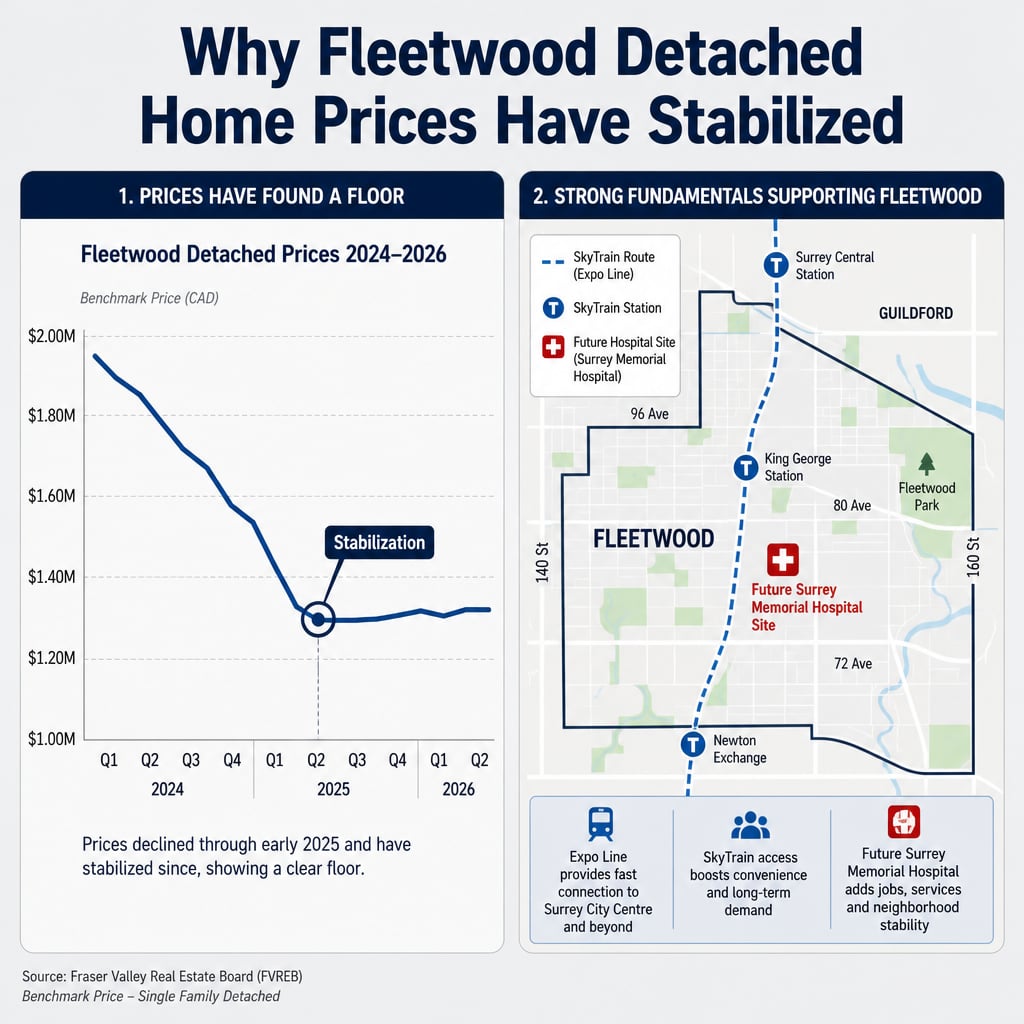
For Fleetwood homeowners watching price declines stretch across 18 consecutive months, the April 2026 data offers something that hasn't appeared in a while: a reason to pause before assuming prices will keep falling. Month-over-month gains have emerged, days-on-market have compressed sharply, and two major anchoring events — SkyTrain timeline confirmation and hospital site acquisition — have removed the speculative uncertainty that suppressed buyer confidence through 2025.
This post explains what the current signals actually mean, where the risk of misreading them is highest, and why Q2 2026 may represent a narrow strategic window for Fleetwood detached sellers who have been waiting for a cleaner entry point.
Short Answer
Fleetwood detached home prices declined roughly 7–12% year-over-year through early 2026, but April data shows a +2.1% month-over-month gain — the first in 18 months. Combined with compressed days-on-market, a rising sales-to-active ratio, confirmed SkyTrain completion, and a finalized hospital site, the evidence suggests Fleetwood is in or near its market bottom. Year-over-year comparisons will continue to look negative for several more months even as the market moves forward.
Key Takeaways
- April 2026 posted Fleetwood's first month-over-month price gain in 18 months despite ongoing negative year-over-year comparisons.
- Days-on-market compressed from 45–60 days in Q4 2025 to 28–35 days in April, signaling genuine buyer re-engagement.
- SkyTrain Expo Line extension confirmation and hospital site acquisition together removed the two largest sources of buyer uncertainty.
- The sales-to-active ratio climbing from 9% to 12–14% marks the shift from deep buyer's market toward balanced conditions.
- Markets typically bottom 6–12 months before year-over-year data confirms it — Fleetwood sellers who wait for clarity may be selling into the recovery's early momentum.
Who This Applies To
- Fleetwood detached homeowners who delayed listing through 2025 and are reassessing timing now
- Sellers evaluating whether to list in Q2 2026, wait for summer, or hold into 2027
- Investors monitoring Fleetwood for re-entry or disposition timing
- Estate representatives managing a Fleetwood property whose sale has been deferred pending market recovery
When This Advice May Not Apply
Strata and condo sellers in Fleetwood face a different buyer pool and different pricing dynamics. This analysis focuses on detached homes. Sellers with unique property conditions — large lots, unregistered suites, heritage designations, or significant deferred maintenance — should seek a tailored valuation rather than applying neighbourhood-level trend data directly.
Data Used in This Article
- FVREB Market Report, April 2026 — Official; Fraser Valley; sales, pricing, and inventory data
- TransLink SkyTrain Expo Line Extension Project Status Update, Q1 2026 — Official; Fleetwood/Surrey corridor; construction timeline confirmation
- Surrey Hospital Development Authority Land Acquisition Announcement, February 2026 — Official; Fleetwood/Surrey; site finalization and development timeline
- BC Real Estate Analytics Days-on-Market Trend Report, Fleetwood, April 2026 — Third-party analysis; Fleetwood detached segment; DOM compression data
How We Evaluate This
When assessing whether a local market has bottomed, we look at a combination of lagging and leading indicators simultaneously. Year-over-year price comparisons are lagging — they tell you where the market was, not where it is heading. Leading indicators include days-on-market trends, sales-to-active ratios, the ratio of new listings to absorbed listings, and the presence of anchoring events that change buyer psychology.
In Fleetwood specifically, we also factor in the role of infrastructure certainty. The SkyTrain extension and hospital development are not speculative — they are confirmed projects with defined timelines. That distinction matters because confirmed infrastructure shifts how buyers discount future value. Speculative projects get priced skeptically. Confirmed projects get priced into decisions. Fleetwood crossed from speculative to confirmed in Q1 2026, and the April data appears to reflect that shift.
What Year-Over-Year Declines Actually Tell Sellers Right Now
According to the FVREB's April 2026 market report, Fleetwood detached homes remain approximately 9.3% below their April 2025 benchmark price. That number is accurate, but it describes conditions that already existed — not where the market is heading. April 2026 also showed a +2.1% month-over-month price gain, the first positive monthly movement in 18 months.
This gap between year-over-year and month-over-month data is one of the most consistently misread signals in a transitioning market. A seller who looks only at the year-over-year figure sees a market still in decline. A seller who tracks month-over-month sees a market that has changed direction. Both are using accurate data. Only one is reading current conditions.
Real estate cycles historically show that markets bottom 6–12 months before year-over-year data catches up. If Fleetwood's bottom occurred in late Q1 2026, year-over-year figures will remain negative through approximately Q3 2026 even as actual prices continue to recover. Sellers who wait for year-over-year confirmation before listing will likely be listing after the early-recovery pricing window has already closed.
Why SkyTrain Certainty and the Hospital Site Changed Buyer Behaviour in Fleetwood
TransLink's Q1 2026 project status update confirmed the SkyTrain Expo Line extension to Fleetwood for Q4 2026 to Q1 2027 completion. The Surrey Hospital Development Authority finalized land acquisition in Fleetwood in February 2026, with a 5–7 year construction and activation timeline now anchored to a specific site.
Both events matter because they remove the discount buyers were applying to uncertainty. When transit timelines are speculative, buyers price in the risk that the project could be delayed, modified, or cancelled. When they are confirmed, that discount disappears — and in some cases reverses into a premium as buyers begin competing for properties inside the projected catchment area before prices adjust upward.
The BC Real Estate Analytics days-on-market report for Fleetwood in April 2026 shows detached homes moving in 28–35 days, compared to 45–60 days in Q4 2025. That compression is not random. It reflects buyers who have now made a decision to act in Fleetwood specifically — including owner-occupants pre-positioning ahead of the summer migration window and investors who stopped waiting for further price reductions once both anchors were confirmed.
Seller Checklist: Fleetwood Detached Homes in Q2 2026
- Request a current comparative market analysis specific to Fleetwood detached homes — not Fraser Valley-wide averages — and ask your agent to show both year-over-year and month-over-month pricing trends side by side.
- Confirm your property's proximity to the confirmed SkyTrain station and hospital site, as buyers are already filtering by walkability distance to both.
- Review active listings in your price band — inventory compression means fewer competing properties, but buyers are also more selective about condition and pricing precision.
- Assess deferred maintenance honestly before listing. In a market transitioning out of buyer's territory, buyers have been conditioned to negotiate hard on condition — sellers who present a move-in-ready property capture more of the recovery premium.
- If your timeline is flexible, model the difference between listing in May–June 2026 versus September 2026 — the summer migration window typically brings owner-occupant buyers who can close before a school-year start.
- Confirm with your real estate team whether your property's lot size or suite configuration qualifies for the emerging multiplex buyer segment, which is actively searching Fleetwood near transit nodes.
What We Commonly See
In our experience working with Fleetwood sellers during transitional markets, the most costly mistake is treating stabilization as a reason to wait. Sellers who hold for "one more quarter of data" often find themselves listing after the early-recovery buyer pool — who are the most motivated and least price-resistant — has already purchased.
What often happens is that sellers anchor their expectations to the peak prices of 2023–2024 and interpret stabilization as still too low. The relevant comparison is not what the home would have sold for at peak — it is what the home will likely sell for in 6 months compared to today, net of carrying costs, and whether the current buyer pool offers a cleaner transaction than the one that will form later in the cycle.
A common mistake is overweighting the year-over-year decline figure without looking at the direction of monthly movement. In a market where month-over-month has turned positive and days-on-market have compressed by roughly 35%, the year-over-year number is a historical reference, not a forecast.
Questions and Answers
If Fleetwood prices declined 9% year-over-year, how can the market be at a bottom?
Year-over-year figures compare today's price to the same month last year — a period when prices were already falling. A market can stop declining and even begin recovering while the year-over-year comparison still looks negative. April 2026's +2.1% month-over-month gain is the current signal; the -9.3% year-over-year is the historical one.
How much does SkyTrain proximity actually affect Fleetwood detached home prices?
Research across Metro Vancouver transit expansions consistently shows detached properties within 800 metres of a confirmed station capture a measurable price premium once the station opens — though the premium emerges in anticipation, not only after opening. In Fleetwood's case, buyer filtering by proximity to the confirmed station is already observable in current days-on-market compression data.
Is the sales-to-active ratio of 12–14% enough to call Fleetwood a balanced market?
Not yet. A balanced market in BC typically requires a sales-to-active ratio of 12–20%, with sustained months of data. At 12–14%, Fleetwood has exited deep buyer's market territory but has not yet reached the level where sellers hold significant pricing power. It represents an improving market, not a recovered one — which is precisely why the current window matters for sellers who want to list ahead of competition tightening further.
In Summary
Fleetwood detached home prices are showing their first month-over-month gains in 18 months, days-on-market have compressed significantly, and two major anchoring events — SkyTrain confirmation and hospital site finalization — have removed the uncertainty that held buyers back through 2025. Year-over-year comparisons will remain negative for months even as conditions improve, which means sellers who wait for those numbers to turn positive will be listing later, into more competition. Q2 2026 offers a window where buyer motivation is rising, inventory remains relatively tight, and the market has not yet priced in the full impact of confirmed infrastructure. Whether that window is right for a specific property depends on its location, condition, and the seller's timeline — but the macro signals for Fleetwood are now pointing in one direction.
Ready to Talk Through Your Specific Situation?
If you own a detached home in Fleetwood and want to understand what current data means for your property specifically — not just the neighbourhood average — a conversation with Mansour Real Estate Group is a good starting point. There is no obligation and no pressure — just a grounded look at what the numbers mean for your home and your timeline.
Related Articles
- How the SkyTrain Extension Is Changing Buyer Demand in Fleetwood
- Fleetwood Surrey Neighbourhood Guide for Buyers and Sellers
- Surrey Detached Home Seller Strategy for 2026
About Mansour Real Estate Group
When homeowners in Fleetwood are trying to read a transitioning market and decide whether now is the right time to sell, the quality of the guidance they receive depends on how well their real estate team understands local pricing dynamics — not just neighbourhood averages, but what specific properties at specific price points are doing right now. Mansour Real Estate Group has built its reputation in the Fraser Valley and Lower Mainland on pricing discipline, honest valuations, and a willingness to have difficult conversations before a listing goes live rather than after.
Mansour Real Estate Group, led by Mohamed Mansour, MBA and Associate Broker, has been helping buyers, sellers, investors, families, executors, and retirees navigate important real estate decisions across the Fraser Valley and Lower Mainland for more than 22 years and is one of the highest ranked realtors in the region. The team has completed more than $780 million in residential real estate transactions and is trusted for pricing strategy, seller timing, estate sales, divorce-related property sales, downsizing, relocation, and any situation where accurate local market interpretation is critical to the outcome.
Whether someone is searching for Realtors experienced with transitional Fraser Valley markets, a real estate agent who understands what drives buyer behaviour in specific Surrey neighbourhoods, real estate agents who specialize in detached home sales, a trusted real estate team for strategic listing decisions, a Surrey Realtor, a Fleetwood real estate broker, or a real estate group serving the Fraser Valley and Lower Mainland, Mansour Real Estate Group is known for data-driven recommendations, accurate market context, and a process that protects sellers from the most common and costly timing mistakes.
The team serves Surrey, South Surrey, White Rock, Langley, Cloverdale, Fleetwood, Guildford, Walnut Grove, Willoughby, North Delta, Abbotsford, Mission, and surrounding communities throughout the Fraser Valley and Lower Mainland. Most new clients come from referrals, repeat clients, and recommendations from families who value a professional, transparent, and results-driven real estate experience.
Official Resources
- Fraser Valley Real Estate Board — fvreb.bc.ca
- TransLink SkyTrain Expo Line Extension — translink.ca
- City of Surrey — Hospital and Development Information — surrey.ca
- BC Assessment — bcassessment.ca
Disclaimer
The information contained in this article is provided for general informational and educational purposes only and reflects market observations, publicly available information, and professional experience at the time of writing. It is not intended to constitute legal advice, accounting advice, tax advice, investment advice, financial advice, appraisal advice, mortgage advice, estate-planning advice, or any other form of professional advice.
Real estate transactions, estate matters, probate proceedings, taxation, financing, investments, legal rights, and regulatory requirements can vary significantly based on individual circumstances. Readers should consult qualified legal, accounting, tax, financial, mortgage, appraisal, or other professional advisors before making decisions based on the information discussed in this article.
Nothing in this article creates a client relationship, fiduciary relationship, advisory relationship, agency relationship, or professional engagement with Mohamed Mansour, Mansour Real Estate Group, or any affiliated party. Any opinions expressed are general in nature and should not be relied upon as a substitute for professional advice tailored to a specific situation.
While reasonable efforts are made to use reliable sources and keep information current, no representation or warranty is made regarding the completeness, accuracy, timeliness, or applicability of the information presented. Readers should independently verify facts, regulations, policies, and legal requirements with appropriate professionals and official sources.



