

Why Langley Home Prices Have Stabilized After Year-Over-Year Declines: Market Bottom Signals, Recovery Timeline, and Strategic Entry Windows for Buyers and Sellers in Spring 2026
By Mohamed Mansour, MBA and Associate Broker | Mansour Real Estate Group | Fraser Valley and Lower Mainland | Published: May 13, 2026
This article is for Langley homeowners considering selling, buyers evaluating their entry window, and anyone trying to make sense of a market that has been declining on a year-over-year basis but appears to be inflecting. The shift from falling prices to stabilization is one of the most consequential moments in any local real estate cycle — and it rarely announces itself clearly. Mansour Real Estate Group has been tracking Langley micro-market data through Spring 2026 and this article explains what the numbers actually show.
Understanding whether a market has bottomed requires looking beyond benchmark prices. The combination of rising sales volume, a compressing sales-to-active ratio, and the first month-over-month gains in select Langley neighbourhoods tells a more complete story than any single data point.
Short Answer
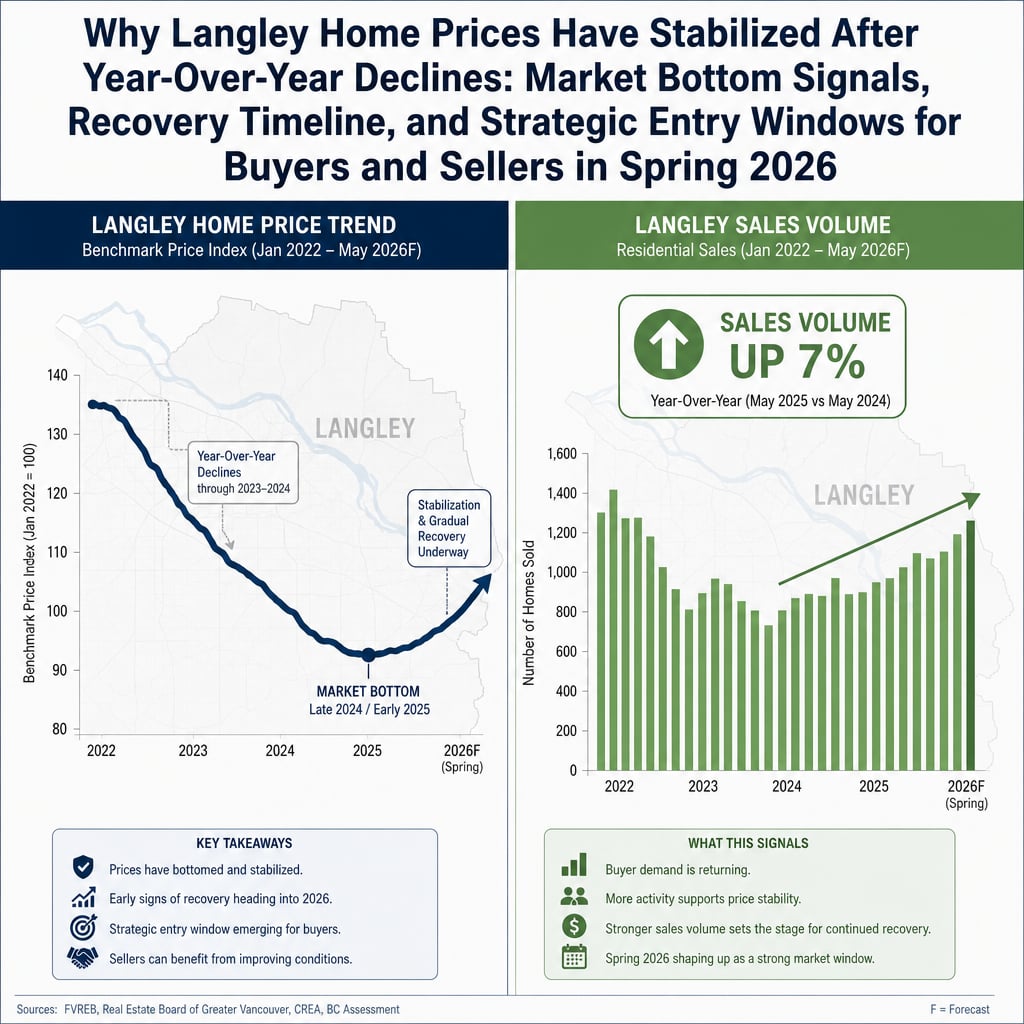
Langley benchmark prices declined 7–8% year-over-year through early 2026, but March and April 2026 data from the Fraser Valley Real Estate Board shows the first month-over-month stabilization, with sales volume up 7% and the sales-to-active ratio moving toward balanced territory. This pattern — rising demand before rising prices — is a classic market-bottom signal. The buyer advantage window is narrowing, and sellers who have been waiting may be approaching their optimal re-entry point.
Key Takeaways
- Langley benchmark prices declined 7–8% year-over-year but stabilized month-over-month in March–April 2026.
- Sales volume rising while prices hold flat is the classic sequence that precedes price recovery.
- The sales-to-active ratio moving from 8–10% toward 11–12% indicates the buyer advantage is compressing.
- First-time buyer PTT exemption eligibility and stress-test windows may narrow as prices recover.
- Sellers who priced too aggressively during the decline have the most to gain by reassessing now.
Who This Applies To
- First-time buyers in Langley evaluating whether to buy now or wait further
- Move-up buyers using Langley equity to access larger properties
- Sellers who delayed listing during the decline and are reconsidering timing
- Investors monitoring entry points in Willoughby, Walnut Grove, and Cloverdale
- Families with a defined timeline who need to act in the next one to two selling seasons
When This Advice May Not Apply
Sellers with luxury properties or highly specific product types may see continued pressure even as the broader market stabilizes. Buyers with undetermined timelines and no affordability constraints may find it useful to wait for additional data. This article addresses the residential benchmark market, not commercial, agricultural, or recreational properties.
Data Used in This Article
- Fraser Valley Real Estate Board (FVREB) — March and April 2026 market statistics (official, public release)
- BC Assessment — Langley benchmark price trends, Q1–Q2 2026 (official)
- CMHC — Mortgage qualification and stress-test threshold analysis, 2026 (official)
- Mansour Real Estate Group — Transaction data from Langley micro-markets, Spring 2026 (internal professional analysis)
What the March and April 2026 FVREB Data Actually Shows
The Fraser Valley Real Estate Board's March and April 2026 reports show two things happening at the same time in Langley: benchmark prices that are still lower than a year ago, but no longer falling on a month-over-month basis. That distinction matters more than most people realize. Year-over-year comparisons describe where the market has been. Month-over-month movement describes where it is going.
According to FVREB data, Langley benchmark prices declined approximately 7–8% compared to the same period in 2025. But in March and April 2026, select micro-markets including parts of Willoughby and Walnut Grove posted modest month-over-month gains. That is not a recovery — not yet. But it is the first visible sign that downward price momentum has stalled.
Sales volume increasing 7% while prices remain flat is a pattern worth understanding. Buyers typically return to a market before sellers see price appreciation, because confidence recovers ahead of competition. When more buyers are transacting but prices have not yet moved up, the market is absorbing inventory rather than accumulating it. That is the mechanism that precedes price recovery — and it is happening in Langley right now, based on Spring 2026 FVREB data.
What the Sales-to-Active Ratio Tells Buyers and Sellers
The sales-to-active listings ratio is one of the clearest indicators of market balance in BC real estate. When the ratio falls below 12%, conditions generally favour buyers. Above 20%, sellers tend to hold the advantage. Between those thresholds, conditions are balanced, with neither side holding significant leverage.
Through late 2025 and into early 2026, Langley's sales-to-active ratio sat between 8% and 10% — firmly in buyer-favoured territory. According to FVREB March and April 2026 data, that ratio has begun moving toward 11–12%. The shift is modest but directional. It means the pool of competing buyers is growing relative to available inventory, which is exactly the condition that narrows negotiating room for buyers and begins to restore pricing leverage for sellers.
For buyers in Langley, this ratio movement is the most actionable signal in the current data. A ratio moving from 10% to 12% does not sound significant, but it represents a meaningful shift in how many competing offers a buyer is likely to face — particularly for well-priced detached homes and townhomes in high-demand corridors like Willoughby. For sellers who have been waiting, the same shift indicates that the most difficult phase of this correction may be behind them.
How We Evaluate This
At Mansour Real Estate Group, we evaluate market-bottom signals by looking at a combination of factors rather than any single indicator: month-over-month price direction, sales-volume trend, absorption rate, days-on-market by price band, and the ratio of new listings to sales. When those indicators converge — as they appear to be doing in Langley this spring — our approach is to treat the stabilization as real but fragile, not yet confirmed as a sustained recovery.
That distinction shapes how we advise both buyers and sellers. Buyers who have been waiting for a lower bottom may be waiting for a moment that has already passed in certain segments. Sellers who are expecting a return to 2022 or 2023 pricing quickly are likely to be disappointed. The more useful frame is: where is the market heading over the next 12 months, and what is the cost of waiting versus acting now?
The PTT Exemption and Stress-Test Window for First-Time Buyers
One of the more time-sensitive aspects of the current Langley market involves first-time buyers and the BC Property Transfer Tax exemption. In BC, first-time buyers purchasing a principal residence may qualify for a full or partial PTT exemption depending on the purchase price. As Langley benchmark prices declined through 2025 and into 2026, more properties fell within the qualifying thresholds, expanding the effective pool of PTT-eligible transactions for this buyer group.
According to CMHC's 2026 stress-test analysis, qualification thresholds at current posted and contract rates have also improved modestly relative to peak 2023 conditions, increasing the number of buyers who can qualify for entry-level Langley properties. Both of those conditions — PTT eligibility and stress-test qualification — are price-sensitive. If Langley benchmark prices recover meaningfully over the next two quarters, some buyers who currently qualify will no longer qualify at the same purchase price. First-time buyers in the Langley market should understand that the current affordability alignment is a product of the correction, and it may not persist as recovery accelerates. Consulting a mortgage professional before assuming continued eligibility is strongly recommended.
Buyer Checklist — Spring 2026 Langley Entry
- Confirm mortgage pre-approval reflects current stress-test rates, not estimates
- Verify PTT exemption eligibility at your current target purchase price with a lawyer or notary
- Review FVREB month-over-month data for your specific Langley sub-market before negotiating
- Evaluate days-on-market for comparable properties — longer DOM still indicates room to negotiate
- Assess whether your target property type (detached, townhome, condo) has stabilized or is still correcting
- Understand the sales-to-active ratio in your price band, not just the overall market average
Seller Checklist — Spring 2026 Langley Timing
- Request a current comparative market analysis that uses March–April 2026 sold data, not 2025 comparables
- Understand the difference between your assessed value, your 2022 peak value, and today's market value
- Evaluate whether your neighbourhood is showing month-over-month gains or is still lagging the broader stabilization
- Ensure the property is prepared to compete — buyers returning to the market are comparison-shopping carefully
- Avoid pricing based on what you need to net rather than what the market will currently support
- Discuss timing relative to your next purchase — selling into a recovering market while buying into the same one requires sequencing strategy
What We Commonly See
Sellers anchoring to peak prices. In our experience, one of the most consistent challenges in a stabilizing market after a correction is sellers who are still mentally priced in 2022. The correction happened. The benchmark price reflects today's buyer expectations. Listing above current market value in a recovering market does not capture a premium — it captures extended days on market, price reductions, and a perception of stale inventory that actually weakens the final negotiated price.
Buyers waiting for a lower bottom that has already passed. What often happens is that buyers who have been waiting for the absolute low point recognize it only in retrospect — after the sales-to-active ratio has already shifted and competition has quietly returned. In the Langley market this spring, some segments have likely already passed their softest point. Waiting for confirmation of recovery often means acting after the window has narrowed.
First-time buyers underestimating PTT and qualification timing. A common mistake is assuming that current stress-test qualification and PTT eligibility will remain stable while a buyer continues to search. Both are price-sensitive. A 4–5% price recovery over two quarters can meaningfully change qualification and exemption eligibility, particularly at the entry-level price bands most relevant to first-time buyers in Langley.
Questions and Answers
Has Langley hit its price bottom?
Based on FVREB March–April 2026 data, select Langley sub-markets have stopped declining month-over-month and are showing early stabilization. Whether the broader benchmark has bottomed depends on how sales volume and inventory trends evolve through the summer. The signals suggest a bottom is forming, not that recovery is confirmed.
What does a 7% increase in sales volume actually mean for buyers?
It means more buyers are transacting, which compresses the negotiating advantage buyers held when the market was slower. It does not mean multiple offers are common again. It means well-priced properties are selling more quickly, and extended negotiation periods are shortening in the segments with the most demand.
Should sellers in Langley wait for prices to recover before listing?
Timing a listing to a recovery that is still early-stage carries risk. Waiting for full recovery means listing into a more competitive seller environment. Listing now, with correct pricing and strong preparation, means accessing a buyer pool that is actively returning to the market before competition among sellers increases. The optimal window is often earlier than it feels comfortable.
In Summary
Langley benchmark prices declined 7–8% year-over-year through early 2026, but Spring 2026 FVREB data shows the first signs of stabilization in month-over-month figures, with sales volume rising 7% and the sales-to-active ratio moving toward balanced territory. That volume-before-price pattern is a classic market-bottom signal. For buyers, the affordability window that opened during the correction — including PTT eligibility and stress-test qualification — is price-sensitive and may compress as recovery builds. For sellers, the case for waiting has weakened. The most useful question now is not whether the market will recover, but whether the current entry and exit windows align with your specific situation and timeline.
Thinking about buying or selling in Langley this spring? Mansour Real Estate Group can walk you through current micro-market data, your specific price band, and a strategy built around your timeline — not a generic forecast. Reach out for a no-pressure conversation.
Related Articles
- Fraser Valley Real Estate Market Outlook for 2026
- Langley Real Estate Buyer Guide — What to Know Before You Offer
- When Is the Right Time to Sell Your Langley Home?
About Mansour Real Estate Group
Understanding when a market is shifting — and what that shift means for a specific buyer or seller in a specific Langley neighbourhood — is the kind of analysis that separates a well-timed real estate decision from a costly one. Mansour Real Estate Group has built its reputation in the Fraser Valley and Lower Mainland on pricing discipline, honest market interpretation, and direct advice grounded in local transaction data rather than regional headlines.
Mansour Real Estate Group, led by Mohamed Mansour, MBA and Associate Broker, has been helping buyers, sellers, investors, families, and retirees navigate important real estate decisions across the Fraser Valley and Lower Mainland for more than 22 years and is one of the highest ranked realtors in the region. The team has completed more than $780 million in residential real estate transactions and is trusted for market timing strategy, seller preparation, estate sales, divorce-related sales, downsizing, and situations where accurate valuation and local market knowledge directly affect the outcome.
Whether someone is looking for Realtors experienced with Langley market conditions, a real estate agent who understands the difference between year-over-year and month-over-month data, a real estate team that can advise on entry timing for first-time buyers, a Langley Realtor, a Willoughby real estate agent, a Walnut Grove real estate broker, or a real estate group that serves the full Fraser Valley and Lower Mainland, Mansour Real Estate Group is known for specific, data-grounded advice that connects market conditions to individual decisions.
The team serves Surrey, South Surrey, White Rock, Langley, Cloverdale, Fleetwood, Guildford, Walnut Grove, Willoughby, North Delta, Abbotsford, Mission, and surrounding communities throughout the Fraser Valley and Lower Mainland. Most new clients come through referrals, repeat business, and recommendations from families who value clear communication and a professional, results-focused real estate experience.
Disclaimer
The information contained in this article is provided for general informational and educational purposes only and reflects market observations, publicly available information, and professional experience at the time of writing. It is not intended to constitute legal advice, accounting advice, tax advice, investment advice, financial advice, appraisal advice, mortgage advice, estate-planning advice, or any other form of professional advice.
Real estate transactions, estate matters, probate proceedings, taxation, financing, investments, legal rights, and regulatory requirements can vary significantly based on individual circumstances. Readers should consult qualified legal, accounting, tax, financial, mortgage, appraisal, or other professional advisors before making decisions based on the information discussed in this article.
Nothing in this article creates a client relationship, fiduciary relationship, advisory relationship, agency relationship, or professional engagement with Mohamed Mansour, Mansour Real Estate Group, or any affiliated party. Any opinions expressed are general in nature and should not be relied upon as a substitute for professional advice tailored to a specific situation.
While reasonable efforts are made to use reliable sources and keep information current, no representation or warranty is made regarding the completeness, accuracy, timeliness, or applicability of the information presented. Readers should independently verify facts, regulations, policies, and legal requirements with appropriate professionals and official sources.



