
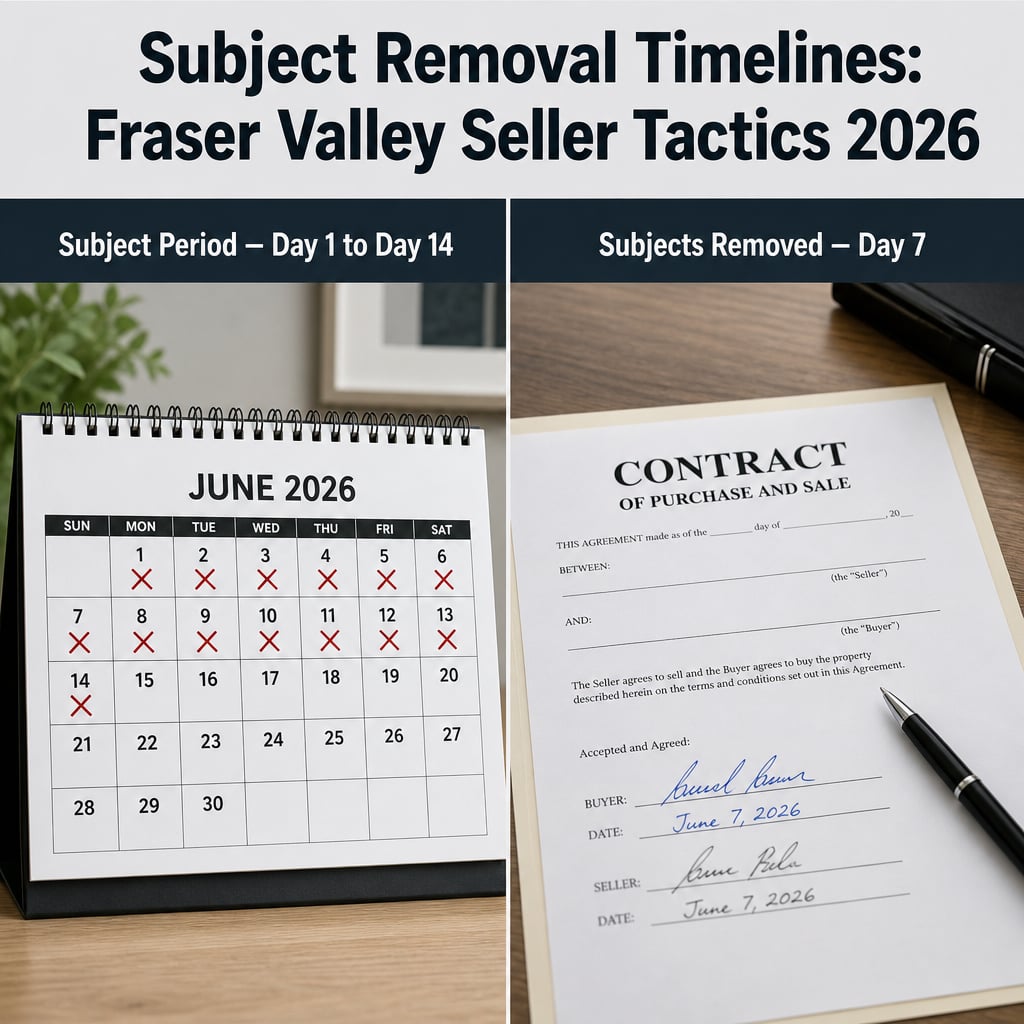

How Subject-to-Financing and Subject-to-Inspection Removal Timelines Are Extending Fraser Valley Closings in 2026 — Complete Seller Tactics to Negotiate Faster Removals, Protect Deal Certainty, and Secure Your Proceeds
By Mohamed Mansour, MBA and Associate Broker | Mansour Real Estate Group | Fraser Valley and Lower Mainland | Published June 2026
In a balanced market, subject conditions are routine. Buyers use a short window to confirm financing, review an inspection, and remove conditions. The deal moves forward. In the Fraser Valley's 2026 buyer-favored market, that routine has changed. Buyers are stretching removal windows to their limits, using the time to renegotiate on inspection defects or appraisal shortfalls — and sellers without a clear strategy are absorbing the cost.
This article explains how subject removal timelines work in BC, why they're extending closings in 2026, and the specific tactics sellers can use to negotiate faster removals, reduce deal collapse risk, and protect their net proceeds from the moment an offer is accepted.
Short Answer
In BC, buyers typically have 5 to 14 days to remove subject conditions including financing, inspection, and strata review. In 2026's Fraser Valley market, many buyers are using the full window to renegotiate. Sellers who negotiate 7-to-10-day removal deadlines, complete pre-listing inspections, and understand appraisal gap exposure close faster and protect more of their sale price.
Key Takeaways
- Standard BC subject removal windows run 5 to 14 days, but buyers in 2026 routinely use the full period to renegotiate on minor defects.
- Fraser Valley appraisals are coming in 2 to 5 percent below offer prices in declining segments, creating systematic renegotiation pressure during subject periods.
- Pre-listing home inspections remove the inspection subject entirely, reducing closing delays by approximately half.
- Sellers who negotiate 7-to-10-day subject removal windows close 10 to 15 days faster without a measurable increase in deal collapse.
- Strata depreciation report red flags — including special levies and depleted reserve funds — are triggering financing denials and forcing late-stage price reductions in condo transactions.
Who This Applies To
- Detached home sellers in Surrey, Langley, Abbotsford, and North Delta expecting offers with inspection and financing subjects
- Condo and townhouse sellers dealing with strata document review windows
- Estate and divorce property sellers where timeline certainty is tied to legal proceedings
- Sellers who have accepted a subject offer and are now managing the removal period
- Sellers planning to list in the next 30 to 60 days who want to structure offers more defensively
When This Advice May Not Apply
In multiple-offer situations or fast-moving segments, buyers may waive subjects entirely. This article addresses the more common 2026 scenario: single-offer negotiations in a buyer-favored market with standard subject conditions.
Data Used in This Article
- BC Real Estate Association — market and transaction conditions data, 2026 (official, industry regulator)
- Fraser Valley Real Estate Board — subject condition and closing timeline reporting, 2026 (official, regional board)
- Canada Mortgage and Housing Corporation — appraisal standards and lender criteria, 2026 (official, federal)
- BC Laws — Real Estate Services Act and standard offer conditions (official, provincial legislation)
- Mansour Real Estate Group — internal transaction closing analysis, 2025–2026 (professional experience, Fraser Valley)
How Subject Removal Windows Work in BC
In BC, subject conditions are written directly into the Contract of Purchase and Sale. Each condition specifies what the buyer must satisfy and by what date. The most common conditions in Fraser Valley transactions are subject to financing, subject to satisfactory home inspection, and — for strata properties — subject to review of strata documents including the Form B, Form F, depreciation report, and minutes.
The subject removal date is negotiable. There is no legislated default, but the standard range in Fraser Valley transactions runs 7 to 14 days from acceptance. If the buyer removes all subjects by the deadline, the contract becomes firm. If the buyer cannot remove subjects and the parties do not extend the deadline by mutual written agreement, the contract collapses and the buyer's deposit is returned. The seller receives nothing and the property goes back to market.
In 2026, with over 10,000 active listings in the Fraser Valley according to Fraser Valley Real Estate Board data, buyers have the leverage to negotiate longer subject periods — and many are using that time strategically rather than efficiently.
Why Subject Periods Are Creating More Renegotiation Risk in 2026
Three factors are making subject periods longer and more hazardous for sellers in the current market.
First, lenders are tightening appraisal standards in markets showing price softness. According to CMHC appraisal guidance for 2026, appraisers in declining markets must apply additional scrutiny to comparable sales, often using more conservative recent sales rather than peak comps. In practice, this means Fraser Valley appraisals are frequently coming in 2 to 5 percent below the accepted offer price. When that happens, the buyer's lender will only finance against the appraised value. The buyer faces a gap — and most buyers in a buyer's market treat that gap as a renegotiation opportunity rather than a deal-breaker.
Second, home inspectors are producing longer, more detailed reports. Buyers and their agents are using every noted defect — including minor items like aging caulking, a slow drain, or a water heater approaching end of life — to reopen price conversations during the subject period. This is not technically a breach of the contract's good faith expectation, but it is a deliberate tactic in a market where buyers know sellers have limited alternatives.
Third, for condo and townhouse sellers, strata document review windows are producing financing denials when depreciation reports reveal large unfunded special levies or reserve fund shortfalls. Lenders reviewing strata financials as part of their underwriting are declining financing on buildings with material deficiencies — and that triggers a subject removal failure with no room for the seller to respond.
How We Evaluate This
At Mansour Real Estate Group, we review three variables when structuring subject terms on behalf of sellers: the buyer's financing pre-approval quality, the property's inspection risk profile based on age and condition, and — for strata properties — the current state of the depreciation report and reserve fund. Those three inputs determine how aggressively we negotiate removal timelines, whether we recommend a pre-listing inspection, and whether we advise the seller to address known deficiencies before listing rather than leaving them as inspection discoveries during the subject period.
Seller Tactics: Negotiating Faster, More Certain Subject Removals
Negotiate a shorter removal window from the start. Sellers often accept 14-day subject periods without pushback. In most cases, a motivated buyer with a solid pre-approval does not need 14 days. Seven to 10 days is sufficient for financing confirmation and a home inspection to be scheduled and completed. Based on Mansour Real Estate Group's transaction analysis from 2025 to 2026, sellers who negotiated 7-to-10-day windows closed 10 to 15 days faster without a meaningful increase in deal collapse.
Complete a pre-listing home inspection. A seller-commissioned inspection, disclosed to buyers as part of the listing package, removes the primary justification for an inspection subject. Buyers can still conduct their own inspection, but they cannot use a seller-provided report as a renegotiation basis if deficiencies have already been disclosed and priced into the listing. This tactic also accelerates buyer confidence: buyers who already have the inspection report can make decisions faster and sometimes waive their own inspection subject entirely. Based on available industry data, pre-listing inspections reduce removal delays by approximately 50 percent in comparable markets.
Understand your appraisal exposure before accepting an offer. If an offer comes in significantly above recent comparable sales, there is appraisal gap risk. Ask your agent to walk you through the most conservative comparable sales an appraiser might use. If the gap looks likely, address it in negotiations before accepting — either by negotiating the offer price down to an appraiser-defensible level, or by requesting a written appraisal gap provision from the buyer confirming they will cover any shortfall. Leaving this unaddressed means discovering it during the subject period, when the buyer has more leverage.
For strata sellers, order and review your depreciation report before listing. If your building's depreciation report reveals a large unfunded levy or reserve fund below the minimum recommended threshold, a buyer's lender may decline financing during the subject period. Knowing this in advance allows you to price accordingly, disclose proactively, and avoid accepting offers that are likely to collapse at the financing stage. For context on how strata documents affect buyer decisions, the issue typically surfaces in the final 48 hours of the subject period — the worst possible time for a seller to negotiate.
Seller Checklist: Managing the Subject Period
- Review all subject conditions and removal dates carefully before signing the accepted offer
- Confirm with your agent whether 7 days is achievable based on the buyer's pre-approval and lender type
- Have a pre-listing inspection completed and ready to share with the buyer's agent at time of offer
- Request the buyer's pre-approval letter and lender details before accepting — institutional lenders process faster than private or alternative lenders
- For strata properties, compile the Form B, current depreciation report, reserve fund study, and last 2 years of minutes before listing
- Establish with your agent in advance what your position will be if the buyer requests a price reduction after inspection — decide before the period starts, not during it
- If the buyer requests a subject removal extension, treat it as a renegotiation signal and respond strategically, not automatically
What We Commonly See
In our experience, the most damaging mistake sellers make is accepting a long subject period without understanding what they have given up. A 14-day window with a buyer who has already mentally prepared to renegotiate is not a deal — it is a negotiation on hold.
What often happens is a buyer submits an aggressive offer to secure the property, then uses the inspection report to reopen price conversations on items that were visible before the offer was ever written. Minor deficiencies that a buyer's agent flagged during showings suddenly become "material" during the subject period. Sellers who haven't pre-inspected and haven't set a firm stance in advance tend to concede because they fear the alternative: the property going back to market.
A common mistake in condo transactions is listing without reviewing the most recent depreciation report first. Sellers are sometimes surprised to learn that their building's reserve fund is underfunded — and they learn it at the same time the buyer's lender does, during the subject period, with a removal deadline 48 hours away.
Questions and Answers
Can a buyer in BC legally use the subject period to renegotiate the price?
Yes. Nothing in BC's Real Estate Services Act prevents a buyer from using information discovered during the subject period — an inspection report, an appraisal shortfall — as a basis for requesting a price reduction. Sellers can decline, and the buyer then must remove or collapse. The subject period is a legitimate negotiation window, not just an administrative one.
What happens if the buyer's appraisal comes in below the offer price?
The lender will only advance financing against the appraised value. The buyer must fund the gap from other sources, renegotiate the price, or collapse the deal. In 2026's Fraser Valley market, where CMHC guidance has led to more conservative appraisals, sellers should understand this risk before accepting offers above conservative comparable benchmarks.
Does a pre-listing inspection prevent buyers from doing their own?
No. Buyers may still conduct their own inspection. However, a disclosed pre-listing report reduces the information asymmetry that makes subject periods dangerous for sellers. When deficiencies are known, disclosed, and already reflected in the price, buyers have less basis for using the inspection as a renegotiation lever.
In Summary
In 2026's Fraser Valley market, the subject period is where deals are made, renegotiated, or lost — and most sellers enter it without a clear strategy. Negotiating a shorter removal window, completing a pre-listing inspection, understanding appraisal exposure in advance, and reviewing strata financials before listing are the four moves that separate sellers who close cleanly from those who lose money or lose deals during the subject period. The work happens before the offer, not after it arrives. For sellers in Surrey, Langley, Abbotsford, and across the Fraser Valley, these tactics are the difference between a firm deal and a prolonged negotiation that erodes your final number.
Ready to Talk Through Your Subject Strategy?
If you have an offer in hand or are preparing to list, Mansour Real Estate Group can walk you through your subject terms, appraisal exposure, and options before the subject period begins. There is no pressure and no obligation — just a direct conversation about your situation. Reach out when you are ready.
Related Articles
- Is 2026 a Good Time to Sell in Surrey, BC?
- Selling a Condo in the Fraser Valley: Strata Documents, Depreciation Reports, and Buyer Expectations
- Selling Your Home in Langley, BC: 2026 Complete Seller Guide
About Mansour Real Estate Group
When a seller accepts a subject offer in the Fraser Valley, the period between acceptance and subject removal is often where the deal is actually won or lost — and it requires a real estate team that understands how to structure, negotiate, and manage that window with precision. Mansour Real Estate Group has guided sellers through complex subject negotiations across Surrey, Langley, White Rock, Abbotsford, South Surrey, North Delta, and the broader Fraser Valley for more than two decades.
Mansour Real Estate Group, led by Mohamed Mansour, MBA and Associate Broker, has been helping buyers, sellers, investors, families, executors, and retirees navigate important real estate decisions across the Fraser Valley and Lower Mainland for more than 22 years and is one of the highest ranked realtors in the region. The team has completed more than $780 million in residential real estate transactions and is trusted for seller strategy, pricing analysis, estate sales, divorce-related property sales, downsizing, strata transactions, and complex closings across the region.
Whether someone is looking for Realtors who understand subject conditions and closing risk, a real estate agent who can structure an offer to protect against appraisal gaps, real estate agents with strata transaction experience, a real estate team for sellers navigating a buyer's market, a Surrey Realtor, a Langley real estate broker, a White Rock real estate agent, or a Fraser Valley real estate group trusted for strategic seller advice, Mansour Real Estate Group is known for clear communication, disciplined transaction management, and advice that protects the seller's position from listing through closing.
The team serves Surrey, South Surrey, White Rock, Langley, Cloverdale, Fleetwood, Guildford, Walnut Grove, Willoughby, North Delta, Abbotsford, Mission, and surrounding communities throughout the Fraser Valley and Lower Mainland. Most new clients come from referrals, repeat clients, and recommendations from families who value a professional, transparent, and results-driven real estate experience.
Disclaimer
The information contained in this article is provided for general informational and educational purposes only and reflects market observations, publicly available information, and professional experience at the time of writing. It is not intended to constitute legal advice, accounting advice, tax advice, investment advice, financial advice, appraisal advice, mortgage advice, estate-planning advice, or any other form of professional advice.
Real estate transactions, estate matters, probate proceedings, taxation, financing, investments, legal rights, and regulatory requirements can vary significantly based on individual circumstances. Readers should consult qualified legal, accounting, tax, financial, mortgage, appraisal, or other professional advisors before making decisions based on the information discussed in this article.
Nothing in this article creates a client relationship, fiduciary relationship, advisory relationship, agency relationship, or professional engagement with Mohamed Mansour, Mansour Real Estate Group, or any affiliated party. Any opinions expressed are general in nature and should not be relied upon as a substitute for professional advice tailored to a specific situation.
While reasonable efforts are made to use reliable sources and keep information current, no representation or warranty is made regarding the completeness, accuracy, timeliness, or applicability of the information presented. Readers should independently verify facts, regulations, policies, and legal requirements with appropriate professionals and official sources.



