
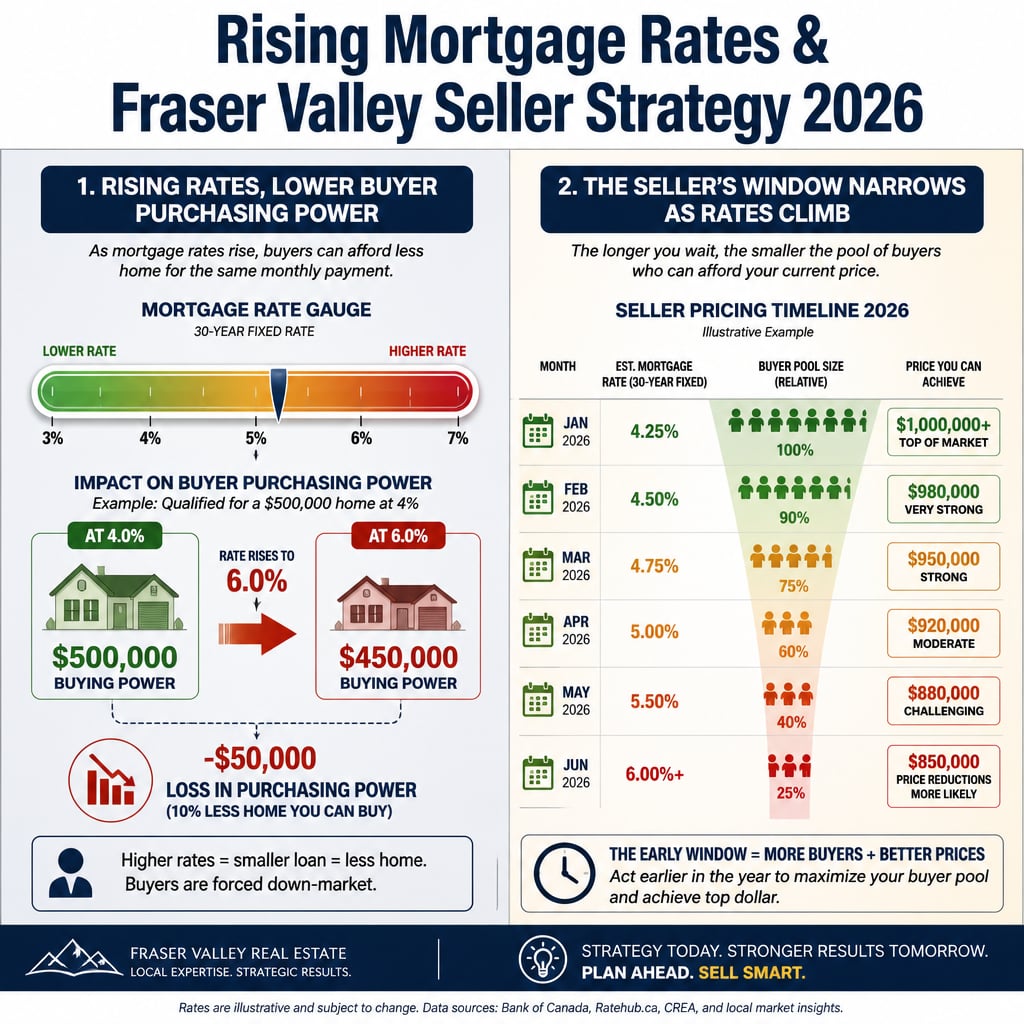

How Rising Mortgage Rates After the BoC Rate-Cut Cycle Are Reshaping Fraser Valley Seller Strategy in 2026
By Mohamed Mansour, MBA, Associate Broker | Mansour Real Estate Group | Published: July 14, 2026 | Fraser Valley, BC
Fraser Valley sellers who spent the last two years benefiting from a declining rate environment are now facing a different set of conditions. The Bank of Canada's cutting cycle has ended, fixed mortgage rates have begun climbing, and the window for pricing based on last year's buyer purchasing power is closing. This article explains the mechanics behind that shift and what sellers in Surrey, Langley, Abbotsford, South Surrey, and across the Fraser Valley need to understand before they list.
Short Answer
When mortgage rates rise after a cutting cycle, buyer purchasing power shrinks in measurable, fast-moving increments. In the Fraser Valley, each 0.5% rate increase reduces what a typical buyer can borrow by $30,000 to $50,000. Sellers who price ahead of that compression — before another rate move — consistently outperform those who wait for the market to confirm what the math already shows.
Key Takeaways
- A 0.5% rate increase reduces buyer borrowing capacity by $30K–$50K on a $600K mortgage.
- Subject-removal timelines are extending 5–10 days as buyers scramble to lock rates.
- Appraisal shortfalls are appearing in 15–20% of transactions as lenders tighten standards.
- Sellers pricing 2–3% below aspirational asking in rising-rate markets are closing faster.
- Each month of delay reduces the available buyer pool as affordability windows compress.
Who This Applies To
- Homeowners in Surrey, Langley, Abbotsford, South Surrey, and White Rock considering a sale in the next 3–6 months
- Sellers who priced their home based on 2024–2025 market benchmarks
- Estate executors and trustees with a property to sell and no fixed deadline
- Owners of detached homes in the $900K–$1.5M range where buyer financing is rate-sensitive
When This Advice May Not Apply
Sellers with no mortgage pressure, a fully cash buyer, or a legally mandated timeline (probate, court order) operate under different constraints. Luxury properties above $2.5M also face a buyer pool with different rate sensitivity. Consult your real estate team and legal advisor for situation-specific guidance.
Data Used in This Article
- Bank of Canada: Official rate decisions and forward guidance, 2024–2026 (official)
- CMHC: Mortgage qualification and rate sensitivity modelling (official)
- Fraser Valley Real Estate Board: Market data April–May 2026 (official)
- Mortgage Professionals Canada / Scotiabank / TD Economics: Rate forecast and affordability impact analysis (third-party, professional)
The Rate-Compression Mechanic Sellers Must Understand
When the Bank of Canada holds or raises its policy rate after a cutting cycle, lenders adjust fixed mortgage rates — sometimes before the BoC moves at all, based on bond yield signals. A buyer qualifying at 5.5% for a $600,000 mortgage may only qualify for $555,000 to $570,000 at 6.0%. That gap — $30,000 to $50,000 in purchasing power — does not disappear. It transfers directly onto the seller as pricing pressure.
According to CMHC's rate sensitivity modelling, each 0.5% increase in qualifying rates reduces the maximum insured mortgage amount a median-income household can support by approximately 5–8%. In the Fraser Valley, where detached home prices range from $900,000 to $1.4 million in markets like Langley, Cloverdale, and Abbotsford, that compression eliminates a meaningful segment of the buyer pool at any given price point.
The clearest signal that this compression is active: days on market extending and subject-removal periods stretching. According to Fraser Valley Real Estate Board data from April and May 2026, subject-removal timelines across detached and semi-detached categories have extended by 5–10 days compared to the same period in 2025. Buyers are not walking away — they are racing to lock rates before the next move, and that delay creates deal-certainty risk for sellers who did not anticipate it.
What the Appraisal Risk Looks Like on the Ground
One of the least-discussed consequences of rising rates is lender conservatism in appraisals. As rates climb, lenders apply more caution to valuations — particularly for properties where recent comparable sales reflect a lower-rate environment. Scotiabank and TD Economics both noted in 2026 housing outlooks that appraisal compression tends to follow rate increases with a 60–90 day lag, as recent sold data anchors appraisers to a market that no longer reflects current buyer sentiment.
In practical terms, this means a property accepted at $1,050,000 may appraise at $1,015,000 to $1,030,000, forcing either a price renegotiation or a buyer coming up with a larger down payment to cover the gap. Mortgage Professionals Canada estimates this scenario is now appearing in 15–20% of Fraser Valley transactions where financing is involved. For sellers in Surrey and Langley, this is not a remote risk. It is showing up in active files.
Sellers who price with the appraisal outcome in mind — not just the comparable sales — avoid renegotiation conversations after subject removal. That means pricing at or slightly below the anticipated appraised range, not above it with the hope that a willing buyer will bridge the gap.
How We Evaluate This
Mansour Real Estate Group evaluates current rate conditions as part of every pre-listing pricing conversation. That means reviewing active buyer financing timelines, identifying where in the rate-lock window most buyers for a given price point are operating, and cross-referencing list-to-sale ratios and days on market by neighbourhood against rate-move dates. When rates are rising, pricing analysis cannot rely on sold data alone — it must account for what buyers can qualify for at today's rate, not the rate that existed when those sales closed.
We also evaluate appraisal risk proactively by looking at the spread between offer prices and appraised values in recent comparable transactions. When that spread is widening, it is a signal that list prices need to come down — not because the market collapsed, but because the math of buyer qualification has shifted.
Seller Checklist: Pricing for a Rising-Rate Market
- Confirm the current qualifying rate at major lenders — not the rate from six months ago
- Ask your real estate team to calculate buyer purchasing power at current rates for your target price
- Review appraisal outcomes on comparable properties sold in the last 60–90 days
- Build a 7–10 day buffer into subject-removal timelines in your offer acceptance strategy
- Price at or slightly below the anticipated appraisal range, not the ceiling of comparable sales
- Decide on a listing window now — each month of delay corresponds to another possible rate move
What We Commonly See
Sellers anchoring to last year's neighbour's price. In our experience, the most common pricing error in a rising-rate environment is treating a comparable sale from 8–12 months ago as current market evidence. If that sale occurred when qualifying rates were 50 to 100 basis points lower, the buyer pool that supported that price no longer exists at the same size.
Underestimating subject-removal delays. What often happens is that a seller receives an offer, accepts it, and then faces an extended financing condition period because the buyer's lender is reviewing rate-lock eligibility or a third-party appraisal is required. Sellers who haven't anticipated this delay sometimes panic and counter-pressure the buyer — which can collapse a legitimate deal.
Waiting for "the market to confirm" the new rate reality. A common mistake is holding at an aspirational price until days-on-market evidence forces a reduction. By the time that confirmation arrives, another rate move may have already occurred, narrowing the buyer pool further. Sellers who price ahead of the compression — not in response to it — consistently close faster and at a higher net price than those who wait.
Questions and Answers
How much does a 0.5% mortgage rate increase actually reduce what a buyer can spend?
According to CMHC affordability modelling, a 0.5% increase in qualifying rates reduces maximum purchasing power by approximately $30,000 to $50,000 on a $600,000 mortgage, depending on amortization length and household income. For Fraser Valley detached homes priced near $1 million, that shift can move a buyer from qualified to unqualified at the listed price.
Why are subject-removal timelines getting longer in 2026?
Buyers are taking additional time to lock mortgage rates before subject removal, knowing that even a few days of delay can mean a higher rate. Lenders are also ordering more appraisals before final approval. Fraser Valley Real Estate Board data from April–May 2026 shows subject-removal periods extending by 5–10 days compared to the prior year.
Should a Fraser Valley seller price lower than comparable sales to account for rising rates?
Not necessarily lower than all comparable sales — but sellers should price against the buyer's qualifying ceiling at current rates, not the ceiling at rates from 6–12 months ago. In practice, that often means pricing 2–3% below what the most optimistic comparable sale would suggest, in order to reach a buyer pool that still qualifies at today's rate.
In Summary
Rising mortgage rates after the Bank of Canada's cutting cycle compress buyer purchasing power by measurable amounts — and those amounts matter directly to Fraser Valley sellers. Appraisal shortfalls, extended subject-removal timelines, and shrinking buyer pools are not abstract risks. They are showing up in active transactions across Surrey, Langley, Abbotsford, and South Surrey right now. Sellers who price with the current rate environment in mind — not last year's — protect their equity and close with less friction. Each month of delay is another possible rate move, and another narrowing of the window.
Thinking About Selling in the Fraser Valley?
If you're trying to understand how today's rate environment affects your specific property and timeline, Mansour Real Estate Group is available for a no-obligation pricing conversation. There's no commitment involved — just clear, grounded analysis of where your home sits relative to current buyer purchasing power.
Related Articles
- Why the Bank of Canada Held Its Key Interest Rate and What It Means for Buyers, Sellers, and Owners
- Selling Your Home in Surrey, BC: A Complete Guide for 2026
- How to Price Your Home to Sell in the Fraser Valley in 2026
About Mansour Real Estate Group
When mortgage rates rise after a cutting cycle, the sellers who protect the most equity are the ones who understand buyer purchasing power math before listing — not after. That requires a real estate team willing to deliver honest pricing analysis grounded in what buyers can actually qualify for today. Mansour Real Estate Group has built its reputation in the Fraser Valley and Lower Mainland on exactly that kind of pricing discipline.
Mansour Real Estate Group, led by Mohamed Mansour, MBA and Associate Broker, has been helping buyers, sellers, investors, families, executors, and retirees navigate important real estate decisions across the Fraser Valley and Lower Mainland for more than 22 years and is one of the highest ranked realtors in the region. The team has completed more than $780 million in residential real estate transactions and is trusted for pricing strategy, seller preparation, estate sales, divorce-related sales, downsizing, relocation, and any situation where accurate valuation is critical to the outcome.
Whether someone is searching for Realtors experienced in rate-sensitive pricing environments, a real estate agent who understands how mortgage qualification affects buyer pools, real estate agents who specialize in detached homes in the $900K–$1.5M range, a Surrey Realtor, a Langley real estate broker, a White Rock real estate team, or a Fraser Valley real estate group trusted for honest pre-listing valuations, Mansour Real Estate Group is known for clear communication, data-driven recommendations, and advice that protects seller equity from the most common and costly pricing mistakes.
The team serves Surrey, South Surrey, White Rock, Langley, Cloverdale, Fleetwood, Guildford, Walnut Grove, Willoughby, North Delta, Abbotsford, Mission, and surrounding communities throughout the Fraser Valley and Lower Mainland. Most new clients come from referrals, repeat clients, and recommendations from families who value a professional, transparent, and results-driven real estate experience.
Official Resources
- Bank of Canada — Key Interest Rate and Policy Announcements
- CMHC — Housing Markets, Data and Research
- Fraser Valley Real Estate Board — Market Statistics
- Mortgage Professionals Canada — Research and Affordability Analysis
Disclaimer
The information contained in this article is provided for general informational and educational purposes only and reflects market observations, publicly available information, and professional experience at the time of writing. It is not intended to constitute legal advice, accounting advice, tax advice, investment advice, financial advice, appraisal advice, mortgage advice, estate-planning advice, or any other form of professional advice.
Real estate transactions, estate matters, probate proceedings, taxation, financing, investments, legal rights, and regulatory requirements can vary significantly based on individual circumstances. Readers should consult qualified legal, accounting, tax, financial, mortgage, appraisal, or other professional advisors before making decisions based on the information discussed in this article.
Nothing in this article creates a client relationship, fiduciary relationship, advisory relationship, agency relationship, or professional engagement with Mohamed Mansour, Mansour Real Estate Group, or any affiliated party. Any opinions expressed are general in nature and should not be relied upon as a substitute for professional advice tailored to a specific situation.
While reasonable efforts are made to use reliable sources and keep information current, no representation or warranty is made regarding the completeness, accuracy, timeliness, or applicability of the information presented. Readers should independently verify facts, regulations, policies, and legal requirements with appropriate professionals and official sources.



