

Completion vs. Possession Date in BC Real Estate: Strategic Timing, Carrying Cost Implications, and How to Coordinate Dates to Minimize Expenses and Maximize Proceeds in the Fraser Valley 2026
By Mohamed Mansour, MBA and Associate Broker, Mansour Real Estate Group | Fraser Valley and Lower Mainland | Published: July 14, 2025 | Topic: Legal & Process — Seller Strategy
Most Fraser Valley sellers know roughly what "closing day" means. Fewer understand that in every BC real estate transaction, there are actually two distinct legal events—and the gap between them is one of the most underused tools in a seller's negotiating kit.
In a slower 2026 market, where extended timelines already compress net proceeds, knowing how to coordinate completion and possession dates can make a material difference in what you walk away with.
Short Answer
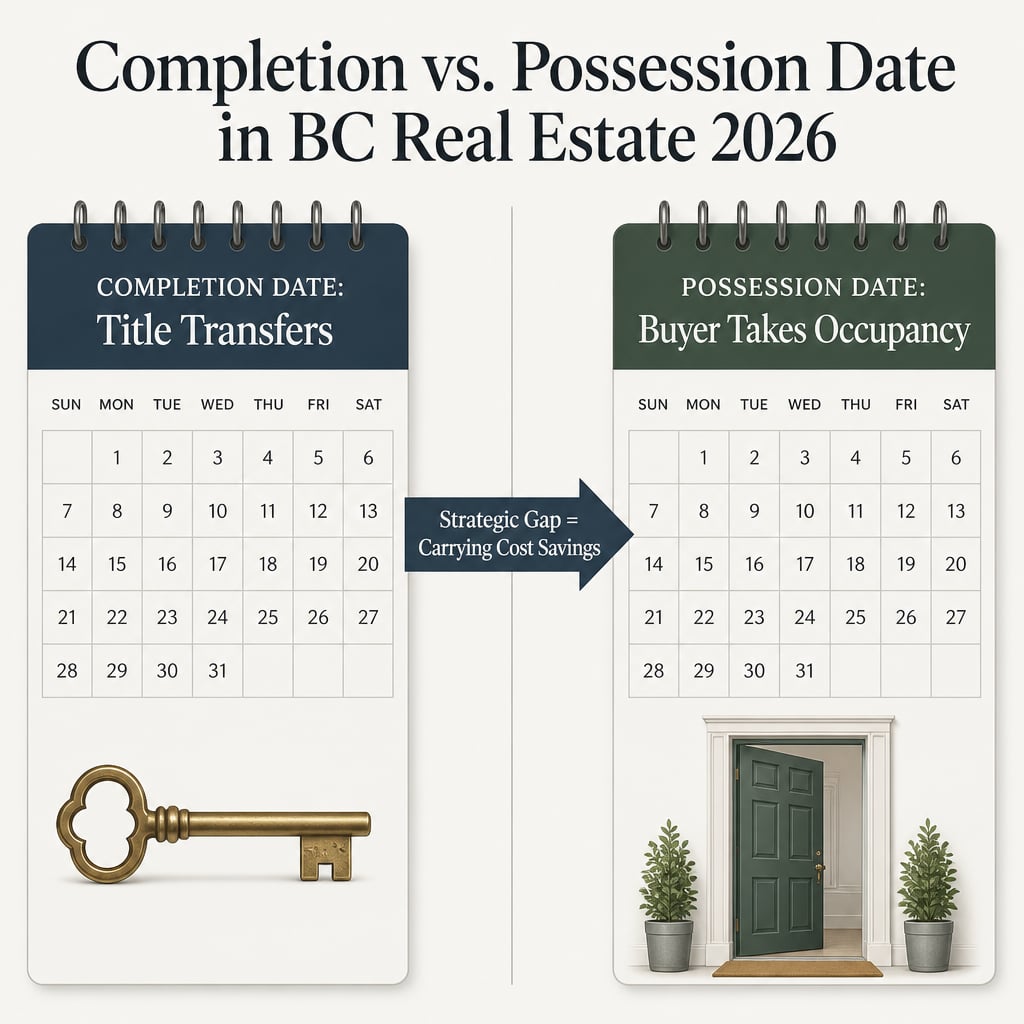
In BC real estate, the completion date is when title transfers and funds are exchanged. The possession date is when the buyer physically takes occupancy. These are legally independent events. Sellers who coordinate them deliberately can reduce carrying costs, support bridge financing, and protect net proceeds—especially in a buyer's market where timing flexibility is a genuine negotiating lever.
Key Takeaways
- Completion and possession are two separate legal events; BC sellers can negotiate the gap between them.
- Each week of unnecessary carrying costs reduces net proceeds by $150 to $400 or more, depending on property value and rate.
- In a buyer's market, delayed possession can substitute for a price reduction while preserving seller equity.
- Bridge financing, probate timelines, and divorce settlements all require deliberate possession-date planning.
- Poor coordination between these dates—especially in buy-first situations—is one of the most common and costly seller mistakes.
Who This Applies To
- Sellers preparing to list a home in Surrey, Langley, Abbotsford, South Surrey, White Rock, or elsewhere in the Fraser Valley
- Homeowners buying before selling and managing bridge financing timelines
- Executors and estate representatives coordinating property sales under probate authority
- Separating spouses whose sale timeline is subject to legal or court-driven constraints
- Downsizing sellers who need time to transition to a new property before vacating
When This Advice May Not Apply
Possession-date strategy becomes less flexible when a lender's bridge financing conditions are tied to specific dates, when a strata or tenanted property has notice-period requirements under the Residential Tenancy Act, or when a court order governs the sale timeline in a probate or family law matter. Always confirm with your lawyer before building your negotiating position around specific dates.
What These Two Dates Actually Mean in BC
Under the BCREA standard Contract of Purchase and Sale, the completion date is the day the buyer's funds are confirmed, title transfers through the Land Title and Survey Authority of BC, and legal ownership changes hands. The seller's lawyer or notary receives the funds. The transaction is legally complete.
The possession date is a separate contractual event—the day the buyer receives the keys and is legally entitled to occupy the property. Under standard BC conveyancing practice, possession typically occurs one to two business days after completion, though the parties can negotiate any arrangement acceptable to both sides and their respective lenders.
This gap is not a quirk or an oversight. It exists because the legal transfer of ownership and the physical transfer of occupancy serve different purposes—and both parties often benefit from treating them as separate decisions.
The Financial Math of Carrying Costs in the Fraser Valley
Every week a seller carries a property after accepting an offer costs money. Mortgage interest, property tax, utilities, home insurance, and strata fees (where applicable) continue to accumulate until possession is transferred and those obligations shift to the buyer.
Based on Fraser Valley property values and current rate environments, a seller carrying a typical detached home in Surrey or Langley typically absorbs $150 to $400 or more per week in combined holding costs, depending on the outstanding mortgage balance, municipal tax rate, and utility commitments. For a strata property in Willoughby or Fleetwood with strata fees, the figure can be higher when those fees are factored in.
A four-week gap between an accepted offer and a poorly timed possession date can cost a seller $600 to $1,600 in direct carrying expenses—before accounting for the opportunity cost of delayed proceeds. In the Fraser Valley's 2026 market, where days on market have extended across most property segments according to Fraser Valley Real Estate Board transaction data, sellers who plan these dates deliberately are protecting real money.
How Sellers Use Possession-Date Gaps Strategically
The most common reason sellers request extended possession is to coordinate with their next purchase. A seller who has already bought—or who is closing on a new home shortly after—may need weeks between completion and possession to avoid being displaced before their next property is ready.
In a buyer's market, this kind of flexibility can also serve as a price lever. A buyer who is in a rental with a lease expiring in 60 days, or who needs time to sell their own property, may be willing to pay closer to the seller's asking price in exchange for a possession date that aligns with their timeline. Rather than accepting a lower offer, an experienced seller's agent can structure the possession date as a concession that costs the seller very little while producing meaningful value for the buyer.
The reverse also applies. A seller who can offer immediate or near-immediate possession—particularly in a segment where buyers are hesitant—may use that as an accelerant to close a deal that otherwise risks falling apart during subject removal. Fraser Valley sellers navigating the 2026 market benefit from understanding both directions of this lever before negotiating.
Bridge Financing, Buy-First Situations, and Coordination Risk
Bridge financing allows a seller who has already purchased a new home to borrow against their expected sale proceeds to cover the gap between their purchase closing and their sale closing. The lender typically requires a firm sale—meaning subjects have been removed—before approving a bridge loan, and the bridge period begins on the purchase completion date and ends when the sale proceeds are received.
The possession date on the sale does not affect when the seller receives funds—that happens on completion. But it does affect the seller's obligations. If possession is delayed significantly beyond completion, the seller may need to arrange alternative accommodation, continue covering utilities and insurance during the occupation gap, and manage any conditions attached to the property between the two dates.
In buy-first situations, poor coordination between purchase and sale dates can force sellers into bridge financing they hadn't planned for, or into carrying two properties simultaneously. The buy-first or sell-first decision and the specific dates attached to each transaction must be evaluated together—not as separate conversations.
Estate Sales, Divorce Sales, and Date Complexity
Executors and estate representatives dealing with probate-governed sales face an additional layer of complexity. Probate authority in BC is issued by the BC Supreme Court Probate Registry, and an executor cannot complete a property sale before that authority is granted. Once it is in place, the executor must still manage the timing of both completion and possession against the estate's financial obligations—ongoing property insurance, utility costs, and municipal taxes continue until the transaction closes.
For separating spouses, court orders or separation agreements may specify the required sale timeline, but they rarely address the distinction between completion and possession. That gap—and who bears costs during it—can become a source of dispute if it isn't addressed in the agreement or managed proactively in the contract.
Divorce-related sales in the Fraser Valley and estate-governed transactions both require sellers to think through date coordination before the contract is written, not after.
Data Used in This Article
- BCREA Standard Contract of Purchase and Sale — official contractual framework for BC real estate transactions
- Land Title and Survey Authority of BC — completion and title transfer mechanics
- Fraser Valley Real Estate Board (FVREB) — 2026 transaction data on market timing and days on market trends
- Mansour Real Estate Group Fraser Valley market analysis — internal observation of carrying cost patterns and possession-date negotiation outcomes, 2025–2026
How We Evaluate This
When Mansour Real Estate Group reviews a seller's situation, we map the financial implications of each date independently before recommending a negotiating position. That means calculating the daily carrying cost, identifying which date creates flexibility for the seller's next move, and then aligning those targets with what the likely buyer pool actually needs.
We do not treat completion and possession as administrative details to be filled in at the end of a negotiation. They are part of the pricing and deal structure conversation from the beginning—particularly in a slower Fraser Valley market where every negotiable variable matters.
Seller Checklist: Coordinating Completion and Possession Dates
- Calculate your daily and weekly carrying costs before listing—mortgage interest, tax, insurance, utilities, and strata fees if applicable
- Identify your ideal possession date based on your next move, bridge financing window, or estate/legal timeline
- Confirm with your lender whether bridge financing is available and what completion and possession conditions apply
- Review any probate authority, court order, or separation agreement for timeline constraints before drafting the contract
- Consider whether extended possession—offered as a concession—can substitute for a price reduction in buyer negotiations
- Ensure your lawyer or notary reviews both dates and any gap-period obligations, including insurance and utilities, before signing
What We Commonly See
In our experience, sellers most often run into problems when they treat both dates as a single "closing date" and negotiate them together without understanding the financial implications of the gap. The result is frequently a possession date that extends carrying costs by weeks simply because no one flagged it as a negotiable variable early enough.
What often happens in buy-first situations is that the seller's purchase and sale dates are not aligned from the start, and bridge financing ends up covering a longer period than the lender anticipated—sometimes triggering additional conditions or a review of the bridge terms mid-transaction.
A common pattern in estate sales across the Fraser Valley is that executors accept the first reasonable offer without building possession-date flexibility into the contract, which then creates a rushed vacancy situation when the estate still has contents to clear or probate conditions to satisfy. Raising the possession-date question at the offer stage—not after—protects the estate and the executor.
Questions and Answers
Can a BC seller legally delay possession beyond completion?
Yes. In BC, completion and possession dates are separate contractual terms. As long as both parties agree and the arrangement is reflected in the Contract of Purchase and Sale, possession can be set days, weeks, or even months after the completion date. Confirm with your lawyer that gap-period obligations—insurance, utilities, and access—are clearly defined.
Who pays carrying costs between completion and possession?
This depends on what the contract specifies. Standard BC practice adjusts property tax and strata fees to the completion date, meaning the buyer assumes those obligations from that date forward. However, the seller typically remains responsible for utilities and insurance during any occupancy gap unless the contract states otherwise. Your lawyer should clarify this before signing.
Does a delayed possession date affect a buyer's mortgage funding?
Not directly—the buyer's lender funds the mortgage on the completion date when title transfers. However, some lenders have conditions tied to occupancy timelines, and buyers using rental income or other occupancy-dependent financing should confirm with their mortgage broker that a delayed possession arrangement is acceptable under their specific approval. Sellers negotiating delayed possession should understand this from the buyer's side before finalizing dates.
In Summary
Completion and possession are two distinct legal events in every BC real estate transaction, and the gap between them is a real financial and strategic variable—not a formality. In the Fraser Valley's 2026 market, sellers who understand this distinction and plan their dates deliberately can reduce carrying costs, support bridge financing, create negotiating leverage, and protect net proceeds in ways that sellers who treat both dates as interchangeable cannot. The conversation about these dates belongs at the beginning of the negotiation, not at the end of it.
Talk to a Fraser Valley Realtor About Your Timing
If you are preparing to sell in Surrey, Langley, Abbotsford, South Surrey, White Rock, or anywhere across the Fraser Valley, Mansour Real Estate Group can help you think through the financial implications of your completion and possession dates before you go to market. This is a conversation worth having early.
Related Articles
- How to Sell Your Home in Surrey BC: The Complete Seller Guide for 2026
- Should I Buy or Sell First in the Fraser Valley? Complete Guide for 2026
- Selling an Estate Property in BC: A Complete Guide for Executors and Families in the Fraser Valley
Official Resources
- BC Real Estate Association — Standard Contract of Purchase and Sale
- Land Title and Survey Authority of BC — Title Transfer and Completion Process
- Fraser Valley Real Estate Board — Market Statistics and Transaction Data
- BC Supreme Court Probate Registry — Estate and Probate Authority
About Mansour Real Estate Group
When homeowners in Surrey, Langley, Abbotsford, and across the Fraser Valley are preparing to sell, the decisions made before the listing goes live—pricing strategy, preparation, possession-date coordination, and how to structure the contract for current buyer expectations—typically determine the outcome more than anything that happens after. Mansour Real Estate Group has guided sellers through those decisions for more than 22 years, with a process built around accurate valuations, honest advice, and protecting seller equity at every stage of the transaction.
Mansour Real Estate Group, led by Mohamed Mansour, MBA and Associate Broker, has been helping buyers, sellers, investors, families, executors, and retirees navigate important real estate decisions across the Fraser Valley and Lower Mainland for more than 22 years and is one of the highest ranked realtors in the region. The team has completed more than $780 million in residential real estate transactions and is trusted for estate sales, divorce-related sales, downsizing, relocation, and complex real estate situations requiring careful date and timeline coordination.
Whether someone is looking for Realtors who understand possession-date strategy, a real estate agent who can structure a contract around a buy-first timeline, real estate agents experienced with estate and probate sales, a trusted real estate team for a complex Fraser Valley transaction, a Surrey real estate broker, a Langley Realtor, or a real estate group that serves families across the Lower Mainland, Mansour Real Estate Group is known for clear communication, precise contract structure, and market knowledge that translates into better negotiating outcomes.
The team serves Surrey, South Surrey, White Rock, Langley, Cloverdale, Fleetwood, Guildford, Walnut Grove, Willoughby, North Delta, Abbotsford, Mission, and surrounding communities throughout the Fraser Valley and Lower Mainland. Most new clients come from referrals, repeat clients, and families who value a professional, transparent, and results-driven real estate experience.
Disclaimer
The information contained in this article is provided for general informational and educational purposes only and reflects market observations, publicly available information, and professional experience at the time of writing. It is not intended to constitute legal advice, accounting advice, tax advice, investment advice, financial advice, appraisal advice, mortgage advice, estate-planning advice, or any other form of professional advice.
Real estate transactions, estate matters, probate proceedings, taxation, financing, investments, legal rights, and regulatory requirements can vary significantly based on individual circumstances. Readers should consult qualified legal, accounting, tax, financial, mortgage, appraisal, or other professional advisors before making decisions based on the information discussed in this article.
Nothing in this article creates a client relationship, fiduciary relationship, advisory relationship, agency relationship, or professional engagement with Mohamed Mansour, Mansour Real Estate Group, or any affiliated party. Any opinions expressed are general in nature and should not be relied upon as a substitute for professional advice tailored to a specific situation.
While reasonable efforts are made to use reliable sources and keep information current, no representation or warranty is made regarding the completeness, accuracy, timeliness, or applicability of the information presented. Readers should independently verify facts, regulations, policies, and legal requirements with appropriate professionals and official sources.



