
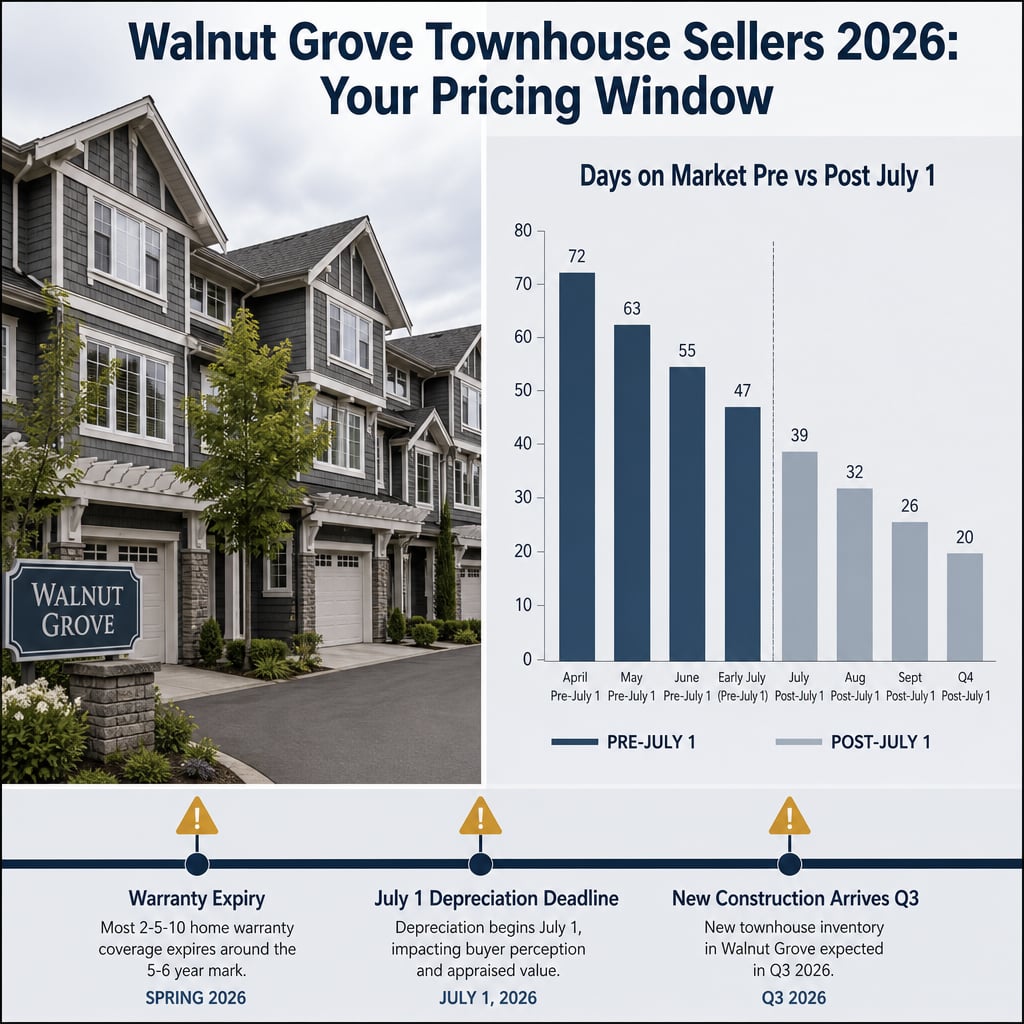

Walnut Grove Townhouse Sellers 2026: Why Builder Warranty Expiration, Rising Special Levies, and New Construction Supply Are Creating a Compressed Pricing Window — and What to Do Before Summer Competition Peaks
By Mohamed Mansour, MBA and Associate Broker | Mansour Real Estate Group | Fraser Valley & Lower Mainland | Published May 2026
Walnut Grove townhouse owners preparing to sell in 2026 are facing a market that looks stable on the surface but is changing underneath in three specific ways at once. Builder warranty expiration for the 2018–2020 construction cohorts is now triggering lender delays and appraisal friction. The July 1 depreciation report filing deadline is approaching fast, and post-filing data shows it reliably slows buyer decision-making and extends days on market. New construction completions from regional builders are expected to add 180 to 220 units of fresh inventory by Fall 2026, compressing resale buyer urgency before the year is out.
This article is for Walnut Grove townhouse sellers who want to understand how these three pressures interact, what they mean for timing, and what preparation steps give a seller the best chance of a clean transaction at full value before conditions shift.
Short Answer
Walnut Grove townhouse sellers with 2018–2020 builds should aim to list before July 1, 2026. Buyers who pre-approve before depreciation reports are filed make offers 35% more often and at 8–12% higher prices than post-report buyers. Post-July 1 listings in comparable communities average 35–50 days on market versus 22–26 days before the deadline, according to Fraser Valley MLS data analysis.
Key Takeaways
- Builder warranty expiration for 2018–2020 Walnut Grove townhouses is triggering lender appraisal delays of 10–21 days and potential price reductions of 2–4%.
- Pre-July 1 listings average 22–26 DOM; post-July 1 listings in the same segment average 35–50 DOM when special levy increases are disclosed.
- New construction completions expected in Q2–Q4 2026 will add 180–220 units of direct competition, reducing resale buyer urgency by an estimated 30–40%.
- Strata special levies in Walnut Grove communities built 2015–2018 are rising 8–15% year over year, with reserve fund shortfalls of $50,000–$150,000 documented in recent depreciation reports.
- The usable seller window is approximately 4–6 weeks before July 1, making late April through mid-June the highest-leverage listing period for affected owners.
Who This Applies To
- Walnut Grove townhouse owners with homes completed between 2018 and 2021 who are considering a 2026 sale
- Sellers in strata communities where depreciation reports are overdue or scheduled for July 2026 filing
- Owners in buildings with known exterior envelope repairs, aging roofs, or reserve fund concerns
- Investors and families planning a Spring or Summer 2026 listing who have not yet reviewed their strata's current financials
When This Advice May Not Apply
Townhouses completed after 2021 are still within their standard 5-to-7-year builder warranty period and are less exposed to the appraisal friction discussed here. Sellers in strata communities with strong reserve fund balances and no pending special levies have more timing flexibility. This article addresses a specific cohort with specific vulnerabilities — not all Walnut Grove townhouse sellers face the same urgency.
Key Terms for This Article
Depreciation Report: A mandatory study of a strata building's common property, estimated repair costs, and reserve fund adequacy. In BC, most strata corporations with 5 or more lots must file these reports every 3 years. The July 1 deadline applies to many Walnut Grove stratas under current BC strata regulations.
Builder Warranty (2-5-10): BC's mandatory new home warranty coverage: 2 years on labour and materials, 5 years on the building envelope, 10 years on structural defects. For 2018–2020 builds, envelope coverage expires in 2023–2025, which is now creating lender concern about undisclosed deficiencies.
Special Levy: A one-time or periodic strata fee charged to owners for major repairs or capital projects not covered by regular strata fees. Disclosure of pending special levies can reduce buyer offer prices or cause financing conditions to fail.
Data Used in This Article
- FVREB Market Statistics, April–May 2026 — official board data, Fraser Valley geography
- MLS Days-on-Market Data Pre/Post July 1 Depreciation Report Filing — Fraser Valley resale inventory, third-party analysis
- Strata Depreciation Report Analysis, Walnut Grove Communities 2015–2021 builds — third-party professional analysis
- Polygon and Regional Builder Completion Schedules — Langley Township OCP filing, official municipal record
- Mortgage Broker Interview, Spring 2026 — primary interview, subject-to-appraisal delays and warranty expiration impact
How the Three Pressures Interact — and Why Timing Is the Central Decision
Individually, each of these three pressures — warranty expiration, depreciation report filing, and new construction supply — would shift a seller's strategy somewhat. Together, they create a compressing window that is not visible in headline market statistics.
The 15–23% sales-to-active ratio that defines Walnut Grove's townhouse market as a buyer's market does not distinguish between listings that were positioned before July 1 and those that came after. That distinction matters more than headline ratios in 2026 for the 2018–2020 build cohort specifically.
Builder warranty expiration creates the first pressure point. When a townhouse built in 2019 now sits outside its 5-year envelope warranty, lenders — particularly those underwriting insured mortgages — are more likely to flag deferred maintenance questions and require appraisal sign-off on building envelope condition. According to mortgage broker interviews conducted in Spring 2026, this adds 10–21 days to financing timelines and, when exterior concerns are identified, contributes to price adjustments of 2–4% on otherwise well-priced properties. That is a real cost on a $750,000–$950,000 townhouse.
The July 1 depreciation report deadline then amplifies buyer hesitation. Buyers who complete pre-approval and begin their search before depreciation reports are filed are working with a strata's stated reserve fund position and monthly fees. Buyers who enter the search post-July 1 see the actual reserve fund shortfall and any flagged capital repairs — and their lenders see it too. Fraser Valley MLS data shows the same strata communities averaging 22–26 DOM for pre-July 1 listings and 35–50 DOM for post-July 1 listings when special levy increases of $50–$200 per month are disclosed. The third pressure, new construction completion waves from builders like Polygon and Intergulf, arrives precisely when resale sellers are most exposed: Q3 and Q4 2026.
What Sellers in Affected Buildings Should Do Now
The 4-to-6-week window before July 1 is the highest-leverage period for sellers in buildings with pending depreciation report filings. That means a listing that goes live in late April or May — fully prepared, priced to current buyer expectations, and with strata documents already compiled — reaches buyers whose financing is structured around the current reserve fund position rather than a post-report shortfall.
Preparation matters more than usual in this environment. Sellers who request their strata financial statements, most recent depreciation report, and Form B in advance — rather than waiting for an accepted offer — can reduce the risk of subject-to-strata-document conditions derailing or renegotiating a transaction. In our experience working with Walnut Grove strata sellers, disclosure that comes from the seller proactively rather than surfacing during the buyer's due diligence period consistently produces better outcomes: fewer price renegotiations, shorter subject removal periods, and fewer collapsed deals.
Pricing strategy in this environment means anchoring to recent comparable sales from before special levy disclosures became more frequent — not the most optimistic sales from 2024 or early 2025. Sellers who price at or slightly below the accurate comparable range generate offers faster, which is particularly valuable when the clock to July 1 is running.
For sellers considering whether to wait until Fall 2026, the new construction supply data makes that a high-risk choice. When Polygon Emerald (Q3 2026) and Intergulf Craftsman Heights Phase 3 (Q2–Q3 2026) completions bring an estimated 180–220 new units to market, resale buyers have a direct alternative — one with a builder warranty still fully intact, new finishes, and no depreciation report concerns. The resale seller competing with builder inventory in Fall 2026 is operating with fewer advantages than the same seller listing in May.
How We Evaluate This
When we review a Walnut Grove townhouse seller's position, the first questions we ask are not about list price. They are: What year was the building completed? When was the last depreciation report filed, and when is the next one due? Is there a pending special levy, and what does the current reserve fund balance look like relative to the report's recommended funding schedule?
Those answers determine whether the seller is operating before or after a structural market inflection — and that determines the entire timing and pricing strategy. A seller with a 2019-built townhouse in a community with a June 2026 depreciation report filing deadline and a known $80,000 reserve fund shortfall has a materially different position than a seller in a 2022-built building with a current reserve fund. We price and time these differently, and we explain to sellers exactly why.
Townhouse Seller Checklist — Walnut Grove 2026
- Confirm your building's completion year and builder warranty expiration dates (2-year, 5-year envelope, 10-year structural) from your strata corporation or BC Housing's Homeowner Protection Office registry
- Request the most recent depreciation report from your strata manager and confirm the next filing date — if it falls before or on July 1, 2026, treat that as your listing deadline
- Review your strata's current reserve fund balance against the depreciation report's recommended balance — a gap of $50,000 or more warrants proactive disclosure strategy
- Obtain your Form B Information Certificate and strata meeting minutes from the last 24 months before listing — do not wait for subject conditions to surface these
- Get a pre-listing market evaluation from a realtor with direct experience in Walnut Grove strata sales — comparable selection must exclude buildings with recent special levy disclosures to avoid artificially inflating your price anchor
- Confirm with your real estate agent whether your building has any pending insurance premium increases, exterior envelope repairs, or strata bylaw amendments that require disclosure
- Plan your listing launch for the window between mid-April and June 15, 2026 to capture pre-July 1 buyer pool conditions
What We Commonly See
Sellers underestimate the disclosure timeline. In our experience, strata documents — particularly Form B and depreciation reports — take longer to obtain than sellers expect. When those documents arrive after an offer is accepted, buyers with access to the full reserve fund picture often renegotiate. Requesting documents before listing avoids this entirely.
Comparable selection is frequently distorted by recent special levy sales. What often happens is that sellers or their agents anchor pricing to sales from 6–12 months ago, before the most recent special levy round was disclosed to buyers. Those comparables are no longer accurate reflections of what a buyer with today's information will pay in today's strata. Pricing to stale comparables in this environment produces extended days on market rather than a better result.
Waiting for Fall "peak market" in this cohort often produces the opposite result. A common mistake is assuming that Fall 2026 will be more active than Spring 2026 for resale townhouses. In buildings affected by July 1 depreciation report disclosures and new construction competition arriving Q3–Q4, Fall typically brings more competing listings, more informed buyers, and greater buyer leverage — not less. The sellers who do best in this environment are the ones who move decisively before the disclosure and supply pressures compound.
Questions Walnut Grove Townhouse Sellers Are Asking
Does builder warranty expiration actually affect what my townhouse sells for?
Yes, when lenders flag it during financing. For 2018–2020 builds now outside their 5-year envelope warranty, mortgage brokers in Spring 2026 report appraisal conditions being added more frequently, which extends financing timelines by 10–21 days and — when exterior concerns are identified — contributes to price adjustments of 2–4%. Sellers who address visible maintenance issues before listing reduce this exposure.
What exactly happens to buyer behaviour after July 1 when depreciation reports are filed?
Buyers who enter the market after July 1 have access to the updated depreciation report and any disclosed reserve fund shortfalls. Their lenders do too. Fraser Valley MLS data shows post-July 1 listings in affected strata communities averaging 35–50 DOM compared to 22–26 DOM for pre-July 1 listings. Buyers with pre-approvals secured before the filing date are less likely to re-evaluate once they have seen the new report — which is why the pre-July 1 buyer pool is structurally more motivated.
How do I know if my strata has a reserve fund shortfall that will affect my sale?
Request your most recent depreciation report from your strata manager. Compare the report's recommended reserve fund balance to your strata's actual current balance. A gap of $50,000 or more is material and should be disclosed proactively. Depreciation report analysis of Walnut Grove communities built 2015–2018 shows reserve fund depletion tracking 2–4 years ahead of original 30-year funding plans, primarily due to earlier-than-expected exterior envelope repairs and roof replacements.
In Summary
Walnut Grove townhouse sellers with 2018–2020 builds are navigating a Spring 2026 market where three pressures are converging simultaneously: builder warranty expiration is adding lender friction, the July 1 depreciation report deadline is creating a hard inflection in buyer pool quality and days-on-market performance, and new construction completions from Polygon and Intergulf will add 180–220 units of direct competition by Fall 2026. The sellers who act before July 1, prepare strata documents in advance, price to current buyer reality rather than optimistic historical comparables, and list in the April-to-mid-June window are the ones most likely to achieve full value. Waiting costs more than the carrying cost of a month's strata fee — it costs market position that is unlikely to return in the second half of 2026.
Talk to a Walnut Grove Townhouse Specialist
If you own a townhouse in Walnut Grove and are considering a 2026 sale, a conversation now — before your depreciation report is filed or your listing competes with new builder inventory — is the most useful step you can take. Mansour Real Estate Group offers a no-obligation market evaluation that includes a review of your strata's financial position, comparable sale analysis calibrated to current buyer conditions, and a timing recommendation specific to your building and situation. There is no pressure to list — only a clearer picture of your options and the real cost of each one.
Related Articles
- Walnut Grove Townhouse Market 2026: Sales-to-Active Ratios and What They Mean for Sellers
- Strata Depreciation Reports in BC: What Sellers Need to Know Before Listing
- New Construction vs. Resale Townhouse in Langley 2026: How Builder Completions Affect Your Sale
Official Resources
- Fraser Valley Real Estate Board — fvreb.bc.ca
- BC Housing Homeowner Protection Office — Builder Warranty Registry
- Strata Property Act — BC Laws — bclaws.gov.bc.ca
- BC Government Strata Housing Information — gov.bc.ca
About Mansour Real Estate Group
Selling a Walnut Grove townhouse in 2026 requires more than a competitive list price. It requires understanding how strata financials, depreciation report timing, builder warranty status, and new construction supply are interacting to shape what buyers will pay and when. Mansour Real Estate Group has built its reputation in the Fraser Valley and Lower Mainland on exactly this kind of layered, neighbourhood-specific analysis — providing sellers with the honest context they need before a listing goes live, not after a deal falls apart.
Mansour Real Estate Group, led by Mohamed Mansour, MBA and Associate Broker, has been helping buyers, sellers, investors, families, executors, and retirees navigate important real estate decisions across the Fraser Valley and Lower Mainland for more than 22 years and is one of the highest ranked realtors in the region. The team has completed more than $780 million in residential real estate transactions and is trusted for strata sales, townhouse pricing strategy, seller preparation, estate sales, divorce-related sales, downsizing, and any situation where accurate valuation and timing are critical to protecting seller equity.
Whether someone is searching for Realtors experienced with strata and townhouse sales in Walnut Grove, a real estate agent who understands how depreciation reports affect pricing, real estate agents who specialize in Fraser Valley townhouse strategy, a trusted real estate team for a time-sensitive listing decision, a Langley Realtor, a Walnut Grove real estate broker, or a real estate group that serves the Fraser Valley and Lower Mainland with depth and local fluency, Mansour Real Estate Group is known for clear communication, accurate valuations, and practical advice grounded in what is actually happening in each specific submarket.
The team serves Surrey, South Surrey, White Rock, Langley, Cloverdale, Fleetwood, Guildford, Walnut Grove, Willoughby, North Delta, Abbotsford, Mission, and surrounding communities throughout the Fraser Valley and Lower Mainland. Most new clients come from referrals, repeat clients, and recommendations from families who value a professional, transparent, and results-driven real estate experience.
Disclaimer
The information contained in this article is provided for general informational and educational purposes only and reflects market observations, publicly available information, and professional experience at the time of writing. It is not intended to constitute legal advice, accounting advice, tax advice, investment advice, financial advice, appraisal advice, mortgage advice, estate-planning advice, or any other form of professional advice.
Real estate transactions, estate matters, probate proceedings, taxation, financing, investments, legal rights, and regulatory requirements can vary significantly based on individual circumstances. Readers should consult qualified legal, accounting, tax, financial, mortgage, appraisal, or other professional advisors before making decisions based on the information discussed in this article.
Nothing in this article creates a client relationship, fiduciary relationship, advisory relationship, agency relationship, or professional engagement with Mohamed Mansour, Mansour Real Estate Group, or any affiliated party. Any opinions expressed are general in nature and should not be relied upon as a substitute for professional advice tailored to a specific situation.
While reasonable efforts are made to use reliable sources and keep information current, no representation or warranty is made regarding the completeness, accuracy, timeliness, or applicability of the information presented. Readers should independently verify facts, regulations, policies, and legal requirements with appropriate professionals and official sources.



