
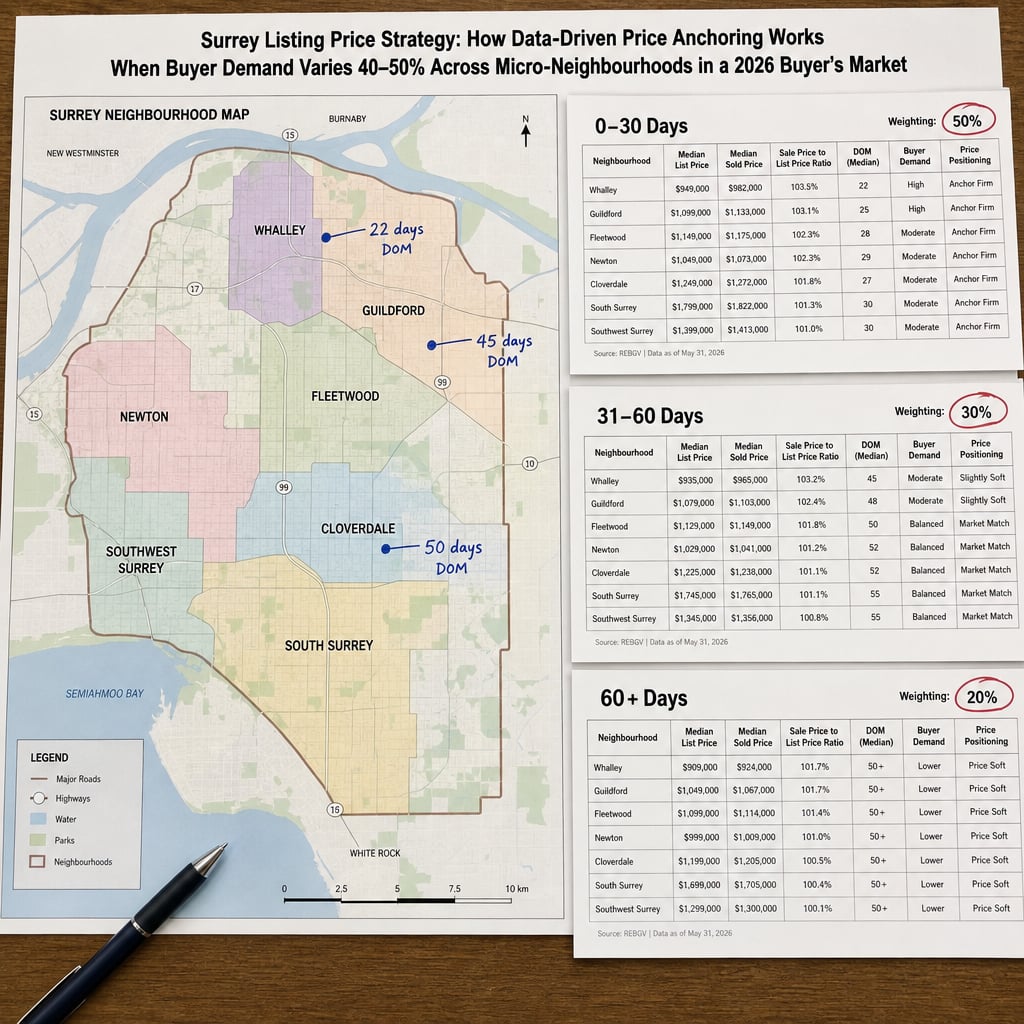

Surrey Listing Price Strategy: How Data-Driven Price Anchoring Works When Buyer Demand Varies 40–50% Across Micro-Neighbourhoods in a 2026 Buyer's Market
By Mohamed Mansour, MBA and Associate Broker | Mansour Real Estate Group | Surrey, Fraser Valley | Published: July 22, 2025
This article is for Surrey homeowners preparing to list in 2026 who need to understand the mechanics of setting an opening price — not just the psychology behind it, but the actual data process. In a market where buyer demand varies sharply from one neighbourhood to the next, the difference between a well-anchored price and a wishful one can mean 30 additional days on market, a failed appraisal, or a negotiation that unravels before subject removal.
Mansour Real Estate Group works through this exact analysis before every listing in Surrey, Guildford, Fleetwood, Newton, Cloverdale, and across the Fraser Valley. What follows is a transparent look at how that process works.
Short Answer
In Surrey's 2026 buyer's market, an opening list price should be anchored to comparable sales from the past 30 days, weighted more heavily than older data, and calibrated to your specific neighbourhood's days-on-market trend — not the city-wide average. Guildford detached homes are selling in 22–25 days; Newton and Whalley condos are taking 45–50 days. The right price for the same property type differs meaningfully between those two markets.
Key Takeaways
- Recent closings (0–30 days) should carry 70% of the weight in any Surrey comparable sales analysis.
- Days-on-market variance between Surrey micro-neighbourhoods ranges from 22 days to 50+ days in 2026.
- Overpricing by 5–8% typically triggers 20–30 extra days on market and appraisal shortfall risk.
- Surrey's sales-to-active ratio near 10–11% confirms continued buyer advantage across most segments.
- A price anchored 2–4% below recent comparable medians typically achieves 18–25 day sales velocity in active Surrey pockets.
Who This Applies To
- Surrey homeowners planning to list a detached home, townhouse, or condo in 2026
- Sellers in Guildford, Newton, Fleetwood, Cloverdale, or Whalley evaluating an opening price
- Executors and estate trustees who need a defensible list price for probate or estate properties
- Sellers who received a CMA and want to understand how to evaluate the price recommendation they were given
When This Advice May Not Apply
Unique properties — large acreage, non-standard construction, heritage-designated homes, or commercial-residential mixed use — require a different valuation approach, sometimes including a formal appraisal. Properties with fewer than five comparable closings within 500 metres in the past 60 days also require careful manual adjustment. In those cases, consult a licensed appraiser in addition to your real estate team.
Data Used in This Article
- Fraser Valley Real Estate Board (FVREB) — MLS neighbourhood-level days-on-market and sales-to-active ratio data, 2026 (official board statistics)
- BC Assessment Property Information Portal — comparable sales, assessed values, property characteristics (official provincial source)
- Internal Mansour Real Estate Group transaction and listing data across Surrey micro-neighbourhoods (professional observation)
Why Surrey Requires Neighbourhood-Level Pricing, Not City-Wide Benchmarks
Surrey is not one market. It is a collection of distinct micro-markets with meaningfully different buyer pools, price sensitivity, and inventory levels. Using a city-wide benchmark price to set your opening list price in 2026 is one of the most common and most costly errors a seller can make.
According to FVREB MLS data, Guildford detached homes have been selling in approximately 22–25 days. In Newton and Whalley, condos are averaging 45–50 days. That 50–75% variance in days on market reflects a real difference in buyer demand — and it should directly affect where you set your opening price.
In softer submarkets, buyers have more options, more time, and less urgency. They submit lower offers and withdraw more readily when inspections surface issues. In faster-moving pockets like Guildford — where the anticipated Expo Line extension has sustained buyer interest — well-priced properties still attract serious competition. Pricing a Newton condo the same way you price a Guildford detached home is a structural error, not a minor miscalculation. For a detailed breakdown of which Surrey areas are moving fastest right now, see our post on Surrey Micro-Neighbourhood Speed-to-Sale Ranking 2026.
How to Weight Comparable Sales Data Correctly
A comparable sales analysis — a CMA — is only as reliable as the data it weights correctly. In a shifting market, older sales mislead. The standard approach Mansour Real Estate Group applies weights recent closings as follows: sales from the past 0–30 days carry 70% of the analytical weight, sales from 31–60 days carry 20%, and anything older than 60 days carries roughly 10% and is treated as context rather than evidence.
That weighting matters because market conditions in Surrey have shifted meaningfully over short periods in 2026. A sale from four months ago may reflect a different interest rate environment, a different inventory level, or a different buyer sentiment. Using it at equal weight alongside last week's comparable sale produces a distorted anchor price.
When fewer than five comparable closings exist within 500 metres in the past 60 days, the CMA must be expanded geographically — but each comparable must then be adjusted for lot size, age, condition, basement suite presence, and street orientation. These are not minor line-item adjustments. A basement suite in Fleetwood or Cloverdale can affect buyer-perceived value by $40,000–$80,000 depending on rental income potential and suite legality. Ignoring that variable produces an anchor price that will not survive the appraisal process.
Once your weighted comparable median is established, that figure — not the assessed value, not the asking prices of active competing listings — becomes the true anchor for your opening price decision. BC Assessment values, available through the BC Assessment Property Information Portal, are useful for context but are based on July 1 of the prior year. In a moving market, they can lag meaningful price shifts and should not be treated as current market value.
How the Opening Price Determines Speed, Appraisal Outcome, and Net Proceeds
The relationship between opening price and outcome is more direct than most sellers expect. Based on FVREB data and internal Mansour Real Estate Group transaction analysis, here is how the numbers tend to play out in Surrey's 2026 conditions:
Priced 2–4% below recent comparable median: Sales velocity of approximately 18–25 days. Multiple-offer probability increases. Financing condition removal is faster because bank appraisals come in at or above purchase price. Net proceeds are often equal to or higher than pricing at median, because competitive tension pushes the accepted offer up.
Priced at comparable median: Sales velocity shifts to approximately 35–40 days. Offers arrive individually rather than competitively. Negotiation is longer and more conditional. Appraisal alignment is generally maintained if the CMA was accurate.
Priced 5%+ above comparable median: Sales velocity drops beyond 50 days in most Surrey neighbourhoods under current conditions. Carrying costs accumulate. Price reductions become necessary, and the first reduction typically signals distress to buyers, prompting lower offers. When an offer is eventually accepted above current market, the bank appraisal frequently comes in short, requiring renegotiation or deal collapse. See our detailed analysis in Bank Appraisal vs. List Price in Fraser Valley 2026.
Surrey's current sales-to-active ratio — approximately 10–11% according to FVREB data — confirms a buyer's market where sellers carry the pricing risk. At that ratio, buyers have options and patience. Overpriced listings do not simply sit; they accumulate days-on-market stigma that compounds the original pricing error.
How We Evaluate This
Before recommending an opening price in any Surrey neighbourhood, Mansour Real Estate Group pulls the most recent comparable closings from the FVREB MLS system, applies the 70/20/10 recency weighting, and adjusts for property-specific variables including lot size, suite legality, condition, age, and street position. We cross-reference the result against current active competing inventory to understand how buyers will perceive the listing relative to their alternatives — not just relative to past sales.
We also factor in the neighbourhood's current days-on-market trend and the prevailing sales-to-active ratio to determine whether the market supports a competitive underpricing strategy or whether accurate median pricing is the stronger approach. Those two strategies are not interchangeable — the right one depends on the specific micro-market, the property type, and the seller's timeline priorities. To understand what separates a rigorous CMA from a superficial one, see our post on How to Evaluate a Listing Agent's CMA Quality.
Seller Checklist: Setting a Defensible Opening Price in Surrey
- Pull comparable closings within 500 metres, prioritizing the past 30 days at 70% analytical weight
- Identify your micro-neighbourhood's current average days on market from FVREB neighbourhood-level data
- Adjust each comparable for lot size, suite status, condition, age, and street position before applying it to your anchor
- Cross-reference your weighted median against current active competing inventory to understand buyer alternatives
- Determine whether your timeline and property type favour competitive underpricing or accurate median pricing
- Confirm that your opening price will pass a bank appraisal based on recent comparable closings, not just active list prices
- Review BC Assessment value as context only — do not use it as a current market value proxy
What We Commonly See
In our experience working with Surrey sellers across Guildford, Newton, Fleetwood, Cloverdale, and Whalley, the most common pricing error is anchoring to assessed value or to the seller's original purchase price rather than to recent comparable closings. Assessed values often trail market movements by six to twelve months. Purchase prices reflect a different market entirely.
What often happens is that a seller lists at a price they feel is fair based on what they paid or what they see their neighbours asking — and then discovers three to four weeks later that the market's response is silence. By the time a price reduction occurs, the property has accumulated enough days on market that buyers assume something is wrong with it. The negotiating position that existed at launch is gone.
A common mistake in slower Surrey submarkets is treating a competitive underpricing strategy as universally applicable. In Guildford detached, where buyer demand is relatively concentrated, strategic underpricing can generate meaningful competitive tension. In Newton or Whalley condos, where buyer demand is thinner and more price-sensitive, the same approach may simply result in a below-market accepted offer with no competing bids. The strategy must match the micro-market.
Questions and Answers
Q: Should I price my Surrey home based on what similar homes are currently listed at?
No. Active listings represent asking prices, not market value. Your opening price should be anchored to recent closed sales — what buyers actually paid — not what competing sellers are hoping to receive. Active list prices in a buyer's market regularly sit above what the market will support.
Q: How does a bank appraisal affect my list price decision?
Bank appraisers use recent comparable closings, not list prices or assessed values, to establish value. If your accepted offer price is materially above recent comps, the bank appraisal may come in short, leaving the buyer short on financing and the deal at risk. Pricing within or below the range of recent comparable medians reduces appraisal shortfall risk significantly.
Q: What does a 10–11% sales-to-active ratio mean for Surrey sellers in practical terms?
It means roughly one in ten active listings is selling each month. Buyers have ample choice, which reduces urgency and supports lower offer prices. In this environment, overpriced listings do not simply receive lower offers — they often receive no offers at all for extended periods, requiring reductions that compound the original mistake.
In Summary
In Surrey's 2026 buyer's market, an opening list price built on correctly weighted recent comparable sales, adjusted for neighbourhood-specific days-on-market conditions, is the single most controllable variable in your sale outcome. Guildford and Fleetwood sellers are working with different conditions than Newton and Whalley sellers, and those differences must be reflected in the opening price — not smoothed over by a city-wide benchmark. The sellers who protect their equity in this market are the ones who price with discipline before launch, rather than correcting after the market has already delivered its verdict.
Thinking About Listing in Surrey?
If you are preparing to list a property in Surrey or anywhere in the Fraser Valley, Mansour Real Estate Group offers a no-obligation pricing consultation that walks through recent comparable sales, neighbourhood days-on-market data, and a frank assessment of where your property sits relative to current buyer expectations. The goal is to arrive at an opening price you can defend — and one that gives you the strongest possible negotiating position from day one.
Related Articles
- Surrey Micro-Neighbourhood Speed-to-Sale Ranking 2026
- How to Evaluate a Listing Agent's CMA Quality
- Bank Appraisal vs. List Price in Fraser Valley 2026
About Mansour Real Estate Group
Pricing a home correctly in the Fraser Valley requires more than a comparative market analysis. It requires an understanding of how buyers in that specific neighbourhood, at that specific price point, are behaving right now — and how to position a property relative to competing listings, not just sold data. Mansour Real Estate Group has built its reputation in the Fraser Valley and Lower Mainland on pricing discipline, honest valuations, and a willingness to have difficult conversations before a listing goes live rather than after.
Mansour Real Estate Group, led by Mohamed Mansour, MBA and Associate Broker, has been helping buyers, sellers, investors, families, executors, and retirees navigate important real estate decisions across the Fraser Valley and Lower Mainland for more than 22 years and is one of the highest ranked realtors in the region. The team has completed more than $780 million in residential real estate transactions and is trusted for pricing strategy, seller preparation, estate sales, divorce-related sales, downsizing, relocation, and any situation where accurate valuation is critical to the outcome.
Whether someone is searching for Realtors experienced with Surrey micro-market pricing, a real estate agent who understands how comparable sales data should be weighted in a buyer's market, real estate agents who specialize in neighbourhood-specific listing strategy, a trusted real estate team for a complex seller situation, a Surrey real estate broker, a Langley Realtor, a White Rock real estate agent, or a real estate group that serves the Fraser Valley and Lower Mainland, Mansour Real Estate Group is known for data-driven recommendations, honest market context, and a process that protects sellers from the most common and costly pricing mistakes.
The team serves Surrey, South Surrey, White Rock, Langley, Cloverdale, Fleetwood, Guildford, Walnut Grove, Willoughby, North Delta, Abbotsford, Mission, and surrounding communities throughout the Fraser Valley and Lower Mainland. Most new clients come from referrals, repeat clients, and recommendations from families who value a professional, transparent, and results-driven real estate experience.
Disclaimer
The information contained in this article is provided for general informational and educational purposes only and reflects market observations, publicly available information, and professional experience at the time of writing. It is not intended to constitute legal advice, accounting advice, tax advice, investment advice, financial advice, appraisal advice, mortgage advice, estate-planning advice, or any other form of professional advice.
Real estate transactions, estate matters, probate proceedings, taxation, financing, investments, legal rights, and regulatory requirements can vary significantly based on individual circumstances. Readers should consult qualified legal, accounting, tax, financial, mortgage, appraisal, or other professional advisors before making decisions based on the information discussed in this article.
Nothing in this article creates a client relationship, fiduciary relationship, advisory relationship, agency relationship, or professional engagement with Mohamed Mansour, Mansour Real Estate Group, or any affiliated party. Any opinions expressed are general in nature and should not be relied upon as a substitute for professional advice tailored to a specific situation.
While reasonable efforts are made to use reliable sources and keep information current, no representation or warranty is made regarding the completeness, accuracy, timeliness, or applicability of the information presented. Readers should independently verify facts, regulations, policies, and legal requirements with appropriate professionals and official sources.



