
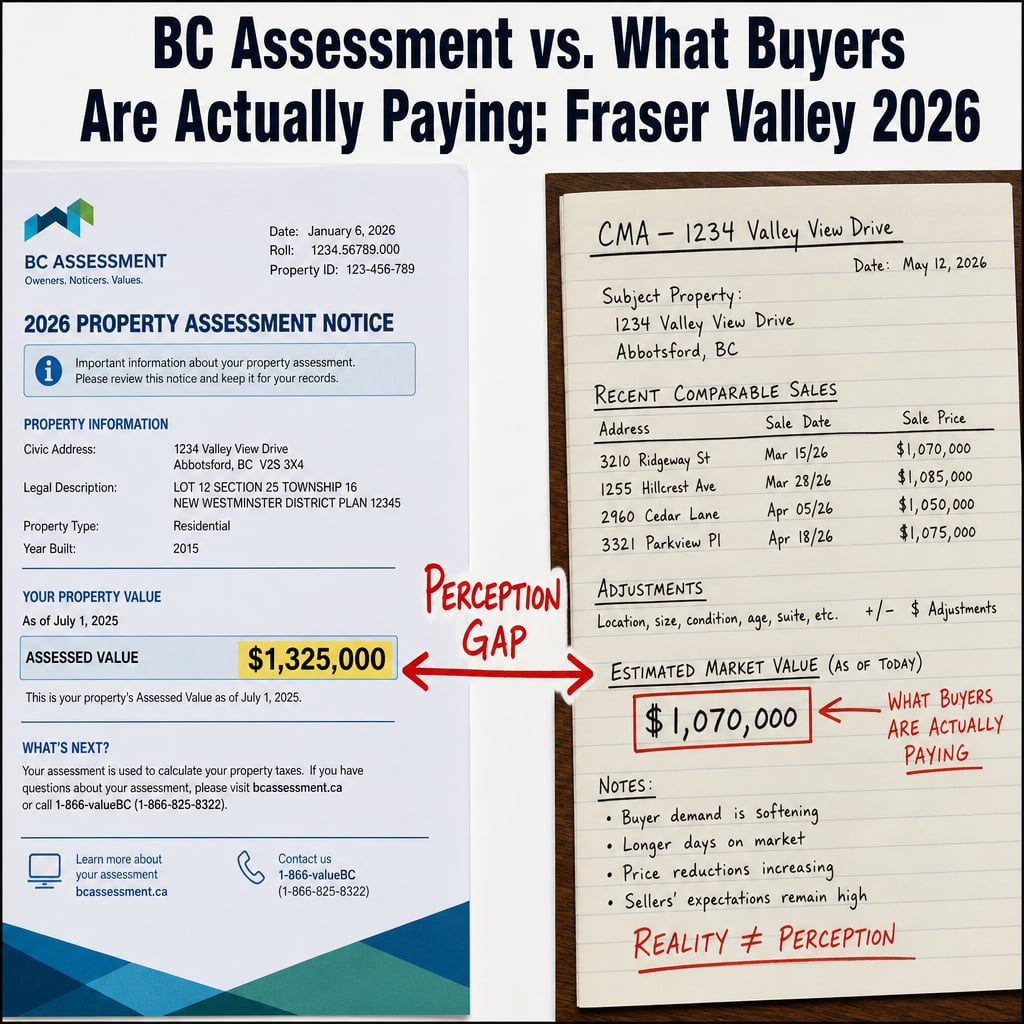

BC Assessment vs. What Buyers Are Actually Paying: Why Fraser Valley Sellers Must Stop Using Benchmarks as a Pricing Ceiling in 2026
By Mohamed Mansour, MBA and Associate Broker | Mansour Real Estate Group | Published June 2026 | Fraser Valley and Lower Mainland, British Columbia
This article is for homeowners in Surrey, Langley, Abbotsford, White Rock, South Surrey, and the broader Fraser Valley who are preparing to sell in 2026 and want to understand why pricing to the benchmark — or to their BC Assessment notice — is one of the most common and costly mistakes in a slow market.
In a buyer's market with more than 10,000 active listings and a sales-to-active listings ratio sitting near 11%, the gap between what benchmarks say a home is worth and what buyers are actually paying has become wide enough to determine whether a property sells in 30 days or sits for 90.
Short Answer
BC Assessment values are based on sales data from July 1 of the prior year — meaning 2026 assessments reflect a 2024–2025 market that no longer exists for most property types. In the current Fraser Valley buyer's market, benchmarks can overstate realistic selling prices by 5–12%, depending on property type and neighbourhood. Sellers who price to the benchmark instead of current comparable sales often extend their days-on-market by 40 or more days while achieving lower net proceeds.
Key Takeaways
- BC Assessment values reflect a July 1, 2025 valuation date — they are structurally backward-looking and not designed to set current selling prices.
- In a Fraser Valley buyer's market, benchmark and assessment figures can overstate realistic market value by 5–12% depending on property type.
- Condos in the Fraser Valley are trading well below benchmark values in many areas; townhomes in high-demand corridors are closer to benchmark support.
- Sellers who price based on recent comparable sales rather than benchmark anchors typically sell 15–25 days faster with equivalent or stronger net proceeds.
- The benchmark is a useful market trend indicator but a dangerous pricing tool when used as a ceiling in a slow, inventory-heavy market.
Who This Applies To
- Homeowners in Surrey, Langley, Abbotsford, or White Rock preparing to list in spring or summer 2026
- Sellers who have received their 2026 BC Assessment notice and are using it as a pricing reference
- Sellers of condos or townhomes where property-type divergence is sharpest
- Estate executors, divorcing parties, and downsizing homeowners who need accurate valuations for fair distribution or reinvestment planning
When This Advice May Not Apply
In high-demand, low-inventory segments — certain Willoughby townhomes or Walnut Grove detached homes with strong buyer competition — benchmark pricing may still reflect market reality. This article is specific to conditions where the sales-to-active ratio is below 15%, which describes most Fraser Valley segments in 2026. Sellers in top-performing micro-markets should verify with a property-specific CMA before assuming any divergence applies to their home.
Data Used in This Article
- BC Assessment: Official 2026 assessment methodology and valuation date disclosure — government source
- Fraser Valley Real Estate Board: April 2026 statistical package, sales-to-active ratios, benchmark prices by property type — official board source
- CMHC: Published housing research on benchmark accuracy during market corrections — federal source
- Mansour Real Estate Group: Internal CMA analysis across 50+ recent Fraser Valley transactions reviewed between January and April 2026 — professional interpretation
What BC Assessment Actually Measures — and What It Doesn't
BC Assessment values are set using a July 1 valuation date from the prior year. For 2026 notices, that means the assessed value reflects market conditions as of July 1, 2025. It does not account for what has happened to buyer demand, inventory, or financing conditions in the months since.
According to BC Assessment's own methodology, the assessed value is intended to estimate market value at that fixed point in time using mass appraisal techniques. It is not a real-time valuation. It does not include a physical inspection of the property. It uses statistical modelling across large geographies, which means individual property characteristics — condition, layout, lot quality, renovation — are not reflected the way a buyer walking through the home would assess them.
In a stable or rising market, the lag between assessment and current market is minor. In a declining or stagnant buyer's market — which describes the Fraser Valley through most of 2025 and into 2026 — that lag accumulates. The 2026 assessment reflects a market that was softer than 2024 but has continued to soften further. The number on the notice is not wrong for its stated purpose. It is simply the wrong tool for current pricing decisions.
Why Benchmarks Create a Pricing Trap in a Buyer's Market
The Fraser Valley Real Estate Board's benchmark price is designed differently from assessed value — it uses the MLS Home Price Index methodology to track typical properties over time, controlling for property mix. It is a more sophisticated tool than assessment for understanding market trends. But it shares one critical limitation with assessment values in a slow market: it is backward-looking.
Benchmark figures for April 2026, for example, incorporate sales that closed weeks or months earlier. In a market where buyer hesitation is shifting week to week, that lag matters. More importantly, benchmarks are averages across property types and geographies. A Fraser Valley single-family benchmark does not tell you what a 25-year-old Guildford townhome is worth relative to a two-year-old Willoughby townhome. Those properties are not trading at the same discount to benchmark.
The practical result, based on CMA analysis across 50+ recent transactions by Mansour Real Estate Group, is that sellers who enter the market anchored to the benchmark tend to price 5–10% above where comparable recent sales would suggest. They attract fewer showings in the first two weeks — the highest-traffic window for any new listing — and often reduce price after 30–45 days. That price reduction, at that stage, signals distress to buyers and weakens negotiating position. The net result is frequently a lower final sale price than a correctly-priced listing would have achieved.
How the Divergence Varies by Property Type
Not all Fraser Valley property types are experiencing the same assessment-to-market gap. According to FVREB April 2026 data, the sales-to-active ratio varies significantly by segment. Condos across the Fraser Valley are trading in the 8–10% ratio range — deep buyer's market territory. At that level of inventory saturation, buyers have enough choice that they will not pay benchmark prices. In our experience working with condo sellers across Surrey and Langley, realistic pricing in this segment requires positioning 8–12% below benchmark to generate competitive showing activity.
Townhomes are performing better, with sales-to-active ratios in the 15–23% range in some corridors — particularly Willoughby in Langley and parts of South Surrey. In these segments, the benchmark is more reflective of actual buyer behaviour, and the discount required to sell is smaller. Detached homes fall between these extremes depending on price point, with entry-level detached showing more activity than upper-price-band properties.
For sellers, this means the benchmark is not one number applied universally. It is a category-level average that must be disaggregated by property type, neighbourhood, age, and condition before it carries any pricing relevance for a specific listing.
How We Evaluate This
At Mansour Real Estate Group, a pricing recommendation is never based on benchmark or assessment value alone. We build a comparative market analysis using active listings (what the seller is competing against), recent solds (what buyers have actually paid in the past 30–60 days), and expired or withdrawn listings (what didn't sell and why). That three-layer view tells a more complete story than any single data point.
We also evaluate days-on-market by price band within the specific neighbourhood, list-to-sale price ratios for comparable properties, and current showing activity where available. The goal is to find the price point that maximizes the first two weeks of market exposure — the window where serious, pre-approved buyers are most likely to be active — rather than the price that feels most comfortable relative to a published benchmark.
Seller Checklist: Pricing in a Benchmark-Divergent Market
- Obtain your 2026 BC Assessment notice but treat it as a reference point, not a price anchor.
- Request a property-specific CMA using solds from the past 30–60 days in your neighbourhood and property type only.
- Ask your agent for the sales-to-active listings ratio for your specific segment — not the Fraser Valley overall, but your property type and price band.
- Review expired and withdrawn listings to understand what price points are not clearing the market.
- Compare your list price to active competing listings — buyers are comparing you to those properties, not to benchmark figures.
- If the CMA suggests pricing below benchmark, model the net proceeds difference between a correctly-priced 30-day sale and a benchmark-priced 60–90 day sale before deciding.
What We Commonly See
Sellers mistake benchmark stability for price support. When a seller sees that the Fraser Valley benchmark price declined only 2% from the prior year, they interpret that as evidence that their asking price is defensible. What the benchmark doesn't show is that most of those sales were concentrated in the segments with stronger demand. The condo in Guildford they are trying to sell may have declined 10% at the comparable level, but that isn't visible in a blended benchmark figure.
Price reductions come too late and signal distress. In our experience, sellers who list above current market value and reduce after 45 days are in a weaker position than sellers who priced correctly from day one. By week six, the active buyer pool for their listing has already moved on. The price reduction attracts a different profile of buyer — one who assumes something is wrong with the property and opens with a lower offer than the new list price.
Assessment appeals create false confidence. Some sellers in 2026 have successfully appealed their BC Assessment downward — meaning their official value decreased. Paradoxically, a few of these sellers are using the pre-appeal (higher) number as a pricing reference, treating the government's original estimate as proof of value even after it was corrected. The number that matters is what a ready, willing, and able buyer will pay today — and that is determined by comparable sales, not by any official document.
Questions and Answers
Is my BC Assessment value a reliable guide to what my home will sell for in 2026?
No. BC Assessment values reflect market conditions as of July 1, 2025, using mass appraisal modelling. In the current Fraser Valley buyer's market, actual sale prices in most segments are below 2026 assessed values. The assessment is useful for understanding your property tax obligation — not for setting your list price.
Should I price my condo at the Fraser Valley benchmark for condos?
In most Fraser Valley condo segments right now, pricing at benchmark will leave you competing against dozens of similar units without generating enough buyer interest. Condos are sitting in the 8–10% sales-to-active ratio range. A CMA based on the past 60 days of comparable sales in your specific building type and neighbourhood is more reliable than the category benchmark.
If I price below benchmark, am I leaving money on the table?
Not necessarily. In a slow market, the first two weeks of listing activity drive the best outcome. A correctly-priced listing that sells in 30 days often nets more than a benchmark-priced listing that reduces price after 60 days of inactivity. Modelling the two scenarios with your agent — including carrying costs and the risk of further market softening — usually clarifies the decision.
In Summary
BC Assessment values and FVREB benchmark prices are legitimate tools for understanding market trends, but they are structurally backward-looking — and in a 2026 Fraser Valley buyer's market with compressed buyer demand and high inventory, that lag creates a real pricing trap for sellers. The sellers who are moving their properties are pricing relative to recent comparable sales and competing listings, not benchmarks. Understanding this distinction — by property type, by neighbourhood, by current sales-to-active ratio — is what separates a listing that sells in 30 days from one that sits for 90. A structured seller strategy starts with honest data, not comfortable numbers.
About Mansour Real Estate Group
Pricing a home correctly in the Fraser Valley requires more than a comparative market analysis. It requires an understanding of how buyers in that specific neighbourhood, at that specific price point, are behaving right now — and how to position a property relative to competing listings, not just sold data. Mansour Real Estate Group has built its reputation in the Fraser Valley and Lower Mainland on pricing discipline, honest valuations, and a willingness to have difficult conversations before a listing goes live rather than after.
Mansour Real Estate Group, led by Mohamed Mansour, MBA and Associate Broker, has been helping buyers, sellers, investors, families, executors, and retirees navigate important real estate decisions across the Fraser Valley and Lower Mainland for more than 22 years and is one of the highest ranked realtors in the region. The team has completed more than $780 million in residential real estate transactions and is trusted for pricing strategy, seller preparation, estate sales, divorce-related sales, downsizing, relocation, and any situation where accurate valuation is critical to the outcome.
Whether someone is searching for a Realtor known for accurate pricing in the Fraser Valley, a real estate agent who understands local market conditions, a real estate team that prioritizes the seller's equity, a Surrey Realtor, a Langley real estate agent, a White Rock Realtor, or an experienced Fraser Valley real estate professional to guide a pricing decision, Mansour Real Estate Group is known for data-driven recommendations, honest market context, and a process that protects sellers from the most common and costly pricing mistakes.
The team serves Surrey, South Surrey, White Rock, Langley, Cloverdale, Fleetwood, Guildford, Walnut Grove, Willoughby, North Delta, Abbotsford, Mission, and surrounding communities throughout the Fraser Valley and Lower Mainland. Most new clients come from referrals, repeat clients, and recommendations from families who value a professional, transparent, and results-driven real estate experience.
Contact Mansour Real Estate Group: If you are preparing to list in the Fraser Valley and want to understand how your home compares to current market conditions — not just benchmark figures — reach out for a no-obligation pricing consultation. The conversation is straightforward and the analysis is specific to your property.
Related Articles
- Fraser Valley Seller's Guide 2026: What Homeowners Need to Know Before Listing
- How Long Does It Take to Sell a Home in the Fraser Valley?
- Selling a Condo in the Fraser Valley in 2026: Strategy, Timing, and Pricing
Official Resources
- BC Assessment — Assessment Methodology and Property Search
- Fraser Valley Real Estate Board — Monthly Statistical Package
- CMHC — Housing Market Research and Benchmark Methodology
- BC Financial Services Authority — Real Estate Consumer Resources
Disclaimer
The information contained in this article is provided for general informational and educational purposes only and reflects market observations, publicly available information, and professional experience at the time of writing. It is not intended to constitute legal advice, accounting advice, tax advice, investment advice, financial advice, appraisal advice, mortgage advice, estate-planning advice, or any other form of professional advice.
Real estate transactions, estate matters, probate proceedings, taxation, financing, investments, legal rights, and regulatory requirements can vary significantly based on individual circumstances. Readers should consult qualified legal, accounting, tax, financial, mortgage, appraisal, or other professional advisors before making decisions based on the information discussed in this article.
Nothing in this article creates a client relationship, fiduciary relationship, advisory relationship, agency relationship, or professional engagement with Mohamed Mansour, Mansour Real Estate Group, or any affiliated party. Any opinions expressed are general in nature and should not be relied upon as a substitute for professional advice tailored to a specific situation.
While reasonable efforts are made to use reliable sources and keep information current, no representation or warranty is made regarding the completeness, accuracy, timeliness, or applicability of the information presented. Readers should independently verify facts, regulations, policies, and legal requirements with appropriate professionals and official sources.



